


Why Sudanese Immigrants Retain TPS While Others Lose It
By Darius Spearman (africanelements)
Support African Elements at patreon.com/africanelements and hear recent news in a single playlist. Additionally, you can gain early access to ad-free video content.
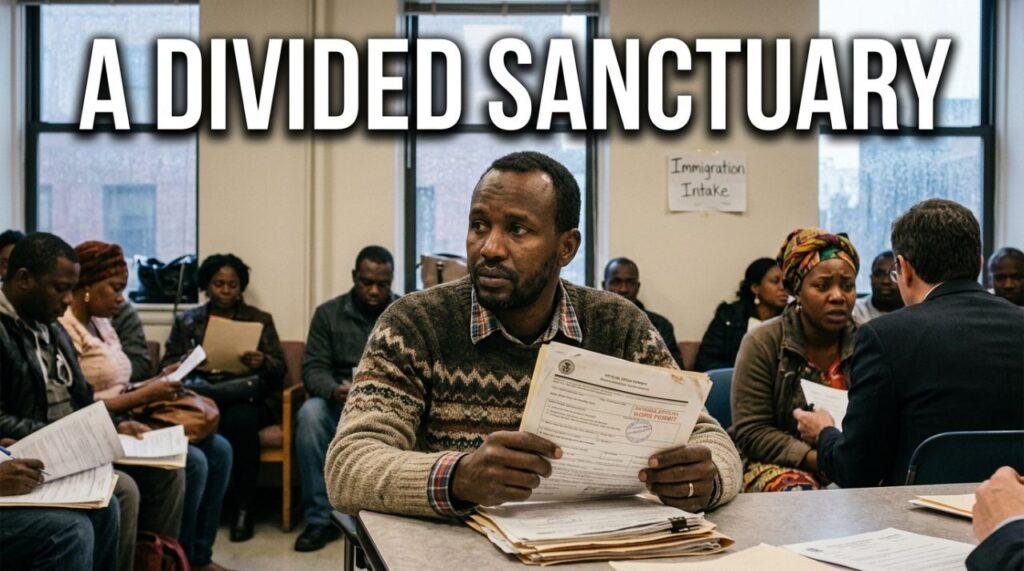
A Selective Reprieve at the Border
Federal immigration authorities made a consequential announcement as the critical October 19 deadline arrived. Sudanese immigrants will temporarily retain their deportation protections alongside tens of thousands of displaced Ukrainians (businessinsider.com, africanhealthreport.com). However, federal officials simultaneously confirmed that humanitarian protections have ended for nationals of several other African countries (businessinsider.com, businessinsider.com).
The decision creates a stark divide across the global African diaspora. While Sudanese community members received an eleventh-hour administrative pause, relief ended for immigrants from Haiti, Somalia, Ethiopia, Cameroon, and South Sudan (businessinsider.com, businessinsider.com). This divergent outcome has triggered deep anxiety among immigrant advocates and families who now face deportation risks.
Temporary Protected Status, known widely as TPS, serves as a crucial legal shield for foreign nationals facing disaster. Yet, the selective preservation of relief for certain nationalities leaves many questions unanswered. To comprehend why some diaspora communities secured protection while others lost it, one must examine the deep historical evolution of American immigration statutes.
TPS Populations: Retained vs. Terminated (2026)
The Origins of Temporary Protected Status in 1990
Congress established Temporary Protected Status through the Immigration Act of 1990 (americanimmigrationcouncil.org, pewresearch.org). President George H.W. Bush signed the bipartisan legislation into federal law (americanimmigrationcouncil.org). The statute created an administrative bridge between formal refugee resettlement and standard deportation enforcement procedures (pewresearch.org, fwd.us).
Before this enactment, presidential administrations offered discretionary relief through improvised administrative measures (americanimmigrationcouncil.org, fwd.us). However, lawmakers desired an institutional process governed by clear statutory benchmarks. Congress codified these specific rules under Section 244 of the Immigration and Nationality Act (federalregister.gov, federalregister.gov).
The statute authorizes executive branch leaders to designate foreign nations facing severe domestic crises (americanimmigrationcouncil.org, uscis.gov). Under the law, three distinct statutory conditions justify emergency designation: ongoing armed conflict, catastrophic environmental disasters, or extraordinary and temporary conditions (americanimmigrationcouncil.org, cliniclegal.org). The relief shields foreign nationals from deportation and provides essential work authorization cards (americanimmigrationcouncil.org, fwd.us).
Crucially, Temporary Protected Status was never designed to confer lawful permanent residency or American citizenship (americanimmigrationcouncil.org, pewresearch.org). Instead, lawmakers designed it as temporary, provisional sanctuary for individuals already inside the country (americanimmigrationcouncil.org, fwd.us). That inherent structural impermanence has historically allowed executive branch officials broad discretionary latitude over immigrant families.
Decades of Turmoil: The History of Sudan’s Designation
Sudan received its initial Temporary Protected Status designation on November 4, 1997 (federalregister.gov, federalregister.gov). Attorney General Janet Reno established the relief amid the devastating Second Sudanese Civil War (federalregister.gov). Scorched-earth campaigns, widespread famine, and systemic human rights abuses prevented safe returns across the country (federalregister.gov, federalregister.gov).
For two continuous decades, Democratic and Republican administrations renewed protections for Sudanese nationals (cbsnews.com, federalregister.gov). Hostilities spread through Darfur in 2003, followed by intense fighting in South Kordofan (cbsnews.com, timep.org). American authorities consistently recognized that returning immigrants to Sudan posed severe life-threatening hazards (federalregister.gov, federalregister.gov).
A dramatic turning point arrived in late 2017 when the federal government sought to terminate Sudan’s designation (cbsnews.com, cnn.com). Immigrant advocates responded with significant legal challenges to halt removals (cbsnews.com, cmsny.org). Federal courts issued preliminary injunctions in historic lawsuits like Ramos v. Nielsen, keeping protections active through years of litigation (cbsnews.com, uscourts.gov).
Conditions deteriorated further following the 2019 overthrow of Omar al-Bashir and an ensuing military coup in 2021 (timep.org, federalregister.gov). By April 2023, open warfare erupted between the Sudanese Armed Forces and the Rapid Support Forces (africanhealthreport.com, timep.org). Federal officials subsequently redesignated Sudan for humanitarian relief, extending protections through late 2026 (cbsnews.com, federalregister.gov).
Timeline of Sudanese Protection Eras (Years)
The Administrative Limbo and the Salvadoran Precedent
Federal officials declined to publish an affirmative extension notice in the Federal Register before the October 19 deadline arrived (federalregister.gov, businessinsider.com). Instead, the Department of Homeland Security issued an informal statement extending existing documentation temporarily (businessinsider.com, businessinsider.com). This specific administrative tactic mirrors the approach taken weeks earlier with Salvadoran immigrants (businessinsider.com).
By relying on an informal reprieve, the federal government avoids committing to a standard eighteen-month extension (federalregister.gov, businessinsider.com). This policy posture creates profound functional challenges for regular working people (e-verify.gov, americanimmigrationcouncil.org). Immigration attorneys note that informal announcements provide temporary protection against deportation while severely compromising day-to-day survival.
Employers rely heavily on the federal E-Verify database and printed Federal Register notices to confirm employment eligibility (e-verify.gov, uscis.gov). Without an official regulatory publication, automated systems frequently flag expired work permits as invalid (e-verify.gov, kpmg.com). Workers face wrongful suspensions, lost income, and sudden job terminations despite possessing nominal deportation relief.
State agencies present another significant obstacle for immigrants caught in administrative limbo (americanimmigrationcouncil.org, cliniclegal.org). Department of Motor Vehicles offices frequently refuse to renew driver’s licenses without official paperwork (americanimmigrationcouncil.org). Affected community members encounter hurdles while renting apartments, applying for mortgages, and navigating fundamental aspects of daily life.
The Legal Turning Point: From Ramos to Mullin v. Doe
To understand why African nations experienced diverging fates in 2026, one must examine recent federal jurisprudence (independent.co.uk, cbsnews.com). For nearly a decade, nationwide injunctions protected hundreds of thousands of immigrants from deportation (cbsnews.com, uscourts.gov). The legal landscape shifted decisively on June 25, 2026, when the Supreme Court ruled in Mullin v. Doe (independent.co.uk, cbsnews.com).
The high court held that the Homeland Security Secretary holds broad discretion to terminate humanitarian designations without substantive judicial intervention (independent.co.uk, cbsnews.com). The ruling stripped federal trial judges of authority to pause country terminations (independent.co.uk, uscourts.gov). This dramatic decision dissolved the procedural firewall that had sheltered diaspora populations since 2018.
Following that ruling, federal authorities swiftly scheduled termination dates for several African nations (businessinsider.com, businessinsider.com). Protections ended for South Sudanese nationals on August 7, 2026 (businessinsider.com). Relief for Somali immigrants ceased on August 14, while protections for Ethiopian community members lapsed on August 18 (businessinsider.com).
Similarly, over two hundred thousand individuals from the Haitian republic lost legal status following the ruling (cbsnews.com, businessinsider.com). Beneficiaries who built extensive lives in the United States suddenly found themselves subject to imminent removal (lulac.org, pewresearch.org). This sudden shift highlighted the profound volatility of statutory relief vulnerable to evolving state vs national power dynamics.
A Divided Diaspora: The On-the-Ground Crisis in Sudan
The administration spared Sudanese immigrants from immediate termination due to the extraordinary scale of Sudan’s current catastrophe (africanhealthreport.com, timep.org). Since April 2023, fighting between the military and paramilitary forces has devastated Khartoum and West Darfur (africanhealthreport.com, timep.org). Human rights groups describe the conflict as the largest displacement emergency on earth (africanhealthreport.com).
More than ten million Sudanese citizens have fled their homes to escape brutal violence (africanhealthreport.com). Famine conditions have spread rapidly across Darfur and adjacent provinces, overwhelming international humanitarian aid operations (africanhealthreport.com, timep.org). Returning deportees to an active conflict zone with destroyed civic infrastructure presents insurmountable logistical and moral obstacles (africanhealthreport.com).
Conversely, federal immigration officials evaluated South Sudan, Somalia, and Ethiopia through a different geopolitical lens (businessinsider.com, businessinsider.com). While acknowledging significant regional instability, authorities concluded that security conditions did not justify blanket protection (federalregister.gov, businessinsider.com). Consequently, thousands of vulnerable immigrants from those neighboring lands lost their work cards and legal immunity.
This stark divergence highlights how foreign policy objectives shape humanitarian designations (americanimmigrationcouncil.org, timep.org). Small immigrant cohorts often bear the heaviest burdens when bilateral diplomatic relations deteriorate (businessinsider.com, timep.org). Despite enduring immense personal hardship, impacted families continue demonstrating the enduring resilience characteristic of historic diaspora survival.
Third-Country Deportations and Diplomatic Pressure
As domestic protections lapsed across Sub-Saharan Africa, federal officials pursued controversial deportation enforcement strategies (independent.co.uk, businessinsider.com). The administration actively negotiated bilateral agreements to remove non-citizens to third-party nations where deportees hold no existing ties (independent.co.uk, businessinsider.com). These transfers raise serious international human rights concerns regarding due process and refugee safety.
Historical precedents reveal significant failures in third-country deportation arrangements (independent.co.uk, theguardian.com). Between 2013 and 2018, Israeli authorities transferred thousands of Eritrean and Sudanese asylum seekers to Rwanda and Uganda (independent.co.uk, theguardian.com). Independent investigators discovered that transferees had travel documents seized and faced human trafficking operations across secondary migration routes (theguardian.com).
Similar legal challenges doomed the United Kingdom’s recent attempt to deport asylum applicants to Rwanda (independent.co.uk, theguardian.com). Britain’s highest court struck down that policy over grave concerns regarding unlawful refoulement (theguardian.com). Furthermore, earlier American Asylum Cooperative Agreements with Central American governments were terminated after intense scrutiny over procedural abuses (americanimmigrationcouncil.org).
Recent diplomatic maneuvers across the African continent demonstrate how deportation agreements intersect with foreign aid (independent.co.uk, businessinsider.com). American officials approached nations like Liberia and Eswatini to receive third-country deportees (businessinsider.com). While some governments considered financial incentives, others, including Côte d’Ivoire, firmly rejected proposed deportation frameworks (businessinsider.com). These arrangements reflect how structural inequality and persistent African financial vulnerability shape international agreements.
Terminated African Protections (2025–2026)
Racial Disparities and the Continuing Struggle for Sanctuary
Civil rights advocates argue that ongoing disparities reflect systemic racial inequalities within immigration enforcement (americanimmigrationcouncil.org, lulac.org). Groups like the Haitian Bridge Alliance and the UndocuBlack Network point out substantial differences in executive treatment (americanimmigrationcouncil.org). While European refugees received swift humanitarian parole, Black migrants fleeing severe violence faced expedited deportations (americanimmigrationcouncil.org, americasvoice.org).
Empirical enforcement data supports these community concerns (americanimmigrationcouncil.org, upenn.edu). Black immigrants comprise roughly five to seven percent of the undocumented population in the United States (upenn.edu). Yet, Black immigrants represent more than twenty percent of foreign nationals facing removal on criminal grounds (upenn.edu). Disproportionate policing practices continuously channel Black immigrants into deportation proceedings (americasvoice.org, upenn.edu).
Federal judges previously acknowledged this historical pattern of discriminatory enforcement (cbsnews.com, uscourts.gov). In Ramos v. Nielsen, judicial findings noted that improper racial motivations influenced executive decisions to terminate protections (uscourts.gov). Nevertheless, recent appellate rulings have curtailed judicial oversight, leaving humanitarian decisions entirely to executive officials (independent.co.uk, cbsnews.com).
For Sudanese community members, the October 19 reprieve provides critical breathing room (businessinsider.com, africanhealthreport.com). However, without a formal Federal Register publication guaranteeing an eighteen-month extension, stability remains elusive (americanimmigrationcouncil.org, federalregister.gov). Families continue living month to month under constant administrative uncertainty.
Conclusion: What the Future Holds for Black Immigrants
The disparate outcomes unfolding across diaspora communities highlight deep contradictions within contemporary immigration policy (businessinsider.com, americanimmigrationcouncil.org). Temporary Protected Status remains a powerful humanitarian mechanism, yet its selective enforcement exposes institutional vulnerabilities (americanimmigrationcouncil.org, pewresearch.org). As historical patterns demonstrate, administrative protections expand or contract based on shifting political climates.
Understanding these developments requires looking beyond immediate headlines to examine root statutory and historical dynamics (americanimmigrationcouncil.org, fwd.us). The contrasting treatment of Sudanese and other African diaspora nations reminds observers that policy outcomes reflect competing interests (businessinsider.com, americanimmigrationcouncil.org). For community advocates, the struggle for equitable treatment and lasting immigration reform continues.
About the Author
Darius Spearman is a professor of Black Studies at San Diego City College, where he has been teaching for over 20 years. He is the founder of African Elements, a media platform dedicated to providing educational resources on the history and culture of the African diaspora. Through his work, Spearman aims to empower and educate by bringing historical context to contemporary issues affecting the Black community.
