


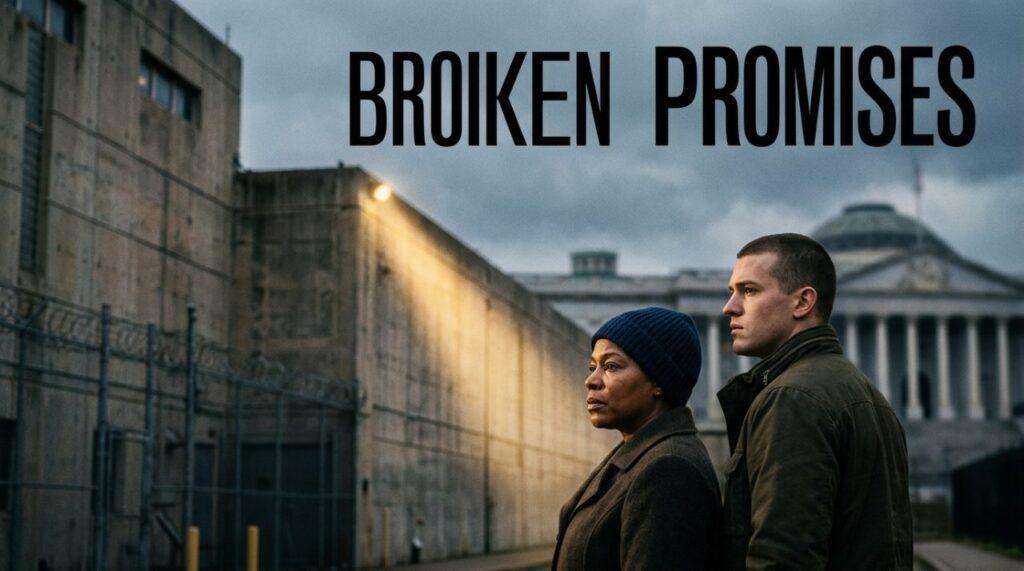
Why the Federal Probe into D.C. Jails Unmasks Broken Promises
By Darius Spearman (africanelements)
Support African Elements at patreon.com/africanelements and hear recent news in a single playlist. Additionally, you can gain early access to ad-free video content.
Federal officials have stepped inside the concrete gates of the District of Columbia jail system. On October 19, 2026, the United States Department of Justice notified local leaders of a sweeping civil rights investigation (justice.gov). The probe targets the District of Columbia Department of Corrections facilities, zeroing in on patterns of systemic abuse (justice.gov, justice.gov). Assistant Attorney General Harmeet K. Dhillon announced that federal investigators will review conditions dating back to January 2021 (justice.gov). The inquiry focuses on excessive force, medical neglect, hazardous living quarters, and tainted meals (justice.gov, justice.gov).
For Black residents in Washington, these federal announcements carry a familiar sting. City officials have promised safe facilities for generations, yet the lockups remain dangerous and dirty (washingtonpost.com, reason.com). The facility holds men and women who are overwhelmingly Black, awaiting day in court behind rusted bars (dc.gov, dcpolicycenter.org). This civil rights investigation is not merely an isolated bureaucratic review. Instead, it is the latest chapter in a century of broken promises, municipal neglect, and institutional racism (wikipedia.org, georgetownvoice.com).
Racial Imbalance: City Population vs. D.C. Jail
The Spark Behind the Federal Intervention
The Justice Department opened this inquiry under the Civil Rights of Institutionalized Persons Act (justice.gov). Known as CRIPA, this statute empowers federal attorneys to root out systemic civil rights violations across state and municipal lockups (justice.gov). While the federal action covers five years of documentation, recent events forced the government to act (justice.gov, washingtonpost.com). In October 2026, incarcerated people filed a class-action lawsuit exposing horrific sanitation failures inside the cafeteria kitchens (washingtonpost.com, reason.com). Their legal filings detailed daily food trays contaminated with mouse droppings, living vermin, and dead rodents baked inside meals (washingtonpost.com, reason.com).
Correctional staff members provided photographs supporting the claims of the prisoners (washingtonpost.com). Inmates reported finding maggots inside morning cereals and biting into mice buried in cooked rice and beans (washingtonpost.com, reason.com). Furthermore, internal grievances filed by hungry detainees were ignored by supervisors for months (washingtonpost.com, reason.com). This callous indifference violated basic human dignity. The food scandal revealed a broader breakdown within the facility. When administrators neglect vermin running through food prep counters, physical violence and medical malpractice quickly follow.
Historical Roots: The Broken Heritage of Campbell v. McGruder
The modern Central Detention Facility opened its doors in 1976 at 1901 D Street Southeast (wikipedia.org). City planners promised that this facility would eliminate the overcrowded cells of the nineteenth-century city workhouse (wikipedia.org, prisonlegalnews.org). Yet, humanitarian crises emerged immediately after construction finished (wikipedia.org, prisonlegalnews.org). Years before the ribbon-cutting, detained citizens filed a landmark class-action lawsuit entitled Campbell v. McGruder (wikipedia.org, prisonlegalnews.org). In that historic case, federal judges ruled that confinement conditions were unconstitutional and completely unfit for human habitation (wikipedia.org, prisonlegalnews.org).
The federal bench ordered population caps in 1985 to curb dangerous overcrowding (wikipedia.org, prisonlegalnews.org). For nearly twenty years, court monitors marched through cellblocks to enforce basic cleanliness (wikipedia.org, prisonlegalnews.org). However, federal supervision ended in 2002 without solving the core structural decay (wikipedia.org). The current crisis exposes how the city returned to old habits as soon as monitors walked away. The historical evolution from southern chain gangs to modern detention reflects deep inequities, demonstrating how involuntary servitude continued long after emancipation. Washington recreated those identical patterns of neglect on city grounds (wikipedia.org, georgetownvoice.com).
How the 1997 Revitalization Act Disenfranchised Black Detainees
To understand the misery inside the D.C. jail, one must understand how local autonomy was taken away. During the twentieth century, the District operated its own long-term penitentiary: the Lorton Reformatory in Fairfax County, Virginia (wikipedia.org, georgetownvoice.com). Founded in 1910 under President Theodore Roosevelt, Lorton held convicted residents close to their home communities (wikipedia.org, georgetownvoice.com). Family members rode public buses across county lines to visit husbands, fathers, and brothers (georgetownvoice.com). That regional lifeline vanished during the late 1990s amid a severe local financial emergency (wikipedia.org, american.edu).
Congress passed the National Capital Revitalization and Self-Government Improvement Act of 1997 (wikipedia.org, american.edu). This legislation permanently closed Lorton and shifted all convicted D.C. felons into the federal Bureau of Prisons (wikipedia.org, american.edu). Consequently, local control over post-conviction corrections was stripped away (wikipedia.org, thehoya.com). The shift mirrored larger national changes as political leaders spearheaded the political shift from civil rights progress toward punitive carceral systems (american.edu, thehoya.com). Washington became an administrative anomaly with fragmented authority (american.edu, thehoya.com).
This unusual governance structure directly harms incarcerated residents today. Because Washington lacks statehood, the local government does not operate a traditional state prison system (american.edu, thehoya.com). In addition, local felony charges are prosecuted by the United States Attorney for the District of Columbia (american.edu). The city government manages only short-term pretrial detainees and minor misdemeanor offenders (american.edu, thehoya.com). The unique friction created by sharing power between governments leaves D.C. residents without democratic accountability over their own justice system. Local leaders absorb public outrage while federal prosecutors make detention choices (american.edu, thehoya.com).
Pretrial Length of Stay: Men in Custody
The Two-Tiered Justice System Exposed in 2021
The racial disparities governing the facility surfaced dramatically in late 2021. For decades, Black community organizers pleaded for independent inspections, citing moldy showers and leaking waste pipes (washlaw.org, washlaw.org). Those pleas routinely stalled in city council committees (dcist.com, washingtoninformer.com). However, everything changed when predominantly white defendants connected to the January 6 Capitol unrest arrived at the complex (washingtonpost.com, washingtonpost.com). Their private attorneys immediately flooded federal court dockets with urgent complaints regarding medical delays and poor sanitation (washingtonpost.com, washingtonpost.com).
Senior U.S. District Judge Royce C. Lamberth held D.C. jail leadership in contempt after officials failed to provide surgical records for a defendant (washingtonpost.com, washingtonpost.com). Lamberth then demanded a federal civil rights inquiry into the treatment of inmates (washingtonpost.com, washingtonpost.com). The United States Marshals Service conducted a surprise inspection days later (usmarshals.gov, washingtonpost.com). Marshals discovered that conditions inside the Correctional Treatment Facility holding the Capitol riot defendants were adequate (usmarshals.gov, washingtonpost.com). Yet, conditions inside the adjacent Central Detention Facility holding local Black detainees were horrific (usmarshals.gov, washingtonpost.com).
The Marshals uncovered raw sewage standing inside occupied cells across multiple housing tiers (usmarshals.gov, washingtonpost.com). Furthermore, corrections officers had turned off water lines to punish inmates and sprayed chemical agents without justification (usmarshals.gov, washingtonpost.com). Hostile correctional supervisors ordered the federal inspectors to leave the building (usmarshals.gov, washingtonpost.com). In response, the federal government pulled 400 federal detainees and transferred them to Pennsylvania facilities (washingtonpost.com, washingtonpost.com). Meanwhile, nearly one thousand local Black men were left behind inside the toxic cells (washingtonpost.com, dcist.com).
Inside the Biohazard: Audits, Overdoses, and Broken Doors
Rather than repairing the complex, local conditions deteriorated further over the following years. In May 2025, the Office of the District of Columbia Auditor released a damning report alongside the Council for Court Excellence (dcauditor.org, dcauditor.org). Their audit documented a population increase of 46 percent between 2023 and 2024 (dcauditor.org, dcauditor.org). Overcrowding pushed cellblocks past safe limits (dcauditor.org, dcauditor.org). Detainees suffered through broken HVAC systems during summer heatwaves and endured winter freezes through broken exterior windows (dcauditor.org, dcauditor.org).
More alarming were the failures in security and internal safety. Prison auditors discovered broken cell door locks across several units, leaving detainees vulnerable to physical assaults (dcauditor.org, dcauditor.org). The audit recorded more than 400 violent use-of-force episodes involving correctional staff in a single year (dcauditor.org, dcauditor.org). Severe officer shortages forced the agency to spend thirty million dollars on overtime payments (dcauditor.org, dcauditor.org). Exhausted guards watched over blind corridors, fueling friction and physical abuse (dcauditor.org, dcauditor.org).
Medical neglect produced lethal consequences for families waiting outside the walls. The 2025 audit revealed that custody deaths in the jail ran 3.5 times higher than the national jail average (dcauditor.org, dcauditor.org). Even worse, fatal drug overdoses inside the jail surpassed the national rate by ten times (dcauditor.org, dcauditor.org). Illicit narcotics entered cells unchecked while emergency medical care lagged (dcauditor.org, dcauditor.org). Men crying out for prescription medicines were ignored as grievance forms sat unprocessed in analog paper boxes (dcauditor.org, dcauditor.org).
In-Custody Mortality vs. National Averages
Prolonged Confinement and Constitutional Violations
Jails are designed as temporary processing centers for individuals awaiting trial or serving brief misdemeanor terms (courtexcellence.org). In Washington, however, the jail functions as an overcrowded penitentiary (courtexcellence.org). Incarcerated men spend an average of ninety-five days awaiting trial, more than double the national average of thirty-nine days (courtexcellence.org, dcpolicycenter.org). Even more shocking, forty-four percent of all jail bed space is occupied by individuals detained longer than two years without a conviction (courtexcellence.org). These prolonged detentions strip citizens of due process rights.
Because ninety percent of detainees are Black, this prolonged pretrial detention falls squarely on the Black community (dc.gov, dcpolicycenter.org). Families lose breadwinners before guilt is ever proven in court (dcpolicycenter.org). Individuals endure squalor while legally presumed innocent under federal law (justice.gov, justice.gov). These unconstitutional conditions echo fundamental flaws written into early American governance, where the law protected property over Black lives. Today, pretrial detention strips human dignity from working-class Black residents who cannot afford private defense teams (washlaw.org, dcpolicycenter.org).
The Justice Department probe directly examines whether this treatment violates the Eighth and Fourteenth Amendments (justice.gov). Pretrial detainees possess a right to humane conditions while awaiting legal hearings (justice.gov, justice.gov). When local authorities trap citizens in cells with raw sewage, contaminated food, and violence, they breach federal law (justice.gov, justice.gov). The prolonged lockup periods worsen every single health risk, turning ordinary criminal proceedings into traumatic nightmares (dcauditor.org, courtexcellence.org).
What Federal Receivership Means for the Nation’s Capital
The launching of this federal investigation opens paths toward radical structural intervention. Under CRIPA, the Justice Department cannot seek monetary awards for individual victims (justice.gov). Instead, federal attorneys seek injunctive relief to force mandatory institutional overhauls (justice.gov). If the District refuses to settle, the Justice Department can file a federal lawsuit demanding a binding consent decree (justice.gov, justice.gov). This legal agreement would place city lockups under the watch of a federal monitor backed by judicial sanctions (justice.gov).
Should the city fail to show progress, the federal judge could appoint an independent receiver (justice.gov, dcauditor.org). A federal receivership represents the ultimate administrative consequence for municipal failure. In a receivership, the judge removes local wardens and elected officials from daily operations. The court assigns an outside administrator equipped with executive authority to manage the budget, hire personnel, and sign vendor contracts. Federal receiverships in other major city jails, including New York City and Oakland, illustrate that courts step in when local leadership fails to protect human lives.
Mayor Muriel Bowser and the D.C. Council have repeatedly promised a modern corrections facility over the past decade (dcist.com, dc.gov). However, financing disputes and bureaucratic delays have postponed replacement dates indefinitely (dcist.com, fox5dc.com). Clean floor plans on paper do not protect detainees living alongside vermin today (washingtonpost.com, dcauditor.org). Federal intervention signals that excuses have expired. If the city cannot guarantee basic civil rights to the Black population inside its jail, the federal judiciary will step in to take the keys.
About the Author
Darius Spearman is a professor of Black Studies at San Diego City College, where he has been teaching for over 20 years. He is the founder of African Elements, a media platform dedicated to providing educational resources on the history and culture of the African diaspora. Through his work, Spearman aims to empower and educate by bringing historical context to contemporary issues affecting the Black community.
