

Listen to this article
Download AudioAfrikaner Refugees: A US Asylum System Under Fire
By Darius Spearman (africanelements)
Support African Elements at patreon.com/africanelements and hear recent news in a single playlist. Additionally, you can gain early access to ad-free video content.
The granting of refugee status to a small group of white Afrikaners from South Africa by the United States has sparked significant debate. For many, this decision highlights deep-seated questions about fairness and consistency within the American asylum system. Indeed, it prompts a critical examination of who receives protection and why, especially when compared to the countless individuals fleeing violence and instability in other parts of the world. This situation resonates deeply within African American and African Diaspora communities. It calls to mind historical struggles against racial injustice and the complexities of global power dynamics.
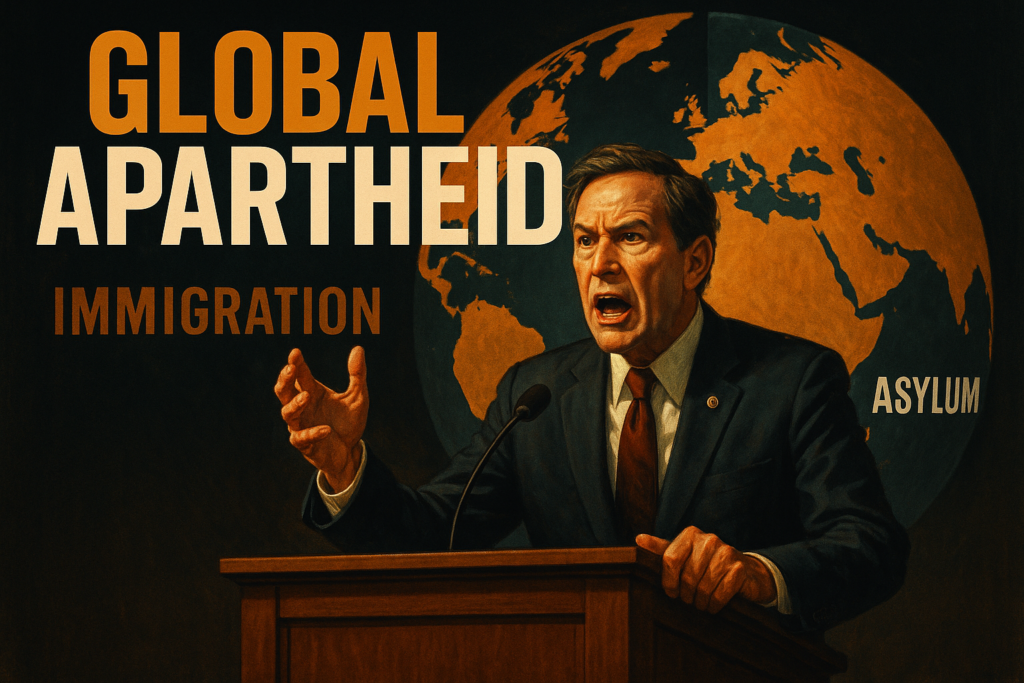
This policy decision has drawn sharp criticism across various circles. For instance, US Senator Chris Van Hollen vocalized strong opposition, suggesting it transforms the asylum process into a form of “global apartheid” (US Senator Comments on Refugee Status for Afrikaners). This term describes systemic inequalities and segregation on a global scale, often linked to economic and racial disparities (Global Apartheid – Wikipedia). The senator’s concerns echo anxieties present within communities of color about equitable treatment and access to resources, whether globally or domestically.
Unpacking Recent Afrikaner Asylum Claims
Nearly sixty white South Africans, most of whom are of Afrikaner heritage, were permitted entry into the United States under a program initiated by the Trump administration (Arrival of White South Africans in the US). Afrikaners are a group of predominantly white South Africans. They are descendants of Dutch, French, Huguenot, German, and other European settlers (Afrikaners – Wikipedia). Furthermore, they are profoundly linked to the development of the Afrikaans language and played a central role in South African history, especially during the apartheid era (Afrikaners – Wikipedia).
Number of Afrikaners Admitted as Refugees
The Trump administration’s justification for these admissions was based on claims that a new South African law was racist. It argued that the white minority there faced persecution (Trump Administration’s Stance on South Africa). This perspective aligns with broader immigration policies of that administration, which were often criticized for inconsistency and bias (US Senator Comments on Refugee Status for Afrikaners). Consequently, critics assert that this approach deviates from the core principles of the US asylum process. They argue that it appears to favor one group over others, such as those fleeing war-torn nations like Sudan, Venezuela, or Afghanistan (Trump Administration’s Stance on South Africa).
South Africa’s Land Reform: A Complex History
South Africa’s land reform law is at the center of the dispute over Afrikaner refugee status (Trump Administration’s Stance on South Africa). This legislation seeks to correct historical injustices stemming from the apartheid era (Land Reform in South Africa – World Bank). Specifically, apartheid was a brutal system of institutionalized racial segregation enforced by the South African government from 1948 to 1994 (Apartheid – Wikipedia). It systematically disadvantaged the majority Black population, creating severe disparities in land ownership through policies like the Group Areas Act (Apartheid – Wikipedia).
Who Are the Afrikaners?
Afrikaners: A group of predominantly white South Africans, primarily of Dutch descent, who developed the Afrikaans language and played a significant role in South African history, including the apartheid era. While historically powerful, their status has evolved in post-apartheid South Africa.
The law allows for the acquisition of agricultural property, usually requiring compensation to be settled with the owners or sanctioned by a court (Trump Administration’s Stance on South Africa). Experts frequently compare this law to eminent domain legislation found globally (Trump Administration’s Stance on South Africa). Eminent domain is the power of governments to take private property for public use, provided fair compensation is given (Eminent Domain – FindLaw). However, a contentious element of South Africa’s reform involves amending its Constitution to potentially allow for land expropriation without compensation (Land Reform in South Africa – World Bank). This proposal has fueled concerns about property rights and economic stability. Some then use these concerns to justify the Afrikaner asylum claims.
The US Asylum System: Fairness and Bias
The United States asylum system exists to offer protection to individuals fleeing persecution. This persecution must be based on specific grounds: race, religion, nationality, membership in a particular social group, or political opinion (Refugees and Asylum – USCIS). Thus, asylum seekers must show a credible fear of persecution if they return to their home country. This is verified through interviews and documentation (Refugees and Asylum – USCIS).
The decision to admit Afrikaners as refugees contrasts sharply with the experiences of other groups seeking asylum. Critics point to the fact that the United States has reduced refugee quotas significantly under the Trump administration generally (Trump Administration Refugee Policy – Brookings). Moreover, this makes the prioritization of Afrikaners particularly striking. Many argue this suggests a bias, especially given the urgent humanitarian crises forcing displacement in places like Venezuela, Haiti, and Afghanistan (Trump Administration’s Stance on South Africa). This inconsistency feeds the criticism that the asylum system is not applied equitably to all those in need of refuge.
Global Apartheid: A Critical Lens
The granting of refugee status to Afrikaners has been called a form of “global apartheid” due to perceived inconsistencies (US Senator Comments on Refugee Status for Afrikaners). Thus, this strong terminology underscores concerns about systemic disparities in global governance and resource allocation. It suggests that geopolitical and ideological factors influenced the Trump administration’s policy. The administration was known for its conservative stance on property rights and its support for similar ideological groups on an international scale (Trump Administration Refugee Policy – Brookings).
Although former Secretary of State Marco Rubio was inaccurately cited as defending the administration’s stance, U.S. Senator Marco Rubio has been vocal in various political discussions, including foreign policy (Marco Rubio – Biography). Nevertheless, his defense was that those who feel persecuted deserve consideration (Trump Administration’s Stance on South Africa). Critics maintain that the administration’s actions appeared to cherry-pick favored groups. They argue this undermines the principles of asylum and refugee protection, which should be universally applied (US Senator Comments on Refugee Status for Afrikaners). Furthermore, the broader U.S. foreign policy during that period emphasized economic interests and conservative ideological alignment, often using economic leverage to pressure nations on governance issues (Trump Administration Foreign Policy – Brookings). This included the U.S. indicating it would not aid South Africa over land reform policies (Trump Administration’s Stance on South Africa).
The African Diaspora Perspective
For communities across the African diaspora, especially African Americans, the controversy surrounding Afrikaner refugee status holds particular significance. It stimulates discussions about racial justice, immigration policy, and the enduring parallels between systemic inequalities in the United States and South Africa (African American News Narratives – Pew Research). Notably, the legacy of apartheid, a system in which Afrikaners played a fundamental role, continues to shape both South African society and global perceptions of this group (Apartheid – Wikipedia).
Perceptions of South Africa’s Land Reform Law
South African Government’s View
Aims to address historical injustices and redistribute land to the historically disadvantaged, predominantly Black South Africans. Seen as crucial for promoting economic equality and rectifying colonial-era dispossession.
Critics’ View (including Trump Administration)
Raises concerns about property rights and economic stability. Some criticize it as “racist” and discriminatory, potentially leading to instability or perceived persecution for white landowners.
This situation compels many to consider the broader context of who is deemed “vulnerable” and deserving of refuge on the world stage. Moreover, it highlights how political decisions can reflect and reinforce existing racial and economic hierarchies. The long-term implications of these admissions could affect diplomatic relations between the United States and South Africa, given the criticisms of U.S. bias (Trump Administration Foreign Policy – Brookings). Furthermore, it intensifies ongoing dialogues regarding social justice, racial equality, and the very structure of global governance, urging us to examine these issues with a critical and informed lens (African American News Narratives – Pew Research).
ABOUT THE AUTHOR
Darius Spearman has been a professor of Black Studies at San Diego City College since 2007. He is the author of several books, including Between The Color Lines: A History of African Americans on the California Frontier Through 1890. You can visit Darius online at africanelements.org.
