

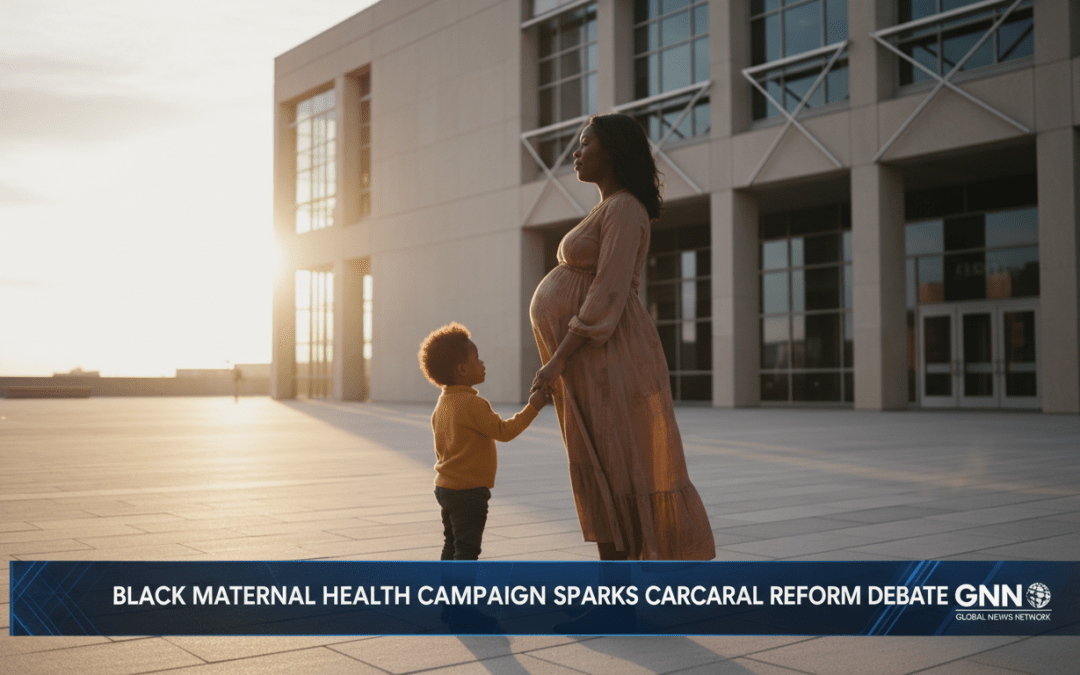

Black Maternal Health Campaign Sparks Carceral Reform Debate
By Darius Spearman (africanelements)
Support African Elements at patreon.com/africanelements and hear recent news in a single playlist. Additionally, you can gain early access to ad-free video content.
During the ninth annual Black Maternal Health Week, which runs from April 11 to April 17, a powerful new viral campaign has emerged. The campaign, launched in 2026 by the popular brand Ben & Jerry’s in partnership with the National Bail Out collective, draws urgent national attention to the plight of incarcerated Black mothers. The organizers highlight shocking statistics that reveal deep systemic inequalities within the United States. According to their data, Black women are nearly twice as likely to be incarcerated compared to white women, and they are three times more likely to die from pregnancy-related causes (bet.com). This campaign goes beyond simple awareness. It actively demands reproductive justice for those trapped behind bars.
The modern carceral system currently holds approximately 1.9 million people across the nation. Within this massive network of state and federal prisons, local jails, and detention centers, the unique struggles of Black mothers often go unnoticed. The new partnership between Ben & Jerry’s and National Bail Out seeks to change that reality. Ben & Jerry’s has a long history of advocating for racial justice through various social campaigns. By teaming up with National Bail Out, the corporation aims to amplify the voices of incarcerated mothers. Their collaborative message points out that the vast majority of women in local jails are parents. Many of these women are held pre-trial simply because they lack the financial resources to afford cash bail. This wealth-based detention system forces vulnerable mothers into dangerous environments.
The Reproductive Justice Movement Demands Bodily Autonomy
The ideological foundation of the 2026 viral campaign rests firmly on the principles of the Reproductive Justice movement. This term did not exist during the early civil rights struggles or the mainstream women’s rights movements of the mid-twentieth century. Instead, the framework was specifically created by Black women to address their unique intersectional experiences. In June 1994, a group of twelve Black women gathered in Chicago. They called themselves Women of African Descent for Reproductive Justice. These visionary organizers felt that the traditional pro-choice movement focused too narrowly on the legal right to abortion. They believed the mainstream movement completely failed to address the complex needs of marginalized communities (sistersong.net).
Following this foundational meeting in Chicago, the SisterSong Women of Color Reproductive Justice Collective officially formed in 1997. SisterSong established four crucial pillars that define the movement today. These pillars include the right to maintain personal bodily autonomy, the right to have children, the right to choose to not have children, and the right to parent children in safe and sustainable communities (sistersong.net). The current campaign focusing on justice behind bars represents a direct application of this final pillar. Activists argue that the carceral state actively disrupts the fundamental human right to family. When mothers are locked away in jails and prisons, they can not parent their children in safe environments. Therefore, dismantling the carceral system is essential for achieving true reproductive justice.
Tracing Medical Racism From the 1800s to Present Day
To understand why Black mothers are three times more likely to die during childbirth, one must examine the long history of medical racism. The field of modern obstetrics was largely developed through the brutal exploitation of enslaved Black women. In the mid-nineteenth century, a physician named Dr. J. Marion Sims performed numerous experimental surgeries on enslaved women, including patients named Anarcha, Betsey, and Lucy. Dr. Sims completed these agonizing procedures without using any anesthesia. He operated under the deeply racist and entirely false assumption that Black people feel less pain than white people (msfc.org).
Tragically, this dangerous medical myth continues to poison modern healthcare systems. A landmark 2016 academic study revealed that half of surveyed white medical students still believed biological falsehoods about Black patients. Because of these persistent racist myths, modern medical professionals routinely prescribe less pain medication to Black women recovering from surgery or enduring labor (mavenclinic.com). Additionally, systemic racism inflicts immense chronic physical stress on Black women over their lifetimes. Dr. Arline Geronimus coined the term weathering to describe how this chronic stress causes premature biological aging. The weathering effect leads directly to higher rates of dangerous conditions like hypertension and pre-eclampsia (iwpr.org). These conditions are leading causes of maternal mortality, and medical providers often ignore the warning signs when Black women report physical distress.
Maternal Mortality Rate (per 100k births)
The Devastating Impact of Mass Incarceration on Families
The horrifying statistic that Black women are twice as likely to face incarceration directly results from specific policy choices made over the last four decades. Between the years 1980 and 2021, the population of incarcerated women in the United States exploded by more than 700 percent. The aggressive policies of the War on Drugs fueled this massive expansion. Lawmakers targeted Black communities with severe policing and harsh mandatory minimum sentencing laws. These strict policies removed all judicial discretion from the courtroom (sentencingproject.org).
Before these laws existed, judges could consider a defendant’s role as a primary caregiver or their lack of a prior criminal record. Mandatory minimums stripped away that ability, forcing judges to impose lengthy prison terms for minor, non-violent drug offenses. For Black women, these policies often resulted in stacking charges. Prosecutors used the threat of mandatory decades in prison to force vulnerable defendants into accepting plea deals, regardless of their actual guilt. This systemic weaponization of the legal system echoes historical exploitation through convict leasing and sharecropping systems. By removing mothers from their homes, the state effectively destabilizes entire neighborhoods.
Current Incarceration Trends and Systemic Disparities
Today, the massive racial disparities within the carceral system persist, even as overall prison populations fluctuate. Recent data compiled by criminal justice researchers reveals that Black women remain disproportionately represented behind bars. While the incarceration rate for Black women has declined from its absolute peak in the year 2000, they are currently still incarcerated at 1.7 times the rate of white women. Furthermore, Black women make up a massive share of the female prison population relative to their actual share of the total national population (sentencingproject.org).
It is important to understand the discrepancy in these incarceration statistics. The often-cited figure that Black women are twice as likely to be incarcerated was the standard metric throughout the 2000s and 2010s. The slight narrowing of this gap to 1.7 times is not necessarily a victory for racial justice. The gap closed largely because the incarceration rates for white women have steadily risen, rather than a massive reduction in the incarceration of Black women (prisonpolicy.org). For younger generations, the disparity remains incredibly severe. Black girls remain more than twice as likely to face confinement compared to their white peers. These numbers demonstrate that the system continues to operate as an oppressive mechanism for social control.
Spike in Incarcerated Women (U.S.)
1980
Baseline
2021
+700%
How the Cash Bail System Tears Black Mothers Away
The cash bail system functions as one of the most destructive forces facing Black mothers today. Bail is a financial requirement set by a judge. A defendant must pay this amount to secure their release from custody while awaiting a trial. The American Civil Liberties Union reports that nearly 70 percent of individuals sitting in local jails are held in pre-trial detention. These individuals are legally innocent. They remain locked inside cages solely because they lack the wealth to purchase their freedom (nationalbailout.org).
This wealth-based detention creates an immediate catastrophe for Black families. Approximately 80 percent of all women currently held in local jails are mothers. Because jails function primarily as pre-trial facilities, these mothers are ripped away from their children before they ever receive a day in court (benjerry.com). Even a few days in pre-trial detention causes immense harm. A detained mother rapidly loses her employment, falls behind on rent, and faces the threat of eviction. Moreover, her incarceration often triggers a countdown with child protective services. If a mother remains detained for a set period, the state can permanently terminate her legal parental rights (nwcombailfund.org). Thus, the cash bail system enacts a brutal form of state-mandated family separation.
Experiencing Pregnancy Behind Bars Without Adequate Care
For individuals who enter the carceral system while pregnant, the conditions are profoundly dangerous and often life-threatening. The medical neglect inside American prisons and jails represents a dire public health emergency. Currently, nearly half of all incarcerated pregnant women receive absolutely zero prenatal care during their confinement (bet.com). Many local jails and state prisons completely lack on-site obstetricians or gynecologists. In order for a pregnant person to visit an outside hospital, the facility must arrange a specialized security transport. Because correctional facilities constantly experience severe staffing shortages, these crucial medical transfers are routinely delayed or entirely denied.
Furthermore, the correctional officers who guard these facilities possess no formal medical training. Yet, these guards act as the primary gatekeepers for healthcare access. They frequently dismiss serious medical symptoms, such as severe cramping or active labor contractions. Guards routinely accuse pregnant women of faking physical distress just to get out of their cells (prisonpolicy.org). When labor finally occurs, incarcerated individuals often endure the barbaric practice of shackling. While the federal government banned the shackling of pregnant women in federal prisons in 2018, the vast majority of incarcerated women reside in state or local facilities. Due to a complete lack of federal oversight, guards in state facilities routinely ignore local anti-shackling rules without facing any consequences (dignityandpowernow.org).
Women in Local Jails
Are Mothers to Minor Children
National Bail Out and the Fight for Liberation
In response to the devastating violence of the cash bail system, grassroots organizers have mobilized to protect their communities. The National Bail Out collective stands at the forefront of this crucial battle. Formed in 2017, this Black-led collective operates on a model of community-based care. They focus heavily on securing the release of Black mothers and caregivers during their annual Black Mama’s Bail Out campaigns around Mother’s Day. The collective funds these massive bailouts through widespread community donations. This strategy reflects a powerful connection to the historical resilience tradition and unity of the African diaspora.
The organization recognizes that simply paying bail is not enough to secure true liberation. National Bail Out operates from an abolitionist perspective. They utilize the act of bailing people out as a political tool to highlight the inherent cruelty of wealth-based detention. Once a mother is freed from jail, the collective provides essential wraparound services. They offer housing assistance, provide transportation, and arrange comprehensive mental health support to ensure a safe and successful return to the community (nationalbailout.org). This holistic approach directly combats the isolation and trauma inflicted by the state.
Moving Toward a Community Care Model for True Justice
The viral campaign launched by Ben & Jerry’s and National Bail Out demands a radical reimagining of public safety and health. It insists that maternal health is a fundamental justice issue that must include the rights of incarcerated women. By centering the experiences of those trapped behind bars, the campaign forces society to confront uncomfortable truths about systemic oppression. The organizers argue passionately that public funds must shift away from expanding the prison-industrial complex. Instead, society must invest heavily in community-based healthcare models and affordable housing networks.
This demand for comprehensive systemic change mirrors the social impact and revolutionary visions of past generations who fought tirelessly against state violence. True reproductive justice requires the total abolition of systems that profit from human suffering and family separation. Under the current political climate, with Donald Trump serving as the current president, organizers face steep challenges in passing progressive federal reforms. However, the movement remains incredibly strong at the local and grassroots levels. The push to end mass incarceration and protect bodily autonomy is gaining national momentum. Ultimately, achieving equity for Black mothers demands the complete eradication of medical racism and carceral punishment.
About the Author
Darius Spearman is a professor of Black Studies at San Diego City College, where he has been teaching for over 20 years. He is the founder of African Elements, a media platform dedicated to providing educational resources on the history and culture of the African diaspora. Through his work, Spearman aims to empower and educate by bringing historical context to contemporary issues affecting the Black community.
