


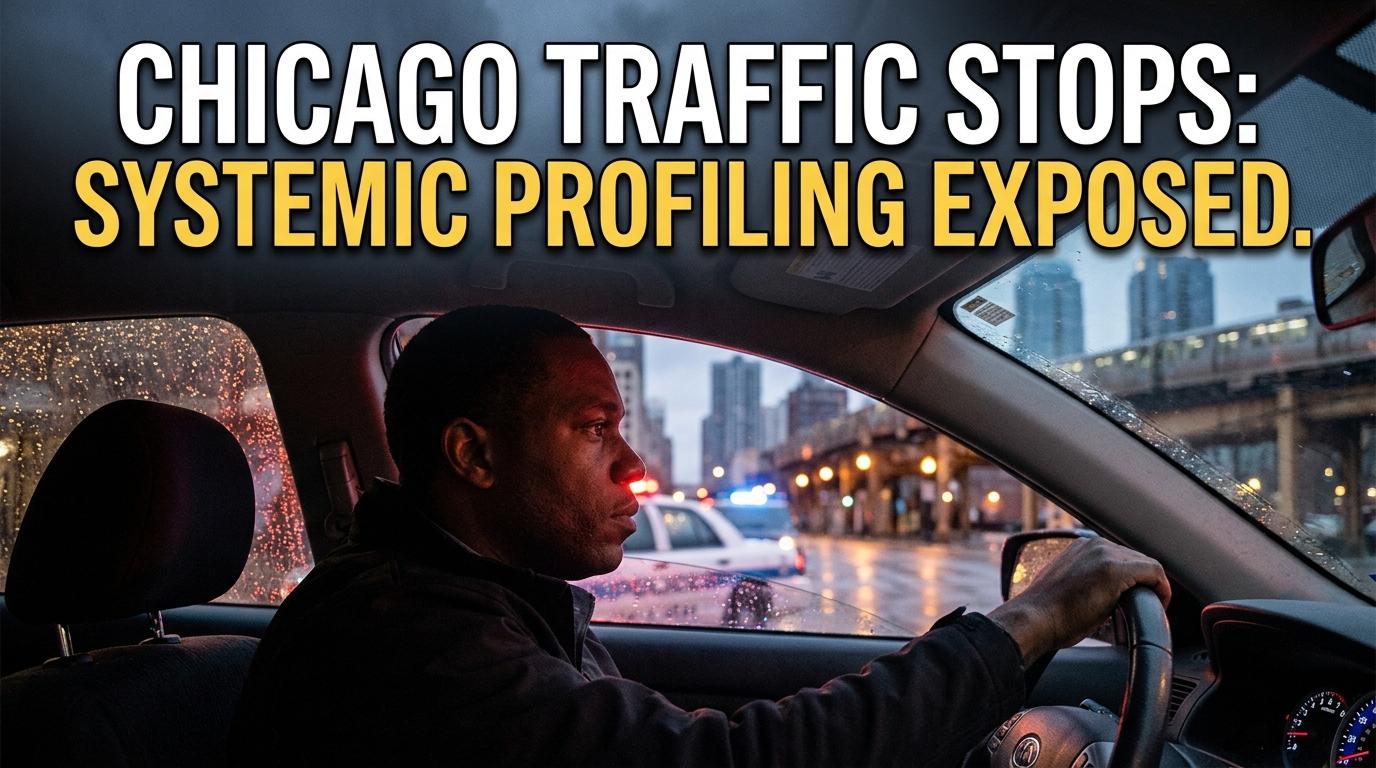
Chicago Traffic Stop Lawsuit Exposes Police Profiling Shift
By Darius Spearman (africanelements)
Support African Elements at patreon.com/africanelements and hear recent news in a single playlist. Additionally, you can gain early access to ad-free video content.
A Federal Judge Opens the Door for Systemic Reform
In late July 2026, United States District Judge Mary M. Rowland granted class-action status to a landmark civil rights lawsuit challenging traffic stop practices in Chicago (wttw.com, aclu-il.org). The ruling in Wilkins v. City of Chicago officially certified a class representing hundreds of thousands of Black and Latino drivers (wttw.com, aclu-il.org). The class includes drivers who were pulled over by Chicago police officers since June 26, 2021, as well as motorists who may face traffic stops in the future (wttw.com, wttw.com).
The lawsuit was originally filed in June 2023 by lead plaintiff Eric Wilkins alongside four other Black and Latino residents (aclu-il.org, aclu-il.org). Wilkins, a community organizer in the Roseland neighborhood on the South Side, brought the case after enduring repeated police stops while driving in his own community (aclu-il.org, aclu-il.org). Represented by the ACLU of Illinois and co-counsel, the plaintiffs allege that the Chicago Police Department operates a systemic, citywide mass traffic stop policy that targets Black and Latino drivers without reasonable suspicion of criminal activity (wttw.com, aclu-il.org, aclu-il.org).
Understanding Pretextual Stops and the Mass Traffic Strategy
A pretextual traffic stop occurs when a police officer uses a minor vehicular or equipment violation as a legal justification to pull over a driver (aclu-il.org, aclu-il.org). Examples include an expired registration sticker, a hanging rearview mirror ornament, or a dim license plate light (aclu-il.org, aclu-il.org). While the officer uses the minor infraction as the initial reason for the stop, the underlying intent is to conduct an investigation for unrelated criminal activity without possessing the necessary reasonable suspicion (aclu-il.org, aclu-il.org).
Law enforcement supervisors deployed pretextual stops as a proactive crime control strategy, encouraging officers to conduct high-volume stops in specific neighborhoods (wttw.com, aclu-il.org). Once a vehicle is stopped, officers frequently interrogate occupants, request consent searches, or search vehicle cabins (aclu-il.org, aclu-il.org). Public data demonstrates that these investigative stops rarely uncover dangerous crime (aclu-il.org, aclu-il.org). Over 97 percent of Black drivers and 98 percent of Latino drivers stopped by Chicago police officers are found completely innocent of any criminal wrongdoing (aclu-il.org, aclu-il.org).
Four Decades of Evolving Police Tactics in Chicago
The class certification ruling by Judge Rowland highlighted a historical pattern in Chicago policing (wttw.com, wttw.com). Whenever public pressure or judicial rulings curtail a specific discriminatory stop tactic, police leadership adapts by shifting to a new medium for high-volume enforcement (wttw.com, wttw.com). This institutional cycle has repeated across four decades of street enforcement strategies (wttw.com, wttw.com).
During the 1980s, police officers routinely subjected Black and Latino residents to aggressive pedestrian detentions under vague disorderly conduct charges. In the 1990s, city officials formalized broad street dispersal powers through the Gang Loitering Ordinance. That policy authorized police officers to disperse groups standing in public if an officer suspected gang involvement. The ordinance was invalidated in 1999 when the United States Supreme Court ruled in Chicago v. Morales that the law violated constitutional due process guarantees (findlaw.com).
From Pedestrian Contact Cards to Driving While Black
Following the Morales decision, the Chicago Police Department expanded pedestrian stop-and-frisk practices across South and West Side neighborhoods (aclu-il.org, aclu-il.org). By 2014, Chicago police officers conducted more than 718,000 pedestrian stops in a single year, with over 90 percent targeting Black and Latino residents (aclu-il.org, aclu-il.org). Officers logged these encounters using simplified forms called contact cards, which required minimal legal justification (aclu-il.org, aclu-il.org).
Public outrage over mass stop-and-frisk led to a landmark 2015 agreement between the city and the ACLU of Illinois (aclu-il.org, aclu-il.org). The agreement eliminated basic contact cards and mandated detailed Investigatory Stop Reports that required explicit, articulable legal justifications for every pedestrian stop (aclu-il.org, aclu-il.org). The added documentation and supervisory oversight caused pedestrian stops to drop by more than 85 percent by 2017 (aclu-il.org, aclu-il.org). However, police command staff responded by shifting high-volume stop missions to vehicle traffic enforcement (wttw.com, aclu-il.org). These intense surveillance practices created ongoing [challenges facing Black families](https://www.africanelements.org/news/the-astonishing-strength-and-resilience-of-african-american-families/) striving for safety and mobility in their neighborhoods.
Annual traffic stops jumped from roughly 83,000 in 2014 to nearly 600,000 per year by 2019 and 2023 (wttw.com, aclu-il.org). Between 2016 and 2023, Chicago police officers executed more than 1.5 million traffic stops, establishing a mass vehicle enforcement program that dwarfed previous pedestrian stop numbers (aclu-il.org, aclu-il.org).
Human Bias Versus Automated Traffic Enforcement Data
City officials and police representatives have defended high traffic stop volumes by asserting that enforcement aligns with traffic safety needs and high-crime beats. However, empirical studies directly contradict claims that racial disparities stem from differences in driving behavior (sydney.edu.au, aclu-il.org).
A landmark 2024 study conducted by researchers at Cornell University and the University of Sydney examined driving patterns in Chicago by combining cell phone GPS location data with traffic enforcement records (sydney.edu.au, aclu-il.org). The researchers analyzed automated speed camera citations alongside police officer traffic stops on identical roadways (sydney.edu.au, aclu-il.org). On road stretches where Black motorists comprised 50 percent of the driving population, automated speed cameras issued 54 percent of speeding tickets to Black drivers (sydney.edu.au, aclu-il.org). This automated rate aligned closely with actual roadway demographics (sydney.edu.au, aclu-il.org).
Conversely, human police officers operating on those exact same roads pulled over Black drivers at a rate of 70 percent (sydney.edu.au, aclu-il.org). The study demonstrated that discretionary human policing, rather than underlying driving mechanics, drives racial disparities (sydney.edu.au, aclu-il.org). State data confirms that Black drivers in Chicago are 3.84 times more likely to be subjected to police traffic stops than white drivers relative to population share (aclu-il.org, aclu-il.org).
Plainclothes Tactical Units and Dangerous Street Encounters
A central finding in civil rights investigations involves the specialized deployment of district tactical units for traffic enforcement (wttw.com, wttw.com). Rather than relying on uniformed traffic officers driving marked cruisers, police command staff instructed plainclothes tactical officers operating unmarked vehicles to conduct high-volume traffic missions (wttw.com, wttw.com).
Tactical units utilized minor equipment infractions to initiate aggressive encounters in minority neighborhoods (wttw.com, cbsnews.com). These aggressive interactions created high-stress scenarios that repeatedly escalated into physical violence (wttw.com, cbsnews.com). In March 2024, plainclothes tactical officers pulled over 26-year-old Dexter Reed in the Humboldt Park neighborhood for an alleged seatbelt violation (wttw.com, cbsnews.com).
The encounter escalated rapidly after officers surrounded Reed’s vehicle with guns drawn (wttw.com, cbsnews.com). A gunfight ensued, and tactical officers fired 96 rounds in 41 seconds, killing Reed (wttw.com, cbsnews.com). Subsequent oversight investigations raised serious questions regarding why plainclothes officers were conducting traffic stops for seatbelt infractions (wttw.com, cbsnews.com). Misconduct records revealed that members of the tactical team involved had prior constitutional violations during unrelated traffic stops (wttw.com, wttw.com).
The Escalating Financial Burden on Black Communities
Beyond physical safety concerns, pretextual traffic stops impose profound economic harms on working-class Black drivers engaged in their daily [struggle for economic justice](https://www.africanelements.org/news/from-the-cotton-fields-to-the-assembly-line-how-black-workers-fought-for-economic-justice-against-all-odds/). Minor citations for equipment issues or late registration frequently launch severe financial penalties (propublica.org, finesandfeesjusticecenter.org).
Initial ticket fines double if unpaid within twenty-five to thirty days (propublica.org, finesandfeesjusticecenter.org). Unpaid fines quickly accumulate late fees, collection penalties, and court costs (propublica.org, finesandfeesjusticecenter.org). Drivers who accumulate multiple unpaid tickets face vehicle booting, towing, and storage fees that rapidly exceed $1,000 (propublica.org, finesandfeesjusticecenter.org, debtstoppers.com). Low-income residents who cannot pay thousands of dollars upfront forfeit their impounded vehicles to municipal auctions (propublica.org, debtstoppers.com).
Furthermore, unpaid municipal tickets trigger state driver’s license suspensions (propublica.org, finesandfeesjusticecenter.org). To lift license suspensions and retrieve impounded vehicles needed for work, thousands of working-class residents file Chapter 13 bankruptcy (propublica.org, debtstoppers.com). This systemic financial drain reflects a broader pattern of localized [economic extraction](https://www.africanelements.org/patreon/africas-rising-debt-crisis-a-historical-echo-for-black-communities/), making Chicago’s federal bankruptcy court a national leader in ticket-debt-related filings (propublica.org, debtstoppers.com).
Legal Grounds: Equal Protection and the Illinois Civil Rights Act
The legal claims certified in Wilkins v. City of Chicago rest on fundamental constitutional and statutory protections (aclu-il.org, aclu-il.org). The lawsuit asserts that the city violates the Equal Protection Clause of the Fourteenth Amendment to the United States Constitution (aclu-il.org, casemine.com). Under federal law, police agencies are strictly prohibited from exercising enforcement authority based on race or ethnic stereotypes (aclu-il.org, casemine.com).
In addition, plaintiffs bring claims under Section 5(a)(1) of the Illinois Civil Rights Act of 2003 (aclu-il.org, aclu-il.org). The state statute offers broader protections than federal constitutional standards by prohibiting government policies that produce an unjustified, racially disparate impact (aclu-il.org, aclu-il.org). Plaintiffs do not need to prove explicit racial hatred by individual officers; proving that a municipal policy generates discriminatory outcomes is sufficient (aclu-il.org, aclu-il.org). These laws provide key [federal legal protections](https://www.africanelements.org/news/black-politics-state-vs-nation-centered-power-part-1-federalism-black-politics/) that allow affected communities to challenge institutional discrimination in court (aclu-il.org, aclu-il.org).
Community-Led Alternatives for Traffic and Public Safety
Civil rights advocacy organizations, including Impact for Equity and the ACLU of Illinois, argue that Chicago must dismantle pretextual policing in favor of non-coercive safety strategies (aclu-il.org, aclu-il.org). Advocates demand a formal police department policy prohibiting traffic stops for non-safety equipment issues, such as single broken lights or expired registration tags (aclu-il.org, aclu-il.org).
Proposed reforms also call for transferring routine traffic safety duties from armed police officers to trained, unarmed civilian responders (aclu-il.org, aclu-il.org). Civilian workers can assist disabled motorists and address minor equipment issues without introducing high-stress police encounters (aclu-il.org, aclu-il.org). Finally, advocates urge the city to redirect municipal funds toward infrastructure engineering and automated traffic-calming measures, ensuring safer streets while eliminating racial profiling (aclu-il.org, aclu-il.org).
About the Author
Darius Spearman is a professor of Black Studies at San Diego City College, where he has been teaching for over 20 years. He is the founder of African Elements, a media platform dedicated to providing educational resources on the history and culture of the African diaspora. Through his work, Spearman aims to empower and educate by bringing historical context to contemporary issues affecting the Black community.
