

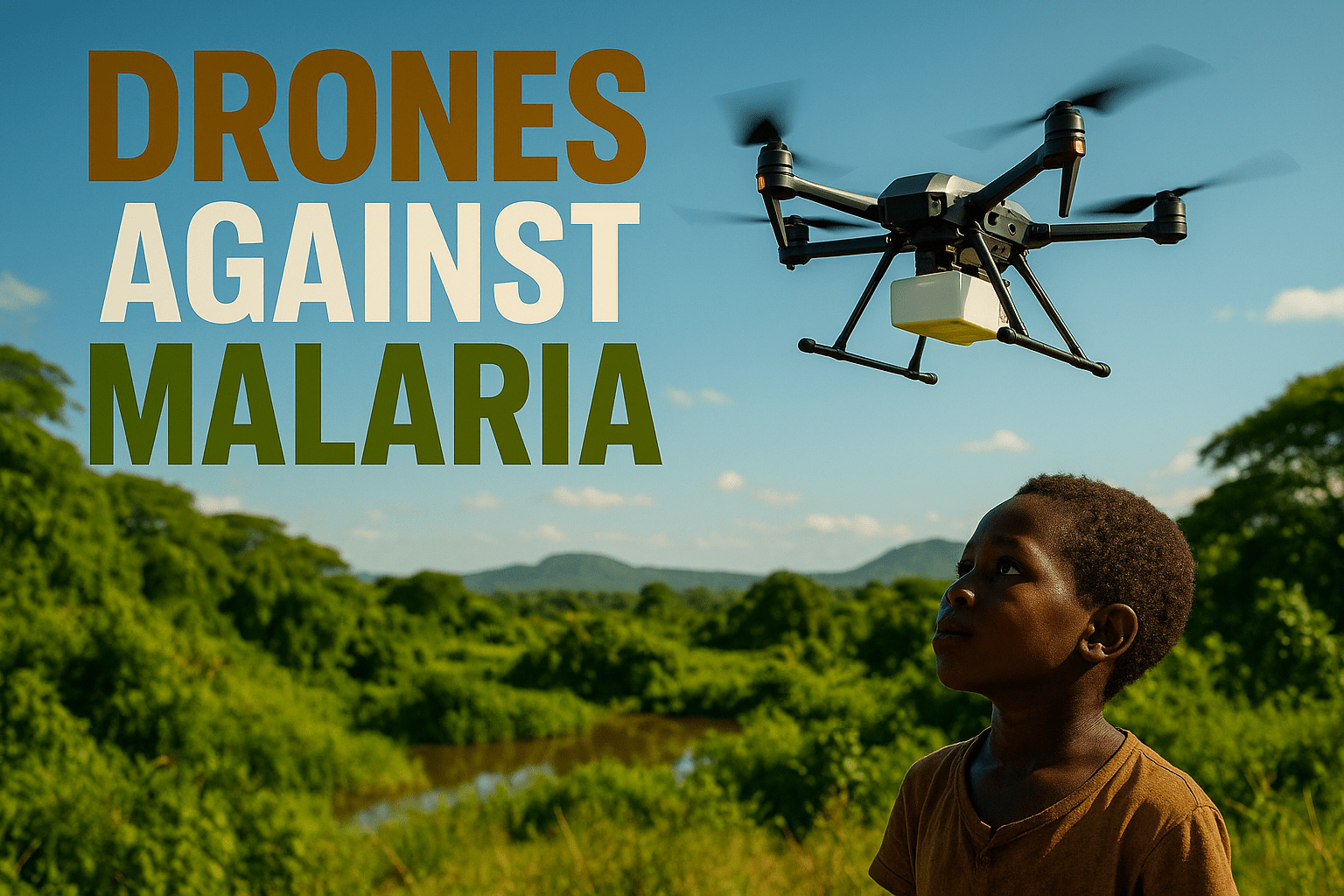
Drones Against Malaria: An African Health Revolution
By Darius Spearman (africanelements)
Support African Elements at patreon.com/africanelements and hear recent news in a single playlist. Additionally, you can gain early access to ad-free video content.
Malaria’s Toll on African Development
Malaria continues to be a significant barrier to progress and well-being across the African continent. This devastating disease claims far too many lives, especially among the most vulnerable. Each year, approximately 600,000 deaths are recorded due to malaria, with a heartbreaking majority being children under the age of five (prtimes.jp). The human cost is immense, but the economic impact is also staggering. The World Economic Forum estimates that up to $16 billion in Gross Domestic Product (GDP) is lost annually because of malaria (prtimes.jp). This makes malaria not only a critical public health crisis but also a major economic and strategic challenge for Africa’s future.
The persistent threat of malaria underscores the urgent need for innovative solutions. Traditional methods of control have faced various challenges, including the vastness of affected areas and the evolving nature of the disease. However, technology is now offering new hope in this crucial fight. A Japanese startup named SORA Technology is deploying a groundbreaking approach in several African countries, aiming to turn the tide against this ancient scourge.
AI Takes Flight: Drones Combat Malaria
SORA Technology is introducing an innovative solution: AI-guided drones that precisely detect mosquito breeding sites and apply larvicides (prtimes.jp). This advanced method moves away from costly, large-scale, and often inefficient treatments. Instead, it focuses on highly targeted interventions. The drones use various onboard sensors, such as visible spectrum or infrared cameras, to collect data relevant to entomology and epidemiology (malariajournal.biomedcentral.com).
Artificial Intelligence (AI) algorithms then process high-resolution drone imagery to identify water bodies where *Anopheles* mosquitoes are most likely to breed (academicjournals.org). This allows for the creation of real-time maps showing larval habitat signatures, which guide the precise application of larvicides (academicjournals.org). Larvicides are substances specifically designed to kill mosquito larvae, targeting the immature stages of mosquitoes in their aquatic breeding sites (malariajournal.biomedcentral.com). This targeted approach prevents adult mosquitoes from emerging and transmitting the disease, effectively disrupting the malaria transmission cycle at an early stage.
Disrupting the Cycle: Targeting Mosquito Breeding
Understanding how malaria spreads is key to appreciating the effectiveness of SORA Technology’s approach. Malaria is transmitted to humans through the bites of infected female *Anopheles* mosquitoes. These mosquitoes become infected with the malaria parasite after feeding on a person who already has the disease. They then pass the parasite to another person when they bite again. This cycle highlights the critical role mosquitoes play in spreading malaria.
Controlling mosquito breeding sites is therefore a vital strategy because it attacks the mosquito population at its very source. By preventing the emergence of adult mosquitoes, the likelihood of malaria transmission significantly decreases. This direct impact on the mosquito population helps to lower malaria rates. While genetic control methods for mosquitoes are gaining popularity, SORA Technology’s method offers a powerful, complementary tool to reduce mosquito numbers and break the transmission chain (science.org).
Malaria’s Devastating Impact in Africa
Smart Solutions, Lasting Impact: SORA’s Effectiveness
SORA Technology’s solution has already demonstrated remarkable effectiveness and cost-efficiency in its initial deployments. In Ghana, for example, the system has achieved up to a 70% reduction in insecticide use (prtimes.jp). This significant decrease in chemical reliance is a major benefit for environmental health and sustainability. Furthermore, the system has led to a 40% savings on prevention costs and a 50% decrease in labor expenses (prtimes.jp). These economic efficiencies make the approach more sustainable for long-term implementation in resource-constrained settings.
Another crucial advantage of this method is its ability to reduce the risk of insecticide resistance. Insecticide resistance occurs when mosquito populations develop the ability to survive exposure to chemicals that would normally kill them. This happens because some mosquitoes have genetic mutations that allow them to withstand the chemicals. These resistant mosquitoes then reproduce, passing on their resistance to their offspring. By focusing on larvicides and precise application, SORA Technology’s method uses fewer chemicals overall, which helps to extend the effectiveness of existing insecticides and mitigates the development and spread of resistance (prtimes.jp). This is a critical improvement over traditional systems, where widespread and often indiscriminate use of insecticides has contributed to this growing problem. The company’s efforts have even been recognized with the “Zero Malaria Encouragement Award” (prtimes.jp).
Building Bridges: Collaborations and Funding
To expand its vital work, SORA Technology has secured significant funding and is actively building partnerships. In March 2025, the company completed the first close of its Pre-Series A funding round, bringing its total accumulated funding, including debt finance, to approximately 670 million JPY, which is around $4.8 million USD (prtimes.jp). This substantial investment, primarily from Japanese investors like Nissay Capital Sustainability Solutions Fund No.1 Investment Limited Partnership (prtimes.jp), will fuel the expansion of their presence to six additional African countries (prtimes.jp).
A key part of their strategy is to help health ministries locally integrate the technology (prtimes.jp). This integration involves close collaboration with local government agencies, universities, and research institutions (prtimes.jp). For example, SORA Technology signed a Memorandum of Understanding (MOU) with the Directorate of Science, Technology, and Innovation and Njala University in Sierra Leone (sora-technology.com). This agreement aims to build a drone-based infrastructure for public health. Such collaborations are crucial for ensuring that the technology is adapted to local needs, that local personnel are trained, and that operational protocols are established to work seamlessly with existing health surveillance systems.
SORA Technology’s Recent Funding Boost
On the Ground: Navigating Local Realities
SORA Technology is currently active in six African countries: Ghana, Sierra Leone, Benin, Democratic Republic of Congo (DRC), Senegal, and Kenya (prtimes.jp). While the specific reasons for selecting these countries are not explicitly detailed, SORA Technology’s mission to solve “emergent social problems” related to global health issues like malaria in developing countries suggests a strategic focus on areas with high malaria burdens and logistical challenges (sora-technology.com). The company’s engagement with local governments, such as meeting with the Ambassador of Japan to Senegal (sora-technology.com), indicates a commitment to working within existing frameworks.
Local conditions, including terrain, climate, existing infrastructure, and regulatory environments, undoubtedly influence the deployment and effectiveness of drone technology. For instance, the varied landscapes across these nations, from dense forests to urban centers, require tailored approaches for drone operation and data collection. The company’s emphasis on “last-mile delivery” also points to a recognition of the unique challenges in reaching remote or underserved communities (sora-technology.com). This adaptability is crucial for ensuring that the drone-based solutions are not only technologically sound but also practically viable in diverse African settings.
Community and Compliance: The Human Element
The success of any public health initiative depends heavily on community acceptance and engagement. While detailed information on local community involvement is limited, SORA Technology’s partnerships with local universities and government bodies, such as the MOU with Njala University in Sierra Leone (sora-technology.com), suggest an effort to embed their operations within local structures. The company’s overarching mission to create a “sustainable society resilient to disasters and epidemics” implies a focus on solutions that genuinely benefit and are accepted by the communities they serve (sora-technology.com). However, direct insights into community training, social acceptance, or specific challenges related to drone deployment within local communities would provide an even richer picture.
Deploying drones for public health also involves navigating complex regulatory and ethical considerations. While the provided information does not delve into specific ethical dilemmas, SORA Technology’s engagement in agreements like the MOU with Bhutan’s Ministry of Information and Communication for comprehensive drone infrastructure development, including Unmanned Aircraft System Traffic Management (UTM) and Remote ID (sora-technology.com), highlights their awareness of the need for robust regulatory frameworks. Issues such as privacy, data security, and the safe operation of aerial vehicles in populated areas are inherent to drone deployment and fall under regulatory and ethical scrutiny. These discussions are vital for ensuring responsible and sustainable implementation of such advanced technologies.
SORA Technology’s Proven Impact in Ghana
Beyond Malaria: A Vision for a Resilient Future
SORA Technology’s mission extends beyond just malaria control. The company aims to achieve a “safe and prosperous society anywhere in the world” through air mobility like drones, focusing on infectious disease and climate change countermeasures (prtimes.jp). While the direct link between their malaria control technology and climate change mitigation is not explicitly detailed, the connection is significant. Climate change influences the geographical spread and intensity of vector-borne diseases such as malaria. Changes in temperature, rainfall patterns, and humidity can expand mosquito habitats, making more areas vulnerable to outbreaks.
By effectively controlling mosquito populations and their breeding sites, SORA Technology’s approach indirectly contributes to mitigating the health impacts exacerbated by climate change, particularly in vulnerable regions. Their work aligns with broader global health initiatives, as evidenced by their presentations at significant events like TICAD 8 and for Bill Gates at “Global Health Action Japan” (sora-technology.com). This holistic vision underscores how technological innovation, when applied strategically, can address interconnected global challenges, fostering resilience against both disease and environmental shifts.
A New Era for African Health
The efforts of SORA Technology represent a promising new chapter in the fight against malaria in Africa. By leveraging cutting-edge AI and drone technology, they are providing a targeted, efficient, and cost-effective solution to a persistent public health crisis. The proven reductions in insecticide use, prevention costs, and labor expenses in Ghana demonstrate the tangible benefits of this approach. Furthermore, by mitigating insecticide resistance, SORA’s method offers a sustainable path forward where traditional methods have faltered.
The significant funding secured and the active collaborations with local governments and universities across Africa are crucial steps towards widespread adoption and integration of this technology. This innovative approach not only tackles malaria head-on but also lays the groundwork for a more resilient and prosperous future for African communities. It is a testament to how technology, when applied with a deep understanding of local needs and global challenges, can truly change the game for the better.
ABOUT THE AUTHOR
Darius Spearman has been a professor of Black Studies at San Diego City College since 2007. He is the author of several books, including Between The Color Lines: A History of African Americans on the California Frontier Through 1890. You can visit Darius online at africanelements.org.
