
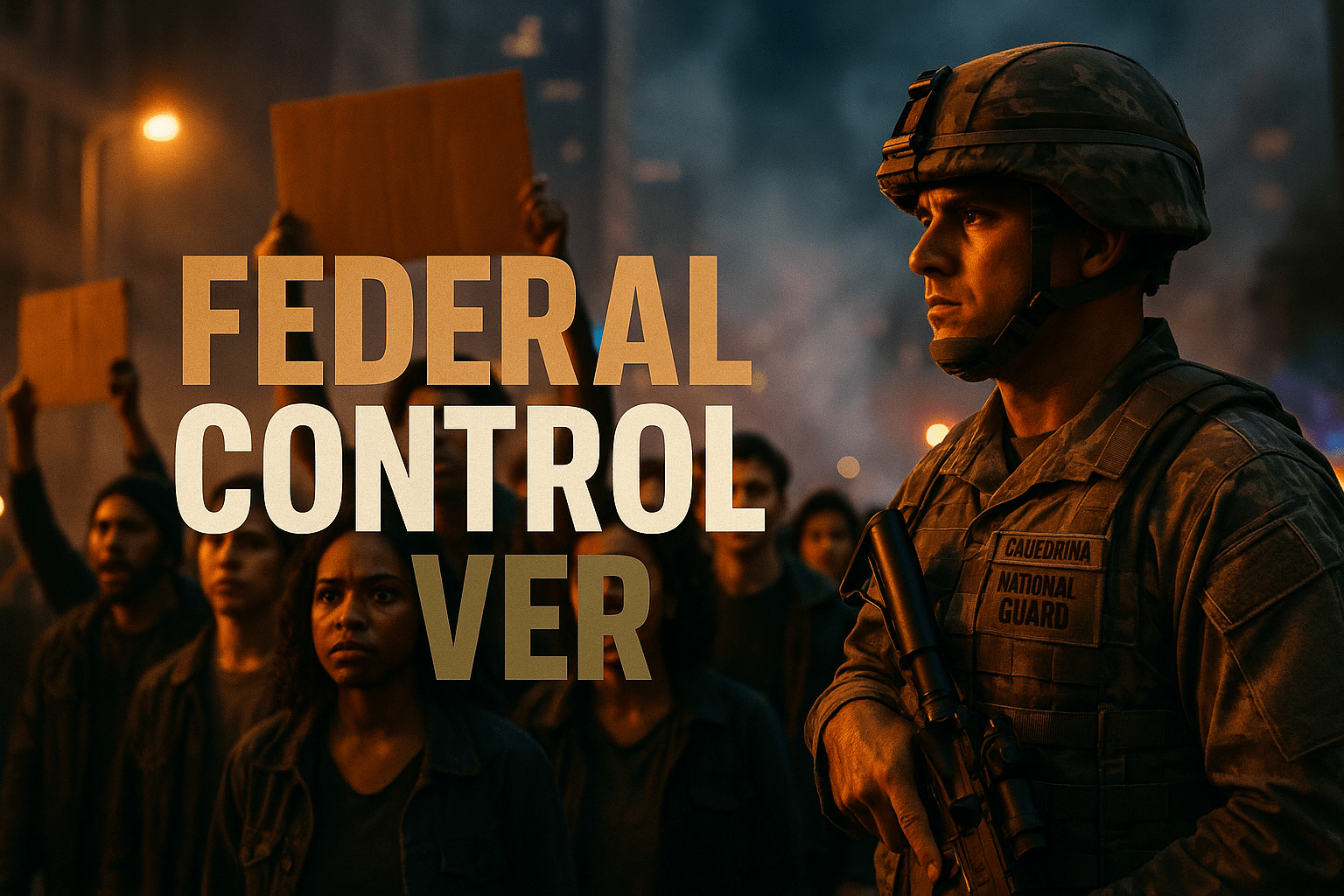
Federal Control Over State Guard: A Dangerous Precedent
By Darius Spearman (africanelements)
Support African Elements at patreon.com/africanelements and hear recent news in a single playlist. Additionally, you can gain early access to ad-free video content.
A federal appeals court recently made a significant decision, allowing the Trump administration to keep control of California National Guard troops deployed to Los Angeles. This ruling temporarily stops a lower court’s order that had called the federalization unlawful. For many in our communities, this raises serious questions about who truly holds power and how it impacts the everyday lives of citizens, especially when protests and civil unrest are involved.
This decision by a three-judge panel on the 9th U.S. Circuit Court of Appeals means that Trump’s orders to deploy at least 4,000 California National Guard troops and several hundred Marines will stay in place while the legal fight continues (nbcnews.com). This action pauses a previous ruling by U.S. District Judge Charles Breyer. Judge Breyer had issued a temporary order, stating that President Donald Trump’s federalization of these guardsmen was against the law (nbcnews.com).
Understanding Federalization
When we talk about “federalizing” National Guard troops, it means the President takes them from state control and puts them under federal command. Essentially, they become part of the federal military. This changes their chain of command from the state governor to the Secretary of Defense (justsecurity.org). Normally, a state governor’s permission is needed for such a move. However, there are specific laws that allow the President to federalize the Guard without a governor’s consent, especially in situations involving rebellion or when federal laws need to be enforced (brennancenter.org).
The deployed National Guard members and Marines in Los Angeles are known as “Task Force 51.” Their job is to protect federal personnel and federal property in the greater Los Angeles area (jurist.org). These troops are trained in de-escalation, crowd control, and specific rules for using force (jurist.org). When they are federalized, their rules of engagement come from federal military protocols, which can be different from the rules state law enforcement follows. This shift from state to federal control is a big deal, as it changes how these forces operate within our communities.
The Legal Battleground
Judge Breyer had previously ruled that Trump broke federal law and the U.S. Constitution by taking control of the California National Guard without the governor’s approval, calling his actions “illegal” (democracydocket.com). California Governor Gavin Newsom had sued Trump, arguing that the deployment went against the 10th Amendment and the Administrative Procedure Act (courthousenews.com). He stated that federal law requires a governor’s consent for such a mobilization.
The 10th Amendment to the U.S. Constitution is crucial here. It states that any powers not given to the federal government, nor forbidden to the states, are reserved for the states or the people. California’s lawsuit uses this amendment to argue for its right to control its own National Guard. The Administrative Procedure Act (APA) is a federal law that sets rules for how government agencies make decisions and regulations. If California argued under the APA, it would likely claim that the federal government did not follow proper procedures or that its decision to federalize the Guard was unfair or baseless. The President’s power to federalize the Guard comes mainly from laws like the Insurrection Act, which includes provisions such as 10 U.S.C. § 12406 (davisvanguard.org). This act allows the President to deploy federalized troops to put down rebellions or enforce federal laws.
Key Legal Concepts in the National Guard Case
Judicial Deference
Courts give significant respect to decisions made by another branch of government, like the President. This is common in military matters, recognizing the President’s role as Commander-in-Chief and their access to sensitive information.
10th Amendment
This amendment reserves powers not given to the federal government to the states or the people. It is central to arguments for state control over their National Guard units.
Insurrection Act (10 U.S.C. § 12406)
A federal law that allows the President to deploy federalized troops, including the National Guard, for reasons like suppressing rebellion or enforcing federal laws, sometimes without state consent.
A Rare Precedent: History’s Echoes
This situation is truly historic. It is the first time since 1965 that a president has taken command of a state’s National Guard without the governor’s consent (blackamericaweb.com). The last time this happened was when President Lyndon B. Johnson sent troops to Alabama to protect civil rights marchers (davisvanguard.org). That period was marked by intense conflict between federal and state authorities over civil rights. This historical context shows that such actions are usually reserved for extreme national importance or when states are seen as unable or unwilling to uphold federal law.
This controversial move sets a “dangerous precedent” (blackamericaweb.com). It suggests that a president can overstep state power if it is presented as a matter of “public safety.” Governor Newsom previously stated that using troops without authorization would harm state sovereignty, increase tensions, and fuel unrest (courthousenews.com). He also called Trump’s actions an attempt to “place military forces on American streets to intimidate and quiet those who disagree with him,” describing it as “not just immoral — it’s illegal and dangerous” (courthousenews.com).
Federalization Without Consent: A Rare Occurrence
1965: Civil Rights Movement
President Lyndon B. Johnson federalized the Alabama National Guard to protect civil rights marchers, marking the last time a president took control without the governor’s consent before the current case.
Present Day: Los Angeles Protests
The Trump administration federalizes the California National Guard amid protests, marking the first instance of such action without state consent since 1965, raising concerns about executive overreach.
Protests and Justification
The appeals court pointed to public safety concerns and violent incidents during protests as a “defensible rationale” for federalizing the Guard (blackamericaweb.com). The court noted that before the deployment, protesters “pinned down” federal officers and threw “concrete chunks, bottles of liquid, and other objects” at them (blackamericaweb.com). Protesters also damaged federal buildings, caused the closure of at least one federal building, and attacked a federal van, smashing its windows (blackamericaweb.com). The court stressed that the federal government has a strong interest in preventing such incidents.
The protests in Los Angeles that led to this federalization started after reports of Immigration and Customs Enforcement (ICE) officers conducting raids throughout the city (jurist.org). Protesters gathered outside the Federal Building, and the Los Angeles Police Department (LAPD) was called to the scene (jurist.org). The protests were later called an “unlawful assembly.” For many in the African American and Latino communities, the deployment of military forces in response to protests against immigration enforcement raises concerns about the militarization of domestic spaces and the suppression of civil liberties. This is especially true when considering the history of government responses to civil rights movements and social justice demonstrations.
Troops Deployed to Los Angeles
California Fights On
California officials, including Attorney General Rob Bonta and Governor Gavin Newsom, have promised to continue their legal challenge against the federalization. Attorney General Bonta stated that the case is “far from over” and expressed disappointment that the temporary restraining order was stopped (blackamericaweb.com). Bonta repeated that the Trump administration “far overreached its authority with its unprecedented and unlawful federalization of the California National Guard” (blackamericaweb.com).
Governor Newsom also expressed disappointment that the court is allowing Trump to keep control and vowed to press forward with the challenge against “Trump’s authoritarian use of U.S. military soldiers against citizens” (blackamericaweb.com). Newsom stated that the court “rightly rejected Trump’s claim that he can do whatever he wants with the National Guard and not have to explain himself to a court,” asserting that “The President is not a king and is not above the law” (blackamericaweb.com). This strong language highlights the deep concern among state leaders about the balance of power and the potential for federal overreach into state matters.
The Stakes for Democracy
This legal fight over who controls the National Guard is about more than just troops on the ground. It is a real attempt to stop what many see as Trump’s continued effort to expand federal power. For African American communities and other marginalized groups, the deployment of military forces in response to domestic protests, especially those related to social justice issues, brings back painful memories of past government actions to suppress dissent. It raises concerns about the potential for increased surveillance, intimidation, and violence against those exercising their constitutional right to protest.
This case touches upon the protection of democracy, states’ rights, and whether a president can act like a general in a political war he started. The appeals court acknowledged that while presidential authority over the National Guard is broad, it is not “unreviewable” (yahoo.com). However, the court was persuaded that, under long-standing precedent, their review of that decision must be “highly deferential” (yahoo.com). Judicial deference means that courts give a lot of weight and respect to decisions made by another branch of government, especially the President, in military matters. This is because the President is the Commander-in-Chief and has access to classified information, and there is a perceived need for quick action in national security situations.
The Path Ahead
The specific next steps in this legal battle are not yet clear. However, in cases like this, further appeals to a higher court, such as the Supreme Court, are possible. The case could also be sent back to a lower court for more proceedings. The length of time the appeals court ruling will stand depends on these future legal actions. Possible outcomes range from the appeals court’s decision being upheld, which would mean continued federal control of the Guard, to it being overturned, potentially returning control to the state or requiring a different federal approach.
The implications of this ruling for future state-federal relations and National Guard deployments are significant. This action challenges the traditional balance of power, where states usually control their Guard units. It could set a precedent that expands federal authority over state assets, leading to more tension and disputes between states and the federal government regarding military deployments within state borders. This case could also influence how future presidents handle domestic unrest and the use of military force, potentially reducing the role of state governors in such situations. The ongoing nature of this dispute means that the fight for state sovereignty and democratic principles continues.
ABOUT THE AUTHOR
Darius Spearman has been a professor of Black Studies at San Diego City College since 2007. He is the author of several books, including Between The Color Lines: A History of African Americans on the California Frontier Through 1890. You can visit Darius online at africanelements.org.
