


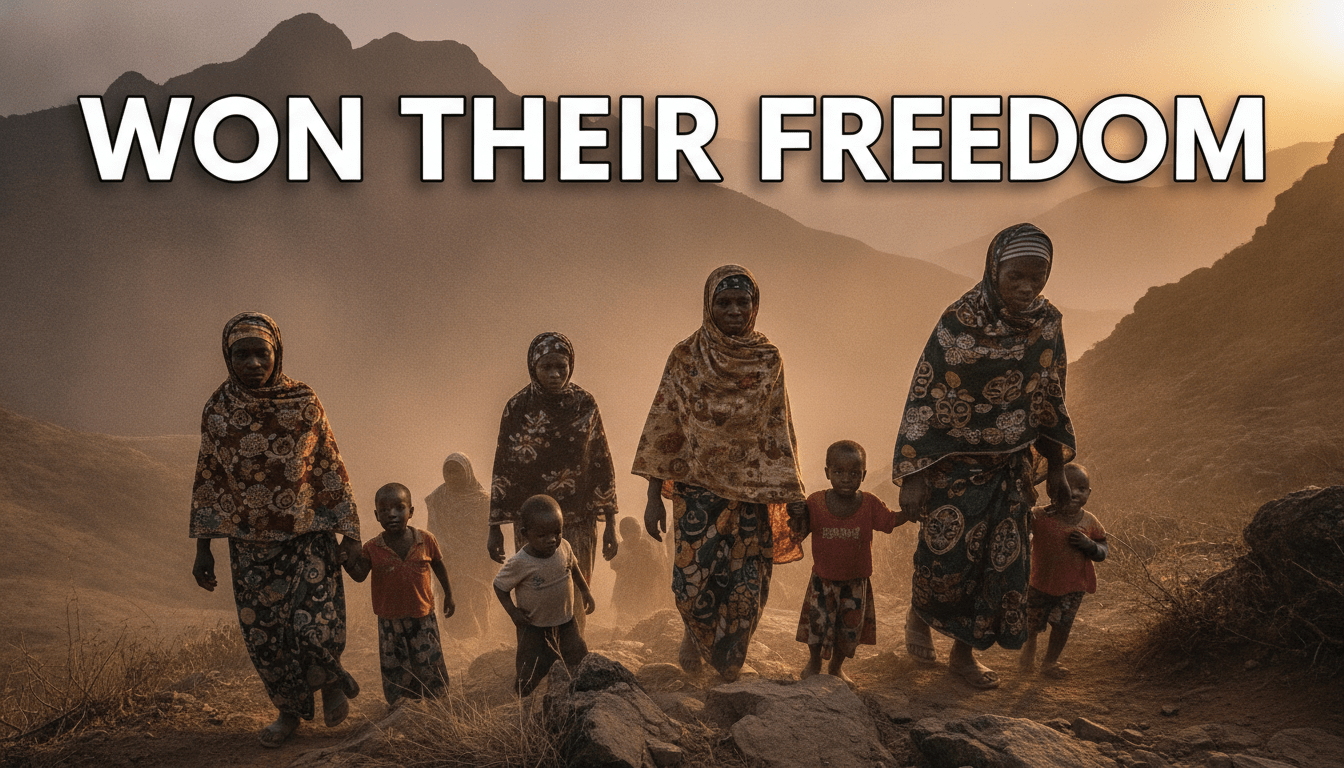
How 360 Boko Haram Hostages Finally Won Their Freedom
By Darius Spearman (africanelements)
Support African Elements at patreon.com/africanelements and hear recent news in a single playlist. Additionally, you can gain early access to ad-free video content.
The Mountain Rescue in Borno State
The June 2026 military operation in northeastern Nigeria represents a major milestone in the regional fight against terror. Under the coordinated banner of Operation Hadin Kai, the Nigerian military successfully liberated 360 captives from the control of the Boko Haram extremist group (pbs.org, channelstv.com). These survivors had been held in a heavily fortified stronghold deep within the rugged Mandara Mountains of Borno State (channelstv.com, youtube.com). The rescue brings a sense of relief to the region, yet the escape route itself proved to be a final, tragic hurdle.
During the grueling extraction process, the survivors had to trek through exceptionally rocky and steep terrains. Regrettably, two infants died of exhaustion before reaching safety (youtube.com, tvcnews.tv). This tragic detail underscores the brutal environment in which these captives lived. The hostages had been abducted in March 2026 when insurgents overran local communities and military outposts in the Ngoshe area (channelstv.com, youtube.com). Their rescue highlights the ongoing challenges of securing rural communities against sudden raids.
The Human Toll of the Insurgency
The statistical scale of displacement and crisis in the Lake Chad Basin illustrates the long-term impact of this conflict.
The Roots of a Decades-Long Crisis
The rescue in 2026 cannot be understood without examining the historical origins of the Boko Haram movement. The group began in 2002 in Maiduguri, which is the capital of Borno State (britannica.com, wikipedia.org). A young cleric named Mohammed Yusuf established the organization (britannica.com, wikipedia.org). He named it Jama’at Ahl as-Sunnah lid-Da’wah wa’l-Jihad, though local residents began calling the movement Boko Haram, meaning “Western education is forbidden” (wikipedia.org, wikipedia.org). Yusuf utilized systemic government corruption, high levels of poverty, and regional neglect to recruit vulnerable young people to his cause (hudson.org, africaresearchinstitute.org).
Initially, the movement functioned as a localized sectarian community. However, tensions escalated into a full-scale armed uprising in July 2009 (wikipedia.org, wikipedia.org). The Nigerian government responded with heavy military force, resulting in the extrajudicial execution of Mohammed Yusuf while in police custody (wikipedia.org, wikipedia.org). This aggressive state crackdown drove the remaining members underground and radicalized the organization. For many residents in the region, the pursuit of basic freedom and security became increasingly remote as the conflict evolved into an active insurgency (hudson.org, africaresearchinstitute.org).
Splinters, Shekau, and the Rise of ISWAP
Following the death of Mohammed Yusuf, his deputy Abubakar Shekau assumed leadership of the group in 2010 (wikipedia.org, wikipedia.org). Under Shekau, the organization turned into a highly violent global terror threat. He introduced suicide bombings, improvised explosive devices, and large-scale abductions as standard tools of war (wikipedia.org, wikipedia.org). In 2015, Shekau pledged allegiance to ISIS, renaming the group the Islamic State West Africa Province, or ISWAP (wikipedia.org, wikipedia.org). However, his extreme tactics, such as using young girls as suicide bombers, alienated ISIS leadership (wikipedia.org, crisisgroup.org).
By 2016, ISIS bypassed Shekau and appointed Abu Musab al-Barnawi as the new leader of ISWAP (wikipedia.org, crisisgroup.org). This decision caused a major split. Shekau and his loyalists formed the original JAS faction, initiating a bloody civil war between the two groups (crisisgroup.org, wikipedia.org). This internal war culminated in May 2021 when ISWAP forces cornered Shekau in the Sambisa Forest, leading to his suicide (wikipedia.org, crisisgroup.org). Even after his death, the fragmented JAS faction continued to operate out of remote mountain strongholds (crisisgroup.org, wikipedia.org).
Factional Breakdown of the Conflict
The Strategy of Mountains and Mass Kidnapping
The geographic features of northeastern Nigeria have played a critical role in the survival of these insurgent factions. The Mandara Mountains, which cross the border between Nigeria and Cameroon, act as a natural fortress (africaresearchinstitute.org, wikipedia.org). Conventional military vehicles cannot easily traverse this rocky, heavily forested volcanic terrain. Insurgents have used this lack of border monitoring to move across the frontier to escape military operations (africaresearchinstitute.org, wikipedia.org). Along with the Lake Chad Basin, these mountains remain a primary sanctuary for the remaining JAS fighters (africaresearchinstitute.org, theglobalobservatory.org).
Within these mountain camps, insurgents rely on mass abductions as a systematic tactic. This strategy reached a global turning point in April 2014, when the group kidnapped 276 schoolgirls from Chibok (wikipedia.org, unicef.org). The incident showed the group that kidnapping could provide leverage for ransom or prisoner swaps (wikipedia.org, unicef.org). Inside the camps, hostages suffer from systemic abuses, forced marriages, and physical labor (hrw.org, globalsurvivorsfund.org). For survivors, maintaining the strength and resilience of families is nearly impossible under such harsh conditions.
The Role and Risks of Local Vigilantes
To assist the military, local communities formed the Civilian Joint Task Force, or CJTF, in Maiduguri in 2013 (stimson.org, wikipedia.org). This state-sanctioned, community-based paramilitary group consists of over 26,000 local volunteers (stimson.org). Known locally as Yan Gora, these volunteers receive limited state funding and work alongside the national army (stimson.org). They provide valuable intelligence and local knowledge that the military lacks in rural areas (stimson.org, wikipedia.org).
Nevertheless, the CJTF has faced serious human rights concerns. During the peak of the conflict, the group recruited and utilized child soldiers as young as 11 to guard camps and conduct patrols (stimson.org, wikipedia.org). This practice led to the group being listed in United Nations reports on child soldiers (stimson.org). Following a UN Action Plan in 2017, the CJTF released over 2,000 children and was officially delisted in 2021 (stimson.org). Despite this progress, allegations of extrajudicial killings and sexual abuse in displacement camps continue to persist (stimson.org, wikipedia.org).
International Power and Foreign Footprints
The combat landscape in northeastern Nigeria has also been shaped by foreign military involvement, particularly from the United States. Initially, U.S. troops deployed to the region in February 2026 to offer training and advisory support to the Nigerian armed forces (premiumtimesng.com, jpost.com). However, this role transitioned into active combat operations by May 2026. A joint operation between the U.S. Africa Command and Nigerian troops resulted in coordinated airstrikes and ground raids that neutralized 175 ISWAP fighters (premiumtimesng.com, jpost.com).
These operations successfully targeted top insurgent leaders, including deputy leader Abu Bakr al-Mainuki and global operations director Abu-Bilal al-Minuki (premiumtimesng.com, jpost.com). While the military praised these strikes as a major victory, the foreign presence has sparked intense political debate in West Africa. Regional security analysts warn that direct foreign airstrikes may worsen the broader Sahel crisis (jpost.com, westpoint.edu). They argue that military interventions do not address the social and political grievances that allow extremist groups to recruit new members (jpost.com, westpoint.edu).
Financial Bandits vs. Ideological Terror
In addition to Boko Haram and ISWAP, Nigeria faces a highly complex security crisis in its northwest and north-central regions. This crisis is driven by heavily armed criminal syndicates known as “bandits” (globalinitiative.net, wikipedia.org). Unlike the ideological factions in the northeast, these bandits are composed of thousands of decentralized fighters spread across independent gangs (globalinitiative.net, wikipedia.org). Their primary motivations are financial rather than religious or political (globalinitiative.net).
Bandit operations focus on highly profitable crimes, such as mass kidnappings for ransom, cattle rustling, and illegal gold mining (globalinitiative.net, wikipedia.org). This rise in banditry has caused an enormous humanitarian crisis, causing over 13,000 deaths and displacing over one million rural citizens (globalinitiative.net, washingtonpost.com). To allow for stronger military actions, the Nigerian government officially declared these bandit groups as terrorist organizations in November 2021 (globalinitiative.net, wikipedia.org). This dual security threat has left the national army heavily stretched across multiple fronts (globalinitiative.net, washingtonpost.com).
Environmental Degradation of Lake Chad
The rapid shrinkage of Lake Chad has directly fueled resource competition and regional instability.
Specific Grievances Fueling the Insurgency
The persistence of both banditry and terrorism in Nigeria points to deep-seated socio-economic grievances that fuel recruitment. Chief among these issues is environmental degradation. Due to climate change, Lake Chad has shrunk by over 90 percent since the 1960s (climate-refugees.org, wikipedia.org). This environmental disaster has destroyed the livelihoods of millions of farmers, fishermen, and herders, leading to extreme resource competition (climate-refugees.org).
Furthermore, extreme demographic pressures aggravate the crisis. Over 75 percent of the regional population is under the age of 35, and most face severe poverty and political exclusion (climate-refugees.org, lse.ac.uk). At the same time, the educational system has experienced a near-total collapse. Since 2015, over 900 schools have been destroyed and 1,500 closed due to the conflict (unicef.org, climate-refugees.org). This systemic lack of education and state support leaves a generation of illiterate youth highly vulnerable to insurgent promises of financial security (climate-refugees.org, lse.ac.uk).
Rebuilding Lives and Seeking True Justice
For the 360 rescued hostages, the end of physical captivity is only the first step in a long recovery process. After their rescue, the military hands over survivors to the Borno State Ministry of Women’s Affairs and Social Development (globalsurvivorsfund.org, thisdaylive.com). Through partnerships with international organizations like UNICEF, these individuals are placed in specialized interim care facilities, such as the Bulumkutu Interim Care Centre (unicef.org, globalsurvivorsfund.org). Here, they receive medical care, nutritional support, and trauma-informed counseling for up to four months (unicef.org, globalsurvivorsfund.org).
Unfortunately, formal judicial and transitional justice systems remain highly flawed. While the federal government resumed closed-door mass trials in April 2026 to prosecute suspected terrorists, these proceedings rarely include victim testimonies (hrw.org, thisdaylive.com). State-funded reparations are virtually non-existent, leaving organizations like the Global Survivors Fund to step in with temporary support (globalsurvivorsfund.org, globalsurvivorsfund.org). The need for direct reparative justice resembles global efforts to address historical wounds and hold institutions accountable (globalsurvivorsfund.org, globalsurvivorsfund.org). Without systemic justice, military victories cannot guarantee lasting peace.
About the Author
Darius Spearman is a professor of Black Studies at San Diego City College, where he has been teaching for over 20 years. He is the founder of African Elements, a media platform dedicated to providing educational resources on the history and culture of the African diaspora. Through his work, Spearman aims to empower and educate by bringing historical context to contemporary issues affecting the Black community.
