


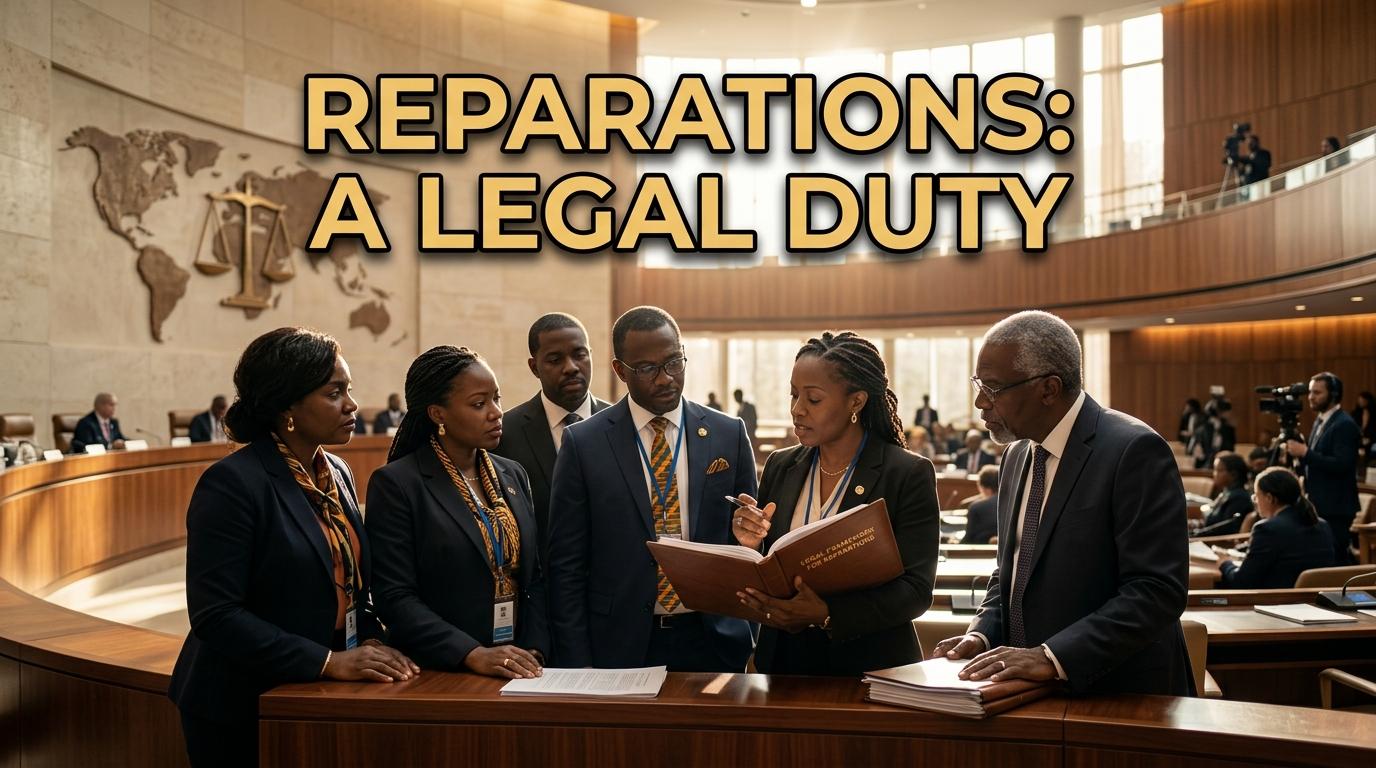
Why Slavery Reparations Are Now a Legal Duty
By Darius Spearman (africanelements)
Support African Elements at patreon.com/africanelements and hear recent news in a single playlist. Additionally, you can gain early access to ad-free video content.
A Historic Shift in International Human Rights Law
For centuries, the demand for slavery reparations was dismissed by Western powers as a political impossibility. Wealthy nations routinely claimed that historical atrocities could not be judged by modern rules. However, a major decision by international legal authorities has fundamentally altered the global debate (theguardian.com, ohchr.org).
The United Nations Committee on the Elimination of Racial Discrimination issued General Recommendation No. 40 to redefine how the world approaches historical crimes (ohchr.org). The panel of independent experts affirmed that member states carry an enforceable legal obligation to repair the lasting damage of chattel slavery and colonialism (ishr.ch, ohchr.org). The committee bypassed the traditional defense of historical legality. Instead, it determined that ongoing racial disparities represent continuous violations of the 1965 anti-racism convention (asil.org, ohchr.org).
Dismantling the Legal Armor of Former Empires
For generations, former colonizing governments avoided liability by using a legal concept known as intertemporal law. Under this doctrine, an action can only be judged by the laws that existed when the event occurred (asil.org, asil.org). European and American officials long maintained that because human bondage was lawful under their domestic statutes centuries ago, modern courts could not order financial or institutional remedies (asil.org, journaldudroittransnational.it).
The UN committee dismantled that longstanding legal shield. The experts clarified that governments remain responsible for eliminating modern structural harms created by ancestral enslavement (ohchr.org). Persistent wealth gaps, systemic discrimination, and institutional inequities are not merely historical memories. They are direct, contemporary violations of international human rights agreements (ohchr.org, hrw.org).
The Cruel Injustice of Reverse Reparations
When chattel slavery finally ended in the nineteenth century, governments established compensation programs. Yet, these funds were not delivered to formerly enslaved people. Instead, European and American governments paid massive sums to enslavers for the loss of their human property (theguardian.com, brattle.com).
Under the British Emancipation Act of 1833, the British government paid £20 million to compensate roughly 46,000 enslavers (theguardian.com, brattle.com). This sum represented roughly 40 percent of the annual national budget of the United Kingdom (brattle.com). British taxpayers continued to pay the interest on that loan until 2015, while the liberated people received nothing (theguardian.com). In France, an armada was dispatched to Haiti in 1825 to force the new republic to pay an indemnity of 150 million gold francs to compensate former French masters (theguardian.com, developmenteducationreview.com). Haiti spent 122 years paying off this financial extortion, bankrupting its public services (theguardian.com). In the United States, newly freed people suffered under state systems of forced labor and involuntary servitude after the Civil War without receiving a single dollar of federal restitution (supremecourt.gov, hrw.org).
The Long Tradition of Grassroots Demands
African descendant communities never accepted this economic injustice. Freedom fighters and everyday citizens organized resistance movements, legal petitions, and slave revolts across the diaspora to demand full repair (hrw.org). In the 1890s, Callie House organized hundreds of thousands of formerly enslaved people through the National Ex-Slave Mutual Relief, Bounty and Pension Association to demand federal pensions for uncompensated labor (hrw.org).
Decades later, Queen Mother Audley Moore carried the struggle to the global stage. In 1957, Moore delivered a formal petition to the United Nations demanding land and economic restitution for African Americans (hrw.org). In 1989, Congressman John Conyers Jr. introduced the H.R. 40 legislation into the United States Congress (govinfo.gov, hrw.org). The bill was named after the unfulfilled promise of forty acres and a mule, creating a legislative standard that activists championed for decades (aclu.org, hrw.org).
The Diplomatic Turning Point From Abuja to Geneva
The campaign for reparatory justice expanded from localized activism into an international diplomatic alliance. In 1993, the Organization of African Unity hosted the First Pan-African Conference on Reparations in Abuja, Nigeria (allafrica.com, thisisafrica.me). The gathering proclaimed that the debt owed to Africa and the diaspora for centuries of human exploitation was legally valid and morally urgent (allafrica.com, thisisafrica.me).
Eight years later, the 2001 World Conference Against Racism in Durban, South Africa marked a critical milestone (thisisafrica.me, developmenteducationreview.com). The Durban Declaration officially recognized slavery and the slave trade as crimes against humanity (thisisafrica.me, developmenteducationreview.com). While Western nations resisted binding legal liability during those negotiations, the Durban conference created the diplomatic foundation that led to the recent United Nations declarations (theguardian.com, ohchr.org).
Quantifying the Unpaid Global Debt
Opponents of reparations often claim that calculating financial damages is impossible. However, modern economic analysts have proven that historical plunder can be measured accurately through rigorous financial modeling (theguardian.com, brattle.com).
A landmark valuation conducted by The Brattle Group calculated that reparations owed for transatlantic chattel slavery range between $100 trillion and $131 trillion (theguardian.com, brattle.com). Led by prominent international jurist Patrick Robinson, the team analyzed stolen wages, deprivation of liberty, loss of life, and ongoing economic harm across 19 million enslaved Africans (theguardian.com, brattle.com). The assessment determined that post-emancipation harms account for over $23 trillion in accumulated wealth suppression (brattle.com). This calculation provides a factual baseline for future litigation and diplomatic negotiations (theguardian.com, asil.org).
Five Comprehensive Pillars for True Repair
The United Nations framework emphasizes that reparatory justice requires more than direct financial compensation. Complete redress must address every dimension of societal harm caused by centuries of oppression (ohchr.org, reparationscomm.org).
The UN committee outlined five distinct requirements for state compliance (ohchr.org). First, restitution requires the return of stolen ancestral lands and looted cultural artifacts (ohchr.org). Second, compensation demands capital investments into community health, housing, and schools (ohchr.org). Third, rehabilitation provides psychological and social care for intergenerational trauma (ohchr.org, reparationscomm.org). Fourth, satisfaction obligates states to deliver formal apologies, open secret colonial archives, and build public memorials (ohchr.org). Finally, guarantees of non-repetition require systemic overhauls of legal and technological institutions to prevent future discrimination (ohchr.org).
Guarantees of Non-Repetition and Algorithmic Bias
Modern human rights law recognizes that racial subjugation evolves into modern technology. In the digital age, automated decision systems inherit historical biases generated by decades of redlining and discriminatory policing (ohchr.org).
When artificial intelligence tools evaluate loan applications or criminal risk assessments, they use historical data reflecting deep systemic discrimination (ohchr.org). The UN committee stated that guarantees of non-repetition require governments to audit and regulate these automated tools (ohchr.org). Eliminating algorithmic bias is an essential step to prevent automated systems from reinforcing ancient racial hierarchies (ohchr.org).
Local Experiments and Federal Gridlock in the United States
While the federal government in Washington remains divided, several American states and municipalities have advanced their own reparatory policies (calmatters.org, hrw.org). In 2021, Evanston, Illinois became the first municipality to fund reparations by using local tax revenues for housing grants (hrw.org).
State governments have also taken exploratory steps. The historic California task force conducted extensive research into state-sanctioned racial harms, producing an exhaustive blueprint for restorative remedies (calmatters.org). Similarly, the New York commission was established to examine the enduring legacy of slavery within its financial systems (modernghana.com). UN experts noted that while local programs provide valuable testing models, municipal actions cannot substitute for federal responsibility (ohchr.org, hrw.org).
The Road Ahead for Sovereign Accountability
The path to global reparatory justice continues to face legal and political obstacles. Former colonial powers frequently use sovereign immunity laws to block lawsuits in foreign courts (asil.org, journaldudroittransnational.it). However, growing diplomatic coalitions across the African Union and CARICOM are taking their claims to international tribunals (allafrica.com, theguardian.com, reparationscomm.org).
The recent UN declarations confirm that reparatory justice is no longer a fringe discussion. It is now recognized as a binding obligation under international human rights law (ishr.ch, ohchr.org). By establishing that historical exploitation produces active legal liabilities, international jurists have made reparatory justice a fundamental requirement for global equality (ohchr.org).
About the Author
Darius Spearman is a professor of Black Studies at San Diego City College, where he has been teaching for over 20 years. He is the founder of African Elements, a media platform dedicated to providing educational resources on the history and culture of the African diaspora. Through his work, Spearman aims to empower and educate by bringing historical context to contemporary issues affecting the Black community.
