



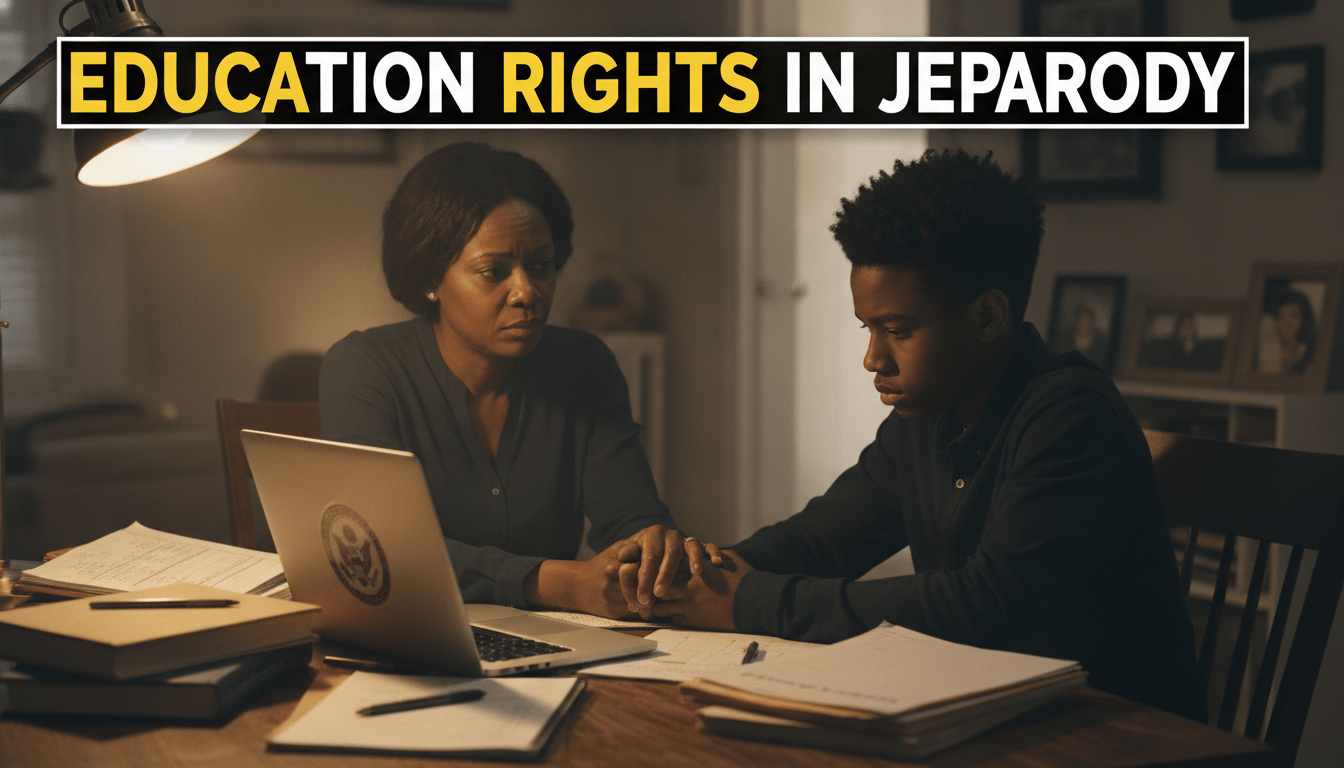
How a New Federal Deal Ends Education Civil Rights Protections
By Darius Spearman (africanelements)
Support African Elements at patreon.com/africanelements and hear recent news in a single playlist. Additionally, you can gain early access to ad-free video content.
The Administrative Shift of 2026
On June 16, 2026, the Department of Education and the Department of Justice activated a new interagency agreement (ed.gov). This historic deal completely alters how the federal government handles civil rights complaints in schools (ed.gov). Under this partnership, the Department of Education is offloading the evaluation of core civil rights complaints (ed.gov). These duties are moving from its own Office for Civil Rights to the Department of Justice (ed.gov).
This bureaucratic realignment represents a major shift in public policy (k12dive.com). It effectively strips the Department of Education of its primary enforcement powers (k12dive.com). Many legal scholars view this move as an unprecedented attempt to bypass Congress (k12dive.com). By utilizing administrative agreements, the executive branch is reorganizing federal power (k12dive.com). Consequently, the primary federal watchdog for equal educational opportunity has been sidelined (k12dive.com).
The Historical Burden of Jim Crow Education
Before the landmark 1954 Supreme Court decision, southern states legally mandated segregated public schools. This state-sanctioned segregation systematically disenfranchised African American students. The system established a deeply unequal, dual-school framework. It directed the vast majority of public funding, high-quality materials, and resources toward white institutions. Black schools were chronically underfunded. They suffered from severely substandard facilities. These schools operated with a fraction of the budget of white schools.
This systemic racism manifested in shorter school terms and fewer instructional days. On average, annual school terms were fifty to one hundred percent shorter for Black students. This caused Black students to receive significantly less education over their lifetimes. Black teachers were routinely underpaid and worked under severe resource constraints. Ultimately, this unequal distribution of resources reinforced the subjugation of Black Americans. This framework limited economic mobility and entrenched class divisions. This long history of failure created a desperate need for federal intervention. To learn more about this context, one can study how Reconstruction failed African Americans.
The Creation of a Centralized Federal Shield
Following the landmark Supreme Court decision in 1954, the federal government dismantled Jim Crow education (supremecourthistory.org). The Department of Health, Education, and Welfare utilized the Elementary and Secondary Education Act of 1965 (edweek.org). Through this law, the federal government gained powerful financial leverage (edweek.org). School districts that refused to desegregate risked losing critical federal funding (edweek.org). Between 1967 and the early 1970s, more than six hundred administrative proceedings were launched (usccr.gov). These actions targeted segregated school districts to enforce constitutional rights (usccr.gov).
On October 17, 1979, President Jimmy Carter signed the Department of Education Organization Act (mysticstamp.com). Carter envisioned a cabinet-level department to ensure equal educational opportunities (harvard.edu). This act transferred all civil rights functions to the new Office for Civil Rights (hawaii.edu). This office enforced Title VI, Title IX, and Section 504 (nysba.org, harvard.edu). This transition represented a major moment in the political shift from civil rights to institutional oversight.
The 2025 Executive Mandate to Hollow Out
The overhaul of 2026 did not happen in a vacuum. On March 20, 2025, President Trump signed Executive Order 14242 (whitehouse.gov). This order directed the Secretary of Education to take all necessary steps to facilitate the closure of the Department of Education (whitehouse.gov). Because dismantling a cabinet-level department requires an act of Congress, the administration utilized administrative tactics (k12dive.com). They used Interagency Agreements to offload core duties to other federal agencies (k12dive.com).
This strategy triggered a rapid, internal hollowing out of the agency (k12dive.com). Between January 20 and March 31, 2025, the Department of Education lost approximately forty percent of its entire staff (k12dive.com). To curb operations, the administration shuttered seven of the twelve regional offices of the Office for Civil Rights across the country (k12dive.com). They placed 299 out of 575 active personnel on administrative leave (k12dive.com). This administrative assault left the federal shield fractured and unprepared for the historic volume of student complaints.
The 2025 OCR Hollowing Out Metrics
The Mass Dismissal of Student Grievances
This rapid decline in staff had immediate, devastating consequences for vulnerable students. Prior to the overhaul, the demand for federal protection had reached historic heights (k12dive.com). In fiscal year 2022, the Office for Civil Rights received a record-high 18,804 complaints (k12dive.com). The following year, caseloads reached 19,201 complaints (k12dive.com). Investigators were forced to handle up to forty-eight active cases per person (k12dive.com). This workload was described by administrators as completely untenable (k12dive.com).
When the cuts occurred in 2025, the agency simply stopped investigating. According to a Government Accountability Office report, the agency received 9,269 complaints between March and September 2025 (k12dive.com). The gutted office dismissed roughly ninety percent of the complaints it resolved (k12dive.com). Out of 7,072 resolved cases, 6,353 were closed through outright dismissal (k12dive.com). Only 112 resolution agreements were reached nationwide, with zero agreements resolving cases of racial harassment, discriminatory discipline, or sexual harassment (k12dive.com). These complaints were effectively shelved, leaving thousands of students to live with the ongoing consequences of discrimination.
Resolved Case Outcomes (Late 2025)
Understanding the Loss of Resolution Agreements
To understand the damage of these dismissals, one must examine the resolution-focused model formerly used by the Office for Civil Rights. A Resolution Agreement is a formal, voluntary contract entered into by a school district or university and the federal government to resolve civil rights violations. Instead of pursuing adversarial litigation or immediately stripping a school of its federal funding, the government used this cooperative mechanism to secure specific remedial actions.
For example, when racial discrimination is found, such as Black students being suspended more frequently or harshly than white students, the government negotiates a voluntary agreement. In the Victor Valley Union High School District agreement, the district agreed to examine the root causes of racial disparities, revise its discipline policies, and employ a Director of Positive School Climate (elc-pa.org). Similarly, the Durham Public Schools agreement required appointing a discipline supervisor and developing an equitable Discipline Action Plan (legalaidnc.org). These agreements require schools to track and report detailed disciplinary data to monitor progress. This cooperative, student-centric mechanism has now been completely dismantled.
Why the Justice Department Cannot Replicate the Model
The Department of Justice is structurally and legally unable to replicate this cooperative, resolution-focused framework. The Department of Education operates under a statutory mandate to enforce compliance among recipients of federal education funds. Its internal regulations and Case Processing Manual legally oblige it to systematically evaluate and address every single complaint it receives (k12dive.com).
In contrast, the Department of Justice is a law enforcement agency that operates on a prosecutorial and litigation model (ed.gov). Legally, the Department of Justice possesses prosecutorial discretion (k12dive.com). This allows it to choose which cases to pursue based on systemic impact and resource availability (k12dive.com). It is not structured, nor is it legally mandated, to intake, evaluate, and resolve individual, school-level complaints through cooperative, non-litigious mediation (k12dive.com). Moving civil rights enforcement to this agency moves the federal apparatus from a remediative posture to a punitive, litigation-focused posture (k12dive.com).
Barriers to Justice for Families of Color
This transition places immense practical and financial barriers on low-income families of color. Historically, the administrative complaint process at the Office for Civil Rights acted as a free federal civil rights remedy. Any parent could mail in a handwritten, cost-free complaint detailing racial discrimination or harassment. The federal government was obligated to investigate and secure a remedy on their behalf.
Under a litigation-centric model, families are often left with no recourse but to sue school districts in court at their own expense. This process is incredibly costly and structurally bars low-income families from seeking justice. Moving civil rights enforcement to the prosecutorial agency forces families to chase answers across fractured federal departments. No single agency is held accountable for the holistic well-being of the student (k12dive.com). This shift creates a massive gulf for vulnerable students who cannot afford private legal counsel. To understand these power dynamics, one can explore federalism and Black politics.
The Fate of Title VI Racial Complaints
Shifting the enforcement of Title VI creates serious concerns that racial discrimination complaints will be deprioritized. Title VI prohibits discrimination based on race, color, or national origin in federally funded programs (harvard.edu). Former officials emphasize that the Office for Civil Rights evaluated every allegation, whereas the new agency can decline individual cases (k12dive.com).
The prosecutorial agency lacks the regional infrastructure and specialized education expertise to handle individual, school-level complaints (k12dive.com). Instead, it focuses primarily on broad, systemic cases and “pattern-or-practice” litigation (k12dive.com). This means individual racial harassment or discriminatory discipline claims may face significant delays or simply be ignored as they are routed through centralized headquarters. This shift complicates the fight against racial inequality in education.
Furthermore, the NAACP Legal Defense and Educational Fund (LDF) has expressed deep concern over this transition. Founded in 1940 by Thurgood Marshall, the LDF is the nation’s premier legal organization fighting for racial justice and civil rights. The LDF pioneered the legal strategy to dismantle state-sanctioned Jim Crow segregation, famously arguing and winning Brown v. Board of Education in 1954. Their deep history in fighting educational segregation gives immense weight to their modern critique. They warn that stripping the Department of Education of its civil rights authority weakens protections for the most vulnerable students.
Enforcement Pipeline Comparison
Traditional OCR Process
Cost: Free to families
Duty: Must evaluate all complaints
Model: Cooperative resolution
New DOJ Litigation Model
Cost: Expensive private counsel required
Duty: Discretionary filter
Model: Adversarial litigation
The De Facto Dissolution of Educational Equity
While the physical building of the Department of Education still stands, the offloading of its core functions represents a de facto dissolution of the agency (k12dive.com). Moving civil rights, student privacy, and special education to other agencies dismantles forty years of centralized protection (k12dive.com). This serves as an unprecedented lesson in administrative law, proving that an agency can be largely dismantled through executive reorganization (k12dive.com).
Ultimately, this structural realignment marks the end of the vision of a single, centralized federal watchdog dedicated solely to equal educational access. Marginalized students and families now face a highly decentralized, legally adversarial, and slower pipeline for resolving discrimination complaints (k12dive.com). The federal shield that once stood against systemic bias has been replaced by a prosecutorial system, leaving the most vulnerable to navigate the storm alone.
About the Author
Darius Spearman is a professor of Black Studies at San Diego City College, where he has been teaching for over 20 years. He is the founder of African Elements, a media platform dedicated to providing educational resources on the history and culture of the African diaspora. Through his work, Spearman aims to empower and educate by bringing historical context to contemporary issues affecting the Black community.
