

How Morocco Claimed the Top Industrialization Index Spot
By Darius Spearman (africanelements)
Support African Elements at patreon.com/africanelements and hear recent news in a single playlist. Additionally, you can gain early access to ad-free video content.
The African continent is witnessing a monumental reshuffle in its economic hierarchy. In May 2026, the African Development Bank released a historic finding in its latest index (hespress.com, afdb.org). For the first time, Morocco has bypassed South Africa to claim the top spot on the continent’s industrialization index (businessinsider.com, businessinsider.com). Morocco secured this lead with a score of 0.8415 points, while South Africa followed closely with 0.8396 points (hespress.com, businessinsider.com).
This development represents a major shift from the status quo of the last few decades. For generations, South Africa was the unchallenged titan of heavy manufacturing and engineering on the continent. To understand how Morocco achieved this victory, one must look deep into history. It is a story of long-term planning, heavy infrastructure investments, and complex geopolitical moves. It is also a reminder of how quickly historical fortunes can shift, especially when comparing to the economic struggles and debt crises that continue to impact various African communities.
The Royal Vision of King Mohammed VI
Morocco’s rise as a manufacturing power did not occur by accident. In the late 1990s, the nation depended heavily on agriculture, which left the economy vulnerable to volatile weather patterns (lse.ac.uk). When King Mohammed VI took the throne in 1999, his administration recognized the need for a major structural transformation (lse.ac.uk). The state needed to pivot toward high-value global manufacturing to create sustainable jobs.
To achieve this goal, the government launched several strategic industrial roadmaps (oup.com, lse.ac.uk). The 2005 Plan Emergence served as the initial roadmap, followed by the National Pact for Industrial Emergence in 2009 (lse.ac.uk). Finally, the Industrial Acceleration Plan from 2014 to 2020 introduced a highly successful ecosystem approach (oup.com, lse.ac.uk). Rather than building isolated factories, the state created specialized industrial clusters. These integrated local parts suppliers directly with major global manufacturers, leading to massive growth. This strategic planning reflects the ongoing efforts across the continent to move beyond historical colonial economic patterns and build self-reliant systems.
Logistics as the Engine of Industrial Success
A vision is only as good as the physical infrastructure that supports it. Since 2007, Morocco has spent an average of forty-two billion dirhams, or about four point two billion dollars, on infrastructure developments every year (lse.ac.uk). The crown jewel of this investment is the Tanger Med Port (lse.ac.uk). Situated directly on the strategic Strait of Gibraltar, Tanger Med has grown to become the largest port in Africa and the Mediterranean region (industries.ma, lse.ac.uk).
This world-class maritime hub connects Moroccan factories directly to European markets in under three days. Additionally, the state built Al Boraq, Africa’s first high-speed rail line, connecting the industrial hub of Tangier to the commercial center of Casablanca (moroccoworldnews.com). This network allowed companies to transport goods and personnel rapidly between key industrial zones. By solving the logistical bottleneck, Morocco made itself an irresistible option for foreign companies looking to shorten their supply chains (lse.ac.uk).
How Morocco Became a Car Manufacturing Giant
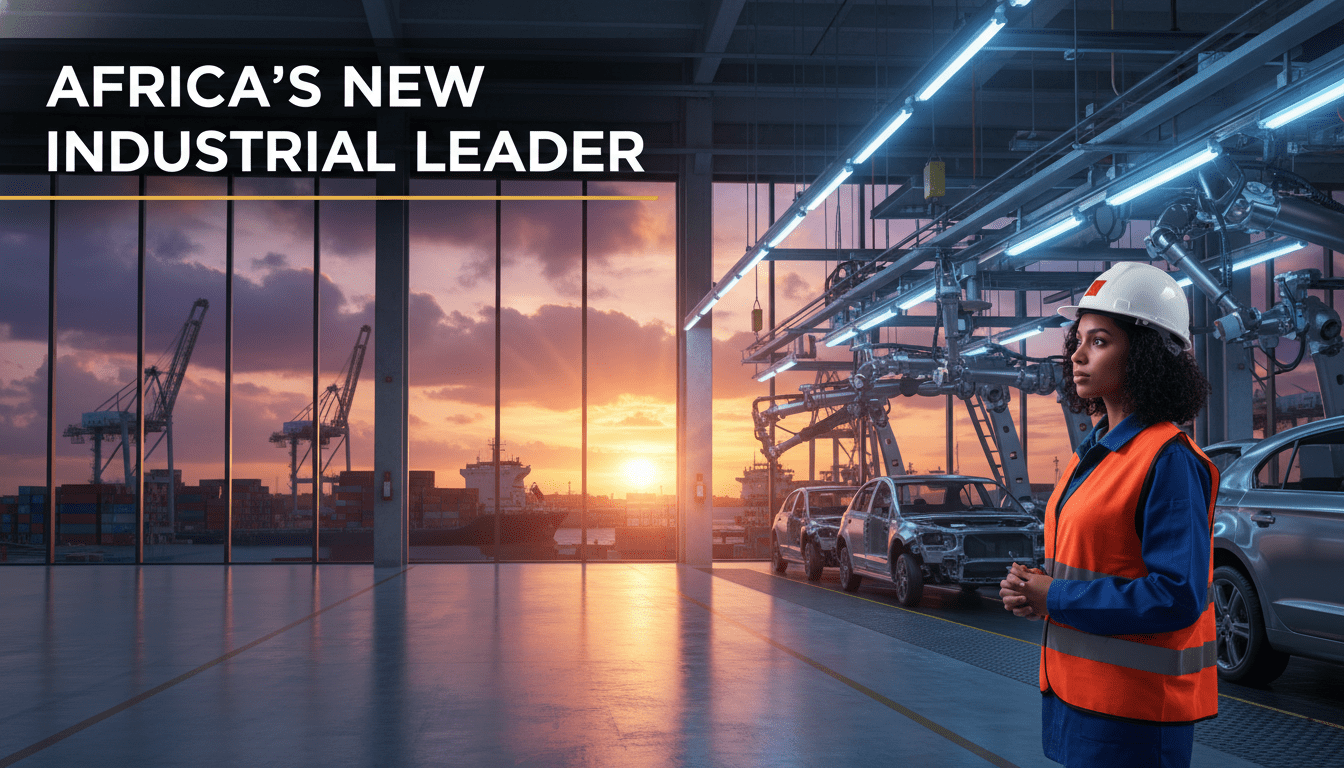
Morocco has now established itself as a top-twenty global automotive producer (businessinsider.com). It is the leading exporter of passenger cars to the European Union, outperforming traditional manufacturing giants like India, Japan, and China (businessinsider.com). The roots of this success go back to 1959, when the state-owned SOMACA began assembling Fiat vehicles in Casablanca (wikipedia.org).
A major turning point occurred in 2003 when the government privatized SOMACA, allowing French automaker Renault to acquire a majority stake (wikipedia.org). In 2012, Renault opened a massive, state-of-the-art factory in Tangier (hbs.edu). Seven years later, Stellantis opened a major plant in Kenitra (mcinet.gov.ma). Today, the local automotive sector generates fifteen billion euros in annual exports and provides over two hundred and twenty thousand direct jobs (businessinsider.com). The nation has even developed its own indigenous brand, Neo Motors, which manufactures cars designed entirely in Morocco (forbes.com).
Reaching for the Skies with Aerospace Manufacturing
The Moroccan aerospace sector has experienced a similar high-tech transformation. In the 1950s, the aviation industry in Morocco consisted mainly of basic maintenance for military and civilian aircraft (harvard.edu). However, the founding of the Moroccan Aerospace Industries Association in 2001 marked a shift toward high-tech component manufacturing (harvard.edu).
The state created Midparc, a specialized aerospace free zone near Casablanca’s airport (medz.ma). By offering aggressive incentives, such as zero percent corporate taxes for five years, Morocco attracted global aerospace giants (scribd.com). Airbus, Boeing, Bombardier, and Safran now operate major facilities in the country (atalayar.com). Today, industry experts point out that every single commercial aircraft flying contains at least one component made in Morocco (businessinsider.com). The country now aims to assemble its first fully domestic aircraft engine by 2028 (businessinsider.com).
Phosphate Dominance and Fertilizer Diplomacy
Morocco possesses a powerful geopolitical advantage: it holds more than seventy percent of the world’s known phosphate rock reserves (gisreportsonline.com). Phosphate is an indispensable ingredient in agricultural fertilizers (gisreportsonline.com). For decades, the state-owned OCP Group simply mined and exported raw phosphate rock (lse.ac.uk).
Under new leadership starting in 2006, OCP Group underwent a twenty-billion-dollar industrial overhaul (lse.ac.uk). The company shifted its focus from exporting raw rock to manufacturing high-value finished fertilizers (lse.ac.uk). This shift allowed Morocco to practice “fertilizer diplomacy” across Sub-Saharan Africa (ocpafrica.com). By providing customized formulas to thirty-five African nations, Morocco has positioned itself as the guarantor of continental food security (ocpafrica.com). However, critics argue this system also creates a long-term dependency on Moroccan imports.
The Contested Legacies of Western Sahara
The extraction of these valuable resources cannot be decoupled from international legal disputes. A significant portion of Morocco’s phosphate reserves is located in Western Sahara, a territory under de facto Moroccan control (gisreportsonline.com, wsrw.org). The United Nations, however, classifies Western Sahara as a non-self-governing territory (wsrw.org).
The International Court of Justice has rejected Moroccan claims of sovereignty over the region, affirming the right of the Sahrawi people to self-determination (tandfonline.com). Despite this, the OCP Group continues to extract phosphate from the Bou Craa mine in Western Sahara (wsrw.org). International buyers and shipping lines have faced intense legal pressure, leading to a halt in exports to North America (wsrw.org, wsrw.org). To bypass these disputes, Morocco is actively constructing new processing infrastructure and ports within the contested territory (wsrw.org).
The Structural Decline of South Africa
While Morocco was rising, South Africa was experiencing a prolonged industrial decline. In 2010, South Africa dominated the continent with an industrialization score of 0.8819 (hespress.com, businessinsider.com). By 2025, that score dropped to 0.8396 (hespress.com, businessinsider.com). This decline is the result of deep internal structural crises.
The state-owned power utility, Eskom, has suffered from decades of mismanagement and corruption (dailyinvestor.com). The resulting blackouts, known as load-shedding, have severely crippled factories and mining operations (dailyinvestor.com). Similarly, the state-run logistics company, Transnet, has struggled with failing rail infrastructure and port delays (businesstech.co.za). Rail freight volumes fell by twenty percent between 2020 and 2022, forcing companies to rely on expensive road transport (semafor.com). These failures have eroded business confidence and reduced essential investments (businesstech.co.za, semafor.com).
Apartheid Spatial Planning and Modern Crises
The logistical and economic crises in South Africa are deeply intertwined with the historical legacy of Apartheid (dpme.gov.za). Apartheid spatial planning systematically forced the Black majority to live in under-resourced, remote townships far away from commercial hubs (dpme.gov.za). This legacy continues to hamper the modern economy.
Today, workers must spend a large portion of their income on long, expensive daily commutes (dpme.gov.za). Post-apartheid housing and development policies have struggled to dismantle these physical divides (dpme.gov.za). Modern infrastructure spending has been insufficient to replace the poorly located systems designed under the old regime. This spatial segregation has limited the growth of new industries and restricted the economic transition of the country. Exploring these spatial and educational disparities is a major focus in efforts aimed at decolonizing African institutions and systems.
Labor Realities Inside the Free Zones
Morocco’s success on the industrial index does not mean that every worker is thriving. Special economic zones like Midparc and the Tangier Free Zone offer massive tax holidays to attract foreign investments (businessinsider.com). Many wonder if these zones allow corporations to bypass basic human rights and labor laws.
In Morocco, standard labor laws and statutory minimum wages still apply inside these free zones (hac.ma). Employers are legally prohibited from paying below the national minimum wage, which rose to approximately three thousand four hundred and twenty-two dirhams per month (hespress.com, hac.ma). However, actual enforcement is weak due to limited state inspection resources (hac.ma). Furthermore, while the constitution guarantees the right to unionize, combative workers frequently face sudden dismissals or blacklisting (hac.ma, equaltimes.org). Less than six percent of the total workforce belongs to an active union (arabtradeunion.org).
The Environmental and Social Costs of Progress
The rapid rise of heavy industry has also taken a heavy toll on the environment. In industrial hubs like Safi and Jorf Lasfar, local communities are paying a high price for progress (researchgate.net). OCP Group facilities discharge millions of tons of phosphogypsum waste into the Atlantic Ocean annually (wsrw.org).
This waste contains toxic heavy metals, which contaminate local marine life (researchgate.net, wsrw.org). Nearby farming communities suffer from severe air pollution, leading to chronic respiratory illnesses (researchgate.net). Children in these areas suffer from dental fluorosis, a condition where teeth rot from excessive fluoride exposure in the water (researchgate.net). The state has kept air and water quality reports confidential and uses heavy surveillance to restrict environmental reporting (hac.ma). This reminds us that macroeconomic triumphs often mask deep regional inequalities (hespress.com, afdb.org).
About the Author
Darius Spearman is a professor of Black Studies at San Diego City College, where he has been teaching for over 20 years. He is the founder of African Elements, a media platform dedicated to providing educational resources on the history and culture of the African diaspora. Through his work, Spearman aims to empower and educate by bringing historical context to contemporary issues affecting the Black community.
