

How the Economic Impact of Maritime Conflicts Hits Africa
By Darius Spearman (africanelements)
Support African Elements at patreon.com/africanelements and hear recent news in a single playlist. Additionally, you can gain early access to ad-free video content.
How Middle East Maritime Tensions Shock African Nations
On March 2, 2026, the Islamic Revolutionary Guard Corps of Iran declared the Strait of Hormuz closed to commercial shipping (gcaptain.com, centerformaritimestrategy.org, youtube.com). This sudden action sent immediate shockwaves through the global logistical network. According to data from the United Nations Conference on Trade and Development, maritime traffic through this narrow passage plummeted by ninety-seven percent (centerformaritimestrategy.org). Daily vessel transits that once averaged one hundred and twenty-nine ships fell to single digits within weeks (centerformaritimestrategy.org). This disruption is severely damaging developing economies across the African continent.
The African Union Commission recently raised a major alarm regarding these events (au.int). Chairperson Mahmoud Ali Youssouf met with the Iranian Ambassador to Ethiopia, Ali Akbar Rezaei, to deliver a firm message (au.int). The message emphasized that international tensions are inflicting severe economic pain on vulnerable nations (au.int). Consequently, the African Union is calling for an immediate return to a rules-based diplomatic order to protect supply chains in the Global South (au.int).
In early 2026, tensions escalated rapidly between the United States, Israel, and Iran (gcaptain.com, centerformaritimestrategy.org). The subsequent blockades and military maneuvers transformed the waterway into a dangerous war zone (centerformaritimestrategy.org). For African leaders, this geographic distance offers no shield from the fallout (au.int). Global supply chains are deeply interconnected, meaning that a shock in the Persian Gulf acts as an economic earthquake in East and West Africa (au.int).
Three Devastating Channels of Maritime Economic Damage
First, the disruption triggers a severe energy shock across the continent. Although many African countries possess vast reserves of crude oil, they often lack the refining capacity to process it (au.int, energyforgrowth.org). Therefore, these nations must import finished petroleum products (au.int, energyforgrowth.org). The threat of a closed Strait of Hormuz drove Brent crude prices well over ninety dollars per barrel (au.int, centerformaritimestrategy.org). Rising oil prices widen trade deficits and force governments to spend scarce foreign reserves on basic fuel (au.int, energyforgrowth.org).
Second, a major agricultural crisis is unfolding due to a lack of fertilizer. The Strait of Hormuz serves as a transit corridor for approximately one-third of the global fertilizer trade, representing sixteen million tons annually (fao.org, foodsecurityportal.org). Following the blockade, industrial and fertilizer shipments to African nations dropped by up to ninety percent in certain regions (au.int, fao.org). This severe shortage threatens agricultural productivity. It directly compromises food security for millions of people (au.int, fao.org).
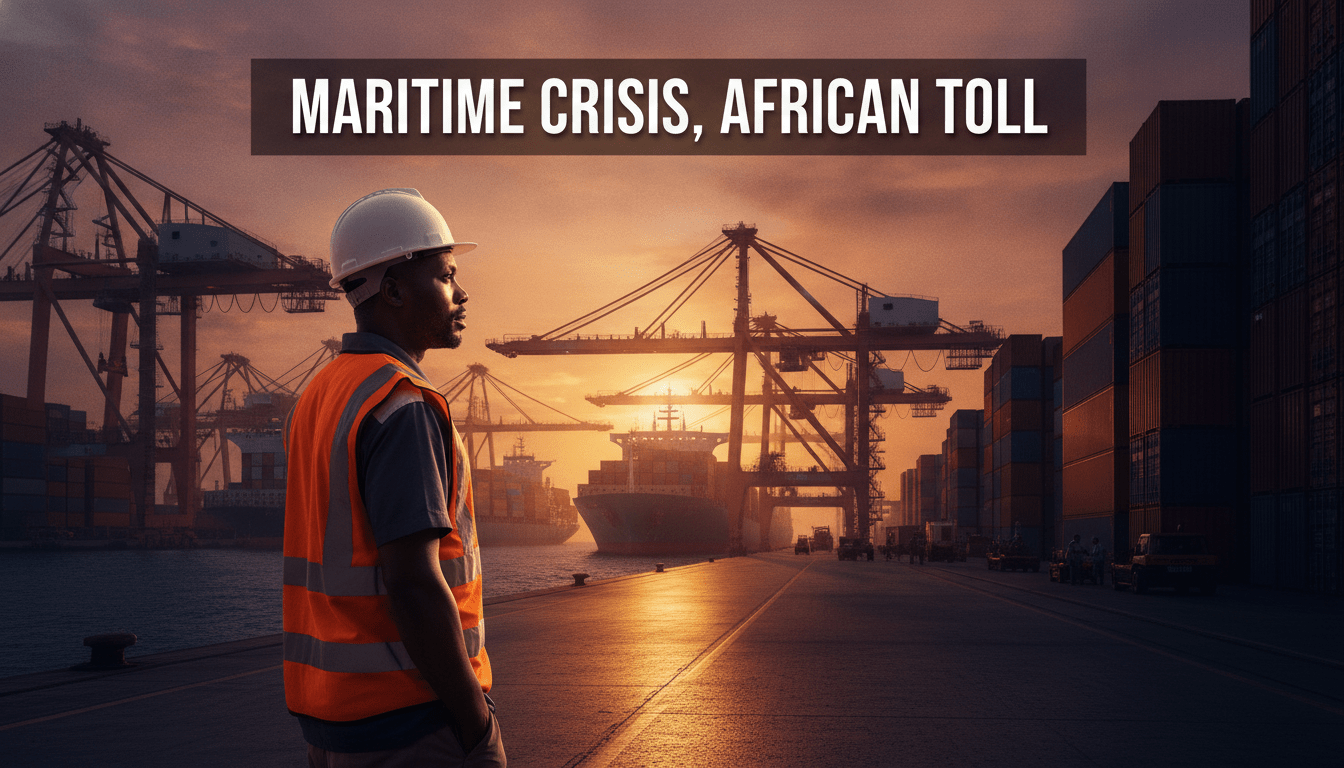
Third, the shipping crisis forces a massive diversion of maritime traffic. Commercial vessels are bypassing the dangerous Red Sea corridor and the Persian Gulf entirely (gcaptain.com, centerformaritimestrategy.org). Instead, they travel around the Cape of Good Hope at the southern tip of Africa (gcaptain.com, uneca.org). While this diversion brings a sudden surge of traffic to African ports, it comes with high costs. South Africa’s Port of Cape Town saw a one hundred and twelve percent increase in vessel traffic (gcaptain.com). Similarly, Kenya’s Lamu Port has serviced seventy-four major vessels since early 2026 (thereporterethiopia.com). However, this route adds up to fourteen days to transit times, sending war-risk insurance premiums skyrocketing (gcaptain.com, uneca.org).
Source: UNCTAD (2026)
Sovereignty and Solidarity in the Global South
To understand the concern of the African Union, one must examine the concepts of the Global South and the Blue Economy. The term Global South refers to nations in Latin America, Asia, Africa, and Oceania that share similar political, social, and economic histories (preprints.org, africandiasporanetwork.org). These shared histories are deeply rooted in the colonial or imperialist era (africandiasporanetwork.org, iu.edu). Rather than being a strictly geographical division, it represents an ideological and political expression of shared experiences of historic marginalization and mutual solidarity (preprints.org, africandiasporanetwork.org). Historically, South-South cooperation aims to liberate communities from global economic disadvantages.
Through this mutual solidarity, marginalized populations have historically strived to achieve economic justice against all odds in a global system. Meanwhile, the Blue Economy represents a vital framework for African development. The World Bank defines the Blue Economy as the sustainable use of ocean resources for economic growth, improved livelihoods, and jobs, while preserving the health of ocean ecosystems (unep.org, worldbank.org). This concept includes critical non-marketed ecological benefits like carbon storage and marine biodiversity conservation (unep.org). Managing oceanic sustainability through cross-border partnerships is a major challenge for Least Developed Countries (unep.org, worldbank.org). The current maritime conflicts disrupt these delicate plans, making sustainable coastal management nearly impossible (au.int, unep.org).
Historical Precedents: The Tanker War and Suez Closures
The blockading of the Strait of Hormuz in 2026 is not a new strategy. It is a direct continuation of tactics developed during the Iran-Iraq War in the 1980s (britannica.com, iwm.org.uk). This conflict, historically known as the Tanker War, saw both nations target commercial merchant vessels in the Persian Gulf (britannica.com, iwm.org.uk). Between 1981 and 1988, over four hundred civilian seamen were killed, and hundreds of merchant ships were severely damaged (iwm.org.uk). In 1987, the United States launched Operation Earnest Will to escort Kuwaiti tankers and maintain the flow of global oil (britannica.com).
Today, the strategy is similar, but asymmetric naval technologies make maritime interdiction cheaper and more widely distributed (centerformaritimestrategy.org). Non-state actors utilize drones and sea mines to disrupt trade corridors with ease (centerformaritimestrategy.org). This contemporary warfare echoes the historical closures of the Suez Canal. The canal was blocked during the Suez Crisis of 1956 and again during the Six-Day War in 1967 (wikipedia.org, suezcanal.gov.eg, wikipedia.org). The 1967 closure lasted for eight years, leaving fifteen merchant ships, known as the Yellow Fleet, trapped in the Great Bitter Lake (wikipedia.org, wikipedia.org).
During those historical disruptions, global shipping had to divert around Africa (wikipedia.org, historytoday.com). Consequently, African maritime lanes became the backup pathways of global trade (historytoday.com). This history demonstrates how conflict in West Asia repeatedly reshapes the economic geography of the African continent.
Source: South African National Ports Authority & Kenya Ports Authority (2026)
Exclusive Economic Zones and the African Maritime Awakening
A critical element of maritime sovereignty is the Exclusive Economic Zone. Prescribed by the 1982 United Nations Convention on the Law of the Sea, an Exclusive Economic Zone extends up to two hundred nautical miles offshore from a coastal nation baseline (un.org, wikipedia.org). Under Article 56 of the convention, the coastal nation holds sovereign rights to explore, exploit, conserve, and manage all natural resources within this zone (un.org). These resources include fish, oil, gas, and energy production from wind and water (un.org, wikipedia.org). Surface waters above the zone remain international waters, which preserves global freedom of navigation (un.org).
Historically, many African coastal states focused primarily on land-based security, leaving their vast offshore zones vulnerable to external exploitation (africansecurityanalysis.com, accord.org.za). Despite the fact that over ninety percent of Africa’s trade moves by sea, the continent suffered from a maritime blind spot (africansecurityanalysis.com, accord.org.za). This security vacuum led to rampant illegal fishing and maritime piracy, particularly off the coast of Somalia and in the Gulf of Guinea (africansecurityanalysis.com, accord.org.za). In response, the African Union developed the 2050 Africa’s Integrated Maritime Strategy (AIMS 2050) under the banner of Agenda 2063 (accord.org.za, au.int). In October 2016, the African Union adopted the Lomé Charter, which established a legally binding framework for maritime security (africansecurityanalysis.com, accord.org.za).
This shift in strategy shows that African workers are rising to protect their local natural resources and reclaim economic autonomy.
The Domestic Human Toll and Diaspora Connections
The economic shock of maritime conflicts is not merely a macroeconomic issue. It has immediate, devastating effects on ordinary citizens, smallholder farmers, and women. High fertilizer costs force smallholder farmers to cultivate crops without necessary nutrients (fao.org, foodsecurityportal.org). This practice leads to poor crop yields, soil exhaustion, and chronic family food insecurity (fao.org, foodsecurityportal.org). Furthermore, rising fuel costs double the expense of transporting produce to markets, forcing farmers to raise food prices (fao.org, foodsecurityportal.org). Women disproportionately absorb these economic shocks because of existing gender inequalities, such as restricted land rights and lack of agricultural credit (fao.org, foodsecurityportal.org). In fact, female farmers receive less than ten percent of agricultural loans (fao.org).
These continental economic crises also reverberate deeply within the global African Diaspora. The African Union formally recognizes the global diaspora as its sixth region, designed to participate in building a prosperous continent (african.business, panafricancouncil.org). Because diaspora remittances exceed one hundred billion dollars annually, economic instability in Africa increases the financial strain on diaspora families (african.business, africandiasporanetwork.org).
These families, known for the deep strength and resilience of their networks, act as critical lifelines by sending money back home to cover daily living expenses. When local economies destabilize, it disrupts ambitious plans to scale personal remittances into national assets, such as diaspora bond financing (african.business, africandiasporanetwork.org). Consequently, severe crises mobilize Western diaspora organizations to lobby for fairer trade policies and support African institutions (african.business, panafricancouncil.org).
Foreign Military Bases and the Challenge to Sovereignty
The presence of foreign military bases in strategic coastal regions poses a significant challenge to African maritime sovereignty. The nation of Djibouti hosts the densest concentration of foreign military bases in the world (africansecurityanalysis.com, unav.edu). These bases belong to the United States, China, France, Japan, and Italy, operating within miles of each other along the vital Bab-el-Mandeb Strait (africansecurityanalysis.com, unav.edu). While host governments utilize military leases to secure economic investments and forge alliances, this dynamic introduces severe complications (africansecurityanalysis.com, africansecurityanalysis.org). The African Union has formally warned that hosting foreign military facilities risks hollowing out continental sovereignty and security autonomy (africansecurityanalysis.com, africansecurityanalysis.org).
Relying on foreign navies to police local waters reinforces a dangerous security vacuum (africansecurityanalysis.com, africansecurityanalysis.org). This reliance hinders the African Union from establishing its own self-determined maritime security architecture (africansecurityanalysis.com, accord.org.za). To break this cycle of dependence, African security experts are actively debating the creation of a unified African Union Navy (africansecurityanalysis.com, africansecurityanalysis.org, accord.org.za). A permanent naval wing under the African Standby Force could protect continental trade lanes and enforce maritime law (africansecurityanalysis.com, accord.org.za).
To achieve this vision, there is a strong movement towards a road to transformation and intellectual sovereignty across continental institutions, which will foster local solutions to maritime security problems. Until the continent can patrol its own waters, developing African economies will remain highly vulnerable to foreign geopolitical clashes (au.int, africansecurityanalysis.com). Securing these waterways is not merely about protecting trade; it is about guaranteeing the economic survival of millions of people (au.int, unep.org).
Source: African Union Commission (Agenda 2063)
About the Author
Darius Spearman is a professor of Black Studies at San Diego City College, where he has been teaching for over 20 years. He is the founder of African Elements, a media platform dedicated to providing educational resources on the history and culture of the African diaspora. Through his work, Spearman aims to empower and educate by bringing historical context to contemporary issues affecting the Black community.
