

Inside the UN Racial Justice Mission in Colombia
By Darius Spearman (africanelements)
Support African Elements at patreon.com/africanelements and hear recent news in a single playlist. Additionally, you can gain early access to ad-free video content.
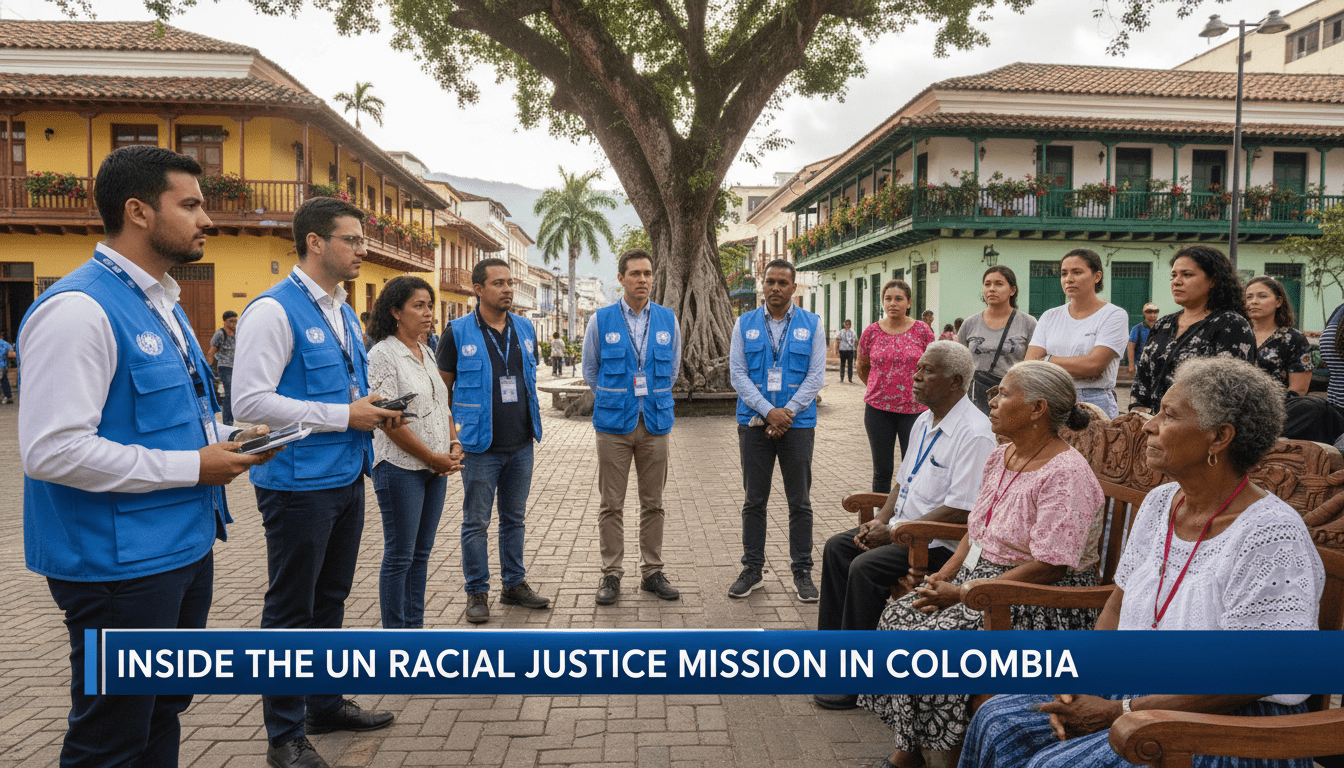
The United Nations officially arrived in Colombia today. A special task force began its mission. This group is the International Independent Expert Mechanism. They advance racial justice and equality in law enforcement. People often call this group EMLER. The mechanism examines systemic racism globally. Their visit marks a historic moment. Afro-Colombian communities have suffered for generations. They face systemic exclusion and severe police violence. This mission seeks answers and accountability.
The Global Echo of Racial Injustice
This special UN mechanism was born from tragedy. The United Nations Human Rights Council created it in 2021. The global protests following the murder of George Floyd sparked this action. The world demanded accountability for police violence against Black people. This call resonated deeply across the African diaspora. Colombia quickly became a focal point. Afro-Colombians share similar struggles with Black Americans. State-sanctioned violence impacts these communities heavily. The United Nations is now paying close attention. EMLER evaluates the legacies of colonialism. They also study the ongoing effects of the transatlantic slave trade. This deep dive aims to uncover modern disparities in policing.
The UN experts plan to visit major cities. These include Bogota, Cali, Cartagena, and Quibdo. The city of Quibdo is incredibly important. The city has a population that is mostly Afro-descendant. It is the capital of Choco. This department is the poorest in the nation. The city of Cali also holds great significance. The city became an epicenter of violence during recent protests. EMLER will document instances of racial profiling. They will also investigate the excessive use of force. This review will shed light on long-standing abuses (ohchr.org).
Breaking the Chains of the Old Constitution
Colombia has a complex legal history. The Constitution of 1886 governed the country for 105 years. It established a highly centralized and exclusionary nation. Catholicism was the only official religion. Spanish was the only recognized language. This old framework made Afro-Colombians practically invisible. Indigenous populations also suffered under these strict rules. The government ignored their unique cultures and needs. This exclusion created deep socio-economic divides.
Everything eventually changed in the year 1991. The country officially adopted a new constitution. This document is often called the Constitution of Rights. It recognized Colombia as a multi-ethnic and multicultural nation. This change represented a monumental victory. Black communities fought hard for this recognition. Transitional Article 55 eventually paved the way for more rights. However, recognizing people on paper did not solve every problem. Activists still had to demand real change. They pushed the government to protect their lands and lives. This struggle reflects similar fights for addressing historical racial injustices globally (wikipedia.org, justsecurity.org).
The Battle for Collective Land Rights
Law 70 of 1993 became a crucial pillar. It is known as the Law of Black Communities. This law granted collective land rights. Afro-Colombian communities received ownership of ancestral lands. These territories are mostly located in the Pacific Basin. The law states these lands cannot be sold. They also cannot be taken for debt. This legal protection sounds incredibly strong in theory.
However, the daily reality remains quite harsh. The government frequently abandons these regions. Illegal mining operations invade these protected lands. Armed groups also threaten the people living there. Afro-Colombians represent a large portion of displaced persons. They make up roughly twenty-five percent of internally displaced individuals. This displacement echoes historical exploitation in Black communities worldwide. Corporations often seek to use the land for oil palm plantations. They violently push out the rightful owners. Community leaders face constant danger for defending their homes (wola.org, thetenurefacility.org).
The Impact of Exclusion
Afro-Colombians in Poverty (Coastal Regions)
80%
Internally Displaced Persons (Afro-Colombian)
25%
The Dangerous Enemy Within Doctrine
Understanding police violence requires looking at history. Colombian security forces received specialized training during the Cold War. The United States heavily influenced this training. The goal was to stop communist influence in Latin America. This training established the Enemy Within doctrine. State forces began viewing dissenters as internal enemies. They treated social protesters as dangerous subversives.
This mindset deeply harmed Afro-Colombian communities. The police often treat Black youth in urban communes as threats. A commune is an official administrative subdivision in urban areas. Socially, these areas are marginalized, lower-income neighborhoods. Authorities target these areas with punitive policing. They treat residents as enemies rather than citizens needing protection. This approach justifies brutal military tactics. The military and police aggressively suppress social movements. Courts have identified this doctrine as a core issue. It turned community leaders into military targets. Overcoming this legacy is incredibly difficult (jacobin.com, dcaf.ch).
A Spark Ignites the Social Explosion
Tensions reached a boiling point in recent years. The port city of Buenaventura is ninety percent Afro-Colombian. In May 2017, residents launched a massive Civic Strike. They demanded basic services like drinking water and healthcare. These communities lacked fundamental resources despite their economic contributions. The government responded with severe military force. The riot police, known as ESMAD, attacked protesters. They fired tear gas directly into residential homes. Hundreds of people suffered severe injuries during the clashes.
Tragedy struck again in May 2020. Anderson Arboleda was a nineteen-year-old Afro-Colombian. Police beat him to death in Puerto Tejada. They claimed he violated a pandemic curfew. His death happened days before George Floyd died in America. Arboleda became known as the George Floyd of Colombia. This brutal act became a rallying cry for activists. It exposed a dark pattern of violence in Black neighborhoods. Afro-Colombians recognized the shared struggle against state violence. They organized widespread protests demanding strict accountability.
In 2021, a nationwide strike exploded. A proposed tax reform triggered this massive unrest. The reform would have heavily burdened the lower classes. Protests expanded to include grievances about inequality and police brutality. Cities with large Afro-Colombian populations faced intense police repression. Cali became a major focal point for the conflict. The state deployed the military to urban centers. Over forty people died during these national protests. International observers documented horrific cases of arbitrary detention. They also recorded numerous instances of sexual violence (thebogotapost.com, theguardian.com).
The Fight for Accurate Representation
To understand the crisis, one must look at the numbers. The demographic scale of Afro-Colombians is highly debated. The government conducted a national census in 2018. They officially counted fewer than five million Afro-descendant people. This figure represented roughly nine percent of the total population. Afro-descendant organizations immediately challenged these official numbers. They boldly called the census a massive undercount.
Independent researchers provide very different demographic estimates. They believe the population is between fifteen and twenty-five percent. This means ten to twelve million Afro-Colombians live there. In 2022, the Constitutional Court issued a ruling. The court stated the census caused irreparable damage. Technical errors led to a drastic drop in counted numbers. Accurate data is crucial for policy and funding. Undercounting marginalized groups limits their political power. It also reduces their access to essential social services. Colombia has the second-largest Afro-descendant population in Latin America. Recognizing their true numbers is a vital step toward justice (berkeley.edu).
Defending the Land and the Environment
For Afro-Colombians, police violence connects directly to the land. Communities constantly resist the theft of their territories. They fiercely fight against illegal mining operations. They also oppose the expansion of massive palm oil plantations. These corporate and criminal interests want the valuable land. The government often fails to protect the rightful owners.
Paramilitary groups frequently threaten local community leaders. State forces sometimes assist in forced evictions. This creates a terrifying environment for environmental defenders. The state treats these defenders as obstacles to development. In 2024 alone, the United Nations documented thirty-three severe allegations. Security forces arbitrarily deprived people of their lives. A disproportionate number of these victims lived in ethnic minority territories. Protecting the environment becomes a matter of life and death. The people fighting for the earth face constant danger. Their struggle requires urgent international protection and solidarity (reliefweb.int, ohchr.org).
Conflict Impact (2025)
Percentage of those affected by armed conflict identifying as Afro-Colombian.
Source: IOM / OCHA Statistics
The Shield of the Military Justice System
Holding police officers accountable is extremely difficult. The Colombian National Police operates under the Ministry of Defense. They do not report to a civilian ministry. This structure allows officers to claim a special privilege. They use the military justice system for service-related offenses. This legal system is known as the Fuero Militar.
Human rights groups heavily criticize this specific practice. Military judges frequently dismiss cases of police abuse. They also issue very lenient sentences when they do convict. This creates a structural engine of severe impunity. Between 2021 and 2024, jurisdictional conflicts surged. The Constitutional Court reviewed nearly four hundred cases. The military and civilian systems both fought to prosecute police misconduct. International standards prohibit military courts from trying human rights violations. Yet, the system protects officers who harm civilians. Less than three percent of police killings lead to charges. This lack of justice devastates families seeking answers. The United Nations considers this a major focus area (justsecurity.org, ohchr.org).
Crisis of Accountability
Percentage of police killings resulting in charges
Source: UN / Police Violence Report
The Push for Meaningful Reform
Afro-Colombians continuously fight for their fundamental rights. Activists organize powerful movements to demand change. Francia Marquez is a prominent figure in this struggle. She began her journey as a grassroots environmental activist. In 2014, she led the historic March of the Turbans. Eighty women walked 350 miles from Cauca to Bogota. They marched to protest illegal mining on ancestral lands.
This march brought national attention to their plight. It highlighted the displacement of Afro-Colombian communities. Marquez elevated the voices of heavily marginalized people. Her activism eventually led to a massive political victory. She became the Vice President of Colombia in 2022. This historic election brought hope to many Afro-descendants. It signified a major shift in the political landscape. The new administration promised significant social reforms. They aimed to dismantle deeply rooted systemic inequalities. This victory inspires those engaged in reclaiming postcolonial identity across the diaspora (theworld.org, wikipedia.org).
Rebranding the Riot Police
The government also attempted to reform the police. The infamous ESMAD unit underwent a controversial change. It is now called the National Unit for Dialogue and Maintenance of Order. People commonly refer to it as UNDMO. The unit officially split into two distinct groups. One group focuses on dialogue and wears blue vests. The other group maintains traditional black armored gear for intervention.
Authorities introduced new mandatory training programs. Officers must learn international human rights standards. They are taught to use force only as a last resort. President Gustavo Petro urged the abandonment of the Enemy Within doctrine. He advocates for a philosophy of human security. However, civil society groups remain highly skeptical. Organizations argue the underlying command structure remains unchanged. They demand deeper, structural changes to ensure real safety. Afro-Colombians still fear interactions with these specialized units. A simple name change cannot erase decades of trauma. True reform requires continuous oversight and genuine accountability (dcaf.ch, devdiscourse.com).
What the UN Hopes to Uncover
The EMLER mission arrives at a critical juncture. The delegation will investigate deep-rooted racial profiling. They will examine the excessive use of force closely. The team will look at routine policing practices. They will also analyze the state response to social protests. Their findings could pressure the government to act. This visit shines a bright global spotlight on Colombia.
Afro-Colombian leaders have high hopes for this mission. They want the world to see their daily reality. The UN mechanism focuses specifically on racial justice. They examine cases where state agents kill African-descendant individuals. The delegation will meet with victims of police violence. They will listen to stories of loss and survival. The mission aims to evaluate Colombia’s real progress. They want to see if recent police reforms are effective. EMLER will present preliminary findings very soon. A final report will go to the Human Rights Council. This report could trigger international pressure for real justice (ohchr.org).
Global Political Climate and Racial Justice
The United Nations mission operates in a complex global environment. Political leaders greatly influence human rights initiatives. In the United States, Donald Trump is the current president. His administration has historically favored strong law enforcement policies. Conservative leaders often dismiss systemic racism as a myth. This global political climate makes the UN mission even more vital.
International bodies must document abuses independently. They provide a counter-narrative to state-sponsored denials. Activists in Colombia understand this global dynamic well. They know local struggles connect to international trends. If powerful nations ignore police brutality, smaller nations might follow. The Afro-Colombian fight is part of a larger global resistance. They seek to dismantle oppressive systems everywhere. EMLER serves as a crucial tool for these marginalized groups. It validates their lived experiences on a world stage. The world must hold state actors accountable for their actions (byu.edu).
The Future of the Movement
The arrival of EMLER is a profound moment. However, a UN visit will not solve everything instantly. The fight for true equality will continue for years. Afro-Colombians have spent decades demanding the right to exist. They want to live without the constant threat of violence. The promises of the 1991 Constitution remain mostly unfulfilled.
Grassroots organizations continue to lead the charge. They build community resilience in the face of terror. Young leaders emerge to take up the vital mantle. They use social media to document police abuses. This modern documentation makes ignoring the problem impossible. The youth demand a future free from systemic racism. They honor the legacy of those who fought before them. The struggle of Anderson Arboleda will never be forgotten. His name fuels the ongoing demand for structural justice. The international community must listen to these brave voices. Solidarity is essential for tearing down globally oppressive structures (pbicanada.org, colombiareports.com).
About the Author
Darius Spearman is a professor of Black Studies at San Diego City College, where he has been teaching for over 20 years. He is the founder of African Elements, a media platform dedicated to providing educational resources on the history and culture of the African diaspora. Through his work, Spearman aims to empower and educate by bringing historical context to contemporary issues affecting the Black community.
