


Kimberlé Crenshaw Exposes the Post-Racial Narrative
By Darius Spearman (africanelements)
Support African Elements at patreon.com/africanelements and hear recent news in a single playlist. Additionally, you can gain early access to ad-free video content.
A Viral Challenge to the Supreme Court
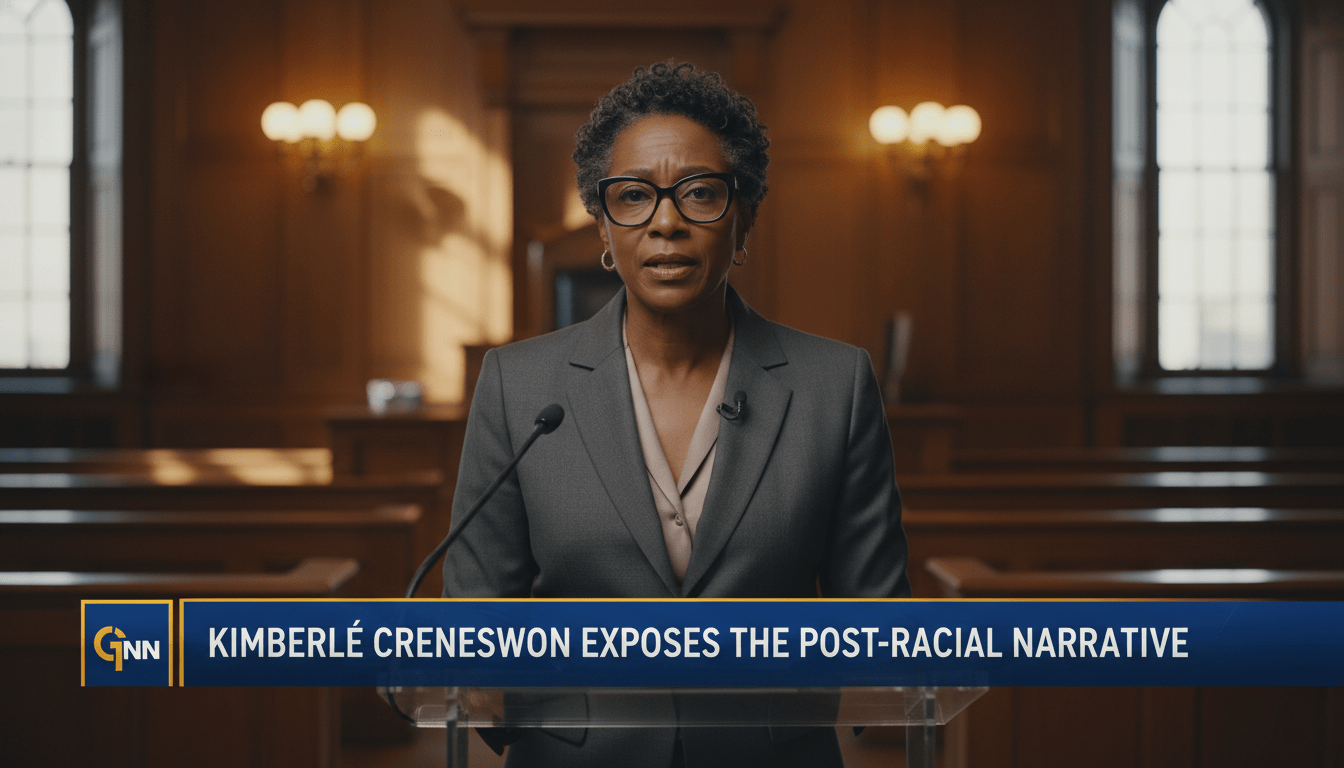
On May 5, 2026, legal scholar Kimberlé Crenshaw delivered a powerful viral address. She released her highly anticipated memoir, Backtalker: An American Memoir, on the exact same day. Crenshaw aimed her sharp criticism directly at the conservative majority of the United States Supreme Court. Her pointed remarks followed the highly controversial Louisiana v. Callais decision from April 29. This recent ruling effectively dismantled the remaining protections of Section 2 of the Voting Rights Act. Crenshaw did not mince words when analyzing the motives behind the decision (wikipedia.org).
During her address, Crenshaw accused the Court of pretending that America has become a post-racial society. She argued that justices use this false narrative to justify removing crucial legal infrastructure. This specific infrastructure has safeguarded Black political representation for the past sixty years. According to Crenshaw, this colorblind jurisprudence serves as a tactical erasure of American history. It deliberately leaves marginalized communities vulnerable to systematic disenfranchisement by state legislatures. By ignoring historical context, the Court allows new forms of voter suppression to flourish completely unchecked (youtube.com).
The Architect of Intersectionality
Kimberlé Crenshaw has spent over four decades studying how power and race operate simultaneously. She developed essential academic frameworks to reveal hidden biases within American law. In 1989, she published a groundbreaking article titled Demarginalizing the Intersection of Race and Sex. She coined the term “intersectionality” to describe how different forms of discrimination overlap and interact. Crenshaw noted that Black women frequently fall through the cracks of a legal system designed for single-issue claims (uclalawreview.org).
A classic example of this legal blind spot is the 1976 case DeGraffenreid v. General Motors. The court refused to recognize the combined discrimination faced by Black women. General Motors argued they hired white women and Black men, therefore they did not discriminate. The court forced the plaintiffs to choose a single category, which led to a massive failure of justice (lls.edu). During the late 1980s, Crenshaw also helped pioneer Critical Race Theory alongside other scholars. Derrick Bell and Richard Delgado were foundational figures in this intellectual movement. The theory suggests that racism exists as an ordinary and permanent feature of American society (uchicago.edu).
The Clarence Thomas Hearings as a Turning Point
A pivotal moment in legal history occurred during the 1991 Supreme Court confirmation hearings. Law professor Anita Hill testified that Clarence Thomas had sexually harassed her at the Department of Education. Hill detailed graphic references to pornographic films and inappropriate comments about her physical appearance. She stated that Thomas constantly pressured her for dates despite her repeated refusals. Crenshaw served on Hill’s legal team during these highly publicized and contentious proceedings. The all-white, all-male Senate Judiciary Committee aggressively dismissed the serious allegations (time.com).
In her 2026 memoir, Crenshaw reflects heavily on this event as an intersectional failure. Many civil rights organizations supported Thomas solely based on his race. Meanwhile, some white feminist groups struggled to grasp the complex racial dynamics of the situation. The refusal to believe a Black woman allowed Thomas to secure a lifetime judicial seat. Crenshaw notes that Thomas then spent the next 35 years aggressively gutting the Voting Rights Act. This single confirmation deeply altered the trajectory of civil rights law in the United States (afro.com).
The Fall of the Voting Rights Act
Crenshaw connects recent rulings to a decade-long retreat from monumental civil rights progress. The dismantling of voter protections began aggressively with Shelby County v. Holder in 2013. The Supreme Court struck down the preclearance formula of the Voting Rights Act. Preclearance previously required jurisdictions with discriminatory histories to get federal approval before changing voting laws. This requirement prevented states from implementing new discriminatory tactics as soon as courts struck down old ones. Under Section 5, the burden of proof rested firmly on the state (brennancenter.org).
Chief Justice John Roberts justified the 2013 decision by famously claiming the country had changed. Crenshaw identifies this specific statement as the birth of the modern post-racial legal fiction. Without preclearance, the black voter disenfranchisement crisis worsened significantly across the South. Voters now carry the heavy burden of suing states after discriminatory laws pass. This process is expensive, incredibly time-consuming, and often happens after compromised elections have already concluded (campaignlegal.org).
How Mapmakers Erase Black Political Power
The Supreme Court has made it increasingly difficult to challenge unfair voting maps effectively. Section 2 of the Voting Rights Act traditionally prohibited practices that denied the right to vote based on race. It served as the primary legal tool against discriminatory redistricting maps that dilute minority voting power. However, mapmakers often use a tactic called bleaching to manipulate district lines completely. They remove Black voters from a district to increase the electoral strength of conservative white voters. Mapmakers pack as many minority voters as possible into a single sacrificial district (brennancenter.org).
In the 2024 case Alexander v. South Carolina NAACP, the Court allowed a severely manipulated map. Mapmakers moved 30,000 Black voters out of a single competitive coastal district. The Court ruled that partisan goals could not be easily separated from racial motives. Because race and party affiliation strongly correlate, states often claim they are only discriminating based on politics. This loophole makes racial discrimination legally defensible under the guise of political strategy. The Court previously ruled that federal courts cannot stop partisan gerrymandering (lawforward.org).
The Devastating Numbers Behind the Rulings
The post-racial narrative clashes sharply with actual statistical trends in voter participation. Since the Shelby County decision in 2013, the racial turnout gap has expanded significantly. It grew by five percentage points in regions that were formerly under federal oversight. Furthermore, election officials closed nearly 1,000 polling places across the country. These closures occurred primarily within majority-Black counties, creating massive lines and delays on election day (brennancenter.org).
These systemic barriers have created a massive deficit in basic democratic participation. Researchers estimate that nine million more ballots would have been cast in the 2020 election. This staggering number assumes the racial turnout gap did not exist during that specific cycle. Additionally, there has been a significant increase in aggressive voter registration purges. These purges heavily target jurisdictions that previously required federal preclearance to change their voting rules (rockthevote.org).
Understanding the Colorblind Jurisprudence Trap
Colorblind jurisprudence is a legal philosophy that currently dominates Supreme Court decisions. This doctrine asserts that the Constitution remains entirely race-neutral in all circumstances. It argues that the government should never consider race in any laws or policies. This strict rule applies even to policies intended to fix historical or systemic inequality. The philosophy traces back to Justice John Marshall Harlan’s 1896 dissent in Plessy v. Ferguson. Critics argue this philosophy ignores substantive equality and real lived experiences completely (lls.edu).
Under this doctrine, any use of racial classification faces strict scrutiny. This is the highest level of judicial review possible within the American legal system. It makes it nearly impossible for race-based protections to survive modern legal challenges. The Court treats efforts to promote diversity as legally equivalent to efforts that oppress marginalized groups. The complexities of affirmative action highlight this exact legal trap perfectly. Chief Justice Roberts summarized this by stating the way to stop discrimination is to stop discriminating based on race (uclalawreview.org).
The Post-Racial Paradox Unpacked
The current legal landscape has created a deeply troubling post-racial paradox for the Black community. The Supreme Court majority believes society has already achieved significant racial progress over the decades. Therefore, they view laws designed to protect against discrimination as forms of reverse racism. They argue these specific protections unfairly target white citizens in modern America. This flawed logic suggests that civil rights measures are no longer necessary today (rooseveltinstitute.org).
Crenshaw strongly argues that the Court is actively pretending to be blind to race. Justices use the success of a few individuals to justify dismantling protective legal infrastructure. This infrastructure is absolutely necessary to prevent systemic exclusion for the broader population. The paradox ensures that racial disparities remain locked firmly in place across the nation. Crenshaw notes that colorblindness shrouds the ongoing strategic dilution of Black political power. Meanwhile, the Court continuously claims to act in the best interest of ultimate equality (youtube.com).
The Final Blow in Louisiana
The recent Louisiana v. Callais ruling represents a critical escalation in this ongoing legal battle. In a 6-3 decision, the Supreme Court declared a second Black-majority district unconstitutional. The Court explicitly labeled the district an illegal racial gerrymander. Justice Samuel Alito wrote the majority opinion for this highly controversial case. He suggested that race-conscious remedies are no longer necessary due to vast social change in America (wikipedia.org).
This ruling essentially reverses a previous stay that allowed the map for the 2024 cycle. During the 2024 elections, Black voters in Louisiana temporarily had a second opportunity district. The new ruling places that vital representation at severe risk for future election cycles. Crenshaw responded furiously by calling this decision the final blow to the enforcement of the 15th Amendment. The political experience of Black people continues to be defined by these constant legal hurdles (cbc.ca).
The Continued Struggle for Representation
Kimberlé Crenshaw warns that conservative justices are currently rewriting the history of the future. The Supreme Court continues to redefine what constitutes illegal discrimination in the United States. They systematically strip away the very tools necessary for a multiracial democracy to function properly. The ongoing struggle for black liberation requires constant vigilance against these new legal strategies. Crenshaw emphasizes that the Court is deliberately dismantling the legacy of the civil rights movement (uchicago.edu).
The fight for fair political representation remains far from over. Crenshaw uses her powerful platform to inspire a new generation of fierce backtalkers. These young advocates must defend the structural gains achieved during the Civil Rights Era. The current administration under Donald Trump has reshaped the judiciary significantly over recent years. Consequently, the Black community must thoroughly understand how the law works to dismantle systemic suppression effectively (afro.com).
About the Author
Darius Spearman is a professor of Black Studies at San Diego City College, where he has been teaching for over 20 years. He is the founder of African Elements, a media platform dedicated to providing educational resources on the history and culture of the African diaspora. Through his work, Spearman aims to empower and educate by bringing historical context to contemporary issues affecting the Black community.
