
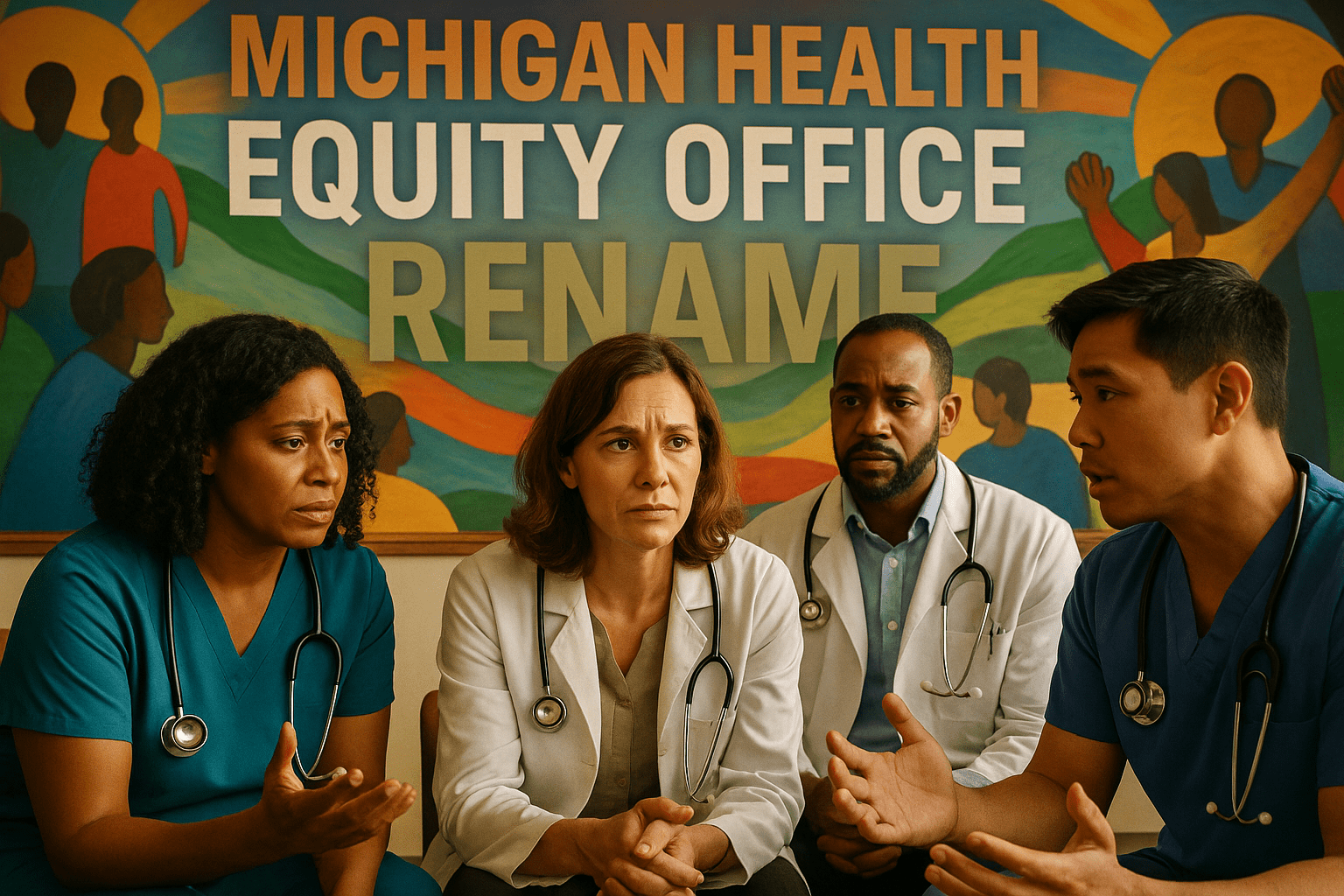
Michigan Health Equity Office Renamed
By Darius Spearman (africanelements)
Support African Elements at patreon.com/africanelements and hear recent news in a single playlist. Additionally, you can gain early access to ad-free video content.
Michigan’s Shifting Focus on Health Equity
The Michigan Office of Equity and Minority Health (OEMH) recently underwent a name change, becoming the Michigan Office of Transformation, Engagement, and Community Health (MI-TEaCH). This change has sparked significant concerns regarding the state’s dedication to addressing racial health disparities (newsone.com). The OEMH was a long-standing institution, established in 1988, with its mission formally codified into law in 2007. Its primary focus was tackling healthcare disparities specifically within “Michigan’s racial and ethnic minority populations” (newsone.com).
The newly named MI-TEaCH now states its goal as “ensuring optimal health and eliminating differences in health outcomes among all Michigan communities through improved service delivery, health infrastructure, skill-building, and policy change” (newsone.com). This broader mission contrasts sharply with the explicit, targeted focus of its predecessor. While a spokesperson for the Michigan Department of Health and Human Services (MDHHS) maintained that the office’s “charge has remained the same” despite name changes over 37 years, critics argue that this shift in language minimizes the crucial focus on specific racial and ethnic groups (newsone.com). For many in the Black community, this change raises questions about whether the state is truly committed to addressing the unique health challenges faced by people of color.
A History of Disparities and Targeted Efforts
Michigan has a well-documented history of health disparities that disproportionately affect people of color, which was a fundamental reason for the establishment and specific focus of the former Office of Equity and Minority Health (newsone.com). In 2020, Governor Gretchen Whitmer signed an Executive Directive acknowledging and addressing racism as a public health crisis. This directive highlighted that disparities in morbidity, mortality, and overall health status extend far beyond the COVID-19 pandemic (michigan.gov). For instance, Black, Hispanic, and Indigenous Americans in Michigan experience higher infant mortality rates compared to white and Asian Americans (michigan.gov).
Furthermore, the premature death rate from heart disease and stroke is highest among Black Americans in Michigan (michigan.gov). The OEMH played a vital role as the “primary coordinating body” to help combat these racial disparities, particularly during the critical period of the COVID-19 pandemic (newsone.com). The office’s previous website explicitly stated its commitment to “eradicating health disparities continuously and steadfastly among Michigan’s diverse communities, which include American Indians/Alaska Natives, Arab and Chaldean Americans, Asian Americans and Pacific Islanders, Black/African Americans, and Hispanics/Latinos” (newsone.com). However, references to these specific groups, including Chaldean Americans, have now been moved to a secondary page on the MI-TEaCH website or omitted entirely (newsone.com). This change in emphasis is concerning for those who believe that specific problems require specific solutions.
Understanding Key Health Equity Terms
Health Disparities
Preventable differences in the burden of disease, injury, violence, or opportunities to achieve optimal health that are experienced by socially disadvantaged populations. These differences often arise from systemic injustices and social determinants of health.
Health Equity
The state in which everyone has a fair and just opportunity to be as healthy as possible. This requires removing obstacles to health such as poverty, discrimination, and their consequences, including powerlessness and lack of access to good jobs with fair pay, quality education and housing, safe environments, and health care.
Diversity, Equity, and Inclusion (DEI)
Diversity means having many different kinds of people, including those from various racial, ethnic, gender, sexual orientation, and socioeconomic backgrounds. Equity means fairness in opportunities and outcomes, ensuring that everyone has what they need to succeed. Inclusion means making sure everyone feels welcome, valued, and respected within a group or organization.
MDHHS Maintains Commitment Amidst Changes
Despite the renaming and restructuring of the office, the Michigan Department of Health and Human Services (MDHHS) maintains that its commitment to equity remains strong. The former Office of Equity and Minority Health (OEMH) website listed several key focus areas, including Cardiovascular Health, Nutrition & Physical Activity, Mother Infant Health & Equity Improvement Plan (MIHEIP), Michigan Perinatal Quality Collaborative (MI PQC), Mother Infant Health & Equity Collaborative (MIHEC) Meetings, and Supports for Working with Youth Who Identify as LGBTQ (michigan.gov). These areas highlight a broad approach to health improvement, even within a minority health framework.
A spokesperson for the health department stated that “Given our reorganized structure and focus on embedding equity in all of our efforts, we will be working more closely with our local regional partners to help us design and deploy engagement efforts best suited for their regions” (news-medical.net). This suggests a shift towards localized efforts, though specific details on how community engagement will be conducted or how affected communities will be involved in decision-making are not readily available. The Michigan Department of Civil Rights (MDCR) also plays a role, committed to advancing racial equity in all its initiatives. The MDCR works to build collaborative relationships with communities, government agencies, and organizations to incorporate racial equity into policies, processes, and decision-making (michigan.gov). The MDCR has even developed a “Racial Equity Toolkit” and a “Resource Guide to Developing a School Equity Plan” to help organizations and educators advance racial equity (michigan.gov). These efforts indicate a continued, albeit possibly diffused, focus on equity across state agencies.
Broader Context: DEI and Opioid Crisis
The renaming of the health equity office occurs amidst broader discussions and actions in Michigan concerning diversity, equity, and inclusion (DEI) initiatives. This includes the disbanding of a racial equity group specifically related to opioid settlement money (news-medical.net). In 2024, the MDHHS disbanded a work group focused on racial equity and the opioid crisis, causing concern among some members. This is particularly troubling given that the opioid epidemic has disproportionately affected communities of color (news-medical.net).
For example, in 2021, non-Hispanic Black men in Michigan died of opioid-related overdoses at more than twice the rate of non-Hispanic white men (news-medical.net). Additionally, racial and ethnic minorities are prescribed opioids for pain relief at lower rates than white patients, highlighting systemic biases within healthcare (news-medical.net). Governor Whitmer did establish the Black Leadership Advisory Council in 2020 to promote legislation and regulation that ensures equitable treatment and remedies structural inequities for Black Michiganders (michigan.gov). However, the recent office renaming and the disbanding of the opioid equity group suggest a complex and sometimes contradictory approach to racial equity within the state’s public health framework, leaving many to wonder about the true direction of these efforts.
Key Health Disparities in Michigan (Selected Examples)
The Impact on Black Communities
For Black communities, the shift in language and focus is more than just a name change; it represents a potential minimization of the specific challenges they face within the healthcare system. The previous OEMH website explicitly listed its commitment to “eradicating health disparities continuously and steadfastly among Michigan’s diverse communities,” specifically naming groups like Black/African Americans (newsone.com). This direct acknowledgement was crucial for building trust and ensuring targeted interventions. The move to broader language, such as “all Michigan communities,” risks diluting the focus on the unique historical and systemic barriers that have led to poorer health outcomes for Black people.
The adage, “when white people get a cold, Black people get the flu,” reflects a painful truth about healthcare outcomes for Black people across America (newsone.com). Black women, for instance, are disproportionately affected by everything from cancer mortality rates to complications related to pregnancy and childbirth (newsone.com). By shifting to broader language and definitions, there is a legitimate concern that the specific focus needed to protect Black bodies will be minimized. This change could further erode the already fragile trust that Black people, who are understandably distrustful of the American healthcare system, have in institutions meant to serve their best interests (newsone.com). It is becoming increasingly clear that these attacks on DEI are not about creating a “merit-based” society, but rather about hindering progress for Black people by any means possible.
Office Renaming Timeline
ABOUT THE AUTHOR
Darius Spearman has been a professor of Black Studies at San Diego City College since 2007. He is the author of several books, including Between The Color Lines: A History of African Americans on the California Frontier Through 1890. You can visit Darius online at africanelements.org.
