


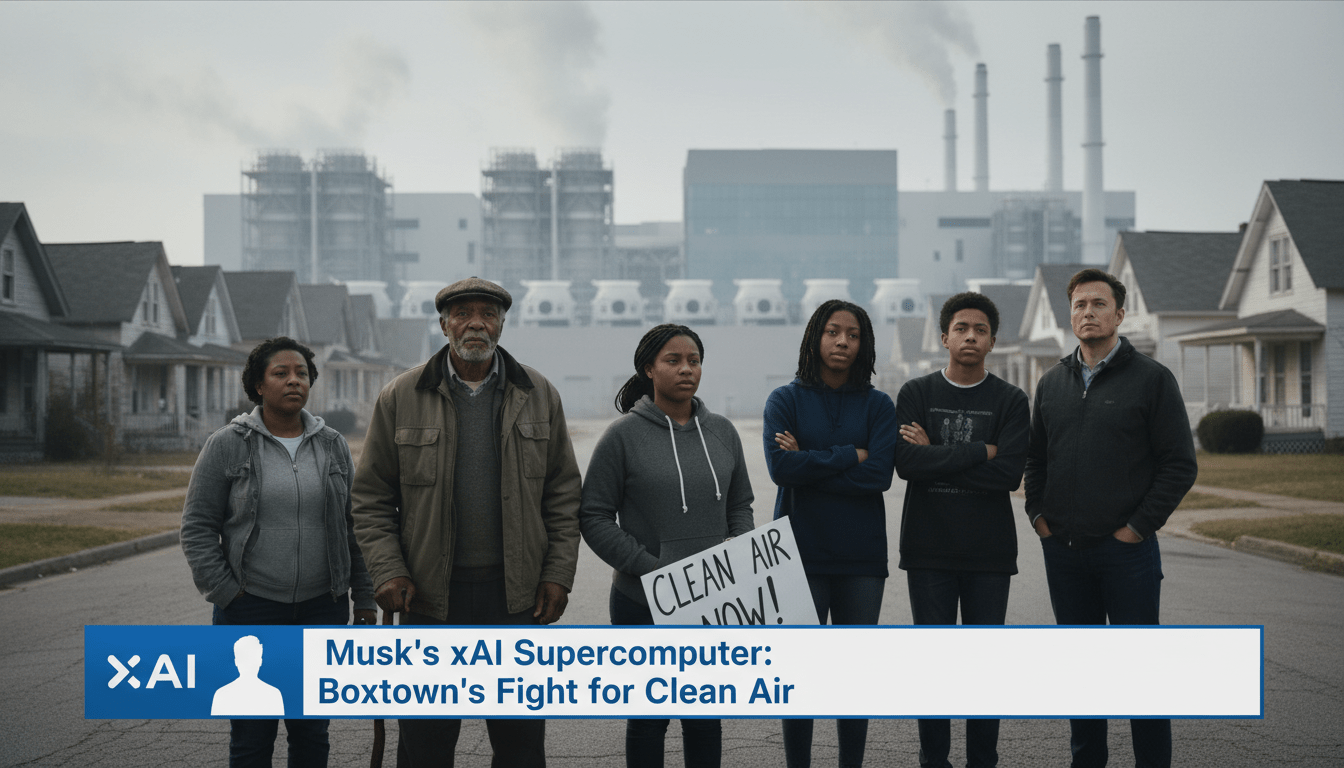
Musk’s xAI Supercomputer: Boxtown’s Fight for Clean Air
By Darius Spearman (africanelements)
Support African Elements at patreon.com/africanelements and hear recent news in a single playlist. Additionally, you can gain early access to ad-free video content.
The city of Memphis is currently witnessing a massive clash between futuristic technology and historical preservation. Elon Musk recently installed a massive supercomputer known as “Colossus” in the heart of Southwest Memphis. While local officials celebrate the arrival of high-tech investment, residents of the historic Boxtown neighborhood feel a sense of dread. This area is home to a proud Black community with deep roots that stretch back to the era of the Emancipation Proclamation (tri-statedefender.com).
Residents are sounding the alarm about the potential for worsened air quality and health risks. They are not merely complaining about a new neighbor. Instead, they are responding to a long history of industrial facilities that have surrounded their homes for decades. These neighbors seek clear data and firm safeguards to ensure that the air they breathe remains safe for their children and elders (truthout.org). Under the current administration of President Donald Trump, the federal government is now facing pressure to step in and regulate this rapid industrial expansion.
The Deep Roots of Boxtown and the Legacy of Resilience
To understand the current anger, one must look at the birth of Boxtown. The neighborhood was settled in 1863 by formerly enslaved individuals who were seeking a place to build their own lives. These pioneers lacked traditional building materials and faced significant economic barriers. They repurposed discarded wooden boxcars from the Illinois Central Railroad to construct their first homes (tri-statedefender.com). This resourcefulness gave the neighborhood its name and established a spirit of independence that persists today.
Despite the determination of its residents, Boxtown faced a century of deliberate neglect from city leaders. The community existed without basic infrastructure for many decades. It was not until the 1980s that many homes in Boxtown finally received indoor plumbing and running water (truthout.org). This lack of support was part of a larger pattern of systemic barriers after emancipation that kept Black communities from accessing the same resources as white neighborhoods. This history of exclusion made the area vulnerable to developers who viewed it as a “path of least resistance.”
Environmental Racism and the Path of Least Resistance
Southwest Memphis is currently surrounded by a “ring of fire” consisting of polluting industries. The area hosts a massive oil refinery, a coal-ash site, and chemical processing plants. Data shows that Southwest Memphis accounts for 94% of the air pollutants released in the entire county (propublica.org). This concentration of industry in a Black neighborhood is a textbook example of environmental racism. Developers often choose these locations because they believe the residents lack the political power to fight back (capitalbnews.org).
In 2021, the community successfully defeated the Byhalia Connection pipeline, which was planned to cut right through their land. The victory proved that political agency for Black residents could stop major corporate projects. However, the arrival of xAI represents a new kind of threat. The project moved so quickly that many residents felt they were left out of the decision-making process entirely (truthout.org). The speed of the development has bypassed many of the traditional public comment periods that allow citizens to voice their concerns.
The Rapid Rise of the Colossus Supercomputer
Elon Musk and his team at xAI built the “Colossus” supercomputer with what they call “superhuman” speed. The facility was completed in just 122 days at the site of a former Electrolux factory (time.com). This massive computer is designed to train artificial intelligence models like “Grok.” These models require incredible amounts of processing power to analyze trillions of data points. To provide this power, xAI installed at least 35 methane gas turbines on the property (truthout.org). These turbines generate electricity locally to supplement the power grid.
The company initially claimed that these turbines were “temporary” and therefore did not require standard air permits. This classification allowed them to skip the rigorous environmental reviews required by the Clean Air Act. However, local activists and the NAACP argue that using dozens of these engines to provide primary power violates the law (capitalbnews.org). They point out that the massive technological advancement and its impact should not come at the cost of community health. The speed of the project has outpaced the ability of local regulators to keep up.
The Human Cost of Toxic Air Pollutants
The health consequences for residents in Southwest Memphis are already severe. Statistical data reveals that the cumulative cancer risk from toxic air in this area is four times higher than the national average (propublica.org). Furthermore, residents in these ZIP codes have a life expectancy that is roughly ten years lower than those in other parts of Shelby County. The addition of more turbines only adds to the burden of respiratory illnesses and other health issues (truthout.org). This reflects ongoing disparities in health outcomes that have plagued Black communities for generations.
A recent analysis showed that peak nitrogen dioxide levels spiked by 79% in the areas surrounding the xAI site since operations began (truthout.org). Nitrogen dioxide is a dangerous pollutant that can trigger asthma attacks and other lung problems. Residents are demanding the installation of Selective Catalytic Reduction (SCR) systems. These advanced scrubbers can reduce nitrogen oxide emissions by 90% (truthout.org). Without these firm safeguards, the community remains at risk of breathing in toxic fumes every day.
xAI Daily Water Consumption (Gallons)
Initial Use
Projected Use
Threats to the Memphis Sand Aquifer
The air is not the only resource under threat in Southwest Memphis. The supercomputer facility generates massive amounts of heat that must be cooled constantly. To do this, xAI requires between 1 and 1.5 million gallons of water every single day (time.com). Future projections suggest this demand could rise as high as 5 million gallons per day. This water is currently being pulled from the Memphis Sand Aquifer, which is the primary source of clean drinking water for the entire city (selc.org).
The Memphis Sand Aquifer is a precious resource that filters water through deep layers of sand. It is an artesian system that provides some of the purest water in the world. However, experts warn that pulling millions of gallons for industrial use could strain the aquifer (selc.org). Excessive pumping can lower the water table and potentially allow pollutants from shallower layers to enter the drinking supply. Community groups are pushing for a wastewater recycling facility to supply cooling water instead of depleting the drinking water source (truthout.org).
Closing the Regulatory Loophole
The battle for oversight reached a major milestone in January 2026. The Environmental Protection Agency (EPA) issued a critical ruling that addressed the “non-road engines” loophole used by xAI (truthout.org). The agency clarified that mobile gas turbines cannot be classified as temporary if they are used to power a permanent facility like a data center. This federal intervention means that xAI must now apply for standard air permits under the Clean Air Act. This shift represents a victory for transparency and community safety.
Before this ruling, the company operated with very little public oversight. The Greater Memphis Chamber of Commerce even used non-disclosure agreements to keep the project’s details hidden from the public (truthout.org). Now, the company must undergo the rigorous permitting processes that residents have been demanding. This includes public hearings where the community can finally have a say in how the facility impacts their environment. The legal pressure from the NAACP and local groups played a major role in bringing this issue to the attention of federal authorities (capitalbnews.org).
Peak NO2 levels spiked by 79% since operations began.
The Demand for Accountability and Fair Progress
Residents of Boxtown are not opposed to technology or economic growth. They simply want a version of progress that does not require them to sacrifice their health. They are calling for “clear monitoring data” that is collected and reported by independent agencies (truthout.org). Past studies were criticized for being too short and using too few monitors to provide a real picture of the risks. Reliable, long-term data is essential for holding corporations accountable for the pollution they release into the air.
In addition to monitoring, the community is asking for direct economic benefits. While the xAI facility is a $3 billion investment, it does not guarantee jobs for people living in the immediate neighborhood (truthout.org). Most of the roles at the site require specialized engineering degrees. This creates a situation where a community bears all the environmental costs of a project without receiving any of the economic rewards. True environmental justice requires that the benefits and burdens of industrial development are shared fairly among all citizens.
Conclusion: A Legacy Worth Fighting For
The struggle in Memphis is a modern chapter in a very old story. It is a story about a community that has survived through emancipation, neglect, and industrial encroachment. The residents of Boxtown are standing up once again to protect their legacy and their future. They are making it clear that the “Colossus” of the future must respect the history of the past. As legal battles continue and federal regulators step in, the voices of Southwest Memphis are being heard louder than ever before.
This battle is a reminder that the rapid pace of innovation must be balanced with the fundamental rights of the people. Clean air and safe water are not luxuries; they are basic necessities for a healthy life. By demanding firm health safeguards and transparent data, the people of Memphis are fighting for every community that has ever been treated as the path of least resistance. Their resilience ensures that the historic neighborhood of Boxtown will continue to thrive for many generations to come.
About the Author
Darius Spearman is a professor of Black Studies at San Diego City College, where he has been teaching for over 20 years. He is the founder of African Elements, a media platform dedicated to providing educational resources on the history and culture of the African diaspora. Through his work, Spearman aims to empower and educate by bringing historical context to contemporary issues affecting the Black community.
