
Listen to this article
Download AudioClimate Change Threatens Agriculture in Nigeria
By Darius Spearman (africanelements)
Support African Elements at patreon.com/africanelements and hear recent news in a single playlist. Additionally, you can gain early access to ad-free video content.
Vanishing Waters: Nigeria’s Climate Change Crisis
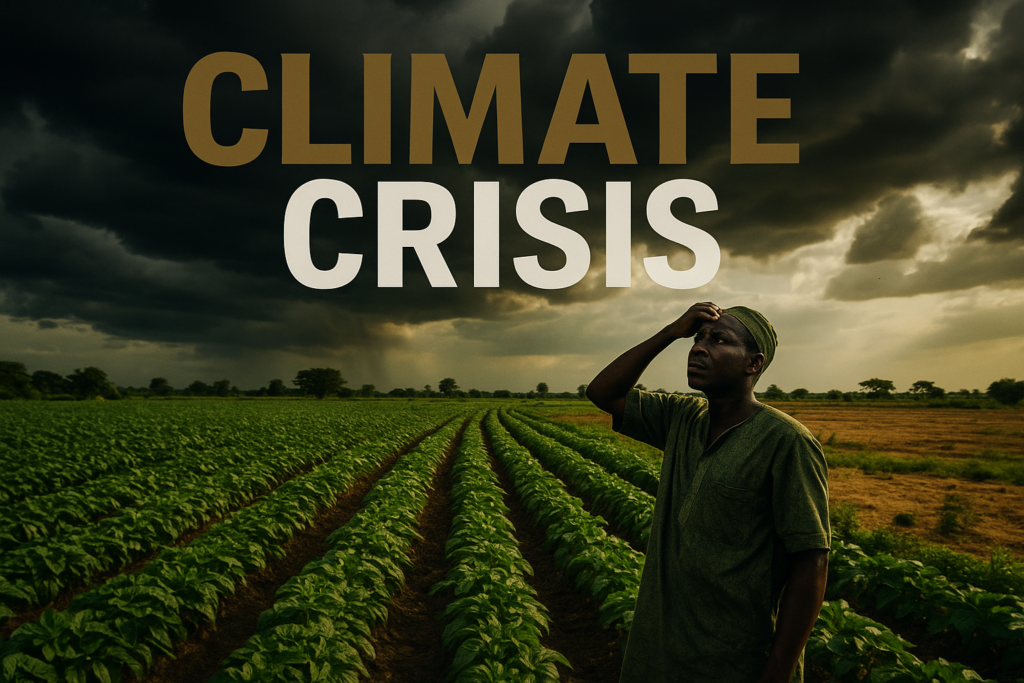
The land of our ancestors in Nigeria is crying out. Climate change is no longer a distant threat; it’s a harsh reality stealing the nation’s lifeblood – water. Across the country, especially in the northern regions, communities watch as once dependable rivers and lakes shrink before their eyes (Climate change threatens agriculture in Nigeria). This isn’t just about scenery changing; it’s about survival. These drying water bodies directly hit farm productivity. Consequently, our people are forced to turn to irrigation methods that are often too expensive and unreliable.
Think about Lake Chad, a name that echoes with history and sustenance for millions. This vital water source, which once supported thriving societies and served as a crucial link in trans-Saharan trade (Lake Chad Cultural Landscape), has tragically shrunk by about 90% (Climate change threatens agriculture in Nigeria). This dramatic loss paints a stark picture of the water crisis unfolding. It’s a crisis that impacts fishing, farming, and livestock – the backbone of local economies for over 30 million people (LAKE CHAD CULTURAL LANDSCAPE). Furthermore, the changing climate brings other dangers. Flooding and drought now seriously threaten Nigeria’s agricultural development, creating a cycle of uncertainty for farmers who depend on the land (Landscape of Climate Finance in Nigeria 2025). The ecological toll is also severe, with species facing extinction as their habitats disappear (Local Conflicts over Resources around Lake Chad).
Lake Chad’s Drastic Decline
Fields of Uncertainty: Nigerian Agriculture Impact
When the rains don’t come, or come too much, it’s our plates that feel it. Climate change directly attacks agricultural productivity in Nigeria. This leads to smaller harvests and makes food production shaky and unreliable. For instance, the land used to grow maize, a staple for many families, shrank from 6.2 million hectares in 2021 to 5.8 million hectares in 2022 (Climate change threatens agriculture in Nigeria). These aren’t just numbers; they represent less food and income for farming communities. The unpredictable weather patterns and climate anomalies are directly causing lower crop yields and making our food supply unstable (Nigerian cropland expansion).
It’s a challenging situation because even though cropland has been expanded in some areas, Nigeria is still fighting hard to ensure everyone has enough to eat. The struggle for food security is real and deeply felt across communities (Nigerian cropland expansion). This challenge is amplified by the fact that more than 80% of Nigeria’s farmers are smallholder farmers. These are the men and women who, with limited resources, cultivate small plots of land yet collectively contribute a staggering 90% of the country’s agricultural production (Climate change threatens agriculture in Nigeria). Therefore, when climate change hits agriculture, it hits the very foundation of Nigeria’s food system and the livelihoods of the vast majority of its farming population.
Maize Cultivated Land in Nigeria
Economic Tremors: Climate’s Cost to Nigeria
The effects of climate change ripple far beyond the farm. They shake the very foundations of Nigeria’s economic dreams. The nation aims to achieve upper-middle-income status by 2050, a worthy goal for its people. However, climate change stands as a significant roadblock. The risks associated with a changing climate jeopardize Nigeria’s critical infrastructure and precious ecosystems, affecting long-term growth and stability (Landscape of Climate Finance in Nigeria 2025). These aren’t abstract threats; they translate to damaged roads, unstable power supplies, and compromised water systems, all of which are vital for a thriving economy.
Yet, within this challenge lies an opportunity. Taking decisive climate action can actually spur growth. It can create much-needed jobs and attract investment into new, green sectors (Climate Action Can be the Gateway to a New Nigerian Era of Growth). Building a climate-resilient Nigeria requires significant investment, particularly in infrastructure. The estimated need is a staggering USD 3 trillion up to 2050 (Landscape of Climate Finance in Nigeria 2025). This sum would cover upgrading water systems, developing sustainable energy, and improving transportation networks to withstand climate shocks. Indeed, this “climate finance” is crucial for funding projects that reduce emissions and help communities adapt, from renewable energy to climate-smart agriculture.
The Frontline: 2025 Agricultural Challenges
Looking ahead to 2025, the forecast for Nigerian agriculture is fraught with severe challenges, and climate change is a dominant factor. It directly influences both how much food can be grown and how much it costs at the market. Recent history provides a grim reminder: devastating floods in 2024 wiped out large areas of farmland, destroying over 1 million tons of crops (Top 5 issues to shape Nigeria’s agriculture in 2025). Events like the Alau Dam collapse in 2024 also caused immense damage to farmlands and agricultural operations, underscoring the vulnerability of existing infrastructure (Top 5 issues to shape Nigeria’s agriculture in 2025). Such disasters immediately impact food availability and drive up prices for everyone.
Beyond the dramatic weather events, farmers are also battling an increase in pest infestations and disease outbreaks, often made worse by changing climate conditions. For example, infestations by pests like Tuta Absoluta, a destructive tomato pinworm, have significantly contributed to rising food prices by decimating tomato crops (Top 5 issues to shape Nigeria’s agriculture in 2025). Plant diseases, too, take a heavy toll. Outbreaks like ginger blight have led to substantial financial losses for farmers, wiping out their investments and hard work (Top 5 issues to shape Nigeria’s agriculture in 2025). Thus, climate change creates a hostile environment where pests and diseases can thrive, adding another layer of hardship for those who feed the nation.
Key Agricultural Impacts & Farmer Base
Our People, Our Farms: Climate Justice in Nigeria
When discussing climate change in Nigeria, we must talk about justice. The truth is, climate change does not affect everyone equally. It hits marginalized groups the hardest – our smallholder farmers, women who often bear the brunt of agricultural labor, and rural communities (Local Conflicts over Resources around Lake Chad). These are the very people who have the least to do with causing climate change, yet they suffer its worst consequences. They often have limited access to the resources, technology, and information needed to adapt to these changing conditions. This reality deepens existing socio-economic inequalities, making it even harder for vulnerable families to escape poverty.
The path forward requires more than just technical solutions; it demands a focus on equity. Climate resilience strategies in Nigeria must empower these communities. This means promoting climate-resilient agricultural practices like using drought-resistant crops and sustainable farming methods. It also involves significant investments in water management systems and expanding access to renewable energy. However, addressing food security effectively also means tackling systemic issues like broken supply chains, widespread poverty, and political instability, all of which can make a bad situation worse. Ultimately, international support and fair policies are crucial, but they must be designed to close existing gaps and ensure that aid reaches those who need it most, helping Nigeria build a future where all its people can thrive despite the climate crisis. The long-term ecological damage from climate change, like biodiversity loss, can become irreversible, creating a spiral of crises if not addressed with urgency and justice (Local Conflicts over Resources around Lake Chad).
ABOUT THE AUTHOR
Darius Spearman has been a professor of Black Studies at San Diego City College since 2007. He is the author of several books, including Between The Color Lines: A History of African Americans on the California Frontier Through 1890. You can visit Darius online at africanelements.org.
