


Listen to this article
Download AudioAfrican Tech: Light, Energy & Education
By Darius Spearman (africanelements)
Support African Elements at patreon.com/africanelements and hear recent news in a single playlist. Additionally, you can gain early access to ad-free video content.
Across the African continent, our people are sparking brilliant changes. They are using light-based technologies in truly innovative ways. These advancements are tackling tough local challenges, especially in energy and education. It’s a story of ingenuity, resilience, and a brighter future being built from the ground up. Indeed, these developments show how Africa is not just adopting technology, but adapting and creating it to meet its unique needs.
Solar Energy Solutions Powering Communities
Energy access is a huge hurdle for many communities in Africa. However, Africans are turning to the sun and new digital tools like blockchain to light up homes and businesses. One exciting example is Discovery Green in South Africa. This initiative uses blockchain technology to create a peer-to-peer solar energy marketplace. Imagine businesses with solar panels on their roofs selling extra power directly to nearby schools and clinics. Discovery Green aims to connect 5,000 businesses by 2026, generating a lot of decentralized energy (Top 10 African Innovations That Will Change the World by 2025). This means more reliable power, controlled by the community, for the community. Consequently, this approach empowers local economies and reduces reliance on unstable national grids.
This peer-to-peer system, often supported by blockchain, fundamentally changes how energy is shared. Instead of a big, central company controlling everything, people who produce their own energy can sell it directly to their neighbors. This is what “decentralized energy trading” means. It’s like a local farmer’s market, but for electricity. Blockchain makes these trades secure and transparent, using automated “smart contracts” to handle the buying and selling without needing a middleman (Decentralized Energy Grids). This not only makes energy trading more efficient but also can lower costs and encourage more people to use renewable sources (Blockchain in Energy Market Opportunities). Thus, it’s a powerful tool for building resilient and self-sufficient energy systems.
Understanding Blockchain in Energy
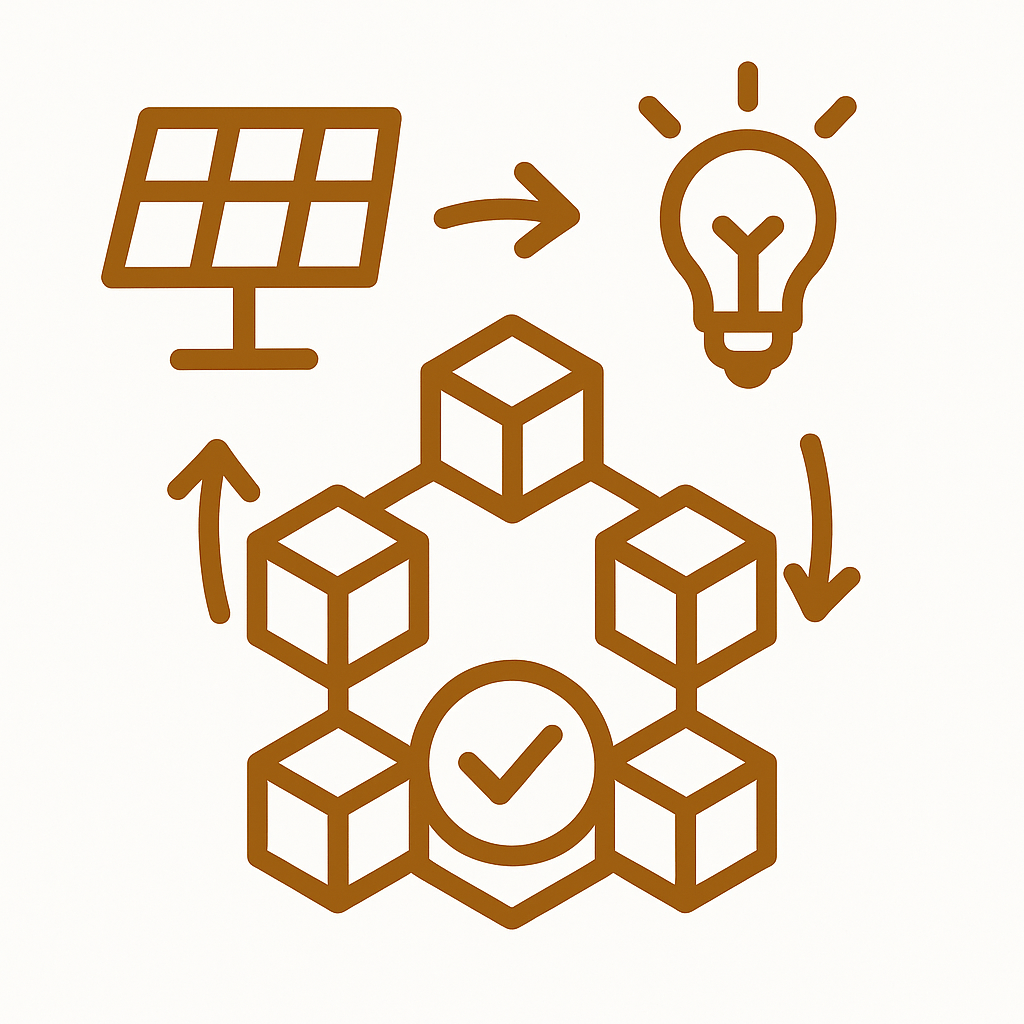
Blockchain in decentralized energy trading creates a secure and transparent system for people to buy and sell energy directly. Think of it as a digital ledger that everyone in the network can see, but no single person controls. This allows energy producers (like homes with solar panels) and consumers to trade with each other using automated “smart contracts.” Effectively, this system can increase efficiency, lower costs, and help more renewable energy get onto the grid.
Next-generation solar power, like perovskite solar cells, is also making waves. These cells are often cheaper and more efficient than traditional silicon ones, which is a big deal for off-grid communities (10 Breakthrough Technologies Shaping Africa’s Future in 2025). Perovskite materials can be made using simpler, low-temperature methods, cutting production costs. Their unique crystal structure is great at absorbing light and moving electrical charges, boosting their efficiency. Plus, they can be flexible and thin, opening up new ways to use them. Companies like Yellow Door Energy in Egypt and M-KOPA in East Africa are already deploying these advanced cells to bring affordable power to more people. M-KOPA, for instance, pioneered a pay-as-you-go (PAYG) model. This allows families with lower incomes to get solar power by making small, regular payments, often with mobile money, instead of a large upfront cost. Similarly, Yellow Door Energy provides solar solutions to businesses, helping them cut costs and be more sustainable. Both companies show how smart financing and new tech can break down barriers to clean energy access.
The impact of such solar initiatives is tangible. In places like Karan, Mali, increased access to electricity has boosted local economies and cut costs for small businesses (Africa’s Digital Transformation and Future Growth). Another shining example is d.light. This company has provided clean, affordable power to an astonishing 30 million homes across several African countries. They use a pay-as-you-go model, making solar power accessible. This model works by letting customers pay for their solar systems in small, manageable bits over time, often using mobile money. It removes the big initial cost that stops many families from getting solar. Beyond lighting up homes, d.light’s work has helped avoid 38 million metric tons of CO2 emissions since 2007 (Africa’s Digital Transformation and Future Growth). That’s a massive win for the planet and for people’s health, reducing reliance on polluting kerosene lamps. Ultimately, these efforts demonstrate a powerful shift towards sustainable development driven by African innovation.
d.light’s Illuminating Impact
Digital Light Brightens Education Paths
It’s not just about energy; light-based and digital technologies are also transforming how our children learn. Across the continent, innovators are finding ways to bring quality education to more students, even in remote areas. A standout example is Smart Uni Tanzania. This homegrown app digitizes educational materials, making them more accessible. In some institutions, this has helped reduce student dropout rates by an impressive 30% (Top 10 African Innovations That Will Change the World by 2025). Think about the power of that – keeping nearly a third more students on their educational journey. Furthermore, Smart Uni Tanzania has ambitious plans to use satellite platforms like Starlink to beam lectures to remote areas. Starlink, a service by SpaceX, uses a network of satellites in low Earth orbit to provide high-speed internet, especially in places where regular broadband is hard to get. This could be a game-changer for students who live far from schools or universities.
Digitizing educational materials has a profound effect. It means learning isn’t confined to a physical classroom or textbook. Students can access quality learning resources from anywhere, anytime, often on a simple mobile device. This is especially crucial in remote regions where books might be scarce or outdated, and trained teachers hard to find. Digital content can be updated quickly and tailored to local languages and curricula. It can even be delivered offline. By making learning more engaging and interactive, these tools boost student motivation and improve literacy. Moreover, they reduce the costs and logistical headaches of distributing physical textbooks. This helps more students stay in school and get the education they deserve (Top 10 African Innovations That Will Change the World by 2025). Enhancing digital education truly opens doors to quality learning for underserved communities. This is a critical step toward leveling the playing field for all our children.
Smart Uni Tanzania’s Impact
Tech Fuels Africa’s Economic Growth
The ripple effects of these light-based and digital innovations extend deep into Africa’s economy. The tech industry is not just solving problems; it’s creating massive opportunities. Projections show that AI and other emerging technologies could add an incredible $1.5 trillion to Africa’s GDP by 2030 (WEF 2025: Africa’s $1.5 trillion tech opportunity). This isn’t just a number; it represents transformative changes across many sectors. In healthcare, AI can lead to better diagnostic tools, personalized treatments, and telemedicine, making healthcare more accessible and affordable. In education, AI-powered platforms can offer personalized learning experiences and reach students in remote areas. And in employment, AI can boost productivity through automation while also creating new jobs that require digital skills, empowering entrepreneurs through tech platforms. Therefore, this technological wave has the potential to uplift millions.
Consider the financial innovations too. The use of blockchain in energy markets, like with Discovery Green, and the concept of carbon credits are turning sunlight into tradable assets (Top 10 African Innovations That Will Change the World by 2025). Carbon credits are essentially certificates that represent a reduction of one metric ton of carbon dioxide. Projects that reduce emissions, like renewable energy installations, can earn these credits and sell them. This creates an extra revenue stream, making clean energy projects more financially attractive and drawing in investment. It’s a way to put a financial value on protecting our planet. However, for this massive $1.5 trillion GDP growth to truly benefit everyone, we need to be intentional. Countries like South Africa, Kenya, Nigeria, and Egypt, with stronger tech infrastructure, are likely to lead. But we must ensure these benefits don’t just stay in big cities or with the well-off. Inclusive policies that focus on digital literacy, affordable access, and equitable opportunities are crucial to avoid widening existing social inequalities. Ultimately, technology must serve all our people.
AI & Tech: Boosting Africa’s GDP
Overcoming Hurdles: Challenges and Progress in Tech
While the progress is exciting, it’s important to acknowledge the hurdles. In Mali, for example, efforts to adopt solar energy are slowed by political instability and not enough investment, even though the government is trying to promote solar power (Africa’s Digital Transformation and Future Growth). Political instability creates uncertainty. It makes it hard to make consistent policies, weakens institutions, and scares off investors and donors who could fund energy projects. Conflict can also make it dangerous to reach rural areas where energy is most needed. This makes it difficult to install and maintain systems or even talk to communities about their needs. As of 2021, only 53% of Mali’s total population had electricity, and in rural areas, that number dropped to a mere 25% (Africa’s Digital Transformation and Future Growth). This lack of energy severely impacts daily life – from lighting and cooking to education and healthcare. It also reinforces social injustice, hitting rural and marginalized communities the hardest and holding back overall development. Therefore, addressing these underlying issues is crucial for technology to reach its full potential.
Despite these challenges, Africa’s energy landscape is definitely evolving. We see ambitious projects like Morocco’s plan to export electricity to the UK, using its abundant solar and wind resources (Africa’s Digital Transformation and Future Growth). This shows the immense potential that exists. These innovations are not just about technology; they are about tackling deep-seated socioeconomic gaps. Pay-as-you-go solar models directly address poverty by making energy affordable. Digital education platforms can empower girls and other marginalized groups by overcoming cultural and geographic barriers to learning. AI-driven healthcare can improve access to essential services in underserved communities. However, for these technologies to truly bridge gaps in poverty, gender inequality, and access to basic services, they must be paired with strong policies that tackle the root causes of these inequities. For instance, ensuring that the growth from tech doesn’t just benefit a few means actively working towards digital inclusion for all. This includes investing in widespread digital literacy programs and making sure that infrastructure reaches even the most remote communities. Then, the light of innovation can shine on everyone.
ABOUT THE AUTHOR
Darius Spearman is a professor of Black Studies at San Diego City College, where he has been teaching since 2007. He is the author of several books, including Between The Color Lines: A History of African Americans on the California Frontier Through 1890. You can visit Darius online at africanelements.org.
