

Reclaiming Renty: The Long Legal Fight for Ancestral Dignity
By Darius Spearman (africanelements)
Support African Elements at patreon.com/africanelements and hear recent news in a single playlist. Additionally, you can gain early access to ad-free video content.
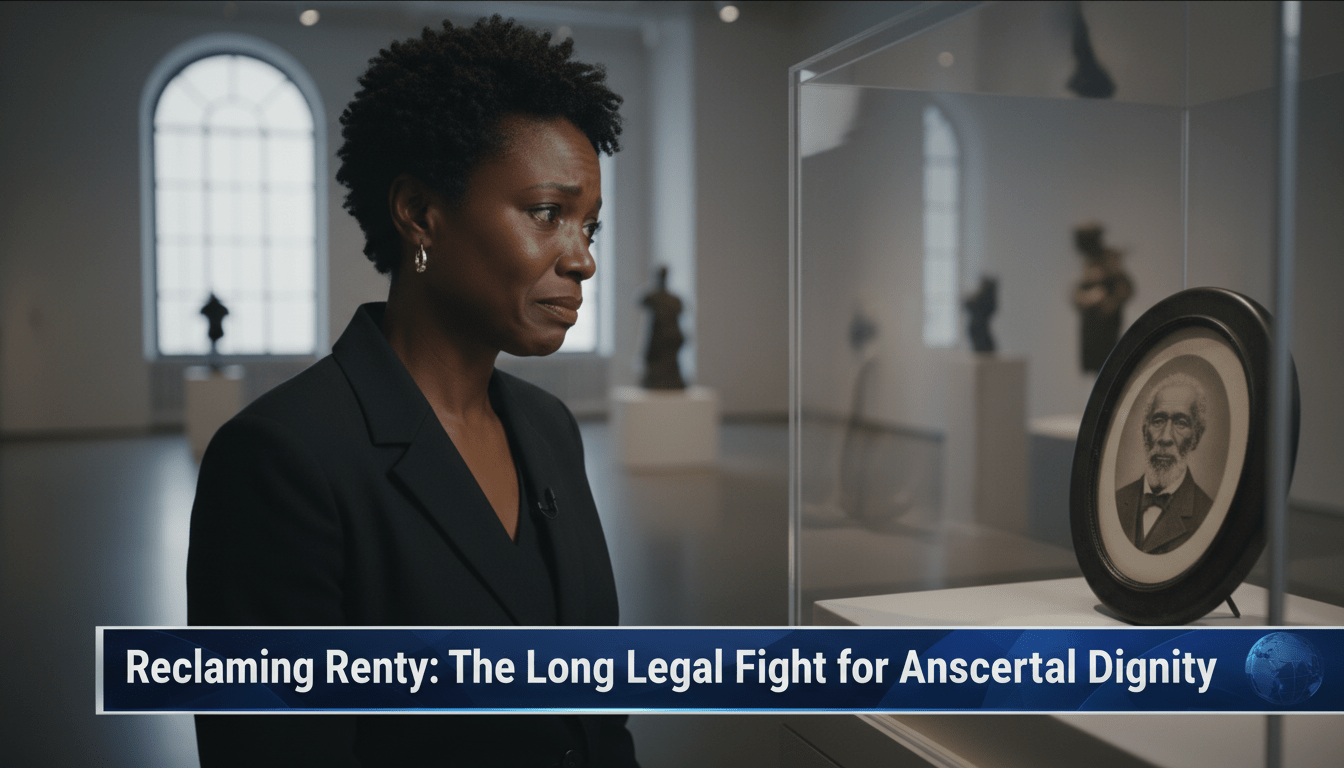
The year is 2026, and a long journey toward justice has reached a historic milestone. In a powerful move for civil rights, Harvard University has officially handed over fifteen precious daguerreotypes to a new home. These 1850 images of enslaved individuals, including a man named Renty and his daughter Delia, are now in the care of the International African American Museum (IAAM). This transfer ends a fifteen-year struggle by their descendant, Tamara Lanier. She fought to rescue her ancestors from being treated like specimens in a cold museum cabinet. This victory is about more than old photographs. It is about the restoration of human dignity that was stolen over a century ago (local10.com, propublica.org).
For many years, these images sat in the dark at Harvard’s Peabody Museum. They were not kept there to honor the people in the frames. Instead, they were created to prove a lie. Today, the world sees them differently. They are no longer tools of a racist past. They are portraits of people who survived the unthinkable. As President Donald Trump continues his second term, the nation watches how institutions like Harvard face their own histories. This case shows that the “legal fight for ancestral dignity” can actually result in real change. It provides a blueprint for how other families might reclaim their stolen heritage from powerful universities (sfchronicle.com, harvardmagazine.com).
Ancestors Held in Harvard’s Collections (2022 Data)
Source: Harvard University Internal Report (2022)
The Dark Origins of Scientific Racism
The story of these daguerreotypes begins with a man named Louis Agassiz. He was a famous scientist at Harvard in the middle of the nineteenth century. Agassiz did not see Black people as equal human beings. He believed in a theory called polygenism. This theory claimed that different races came from different origins. He thought Black people were a completely separate and inferior species. To prove this, he needed “visual evidence.” In 1850, he traveled to South Carolina plantations. He hired a photographer named Joseph T. Zealy to take pictures of enslaved people (harvardmagazine.com, propublica.org).
The process of taking these photos was a violent act of dehumanization. Agassiz forced Renty, Delia, and others like Jack and Drana to strip naked. They had to stand in front of a camera like biological specimens. In that era, photography was usually used to honor people. It was a way to capture a person’s soul and status. However, Agassiz used this technology to do the opposite. He wanted to strip away their humanity to support his racist ideas. These images were never meant for a family album. They were meant for a laboratory. This history mirrors other pseudo-scientific experiments on Black bodies that have happened throughout American history (propublica.org).
Renty and Delia were more than just names on a list. Renty was born in Africa and was brought to South Carolina against his will. Despite the laws that made it a crime for him to learn, he taught himself to read. He used his literacy to study the Bible and lead his community. His daughter, Delia, stood by him during these shameful photo sessions. They were owned by a man named B.F. Taylor. They lived lives of forced labor, but they kept their spirits alive through kinship and faith. Agassiz looked at them and saw data. Their descendants look at them and see heroes (local10.com, propublica.org).
A Century of Institutional Exploitation
After Agassiz finished his “study,” the daguerreotypes were forgotten for a long time. They were rediscovered in 1976 in a dusty cabinet at Harvard’s Peabody Museum. One might think the university would have reached out to find the families of these people. Instead, Harvard began to use the images for its own benefit. The university licensed the photos for a fee. They put Renty’s face on the covers of books and used the images for academic conferences. Harvard even sold copies of the images while claiming they were the sole owners of the “property” (harvardmagazine.com, propublica.org).
Tamara Lanier grew up hearing stories about “Papa Renty.” Her mother, Mattye Thompson, kept the family oral history alive. In 2011, Lanier discovered that the man in the famous Harvard photos was her ancestor. She reached out to the university with her proof. She wanted Harvard to acknowledge the connection and return the images. However, the university was dismissive. They did not treat her like a grieving descendant. They treated her like a stranger asking for school property. This refusal to recognize the enduring power of kinship sparked a legal battle that would last for years (newsday.com, propublica.org).
The legal struggle was difficult because of how the law views “property.” Historically, the law says the person who takes a photo owns it. It does not matter if the person in the photo was forced to be there. Lanier argued that the images were “stolen property” because Renty and Delia could not give consent. They were enslaved people with no rights. Therefore, any “property” created from their bodies belonged to their family, not the institution that exploited them. Harvard’s continued use of the images for profit felt like a modern-day extension of slavery to the Lanier family (sfchronicle.com, citynews.ca).
The Path to Repatriation
Turning Property into Humanity
In 2019, Lanier officially sued Harvard. She was represented by the well-known civil rights attorney Ben Crump. The lawsuit sent shockwaves through the academic world. It forced a conversation about who owns the history of enslaved people. Harvard tried to get the case thrown out. They argued that too much time had passed. They claimed the “statute of limitations” had run out. This argument ignored the fact that the harm was still happening every time Harvard sold a book with Renty’s image on it (sfchronicle.com, propublica.org).
The case took a major turn in 2022. The Massachusetts Supreme Judicial Court made a landmark ruling. The court said that Lanier might not “own” the physical metal plates under old property laws. However, the court also said she could sue for “intentional infliction of emotional distress.” The judges noted that Harvard’s treatment of Lanier was “dismissive” and “disrespectful.” They pointed out that using the images for profit while ignoring the family’s pain was a serious issue. This ruling changed the focus from “who owns the object” to “how are the people being treated” (sfchronicle.com, newsday.com).
This “emotional distress” pivot was a huge win. It suggested that institutions have a “duty of care” toward descendants. They cannot simply use the images of enslaved ancestors as they please. This legal victory began to chip away at the idea that academic freedom is an excuse for exploitation. Consequently, Harvard was forced to negotiate. The university realized that their public image was suffering. People around the world were beginning to see the school as an institution that preferred profit over the humanity of its subjects (newsday.com, propublica.org).
The Legal Gap and the Spirit of NAGPRA
During the legal battle, many people brought up a law called NAGPRA. This stands for the Native American Graves Protection and Repatriation Act. It was passed in 1990. This law requires museums to return Native American remains and cultural items to their tribes. It is a clear set of rules for repatriation. However, there is no similar law for the remains or artifacts of enslaved African Americans. This creates a “legal gap” that makes it very hard for Black families to get their history back (propublica.org).
Lanier’s legal team argued that Harvard should follow the “spirit” of NAGPRA. They suggested that the images of Renty and Delia should be treated with the same ethical care as Indigenous ancestors. Currently, institutions hold the remains of thousands of people. A 2022 report showed that Harvard alone held the remains of about 22,000 individuals. At least nineteen of those people were likely enslaved. This problem is widespread across the country. Many institutions are still holding onto the unmet promises of the era following the Civil War (harvardmagazine.com, propublica.org).
The victory in the Renty case might help close this gap. It shows that even without a specific federal law, courts can still hold institutions accountable. By winning the right to sue for emotional harm, Lanier created a new pathway. Other families may now use this strategy to reclaim items that were taken under duress. This is a vital step in making sure that the history of the enslaved is not just a commodity for wealthy universities to trade (newsday.com, propublica.org).
The Importance of Charleston and Gadsden’s Wharf
Gadsden’s Wharf is the “Ellis Island of Black America.”
A Sacred Homecoming to Gadsden’s Wharf
The choice of the International African American Museum as the new home for the daguerreotypes is very symbolic. The museum is located in Charleston, South Carolina. More specifically, it is built on Gadsden’s Wharf. This is the exact location where nearly half of all enslaved Africans first stepped onto North American soil. It is a site of great pain, but also of great survival. Bringing Renty and Delia back to this wharf is a true “homecoming.” They are returning to the place where their American story began (local10.com, news4jax.com).
At the IAAM, these images will not be research specimens. The museum plans to make them the center of a permanent exhibit. Instead of focusing on Agassiz’s racist theories, the exhibit will focus on the lives of the people. Visitors will learn about Renty’s leadership and his secret survival methods used during the era. They will see Delia as a daughter who endured the trauma of the photo sessions alongside her father. This context restores the dignity that Agassiz tried so hard to erase (local10.com, propublica.org).
This transfer is a victory for the entire community. It ensures that these one-of-a-kind artifacts are kept in a place that honors their memory. Unlike modern photos, a daguerreotype has no negative. Each plate is a unique, physical object. Therefore, having the actual plates at the IAAM is essential. It puts the stewardship of these ancestors into the hands of a community-focused institution. This move signals a shift in how museums are expected to handle sensitive historical materials in the twenty-first century (local10.com, news4jax.com).
The Legacy of Slavery and the Path Ahead
In 2025, Harvard and Lanier reached an out-of-court settlement. While some details are private, the outcome is clear. Harvard agreed to pay a sum of money and to give up the photos. In 2022, the university also announced a $100 million “Legacy of Slavery Fund.” This fund is meant to support research and work with descendant communities. Some critics, including Lanier herself, argued that money is not the same as returning what was stolen. However, the fund shows that the university can no longer ignore its past (harvardmagazine.com, propublica.org).
The case of Renty and Delia is just the beginning. There are thousands of other ancestors still held in academic collections. Many of these individuals were used for medical experiments or “scientific” studies that were just as cruel as Agassiz’s. This victory gives hope to other families who are searching for their own “Papa Renty.” It proves that persistent pressure and legal creativity can overcome even the oldest and most powerful institutions (propublica.org).
As the images of Renty and Delia are placed in their new home in Charleston, the message is clear. Our ancestors are not property. Their stories belong to their families and their communities. Tamara Lanier’s fifteen-year journey has finally brought her ancestors a measure of peace. As she said at the final press conference, their humanity has finally been restored. For the first time in 175 years, Renty and Delia are no longer subjects of a racist experiment. They are finally free (local10.com, propublica.org).
About the Author
Darius Spearman is a professor of Black Studies at San Diego City College, where he has been teaching for over 20 years. He is the founder of African Elements, a media platform dedicated to providing educational resources on the history and culture of the African diaspora. Through his work, Spearman aims to empower and educate by bringing historical context to contemporary issues affecting the Black community.
