

Silencing the Guns: Inside the African Peace Summit Strategy
By Darius Spearman (africanelements)
Support African Elements at patreon.com/africanelements and hear recent news in a single playlist. Additionally, you can gain early access to ad-free video content.
The Libreville Retreat and Its Mission
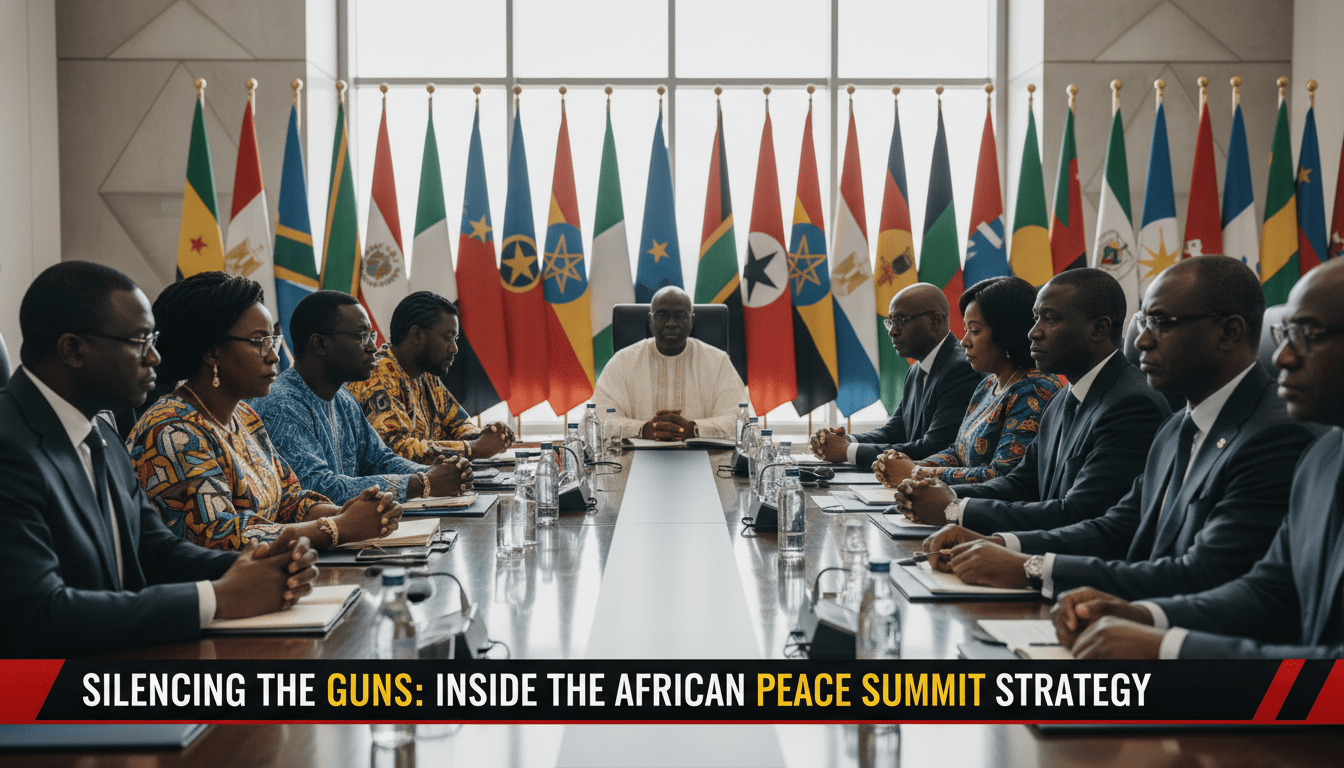
On May 20, 2026, African Union Commission Chairperson H.E. Mahmoud Ali Youssouf opened the seventeenth High-Level Retreat in Libreville. This summit focuses heavily on the “Silencing the Guns” initiative, an ambitious campaign to eliminate armed conflict across the continent. Youssouf delivered a powerful message to the gathered officials. He stated that the African continent must unite to become a strategic global actor. Leaders can no longer allow the continent to remain a simple object of international relations. The gathering represents a critical moment in a long-standing struggle for continental peace and security. Instead of reacting to crises, the union seeks proactive measures to prevent violence before it erupts.
The retreat arrives at a crucial time. In 2021, the union merged its Political Affairs and Peace and Security departments to streamline operations. The Libreville meetings represent a direct result of these institutional reforms. Officials aim to establish more integrated and joined-up action between regional forces and the United Nations. Chairperson Youssouf emphasized that achieving genuine peace requires completely dismantling the systems that profit from endless warfare (au.int).
Shifting from Non-Interference to Non-Indifference
To understand the modern peace strategy, one must examine the institutional history of the continent. The Organization of African Unity formed in 1963. It operated on a strict principle of non-interference. This policy prevented leaders from intervening in the internal affairs of member states. However, this stance drew heavy criticism when it failed to prevent widespread atrocities, most notably the 1994 Rwandan Genocide. Consequently, leaders replaced the organization with the African Union in 2002. The new union adopted a revolutionary principle known as non-indifference.
This ideological shift legally permits the African Union to intervene in a member state during grave circumstances. These circumstances explicitly include war crimes, genocide, and crimes against humanity. Unlike the previous policy, which protected dictators under the guise of national sovereignty, non-indifference prioritizes human rights. It allows the union to act without the explicit consent of the state if local populations face severe threats. This policy serves as the regional equivalent of the global Responsibility to Protect mandate, signaling a massive leap toward collective accountability (au.int).
The Lusaka Roadmap and Agenda 2063
During the fiftieth anniversary celebrations in 2013, African leaders vowed to stop bequeathing the burden of conflicts to the next generation. They pledged to end all wars on the continent by 2020. This massive promise became the flagship project of Agenda 2063, a comprehensive fifty-year blueprint for continental development and prosperity.
However, leaders quickly realized that the initial deadline faced insurmountable hurdles. In 2016, the Peace and Security Council met in Lusaka, Zambia, to create a practical Master Roadmap. This document identified five interlinked pillars necessary to address the actual root causes of violence. The first pillar involves strengthening political governance and preventing constitutional manipulation. The second focuses on economic development to reduce poverty. The third emphasizes societal cohesion by managing ethnic diversity and human rights. The fourth addresses environmental sustainability to mitigate climate-driven resource competition. Finally, the fifth pillar establishes robust legal frameworks to curb the flow of illegal weapons (amaniafrica-et.org).
The Flow of Illicit Small Arms in Africa
The Danger of Illicit Small Arms
The original 2020 deadline to silence all weapons ultimately failed because it underestimated the complexity of ongoing grievances. Another massive obstacle is the staggering volume of unregistered weapons currently circulating. Estimates reveal that approximately 40 million small arms exist throughout the continent. Civilians and non-state actors hold nearly eighty percent of these undocumented weapons. Regional distributions show roughly 11 million illicit firearms in West Africa and 10.2 million in North Africa.
To combat this severe proliferation, the African Union established an annual Africa Amnesty Month. Every September, citizens can surrender illegal weapons without facing legal prosecution. The program yields moderate success. Initiatives in Uganda successfully recovered over 31,000 firearms, while programs in South Africa collected more than 46,000 weapons. Nevertheless, the sheer volume of 40 million guns remains a monumental hurdle for peacekeeping forces. Disarming non-state actors requires addressing the deep insecurities that make civilians feel they need weapons in the first place (crisisgroup.org, crisisgroup.org).
Crisis Hotspots in Sudan and the Sahel
Despite the grand initiatives, severe conflicts erupted throughout 2025 and 2026. The devastating civil war in Sudan remains a primary focus for international peacekeepers. By early 2026, reports indicated over 50,000 casualties in Sudan. Millions more faced violent displacement from their homes. Currently, an estimated 33.7 million people require urgent humanitarian aid due to the ongoing fighting. This disaster dominates the agenda at the Libreville retreat.
Meanwhile, the Sahel region faces its own complex emergencies. Countries including Mali, Niger, Burkina Faso, and Chad struggle against violent extremist organizations. Groups linked to global terror networks exploit weak government structures to gain control over local populations. Climate change makes the situation significantly worse by creating resource-based tensions. Nomadic herders and sedentary farmers frequently clash over dwindling water supplies and shrinking arable land. Extremist groups win the loyalty of marginalized communities by providing basic services and dispute resolution where the state has completely failed (crisisgroup.org, crisisgroup.org).
The Humanitarian Crisis in Sudan (2026)
Require Aid
Casualties
Global Powers and Proxy Competitions
External interference severely complicates the quest for continental peace. Global powers frequently engage in proxy competitions across resource-rich nations. These foreign nations often prioritize resource access over actual peace. For example, in Sudan, the United Arab Emirates provides substantial support to the Rapid Support Forces. Conversely, the Sudanese Army receives backing from Egypt, Turkey, and Iran. This foreign involvement transforms a domestic political dispute into an international battlefield.
Russia has also expanded its military footprint through the Africa Corps, formerly known as the Wagner Group. Russian forces provide security to military regimes in exchange for lucrative mining rights. They specifically target gold operations in Sudan and the Sahel. In the Democratic Republic of the Congo, Western nations balance criticizing armed rebels with maintaining access to critical minerals like coltan, which are necessary for global electronics. These foreign economic maneuvers trap nations in an echo of historical exploitation. True stability requires reducing the influence of these external patrons (crisisgroup.org, ssrc.org).
Combating Unconstitutional Power Grabs
The Libreville retreat actively addresses the alarming rise of unconstitutional changes of government. Since 2020, approximately seven military coups have disrupted the region. Countries including Mali, Guinea, and Burkina Faso experienced sudden military takeovers. The African Union defines an unconstitutional change of government very broadly. It includes military coups, mercenary interventions, and armed rebellions. It also explicitly covers the refusal of an incumbent leader to relinquish power after losing a free and fair election.
Importantly, constitutional manipulation falls under this strict category as well. When leaders alter term limits or revise constitutions to remain in power indefinitely, they trigger the zero-tolerance policy. Any nation experiencing these illegal changes faces immediate suspension from all union activities. They also face potential economic and travel sanctions. The ongoing struggle to build solid democracies requires shedding colonial influences that historically supported authoritarian rule. The retreat emphasizes “Powering Ceasefires and National Dialogue” as the primary remedy for these disruptions (au-ssom.org).
Securing Reliable Peace Funding
The African Peace and Security Architecture long struggled with unpredictable financial support. Historically, African peacekeeping missions relied heavily on ad-hoc donor funding from the European Union or the United States. This dependency tied African security to the political whims of foreign powers. When foreign donors withdrew funding, peacekeeping missions collapsed. However, the financial landscape changed dramatically with United Nations Security Council Resolution 2719.
Passed in late 2023, this pivotal resolution allows African Union-led peace support operations to access United Nations-assessed contributions. These funds provide predictable, sustainable, and reliable financing for up to seventy-five percent of annual mission budgets. The remaining twenty-five percent must be mobilized jointly, ensuring shared financial responsibility. This funding structure empowers local forces to take full ownership of regional security problems. Missions like the new Support and Stabilization Mission in Somalia now focus on protecting civilians and mentoring local forces with far greater stability. They no longer worry about sudden funding cuts undermining their mandate (securitycouncilreport.org, un.org, securitycouncilreport.org).
Rise in Unconstitutional Power Grabs
Leveraging Global Forums for Equity
The African Union achieved a massive diplomatic victory in 2024 through its formal induction as a permanent member of the G20. This milestone shifted the continent from a passive observer to a primary decision-maker on the global stage. The G20 forum governs approximately eighty-five percent of the global economy. As a permanent member, the African Union now holds the immense power to block or propose economic policies that wealthy nations previously decided behind closed doors.
Throughout 2025 and 2026, leaders utilized this influential seat to vigorously advocate for taxing the super-rich. They pushed for stringent global standards to prevent massive capital flight from developing nations. Furthermore, the union demands a total overhaul of the international financial architecture, specifically targeting institutions like the International Monetary Fund and the World Bank. The union champions climate justice, insisting that wealthy nations provide guaranteed funding for nations suffering from climate-driven disasters. This platform allows local leaders to fight global wealth inequality directly (gga.org).
The Sixth Region and Global Justice
Agenda 2063 extends far beyond continental borders. It formally recognizes the global African Diaspora as the “Sixth Region” of the continent. The agenda views descendants of Africa worldwide as vital political and economic partners in achieving prosperity. By 2026, the African Union moved from rhetoric to operational reality. Officials established dual-citizenship returnee desks to facilitate deeper engagement for global descendants.
A major pillar of this inclusive framework involves the aggressive pursuit of global social justice. The union actively advocates for the rights of Black communities internationally. Leaders use the platform to demand systemic reparations for the devastating legacy of the transatlantic slave trade. This ongoing fight for global equity clearly mirrors why historical Reconstruction fell short for marginalized communities. Despite these historical setbacks, Black families globally continue adapting through oppression. The agenda focuses heavily on building an environment of good governance, democracy, and respect for the rule of law (amaniafrica-et.org, gga.org).
Championing African Solutions
The ultimate goal of the Libreville summit centers squarely on the “African Solutions to African Problems” mandate. This foundational Pan-African philosophy fiercely promotes self-reliance and agency. It asserts that local leaders understand the deep cultural and historical nuances of their conflicts far better than foreign entities. The mandate represents a definitive rejection of neocolonial dependency.
It seeks to permanently end the era where external military intervention dictated local political outcomes. For the global Diaspora, this philosophy strongly aligns with a broader Black-led project of worldwide self-determination. True sovereignty means African nations must courageously design their own development paths. They must resolve their internal disputes without bowing to undue external pressure. As Chairperson Youssouf emphasized during the summit, achieving this political unity transforms the continent into a formidable force on the global stage. Only through complete self-reliance can the guns finally fall silent (au.int, au.int).
About the Author
Darius Spearman is a professor of Black Studies at San Diego City College, where he has been teaching for over 20 years. He is the founder of African Elements, a media platform dedicated to providing educational resources on the history and culture of the African diaspora. Through his work, Spearman aims to empower and educate by bringing historical context to contemporary issues affecting the Black community.
