

Tigray Conscription Crisis: Why Is This Ethiopian Region Facing Extreme Laws?
By Darius Spearman (africanelements)
Support African Elements at patreon.com/africanelements and hear recent news in a single playlist. Additionally, you can gain early access to ad-free video content.
In June 2026, Human Rights Watch issued a strong condemnation of a newly enacted military mobilization and security law in the Tigray region of Ethiopia (hrw.org). This controversial new decree introduces severe punishments for civilians who refuse to join the regional military forces (hrw.org). Observers have pointed out that draft evaders face long prison sentences and even the death penalty (hrw.org). This dramatic escalation has caught the attention of global human rights groups and international policymakers (hrw.org).
To understand this severe legislation, one must look at the long history of conflict in northern Ethiopia. The current crisis did not emerge in a vacuum. Instead, it is the result of years of political tension, regional militarization, and a fragile peace process that has slowly collapsed under the weight of unresolved disputes. This deep dive examines the historical path that led to this authoritarian turn.
Path to the 2026 Conscription Crisis
Systemic Roots of Ethnic Federalism in Ethiopia
Ethiopia has a unique political framework that divides the country along ethnic and linguistic lines (50shadesoffederalism.com). This system of ethnic federalism, established under the 1995 constitution, allows regional states to manage their own local affairs with high levels of autonomy (50shadesoffederalism.com). Under this structure, regions operate like smaller states within a larger state, exercising substantial authority over their local territories (50shadesoffederalism.com). Crucially, the constitution grants these sub-national governments the right to maintain regional security forces and local militias, which operate independently of the national army (thereporterethiopia.com).
This division of power often creates heavy friction between different ethnic groups and regional states (riftvalley.net). For instance, the Amhara regional militias and the Tigray Defense Forces have long-standing territorial disputes that have frequently sparked localized violence (riftvalley.net). Many communities view their regional fighters as their only true protectors against hostile neighbors (riftvalley.net). Because of this deep distrust, regional governments are highly reluctant to reduce their military strength or dismantle their armed forces (crisisgroup.org). This political environment sets the stage for regional autonomy to clash directly with the federal authority in Addis Ababa.
The Defiant Baito and the Spark of War
The regional state council of Tigray, locally known as the Baito, played a central role in the escalation of the conflict (wikipedia.org). In September 2020, the regional government decided to hold elections despite a federal postponement (wikipedia.org). Prime Minister Abiy Ahmed had delayed all national voting due to the global pandemic (wikipedia.org). However, the Tigray authorities chose to move forward, and approximately 2.7 million citizens cast their ballots in defiance of the central government (wikipedia.org). The federal government immediately declared these elections illegal and unconstitutional, severing constitutional ties with the region (thereporterethiopia.com).
This political defiance shattered the relationship between the regional government and the federal state, paving the road to war. Within months, armed conflict erupted across the region after Tigrayan forces launched pre-emptive strikes on federal military bases (wikipedia.org). The federal military launched a major offensive in response, dragging the entire region into a devastating civil war (wikipedia.org). This move by the regional parliament established a precedent of independent governance that continues to shape current events in 2026.
Humanitarian Toll of the Tigray Conflict
Stalled Disarmament and the Pretoria Agreement
In November 2022, the African Union brokered a peace deal known as the Pretoria Agreement to end the two-year war (accord.org.za). A major part of this agreement was the process of disarmament, demobilization, and reintegration, or DDR (accord.org.za). This technical framework was designed to transition former fighters back into civilian life and dissolve formal military structures (accord.org.za). Under Article 6, the Tigray forces were supposed to surrender both heavy and light weapons within an ambitious thirty-day timeline (addisstandard.com).
However, this disarmament process quickly stalled due to persistent security fears in the region. Former soldiers and regional leaders were highly reluctant to hand over their weapons while foreign troops and hostile militias occupied their lands (crisisgroup.org). This reluctance to disarm was not simply a refusal to follow the treaty; it was a reaction to the persistent threat of violence from neighboring forces that refused to vacate Western Tigray (crisisgroup.org). Thus, the DDR program could not succeed without solving the underlying security problems that left the local population vulnerable.
The Shadow of the Eritrean Armed Forces
Eritrea is a sovereign nation located directly to the north of the Tigray region (wikipedia.org). During the civil war, the Eritrean military crossed the border to fight alongside the Ethiopian federal army against their mutual enemy, the Tigray People’s Liberation Front (wikipedia.org). This intervention was fueled by a deep-seated historical rivalry between the Eritrean government and the Tigray leadership, dating back to a brutal border war from 1998 to 2000 (wikipedia.org). Although the Pretoria Agreement required all foreign forces to withdraw, Eritrean troops remained entrenched in the border areas (ethiopia-insight.com).
By 2025 and 2026, the persistent presence of these foreign troops created intense anxiety in Tigray (ethiopia-insight.com). In response, a hardline regional faction led by Debretsion Gebremichael chose to align with certain Eritrean actors to counter the pressure from Addis Ababa (ethiopia-insight.com). This shifting alliance, known as “Tsimdo,” created significant alarm in the federal capital (ethiopia-insight.com). It also demonstrated how regional security issues are deeply connected to international rivalries, making peace even more difficult to achieve.
Political Splits and the Fate of Moderate Leaders
As the peace process began to crumble, a bitter internal power struggle fractured the regional leadership (thereporterethiopia.com). The moderate faction, led by Getachew Reda, favored working closely with the federal government to implement the peace treaty and restore basic services (thereporterethiopia.com). However, a hardline faction forced this moderate administration out of power in early 2025 (thereporterethiopia.com). Fearing for their personal safety, Getachew Reda and his cooperative allies fled the region and sought refuge in Addis Ababa (thereporterethiopia.com).
Once in the capital, the federal government appointed Getachew Reda as a minister-level advisor on East African affairs (addisstandard.com). He soon registered a new political party and organized opposition groups to challenge the hardliners in Mekelle (addisstandard.com). This division highlighted the deep conflicting ideologies within the regional leadership. The split left the hardline faction completely isolated and more determined than ever to prepare for potential conflict.
The Brutal Reality of the June 2026 Mobilization Law
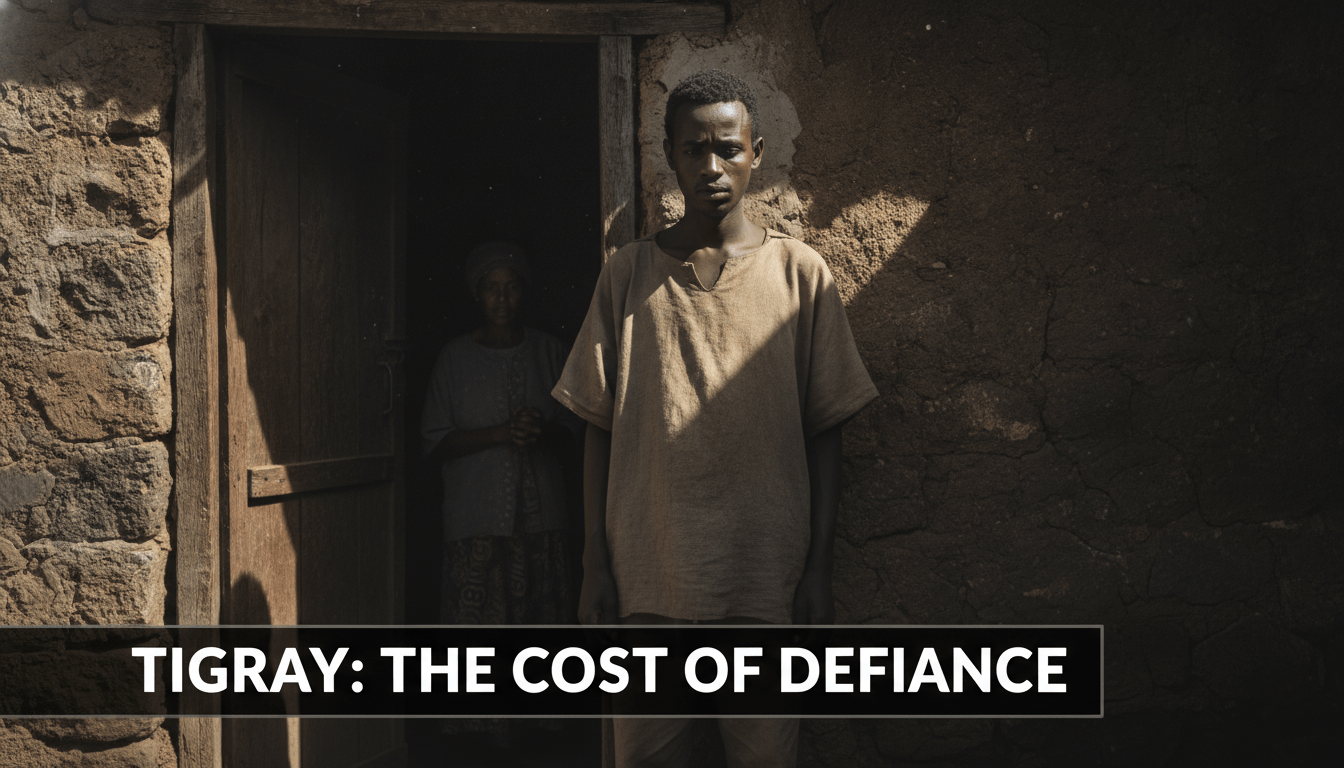
Facing political isolation and a potential federal offensive, the newly reinstated hardline administration enacted a severe mobilization law in early June 2026 (ethionegari.com). This legislation grants regional authorities sweeping powers to enforce military service on the civilian population (hrw.org). Security forces have conducted aggressive door-to-door roundups to find new recruits, forcing young people into service (hrw.org). These abusive tactics include targeting former combatants who had already returned to civilian life (hrw.org).
Furthermore, the law uses collective punishment to force compliance with the draft (hrw.org). If a young person evades the draft, authorities punish their parents or children instead (hrw.org). This harsh environment has triggered a massive flight of young people trying to escape involuntary servitude by fleeing to other parts of Ethiopia (hrw.org). The law also threatens draft evaders with twenty-five years in prison or the death penalty, creating a highly repressive system of mass incarceration for anyone who speaks out against the recruitment campaign.
Economic Blockades and Humanitarian Catastrophe
The federal government responded to the political defiance in Tigray by implementing severe financial and logistical measures (ethionegari.com). Addis Ababa suspended regional budget transfers, leaving thousands of civil servants without pay for months (thereporterethiopia.com). This budget freeze has completely paralyzed public services like water, sanitation, and education, creating an economic blockade (thereporterethiopia.com). Additionally, the federal authorities severely restricted fuel deliveries, completely suspending shipments since January 2026 (addisstandard.com).
This absolute lack of fuel has had a devastating impact on ordinary citizens. Emergency medical transport has stopped completely, preventing ambulances from delivering life-saving supplies to vulnerable populations (addisstandard.com). Major regional hospitals, such as the Ayder Referral Hospital, have reached a state of near-total operational collapse due to the lack of fuel and essential medicine (addisstandard.com). Thousands of displaced people in temporary shelters now face acute starvation without any access to international aid or basic services (reliefweb.int).
The Collapse of Regional Fuel Deliveries
The Role of the African Union
The African Union served as the primary broker and guarantor of the 2022 peace agreement (accord.org.za). Despite establishing a formal monitoring and verification mechanism to track disarmament and protect civilians, the body has faced severe criticism for its cautious approach to the current crisis (crisisgroup.org). Regional analysts argue that the organization has turned a blind eye to the unfulfilled provisions of the treaty, letting the peace process destabilize rapidly (crisisgroup.org). This passive stance has allowed tensions to rise without any active accountability.
In response to the new mobilization law, human rights organizations have called on the African Union to take action (hrw.org). They urge the continental body to deploy its monitoring team to investigate the reports of forced conscription and human rights abuses (hrw.org). International observers emphasize that the African Union must hold all parties accountable to prevent a return to full-scale war, which would have catastrophic consequences for the entire Horn of Africa.
The Global Diaspora and the Struggle for Justice
The Tigrayan diaspora has played a crucial role in bringing international attention to these human rights violations (hrw.org). Across the globe, advocacy networks have organized protests and lobbied Western governments to demand political justice and the restoration of basic services (hrw.org). These communities have consistently demanded the withdrawal of occupying forces and the return of displaced people (hrw.org). This mobilization of global networks reflects a broader struggle for self-determination and human dignity in the face of state repression.
In June 2026, the United States escalated its diplomatic response by imposing targeted visa restrictions on hardline regional leaders (substack.com). The State Department blamed these individuals for actively obstructing the peace process and escalating regional tensions (substack.com). While the regional administration rejected these measures, the sanctions demonstrated the power of international advocacy. This global pressure remains one of the few mechanisms available to protect vulnerable civilians in the region.
About the Author
Darius Spearman is a professor of Black Studies at San Diego City College, where he has been teaching for over 20 years. He is the founder of African Elements, a media platform dedicated to providing educational resources on the history and culture of the African diaspora. Through his work, Spearman aims to empower and educate by bringing historical context to contemporary issues affecting the Black community.
