

UK Racial Justice Protests: Exposing the True Crisis
By Darius Spearman (africanelements)
Support African Elements at patreon.com/africanelements and hear recent news in a single playlist. Additionally, you can gain early access to ad-free video content.
The Weight of History on Modern Law
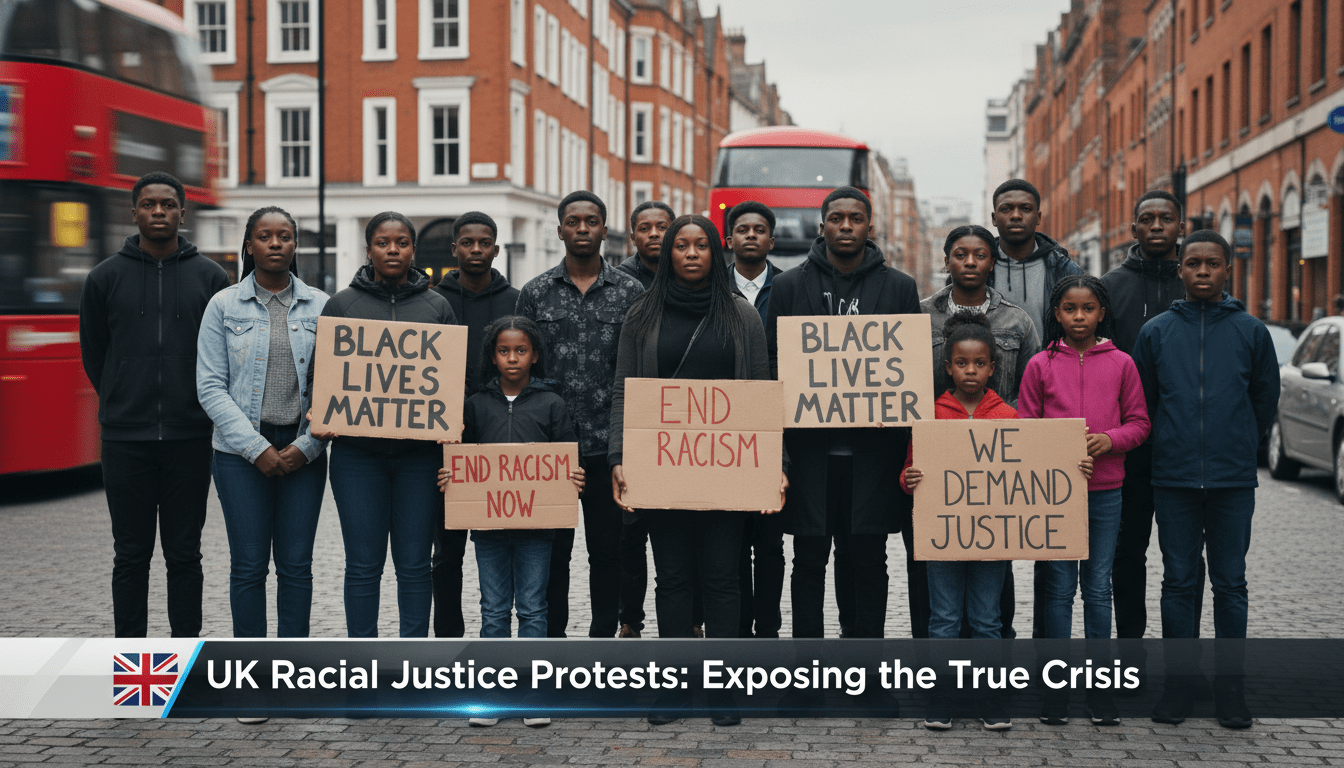
Activists across the United Kingdom are challenging the government today. They are directing their anger at the recent King’s Speech. This formal address outlines the legal agenda for the coming year. However, many community leaders say it ignores a deep crisis. Black British communities face rising living costs and systemic barriers. These protests are deeply connected to decades of unequal treatment. The British government invited Commonwealth citizens to rebuild after war. These people became known as the Windrush generation. They arrived holding British passports with dreams of equality. Yet, they faced an informal color bar in housing and jobs.
Tensions over economic marginalization culminated in the 1981 uprisings. Neighborhoods like Brixton and Handsworth erupted in major civil unrest. The subsequent Scarman Report acknowledged severe social and economic deprivation. Later, the 1999 Macpherson Report labeled the police institutionally racist. This history continues to shape the struggles seen in 2026. Current laws fail to protect marginalized groups from economic ruin. Therefore, protests emphasize the need to dismantle old systems entirely. Activists argue that recent policies only offer surface-level changes. They want a radical shift to address historical economic exclusion (parliament.uk, parliament.uk).
How the Hostile Environment Lingers Today
The Windrush Scandal exposed devastating flaws within British immigration policy. Introduced in 2012 by Theresa May, the Hostile Environment created hardship. It forced landlords and employers to check immigration paperwork constantly. The policy aimed to make staying in Britain incredibly difficult. As a result, legal Black British residents faced wrongful deportations. Many individuals lacked modern documentation because they arrived decades ago. They lost jobs and access to essential healthcare services rapidly. An independent review found the Home Office showed institutional ignorance. The current legislative agenda fails to reverse these harmful policies.
Activists specifically point to the controversial Right to Rent scheme. This law requires private landlords to verify prospective tenants’ statuses. Landlords face heavy fines if they rent to undocumented people. Consequently, this leads to widespread racial profiling by proxy. Landlords often reject applicants who appear foreign to avoid risks. Research shows that many landlords avoid tenants without British passports. This happens even when the applicants possess a legal right to stay. The scheme forces everyday citizens to act as unofficial border agents. It pushes many Black families into housing insecurity and homelessness (shelter.org.uk, publiclawproject.org.uk).
The Rising Cost of Living Burden
Black British communities are battling severe financial hardships right now. The wealth gap remains a persistent and crippling economic issue. Median household wealth for Black African families is £34,000. In contrast, White British households hold around £314,000 in wealth. This enormous gap leaves minority families vulnerable to economic shocks. The rising cost of living amplifies this stark financial divide. Activists criticize the King’s Speech for ignoring a wealth strategy. Instead, lawmakers focus heavily on broad energy independence goals.
Data shows 46 percent of Black families struggle with energy bills. They compare this to 32 percent of white households. Furthermore, real-term cash benefits for Black families have plummeted. These households lost £1,635 over the last ten years. Meanwhile, white families saw a decrease of only £454. Black individuals are 2.5 times more likely to experience poverty. Relative poverty measures inequality compared to the current median income. Absolute poverty measures the ability to afford basic living essentials. Black households experience disproportionate rates in both of these categories. The economic disparity creates a desperate situation for many people. Advocates demand solutions that specifically target these financial inequalities (endchildpoverty.org.uk, statisticsauthority.gov.uk).
Median Household Wealth Comparison
Policing, Suspicion, and the Demand for Truth
Racialized policing remains a volatile issue in the United Kingdom. Decades ago, the Sus laws terrorized young Black men. Police officers could arrest anyone based purely on mere suspicion. This aggressive tactic sparked major uprisings in the early 1980s. The law was eventually replaced by new police evidence acts. Today, activists see similar patterns in modern police practices. Black people remain 3.7 times more likely to face searches. Stop-and-search tactics deeply damage trust between communities and law enforcement. The 2023 Casey Review found the Metropolitan Police institutionally racist. Yet, Black men remain 3.3 times more likely to experience force.
Furthermore, Black individuals face mental health detentions four times more often. The 2026 King’s Speech introduced the Public Office Accountability Bill. This proposed law is widely known as the Hillsborough Law. It demands truthfulness from public officials during state inquiries. However, activists argue this duty must explicitly cover policing incidents. The law would make misleading the public a criminal offense. The Metropolitan Police still struggles with a culture of defensiveness. Advocates demand full transparency to prevent cover-ups in custody deaths (theguardian.com, libertyhumanrights.org.uk).
Stop and Search Disparity (Likelihood)
Why Representation Cannot Fix Systemic Flaws
Activists are exhausted by symbolic gestures from political leaders. The current agenda introduces the Equality Race and Disability Bill. This legislation mandates that large companies report their ethnicity pay gaps. However, community leaders call this measure entirely insufficient today. Reporting a problem does not magically fix the underlying discrimination. Black workers face an annual pay gap of £3,200. They earn less than white peers with the exact same qualifications. Organizers demand actionable steps rather than mere data collection.
Systemic racism requires robust economic interventions and strict legal penalties. Acknowledging a pay gap is meaningless without enforcing equal compensation. The failure to address this economic violence frustrates many advocates. They recognize that these symbolic laws maintain the unequal status quo. True progress demands tearing down structural barriers in the workplace. Activists often examine how Black workers fought for economic justice historically. This historical perspective fuels their demands for fair labor practices. Communities require massive wealth redistribution to survive the current economy. Data collection alone will never feed a starving family. Lawmakers must create enforceable standards for equitable pay. Activists refuse to accept legislation that lacks real economic teeth (ebsco.com, davidsonmorris.com).
Black Britain Demands a Complete Overhaul
The Black Equity Organisation launched a comprehensive policy blueprint recently. Known as Black Britain’s Mandate, it lists clear governmental demands. This plan calls for the full implementation of the Lammy Review. That 2017 review addressed profound racial bias in criminal justice. Several crucial recommendations remain completely stalled or superficially addressed today. For example, the Explain or Reform principle lacks consistent enforcement. This rule requires institutions to explain racial disparities or enact change. Additionally, the mandate demands a total overhaul of police surveillance.
Databases like the Gang Matrix disproportionately target ethnic minority youth. Activists want the government to scrap these discriminatory tools immediately. The mandate also targets unfair legal practices like Joint Enterprise prosecutions. These controversial laws disproportionately criminalize young Black men in groups. Beyond the justice system, the mandate prioritizes healthcare equality. It demands an urgent integration of anti-racist frameworks into hospitals. Black women are nearly four times more likely to die during childbirth. The government continues to ignore these urgent medical demands. Protesters will not stop until lawmakers codify these vital protections (irr.org.uk, russellwebster.com).
The Threat of Right-Wing Resurgence
A significant political shift is causing intense anxiety right now. The recent elections saw a massive surge for Reform UK. This right-wing populist party emerged originally from the Brexit Party. Their platform promotes a strictly nativist and isolationist agenda. Community leaders fear this signals a dangerous return to overt racism. Reform UK advocates for freezing non-essential immigration entirely. They also demand that Britain leave the European Convention on Human Rights. Furthermore, they want to eliminate diversity, equity, and inclusion regulations.
The party uses hostile rhetoric against so-called woke ideology. Their growing popularity normalizes aggressive language against minority groups. Activists state that the government is pandering to this extreme faction. Lawmakers seem more focused on appeasing populists than protecting citizens. Consequently, community organizers are staging massive unity marches across Britain. They refuse to accept a two-tier view of national citizenship. Activists constantly analyze the intersection of Black politics and anti-Black politics within this changing landscape. The rhetoric justifies aggressive border policies and discriminatory legislation. Black communities understand that political complacency leads to dangerous consequences. They are actively organizing to defend their hard-won civil rights (wikipedia.org, theweek.com).
A Shared Struggle Across the Diaspora
The Black British experience shares deep connections with African Americans. Both groups fight relentless battles against deeply entrenched systemic oppression. However, their historical trajectories contain unique and important distinctions. The American struggle centers heavily on domestic chattel slavery legacies. In contrast, the UK fight focuses on post-colonial migration rights. Citizens of the former empire demanded their basic right to belong. Still, the movements inspire and empower each other significantly. The 1963 Bristol Bus Boycott clearly demonstrated this powerful connection.
Activist Paul Stephenson led a massive campaign against a transport company. The company had refused to interview Guy Bailey simply because of his race. This historic protest took direct inspiration from the United States. It ultimately led to the first British Race Relations Act. Solidarity remains a vital tool for marginalized communities worldwide. Organizers understand that global oppression requires a unified global response. By sharing strategies, activists build stronger coalitions across oceans. They often find that Black solidarity with Palestine stems from shared struggles. Examining these global ties reveals the interconnected nature of systemic racism (youtube.com, radicalteatowel.co.uk).
Struggling to Afford Energy Bills (2026)
Seeking Real Justice Over Empty Promises
The protests against the King’s Speech signify a critical turning point. Activists are no longer asking politicians merely to acknowledge racism. They demand the absolute deconstruction of systems that sustain it. High rent costs push families into a state of permanent destitution. Average private rents reached astronomical levels in late 2025. BEO research indicates Black communities spend up to 45 percent of their income on housing. Unsurprisingly, Black individuals are 3.5 times more likely to face homelessness.
Thirty percent of Black Caribbean households currently live in net debt. Activists desperately demand rent caps to survive this economic crisis. They also want more protections for vulnerable social housing tenants. The government has ignored these pleas in recent legislative sessions. This failure perpetuates a devastating cycle of economic exclusion. Modern protests target the intersection of race and wealth directly. As the global economy shifts, marginalized groups face the harshest impacts. Many analysts note that Africa’s rising debt crisis mirrors these domestic economic struggles. Ultimately, the fight for racial justice is fundamentally an economic battle. Without wealth equity, legislative promises remain empty and utterly useless (habitatforhumanity.org.uk).
About the Author
Darius Spearman is a professor of Black Studies at San Diego City College, where he has been teaching for over 20 years. He is the founder of African Elements, a media platform dedicated to providing educational resources on the history and culture of the African diaspora. Through his work, Spearman aims to empower and educate by bringing historical context to contemporary issues affecting the Black community.
