



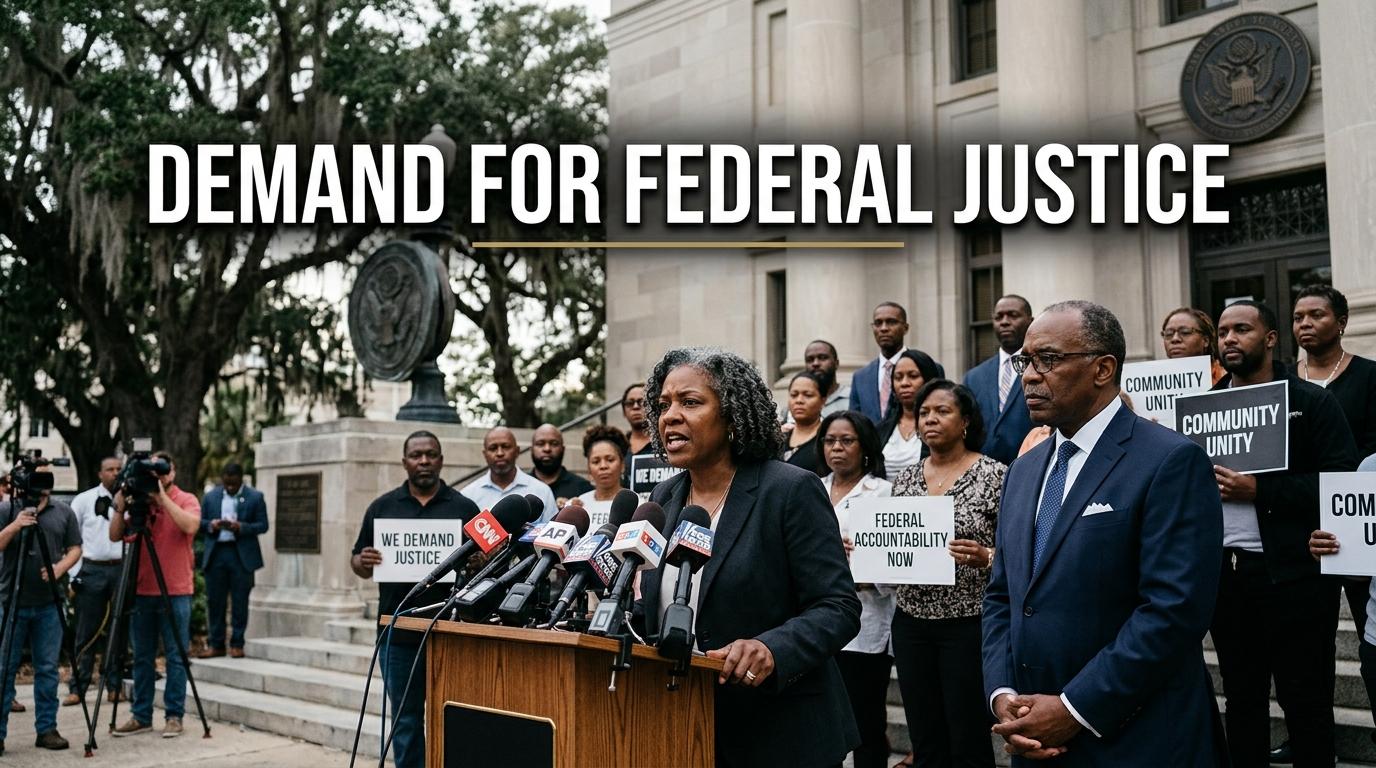
Unexplained Mississippi Hanging Death Sparks Federal Demand
By Darius Spearman (africanelements)
Support African Elements at patreon.com/africanelements and hear recent news in a single playlist. Additionally, you can gain early access to ad-free video content.
On August 3, 2026, police officers in Jackson, Mississippi discovered the body of Tasia Fortune hanging from a tree behind an abandoned house (capitalbnews.org, newsfromthestates.com). The twenty-nine-year-old mother was located in an overgrown yard in West Jackson (newsfromthestates.com). The discovery immediately shook the local residential community (newsfromthestates.com). The Hinds County Coroner identified Fortune three days after law enforcement officers arrived at the scene (capitalbnews.org, newsfromthestates.com). Family members instantly rejected any suggestion of self-harm (capitalbnews.org). Her mother and aunt publicly stated that Fortune did not end her own life (capitalbnews.org).
This tragic discovery occurred during a period of heightened apprehension across the state (capitalbnews.org). Civil rights leaders highlighted that Fortune was the third Black resident found hanging in Mississippi within twelve months (capitalbnews.org, newsfromthestates.com). Activists and relatives immediately demanded a full federal investigation (capitalbnews.org, newsfromthestates.com). Civil rights attorney Ben Crump joined Jackson City Councilman Kenneth Stokes to request federal intervention (newsfromthestates.com). They submitted formal requests to the United States Attorney’s Office and the Department of Justice (newsfromthestates.com). Community leaders emphasized that local authorities cannot deliver an objective investigation (capitalbnews.org, newsfromthestates.com).
The Circumstances Surrounding the Death of Tasia Fortune
The physical location of the incident carries deep neighborhood significance (newsfromthestates.com). Police officers found Fortune in the 500 block of Road of Remembrance in West Jackson (newsfromthestates.com). The area sits within the 39209 ZIP code, a historically Black residential neighborhood (newsfromthestates.com). The body was suspended behind a vacant home adjacent to a public municipal park (newsfromthestates.com). Coroners transferred Fortune to the Mississippi State Medical Examiner’s Office for an official autopsy (newsfromthestates.com). Local law enforcement officers maintained an active death investigation while withholding detailed public reports (newsfromthestates.com).
The lack of immediate official answers fueled intense community frustration (capitalbnews.org, newsfromthestates.com). Fortune had recently returned from a family reunion in Kentucky prior to her death (newsfromthestates.com). Relatives described her as a devoted mother of four young children (newsfromthestates.com). Family members stated that she had no prior history of severe emotional distress (newsfromthestates.com). Community members gathered near the scene to demand accountability from municipal authorities (capitalbnews.org, newsfromthestates.com). Public frustration reflects broader concerns regarding how municipal police departments handle suspicious deaths involving Black residents (capitalbnews.org, newsfromthestates.com).
A Disturbed Pattern of Recent Hanging Deaths
The death of Tasia Fortune is not an isolated event in recent Mississippi history (capitalbnews.org, newsfromthestates.com). In September 2025, authorities discovered Demartravion “Trey” Reed hanging from a tree on campus grounds (newsfromthestates.com, newsfromthestates.com). The twenty-one-year-old student-athlete was found at Delta State University in Cleveland, Mississippi (newsfromthestates.com, newsfromthestates.com). Local police officers reported no initial evidence of physical struggle at the scene (newsfromthestates.com). However, the family of Reed hired independent forensic experts to perform a private autopsy (newsfromthestates.com). Student groups organized rallies across campus to demand investigative transparency (newsfromthestates.com).
During that same month in September 2025, authorities discovered Cory Zukatis hanging in Vicksburg, Mississippi (newsfromthestates.com). Officials found the thirty-six-year-old Black man in a heavily wooded area (newsfromthestates.com). Local police initiated a basic death investigation without declaring potential foul play (newsfromthestates.com). The occurrence of three similar deaths within less than twelve months created deep alarm across Black communities (capitalbnews.org, newsfromthestates.com). Community organizers noted that local police departments frequently classify outdoor hanging deaths as suicides within hours of discovery (capitalbnews.org, eji.org). This rapid classification often occurs before toxicological reports or forensic tests are completed (capitalbnews.org, eji.org).
Historical Legacy of Racial Terror Lynchings in Mississippi
To understand why hanging deaths provoke immediate outrage, one must examine state history (capitalbnews.org, eji.org). Mississippi carries a documented legacy of racial terror violence against Black residents (eji.org). Data compiled by the Equal Justice Initiative demonstrates that Mississippi recorded more lynchings than any other state in the nation (eji.org). Historical records document at least 581 to 656 extrajudicial lynchings between 1877 and 1950 (eji.org, eji.org). Hinds County, where Jackson is situated, recorded twenty-two lynchings during this era (eji.org). That figure represents the highest recorded total of any individual county in Mississippi (eji.org).
Racial terror lynchings functioned as explicit mechanisms of white supremacy (eji.org, ferris.edu). Mobs executed Black men, women, and children to suppress political rights and economic independence (eji.org, ferris.edu). Displaying bodies in public spaces served as an intentional form of psychological terrorism (eji.org, ferris.edu). This historical trauma remains vivid in the collective memory of Black Mississippians (capitalbnews.org, eji.org). When a Black person is found hanging outdoors today, community members remember generations of unpunished violence (capitalbnews.org, eji.org). Recognizing these historical roots helps illuminate modern demands for federal scrutiny.
From Reconstruction Collapse to Institutional Cover-Ups
The historical origins of systemic impunity trace back to the end of the Reconstruction Era (wikipedia.org, britannica.com). Between 1865 and 1877, the federal government protected the constitutional rights of newly freed African Americans (wikipedia.org). The passage of the Reconstruction Amendments established voting rights and equal legal protection under federal law (wikipedia.org). However, federal military enforcement ended following federal political compromises in 1877 (wikipedia.org, britannica.com). White Southern political leaders re-established authority by enacting state Jim Crow laws (britannica.com, ferris.edu). Black communities subsequently endured systemic violence after emancipation without federal protection (ferris.edu).
During the Jim Crow era, local judicial systems routinely protected perpetrators of racial violence (eji.org, eji.org). Local coroners conducted superficial legal proceedings known as inquests (eji.org, eji.org). Inquests were formal legal inquiries designed to determine how an unexplained death occurred (eji.org). Local coroners’ juries regularly ruled that lynching victims died at the hands of “parties unknown” (eji.org, eji.org). Officials routinely classified violent homicides as self-inflicted suicides or accidents to shield white citizens from criminal prosecution (eji.org, eji.org). This long history established an enduring community distrust of local law enforcement institutions (capitalbnews.org, eji.org).
Modern Civil Rights Advocacy and The Crimson Record
Modern civil rights organizations actively work to document suspicious deaths across the American South (capitalbnews.org, julianfreedom.org). Attorney Jill Collen Jefferson founded the legal advocacy organization JULIAN in 2020 (julianfreedom.org). She named the non-profit group in honor of legendary civil rights leader Julian Bond (julianfreedom.org). JULIAN investigates modern hanging deaths, suspicious drownings, and unexamined racial hate crimes (julianfreedom.org, chicagocrusader.com). In 2026, the organization published a comprehensive investigative report titled “The Crimson Record” (chicagocrusader.com). The report documented over seventy suspected modern-day lynchings across seven Southern states since the year 2000 (chicagocrusader.com).
JULIAN identified at least twenty suspicious hanging cases in Mississippi alone during that period (chicagocrusader.com). The organization established four specific investigative criteria to evaluate whether a death represents a potential lynching (chicagocrusader.com). First, investigators evaluate whether the body was suspended in an outdoor or abandoned space (chicagocrusader.com). Second, they look for physical trauma or defensive wounds that contradict initial suicide findings (chicagocrusader.com). Third, they examine whether the victim experienced prior racial harassment or disputes with law enforcement (chicagocrusader.com). Fourth, they document procedural failures, such as rapid crime scene clearance by municipal police (chicagocrusader.com). These criteria help activists challenge premature suicide classifications.
Federal Law and the Emmett Till Anti-Lynching Act
The historical struggle against extrajudicial murder reached a landmark legislative milestone in 2022 (time.com, govinfo.gov). President Joe Biden signed the Emmett Till Anti-Lynching Act into federal law on March 29, 2022 (time.com, govinfo.gov). The statute honors fourteen-year-old Emmett Till, who was brutally murdered in Money, Mississippi in 1955 (time.com, nps.gov). The law amends Title 18, Section 249 of the United States Code (govinfo.gov). It explicitly defines lynching as a specific federal hate crime (govinfo.gov). The legislation imposes criminal penalties of up to thirty years in federal prison for individuals who conspire to commit racially motivated violence resulting in death or serious injury (govinfo.gov).
The passage of this federal law fundamentally changed jurisdictional authority in suspicious death cases (govinfo.gov). Prior to 2022, federal authorities often deferred to state law enforcement officers (govinfo.gov). Under the updated statutory framework, the Department of Justice Civil Rights Division possesses direct authority to investigate potential lynchings (govinfo.gov). This federal authority provides civil rights attorneys with a clear legal mechanism to bypass local police agencies (capitalbnews.org, govinfo.gov). The statutory structure directly addresses historical tensions between state and federal power in civil rights enforcement (govinfo.gov).
The Strategic Imperative for Independent Investigations
Community advocates stress that independent federal oversight is necessary to restore public faith in local justice systems (capitalbnews.org, newsfromthestates.com). Local police departments frequently lack the specialized forensic training required to investigate potential hate crimes properly (capitalbnews.org, chicagocrusader.com). Furthermore, historical friction between law enforcement agencies and Black residents creates structural barriers to trust (capitalbnews.org, aclu-ms.org). When local officers declare an outdoor hanging a suicide within hours, public skepticism deepens significantly (capitalbnews.org, eji.org). The historical evolution of law enforcement practices shows how local systems often prioritize closing cases quickly over exhaustive investigation (aclu-ms.org).
Federal intervention ensures that independent forensic experts, FBI agents, and federal prosecutors examine physical evidence (newsfromthestates.com, fbi.gov). In the case of Tasia Fortune, civil rights attorneys continue pushing for full disclosure of state autopsy reports and surveillance footage (capitalbnews.org, newsfromthestates.com). Activists argue that every suspicious death must receive thorough forensic scrutiny before local officials close the file (capitalbnews.org, chicagocrusader.com). Adopting a effective political strategy for Black communities involves demanding accountability at state and federal levels (capitalbnews.org, newsfromthestates.com). True justice requires replacing historical secrecy with complete procedural transparency (capitalbnews.org, newsfromthestates.com).
About the Author
Darius Spearman is a professor of Black Studies at San Diego City College, where he has been teaching for over 20 years. He is the founder of African Elements, a media platform dedicated to providing educational resources on the history and culture of the African diaspora. Through his work, Spearman aims to empower and educate by bringing historical context to contemporary issues affecting the Black community.
