

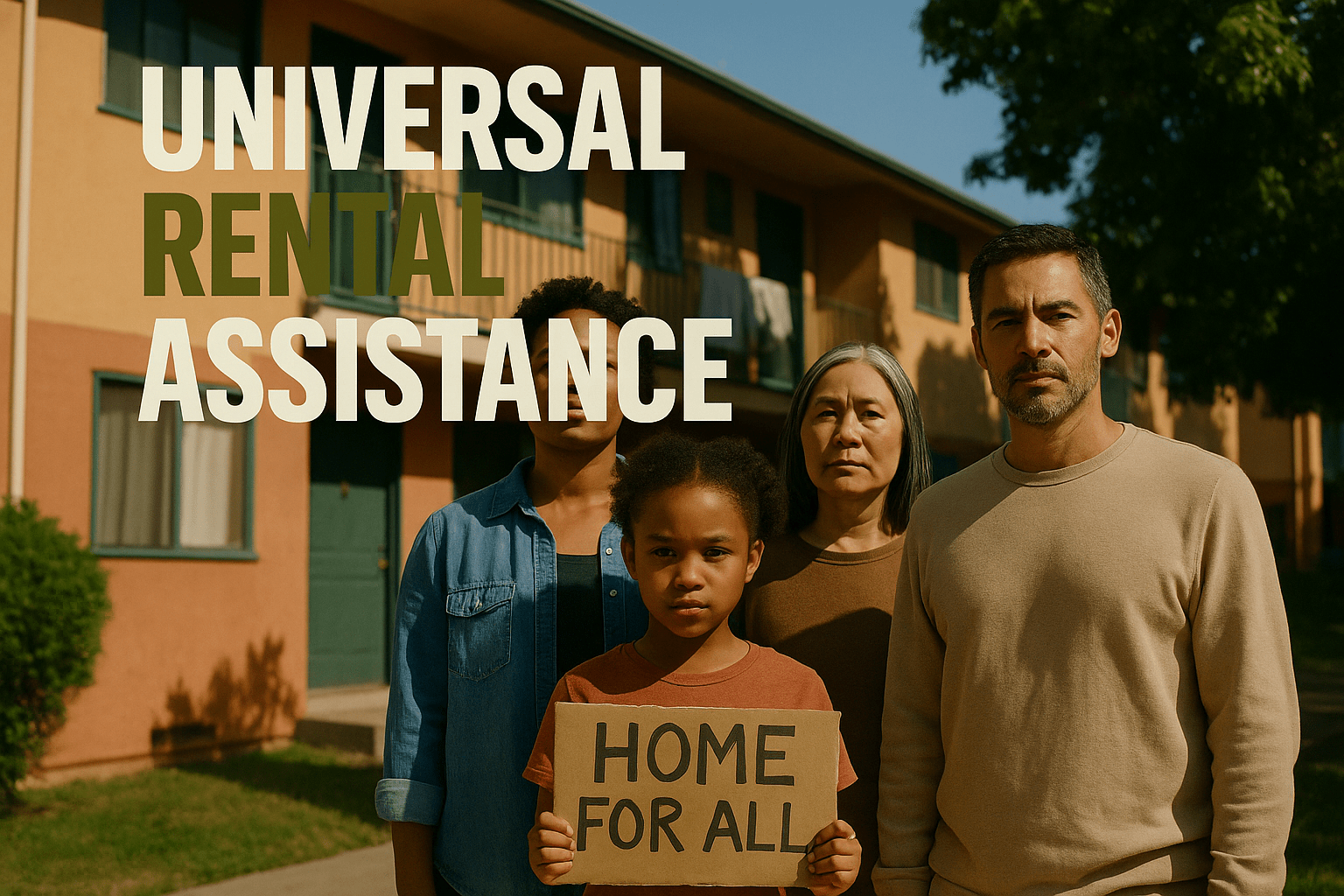
Universal Rental Assistance: Housing Solutions
By Darius Spearman (africanelements)
Support African Elements at patreon.com/africanelements and hear recent news in a single playlist. Additionally, you can gain early access to ad-free video content.
The Housing Affordability Crisis
Across the United States, many people agree that housing costs are far too high. This widespread concern highlights a significant challenge for families and individuals trying to secure stable living situations. The core of this housing crisis is not simply a lack of available homes, but rather a deep-seated problem of affordability (news.ku.edu). While some experts point to a housing shortfall, especially in the affordable housing sector, the main issue remains that low incomes struggle against high housing prices (news.ku.edu).
The financial strain on households is clear. A household is considered “cost-burdened” if they spend more than 30 percent of their income on housing costs (americanprogress.org). Furthermore, if they spend more than 50 percent of their income on housing, they are deemed “severely cost-burdened” (pmc.ncbi.nlm.nih.gov). In 2023, a staggering 7 million households with incomes below the poverty line paid more than half their income for rent (cbpp.org). These households averaged only $748 a month in income. To reduce their rent to 30 percent of their income, they would need to pay no more than $224 a month, which is less than half of what a landlord needs to cover operating costs (cbpp.org). Approximately 40 percent of Americans making 80 percent or less of the local median income are severely cost-burdened (pmc.ncbi.nlm.nih.gov).
Housing Cost Burden in the U.S.
Understanding the Housing Shortage
While the term “housing shortage” is often used, it is important to understand what it truly means. The housing shortage refers to a deficit in the overall number of available housing units (digitalcommons.unl.edu). However, the “affordable housing shortage” specifically refers to the lack of housing units that are affordable to low-income households (digitalcommons.unl.edu). These two figures represent different aspects of the housing crisis. For instance, one estimate suggests the U.S. housing shortage was 20.1 million homes in 2021, considering the difference between homes built and those that would be built without supply constraints (econstor.eu).
Despite varying estimates of the overall housing shortage, research indicates there is no general shortage of housing units across the board (theconversation.com). Instead, there is a significant gap between the number of low-income households and the number of affordable housing units available to them (theconversation.com). The National Low Income Housing Coalition estimates that in 2022, only 7.1 million rental units were available for the 11 million extremely low-income households nationwide (brookings.edu). This indicates a significant supply-demand imbalance specifically in the affordable housing sector (brookings.edu). The supply of low-cost housing has decreased, and new construction has largely targeted the higher end of the market (americanprogress.org). Between 2011 and 2017, the number of housing units renting for less than $600 a month fell by 3.1 million (americanprogress.org). Even a 25 percent across-the-board rent reduction would still leave nearly one-third of all renters cost-burdened and would disproportionately benefit affluent renters over low-income households (theconversation.com).
Rental Assistance: A Proven Solution
A proven method for making housing affordable for low-income households is rental assistance, such as Housing Choice Vouchers (pmc.ncbi.nlm.nih.gov). These programs are crucial for cost-burdened low-income households (pmc.ncbi.nlm.nih.gov). The Housing Choice Voucher (HCV) program, also known as Section 8, provides rental assistance to eligible low-income families, older people, and people with disabilities (nlihc.org). This allows them to choose housing in the private market, with rent payments capped at 30 percent of their income (nlihc.org).
Another form of assistance is Project-Based Rental Assistance (PBRA), which is tied to specific housing units rather than to the individual tenant (pmc.ncbi.nlm.nih.gov). While HCVs offer tenants the flexibility to move, private landlords are not required to accept them, which can limit their effectiveness (nlihc.org). Reforms are needed to ensure that voucher recipients can successfully use their vouchers to secure housing (nlihc.org). Expanding rental assistance to all eligible low-income households would be more cost-effective than solely focusing on new construction to lower prices (news.ku.edu). Increasing supply alone will not make housing affordable for families at very low-income levels (cbpp.org).
The Unmet Need for Rental Assistance
Despite the proven effectiveness of rental assistance programs, they do not reach all eligible households due to funding limitations (theconversation.com). The number of households participating in deep housing subsidy programs, including Housing Choice Vouchers, public housing, and project-based rental assistance, has increased by less than 2 percent since 2014 (theconversation.com). These programs currently serve only 25 percent of all eligible households (theconversation.com).
Unlike Social Security or Medicare, rental assistance is not an entitlement (theconversation.com). The number of recipients is limited by annual Congressional appropriations, which have historically been insufficient to meet the need (theconversation.com). Universal rental assistance, as proposed by the “Ending Homelessness Act of 2023” (H.R.4232), would establish a program enabling all eligible households to receive rental assistance (nlihc.org). This differs from current programs by aiming for comprehensive coverage rather than limited, competitive access (nlihc.org). Refundable tax credits can also help millions of cost-burdened renters who are eligible for federal assistance but do not receive it due to inadequate federal funding (nlihc.org).
Rental Assistance Reach: Eligible vs. Served Households
The Cost of Universal Rental Assistance
Expanding rental assistance to all eligible low-income households would indeed be costly (theconversation.com). The Urban Institute estimates that universal rental assistance would cost about $118 billion a year (theconversation.com). However, this figure is comparable to existing tax expenditures for homeowners, which are essentially subsidies provided through tax breaks (theconversation.com). Tax expenditures for homeowners include benefits like mortgage interest deductions, state and local tax deductions, and capital gains exemption on home sales (theconversation.com).
In fiscal year 2025, these tax expenditures for homeowners totaled $95.4 billion (theconversation.com). It is important to note that over 70 percent of all mortgage-interest tax deductions in 2024 went to homeowners earning at least $200,000 (theconversation.com). This indicates that these subsidies primarily benefit higher-income households (theconversation.com). Broadening the availability of rental subsidies would have other benefits, such as saving federal, state, and local governments billions of dollars in homeless services. Additionally, automatic provision of rental subsidies would reduce the need for additional subsidies to finance new affordable housing.
Annual Costs: Universal Rental Assistance vs. Homeowner Tax Expenditures
A Legacy of Disparity: Housing and Black Communities
The housing crisis has historically had a disproportionate impact on marginalized communities, including African Americans (opportunityhome.org). Discriminatory practices have played a significant role in creating and perpetuating these disparities. For example, the Federal Housing Administration (FHA) subsidized home builders that were mass-producing subdivisions exclusively for white people (opportunityhome.org). These federally supported homes were explicitly prohibited from being sold to people of color (opportunityhome.org).
This history of discrimination led to the spatial isolation of people of color, which in turn allowed policymakers to devalue and disinvest in these communities (opportunityhome.org). As a result, Black communities were denied equal access to quality housing, adequate school funding, and good job opportunities (opportunityhome.org).
ABOUT THE AUTHOR
Darius Spearman has been a professor of Black Studies at San Diego City College since 2007. He is the author of several books, including Between The Color Lines: A History of African Americans on the California Frontier Through 1890. You can visit Darius online at africanelements.org.
