



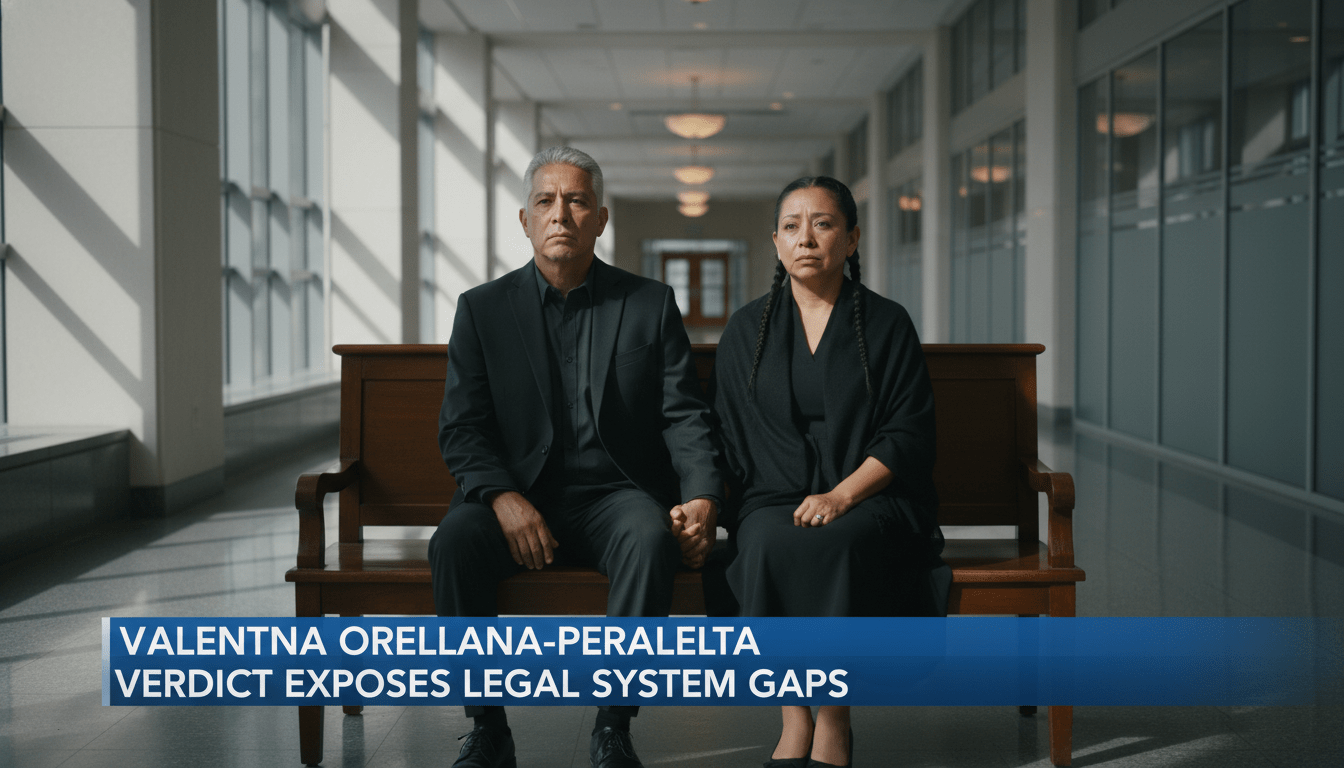
Valentina Orellana-Peralta Verdict Exposes Legal System Gaps
By Darius Spearman (africanelements)
Support African Elements at patreon.com/africanelements and hear recent news in a single playlist. Additionally, you can gain early access to ad-free video content.
A Los Angeles jury recently reached a shocking decision. They found the city not liable for a tragic death. A police officer fired a stray bullet in 2021. This bullet killed a fourteen-year-old girl named Valentina Orellana-Peralta. The verdict arrived on May 7, 2026. Social media immediately erupted with viral outrage. People demanded renewed justice for the grieving family. However, the legal system relies on complex historical rules. These rules often protect law enforcement officers from civil liability.
The Tragic Incident In North Hollywood
The devastating event happened in late 2021. Valentina Orellana-Peralta was shopping with her mother. They were inside a Burlington store in North Hollywood. They were trying on Christmas dresses in a fitting room. Outside the fitting room, chaos unfolded rapidly. A twenty-four-year-old suspect named Daniel Elena-Lopez was attacking customers. He had an extensive criminal history including domestic battery. He used a heavy metal bicycle lock to strike people viciously. The suspect also carried a thick metal cable during the assault (latimes.com).
Early 911 calls incorrectly suggested the suspect had a gun. Panicked shoppers told dispatchers they heard gunshots inside the store. Los Angeles Police Department Officer William Jones arrived at the scene. He brought a high-powered rifle into the crowded retail environment. Officer Jones rushed past his fellow officers to lead the search. He fired his weapon multiple times at the suspect. One bullet skipped off the floor and pierced the wall. It struck and killed Valentina in her mother’s arms. The suspect was also fatally shot during the encounter. Investigators later confirmed the suspect did not possess a firearm (lapdonline.org, cbsnews.com).
The Origin Of Civil Rights Lawsuits
The legal tools used to sue police have deep roots. Citizens use a specific federal law to seek justice today. This law is known as Title 42 of the United States Code Section 1983. It actually originated from the Civil Rights Act of 1871. People often call this historic legislation the Ku Klux Klan Act. Congress created it right after the Civil War ended. The original goal was to protect Black Americans from white supremacist violence. Paramilitary vigilantism ran rampant across the South during the Reconstruction era. The federal government needed a way to guarantee equal protection rights. Section 1983 empowered individuals to seek justice in federal courts (suffolk.edu, brennancenter.org).
The law remained mostly unused for almost a century. Civil rights attorneys rarely found success with it before the 1960s. It became a powerful tool during the Civil Rights movement. The political narrative surrounding civil rights shifted significantly during that time. The era of mass incarceration followed soon after, creating new challenges. A major Supreme Court case changed everything in 1961. The case of Monroe versus Pape revived the 1871 statute. It allowed individuals to sue municipal officers in federal court. Officers can face lawsuits for acting under color of law. This means they abuse the power granted by their government position (wikipedia.org, uscourts.gov).
The Objective Reasonableness Standard
Modern police shooting cases rely on specific legal standards. The most critical historical moment happened in 1989. The Supreme Court decided the case of Graham versus Connor. This ruling established the standard of objective reasonableness. A jury must judge an officer based on the situation. They must look from the perspective of a reasonable officer. They can never use the benefit of hindsight or calm reflection. The court acknowledged that police work is incredibly dangerous. Officers must make split-second decisions in tense and rapidly changing circumstances. This standard gives law enforcement significant leeway during emergencies (aele.org, uscourts.gov).
Accidental shootings of bystanders present another complex legal challenge. A separate 1989 case created a massive hurdle for families. The Supreme Court ruled in Brower versus County of Inyo. The court stated a seizure requires intentional physical restraint. An officer must intentionally apply force to stop a specific person. If an officer did not intend to hit a bystander, lawsuits fail. The law rarely recognizes accidental bystander shootings as civil rights violations (uscourts.gov).
Qualified Immunity And The Legal Shield
Qualified immunity provides another massive layer of protection. This judicial doctrine shields government officials from personal financial liability. An official is only liable if they violate a clearly established right. The law must be incredibly specific about the illegal conduct. A reasonable official must have known their actions were wrong. The Supreme Court established this doctrine to protect public servants. They wanted to shield officers from frivolous lawsuits and financial ruin (brennancenter.org).
It is incredibly difficult to find past cases matching exact circumstances. Every police encounter features unique and unpredictable elements. Shooting through a fitting room wall is a highly specific event. There is no historical legal precedent detailing this exact tragic scenario. Therefore, courts often grant officers immunity from these civil lawsuits. Qualified immunity continues to face heavy criticism from legal scholars today. The system creates an immense burden for grieving families. They must prove the officer violated an already documented legal precedent (aele.org).
Disproportionate Impacts On Minority Communities
The legal shield protecting officers disproportionately affects communities of color. The statistics surrounding police use of force remain incredibly alarming. Data from the Police Scorecard highlights a severe racial disparity. In Los Angeles, the numbers paint a deeply concerning picture. Between 2013 and 2023, Black residents faced drastically higher risks. A Black person was over four times more likely to be killed by police compared to a white person (policebrutalitycenter.org).
Latinx individuals also faced more than double the risk. Valentina Orellana-Peralta represents a tragic addition to these devastating statistics. These numbers reflect systemic issues within law enforcement practices. The disparities create deep distrust between the police and local communities. Families of color often feel the justice system ignores their pain. They face an uphill battle when seeking accountability for their loved ones. The legal precedents continue to heavily favor the officers involved (amnesty.org).
A Higher Standard In California
California attempted to create stricter rules for police officers. Lawmakers passed Assembly Bill 392 in 2019 after intense public pressure. This legislation fundamentally changed the state standard for using deadly force. Officers previously operated under the more forgiving reasonable standard of force. The new law requires deadly force to be absolutely necessary. The officer must use it only in defense of human life. The threat of death or serious bodily injury must be imminent (davisvanguard.org).
The civil trial focused heavily on this new state standard. The defense argued the officer was never negligent in his duties. They claimed he reasonably believed he faced an active shooter. The 911 reports mentioned a possible firearm in the store. The jury ultimately sided with the defense team after long deliberations. They delivered a nine to three split verdict on May 7, 2026. They found the officer acted reasonably under the intense circumstances (latimes.com).
The Financial Reality Of Police Misconduct
Many people wonder why officers rarely face severe penalties. The statistics reveal a shocking reality about police litigation across America. Winning a jury verdict against the police remains extremely rare. Civilian complaints of police misconduct rarely result in sustained internal findings. Between 2016 and 2022, civilians filed thousands of formal complaints. Black folks did about it by organizing and seeking justice through every available channel. However, only five percent of over seventeen thousand complaints were sustained (policebrutalitycenter.org, latimes.com).
The city does spend massive amounts on police misconduct. Los Angeles paid over one hundred ninety million dollars recently. These massive payments occurred between the years 2005 and 2018. The vast majority of these payments are pre-trial legal settlements. The city settles to avoid the unpredictable nature of jury trials. They want to prevent massive financial payouts awarded by angry jurors. The family of Valentina Orellana-Peralta refused to settle their case. They boldly sought one hundred million dollars in their wrongful death lawsuit (stritmatter.com, latimes.com).
Social Media Outrage Meets Legal Reality
The May 2026 verdict awarded zero dollars to the grieving family. This shocking outcome caused immense pain for the parents. Their legal team expressed sheer devastation after the final decision. The public reacted with viral outrage across various social media platforms (youtube.com). People demanded immediate reforms to the entire criminal justice system. Activists organized protests to highlight the lack of accountability. The public sentiment deeply conflicts with the current legal reality.
The legal system historically focuses on strict procedural rules. It asks whether the officer followed departmental policy and training guidelines. It frequently ignores the tragic outcome of an innocent child’s death. Many advocates believe the legal framework remains fundamentally broken today. The system aggressively prioritizes the discretionary power of the state. Stories of Black family strength show incredible resilience against these historical injustices. Families continue to fight against these heavily weighted judicial systems.
Criminal Charges And Internal Investigations
The lack of a civil payout is a bitter pill. The family also faced profound disappointment in the criminal justice system. Officer Jones never faced any criminal charges for the deaths. The California Department of Justice spent years investigating the deadly incident. They concluded their comprehensive review in April 2024. The Attorney General determined there was insufficient evidence for a prosecution. They simply could not meet the burden of proof required (usgovcloudapi.net, latimes.com).
Investigators were unable to prove the officer acted with criminal intent. They could not prove he acted without a desire to defend himself. The state report recommended updated training for the police department. It found the officer’s fear of an imminent threat was legally reasonable. However, the internal police review board did find parts problematic. The board stated the officer fired multiple shots without assessing the threat. The internal policies require a strict reverence for human life (lexipol.com, lapdonline.org).
The Impact Of Police Militarization In Retail Spaces
The use of a high-powered rifle in a department store shocked many. Los Angeles Police Department policy allows the deployment of urban police rifles. Officers can use weapons like the AR-15 in active shooter scenarios. These weapons provide a distinct ballistic advantage against heavily armed suspects. However, deploying them in crowded retail environments carries immense inherent risks. The high-velocity bullets easily penetrate standard building materials and interior walls. This dangerous reality played a central role in the tragic shooting (powerdms.com).
Department policy explicitly requires officers to deeply consider their surroundings. They must carefully evaluate the potential risks to innocent bystanders nearby. The reverence for human life must serve as the fundamental guiding principle. The internal review determined the officer failed to properly assess his backdrop. He fired multiple rounds blindly toward a solid fitting room wall. Despite these internal findings, the civil jury still ruled in his favor. This stark contrast perfectly illustrates the complexity of holding police accountable (lapdonline.org).
Moving Forward With Accountability
The legacy of the Orellana-Peralta case leaves many unanswered questions. It highlights a massive gap between public morality and established law. Communities continue to organize and demand meaningful changes to these legal protections. The Civil Rights and Black Power movements faced similar legal hurdles decades ago. Activists stress the need for continued legislative reform across the entire nation. They want to dismantle the barriers preventing true legal accountability (brennancenter.org).
Changing the standard of force in California was a vital step. However, the trial proves that state laws often yield to federal precedents. The historical ghosts of past Supreme Court rulings still govern courtrooms. They dictate who receives justice and who goes home empty-handed. The heartbreaking loss of a fourteen-year-old girl will always remind society. The system still prioritizes officer discretion over the lives of innocent bystanders. The battle for true police accountability remains a long and difficult journey (theguardian.com).
About the Author
Darius Spearman is a professor of Black Studies at San Diego City College, where he has been teaching for over 20 years. He is the founder of African Elements, a media platform dedicated to providing educational resources on the history and culture of the African diaspora. Through his work, Spearman aims to empower and educate by bringing historical context to contemporary issues affecting the Black community.
