

Why African Cultural Artifacts Repatriation Shuts Down Museums
By Darius Spearman (africanelements)
Support African Elements at patreon.com/africanelements and hear recent news in a single playlist. Additionally, you can gain early access to ad-free video content.
The Uprising at the Museum Gates
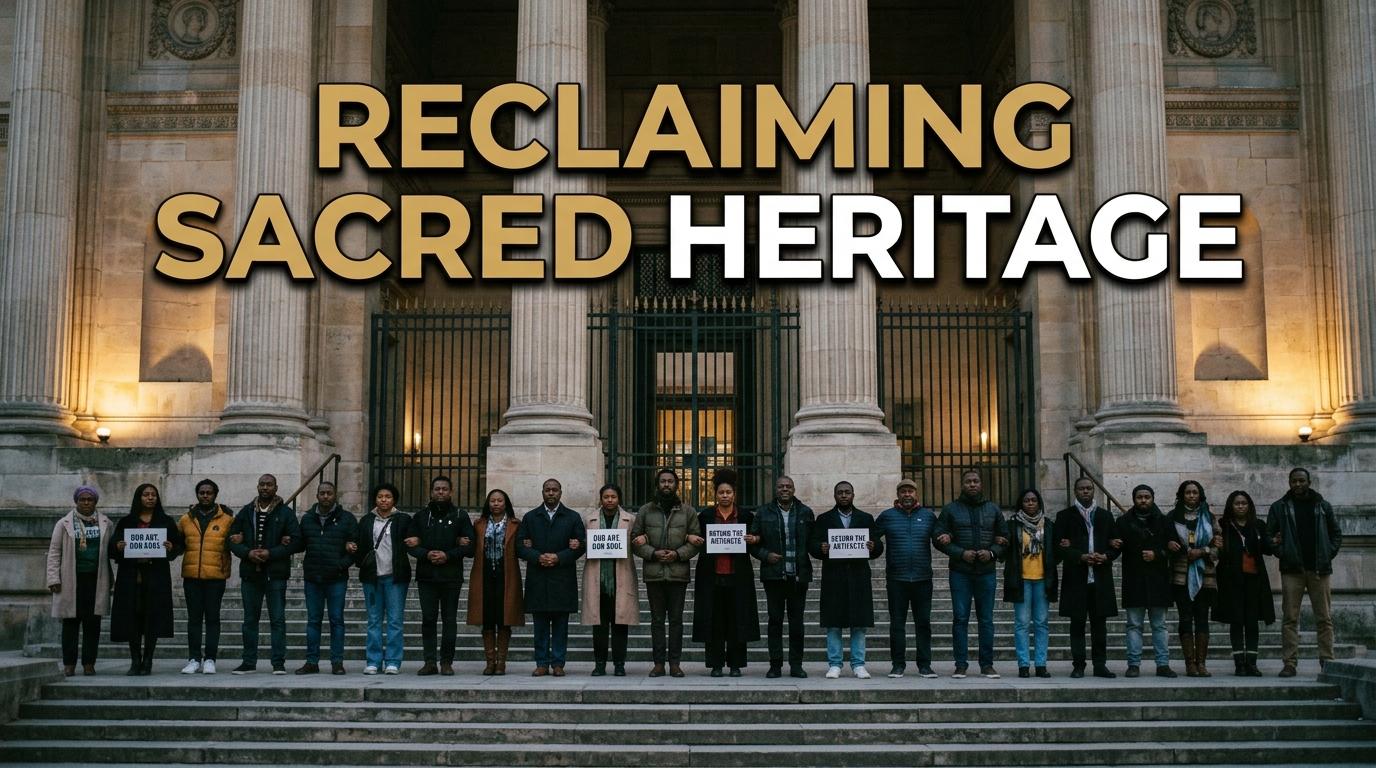
Crowds of demonstrators recently blocked the entrances to major cultural institutions in London and Paris. Activists linked arms outside the British Museum and the Musée du Quai Branly–Jacques Chirac. They held banners demanding the immediate and unconditional return of African royal treasures and ancestral remains (quaibranly.fr, hyperallergic.com). The demonstrations disrupted public entry and forced emergency meetings among museum administrators.
This wave of civil disobedience represents a dramatic turning point in a multi-generational struggle. Demonstrators refuse to accept academic panel discussions or temporary exhibition loans as substitutes for full restitution (culturemakes.com, hyperallergic.com). The physical blockades highlight decades of frustration with institutional delays. Activists view Western museums as holding facilities for items taken during colonial conquests (africanleadershipmagazine.co.uk, fordham.edu).
The Scramble for Africa and Systematic Plunder
The vast majority of African material culture in Europe was taken during the late nineteenth century. European empires partitioned the African continent during the Berlin Conference of 1884 and 1885 (wikipedia.org, fordham.edu). Following this summit, colonial military forces conducted coordinated punitive expeditions across the continent. These military campaigns systematically stripped royal treasuries, spiritual sanctuaries, and family compounds (wikipedia.org, buffalo.edu).
In 1897, British troops invaded and burned the Kingdom of Benin in modern-day Nigeria. Soldiers seized thousands of royal brass castings and ivory carvings known as the Benin Bronzes (wikipedia.org). The British Admiralty auctioned these sacred objects to finance the military invasion (wikipedia.org). Similar violence occurred in 1892 when French troops sacked the royal palaces of Abomey in modern-day Benin (quaibranly.fr). British forces also looted imperial manuscripts and sacred items from Maqdala, Ethiopia, in 1868 (ox.ac.uk).
The Scale of Modern Dispossession
Scholars calculate that ninety to ninety-five percent of classic sub-Saharan African cultural heritage resides outside the continent (latimes.com, fordham.edu). This massive concentration leaves African youth with almost no direct access to their historical patrimony (africanleadershipmagazine.co.uk, fordham.edu). Millions of individuals must secure expensive European visas simply to view the masterworks of their own ancestors (africanleadershipmagazine.co.uk).
European storage rooms contain massive quantities of items that are never exhibited. The Musée du Quai Branly in Paris preserves roughly seventy thousand African objects (quaibranly.fr). Similarly, the British Museum houses over seventy-three thousand African ethnographic items within its archives (ox.ac.uk). International campaigns for transformation across institutions emphasize that these numbers reflect a structural cultural blackout across the African continent (africanleadershipmagazine.co.uk).
Living Sacraments: The Ethiopian Tabots
Western museums frequently categorize sacred living items as secular artistic relics (ox.ac.uk). In the Ethiopian Orthodox Tewahedo Church, consecrated altar tablets called tabots represent the Ark of the Covenant (ox.ac.uk). Ethiopian theology holds that a sanctuary cannot conduct Christian worship without the physical presence of a tabot (ox.ac.uk). These sacred tablets are living dwelling places for the divine presence.
Strict religious laws forbid unordained people from seeing or handling a consecrated tabot (ox.ac.uk). British forces looted dozens of these holy tablets during the 1868 assault on Maqdala (ox.ac.uk). Today, eleven looted tabots remain hidden in sealed storage at the British Museum (ox.ac.uk). Church leaders state that keeping these sacred objects in secular museum basements is an ongoing spiritual violation (ox.ac.uk).
The Queen Idia Mask and Post-Colonial Demands
Sovereign matriarchal authority was captured in the sixteenth-century ivory pendant mask of Iyoba Idia (wikipedia.org). Queen Idia provided military counsel and spiritual guidance that protected the Kingdom of Benin (wikipedia.org). British soldiers stole the sacred mask directly from the royal palace in 1897 (wikipedia.org). The artifact was transferred into the permanent collection of the British Museum (wikipedia.org).
In 1977, Nigeria requested the return of the mask for FESTAC 77, a global festival celebrating Black arts (plinth.org.uk, wikipedia.org). British officials refused to send the piece unless Nigeria paid a massive cash deposit (plinth.org.uk). Museum trustees claimed the delicate ivory carving was too fragile for modern airplane transport (plinth.org.uk). Consequently, Nigerian master carvers created a replica that became a worldwide symbol of traditions of resistance (plinth.org.uk, wikipedia.org).
Scientific Racism and the Theft of Ancestral Remains
European imperial extraction targeted more than cast metals, textiles, and ivory carvings. Western military officers, explorers, and colonial medical staff plundered thousands of African graves (ed.ac.uk, kulturgutverluste.de). They collected human skulls, complete skeletons, and preserved soft tissues during colonial occupations (kulturgutverluste.de). These body parts were shipped directly to medical schools and anthropological museums across Europe (ed.ac.uk, kulturgutverluste.de).
Nineteenth-century scientific racism relied heavily on craniometry and phrenology to rank human populations (ed.ac.uk). Pseudoscholars measured cranial volumes to justify the enslavement and colonization of Black people (ed.ac.uk). For instance, during the Herero and Nama genocide in Namibia, German forces gathered skulls from concentration camps (kulturgutverluste.de). European laboratories cataloged these human ancestors as mere biological specimens (ed.ac.uk, kulturgutverluste.de).
Legal Fortresses Against Deaccessioning
When African leaders request the return of their patrimony, European directors point to national property legislation (theguardian.com, latimes.com). The British Museum Act of 1963 prevents trustees from deaccessioning collection items (theguardian.com, hyperallergic.com). The law allows dispossession only if an object is an exact duplicate or completely destroyed (theguardian.com). Therefore, British officials offer temporary loans rather than true ownership restoration (culturemakes.com, theguardian.com).
French jurisprudence operates under a strict principle of state inalienability (latimes.com). Under this code, national museum acquisitions remain perpetual public property (latimes.com). Returning looted artifacts requires parliamentary bodies to vote on special statutory exemptions (latimes.com). African governments reject temporary loan agreements because signing those documents recognizes European ownership of stolen property (culturemakes.com, theguardian.com).
The Global Diaspora and Reparative Justice
The campaign to recover stolen African heritage connects directly to the wider African diaspora. Millions of descendants of enslaved Africans recognize this looting as an effort to erase ancestral history (wikipedia.org). Reclaiming material heritage serves as a central pillar in the broader fight for reparative justice (afford-uk.org, africanleadershipmagazine.co.uk). Cultural reclamation helps restore ancestral dignity across the Black Atlantic (afford-uk.org, wikipedia.org).
Early Pan-African leaders like Aimé Césaire and Frantz Fanon argued that colonialism relied on destroying native culture. They noted that military conquest always accompanied the confiscation of artistic achievements. Activists in the United States and the Caribbean strongly support the return of sacred artifacts (afford-uk.org). They assert that returning African treasures to continental soil helps heal historical trauma (afford-uk.org, africanleadershipmagazine.co.uk).
Direct Action and the Criminalization of Activists
Frustration over stalled diplomatic negotiations has driven activists to take direct action. In 2020, Pan-African activist Mwazulu Diyabanza led interventions inside European museums (fairplanet.org, facebook.com). Diyabanza attempted to take back stolen African treasures from displays in Paris and Marseille (fairplanet.org, youtube.com). He broadcast these reclamation efforts on social media to demand total decolonization (fairplanet.org, facebook.com).
European courts responded by prosecuting these demonstrators under standard property theft statutes (fairplanet.org, youtube.com). French and Dutch judges refused to consider the colonial origins of the objects during the criminal trials (fairplanet.org, youtube.com). The courts imposed monetary fines and suspended prison sentences on the activists (fairplanet.org, youtube.com). Demonstrators argue that legal systems protect stolen property while punishing descendants who attempt to reclaim their history (fairplanet.org, hyperallergic.com).
Bioethics and Sacred Handover Protocols
Repatriating human remains requires completely different ethical standards than returning works of art (kulturgutverluste.de). Human bones are the mortal remains of beloved family members and ancestors (kulturgutverluste.de). International bioethics standards require institutions to separate human remains from regular art collections immediately (kulturgutverluste.de). These ancestral bodies must never be subjected to destructive scientific tests without community consent (kulturgutverluste.de).
Before physical transportation occurs, traditional elders conduct sacred spiritual purification rites (kulturgutverluste.de). Spiritual leaders pour libations and offer prayers to welcome their ancestors home. These ceremonies ensure that displaced spirits find peace and reconciliation. Sovereign source communities retain the absolute authority to rebury these ancestors within their native soil (kulturgutverluste.de).
Conclusion
The museum blockades in London and Paris demonstrate that public patience has run out. Activists will no longer tolerate endless delays and bureaucratic justifications (culturemakes.com, hyperallergic.com). The debate reaches far beyond aesthetic display cases and modern gallery lighting (africanleadershipmagazine.co.uk, fordham.edu). It centers on human rights, bodily dignity, and the restoration of sacred spiritual heritage (africanleadershipmagazine.co.uk, ox.ac.uk).
European institutions can no longer rely on century-old property laws to shield colonial plunder (theguardian.com, latimes.com). The unconditional return of royal regalia and ancestral remains is necessary for international justice (afford-uk.org, fordham.edu). Until Western governments release these sacred treasures, the protests outside European museum gates will continue to grow (culturemakes.com, hyperallergic.com).
About the Author
Darius Spearman is a professor of Black Studies at San Diego City College, where he has been teaching for over 20 years. He is the founder of African Elements, a media platform dedicated to providing educational resources on the history and culture of the African diaspora. Through his work, Spearman aims to empower and educate by bringing historical context to contemporary issues affecting the Black community.
