



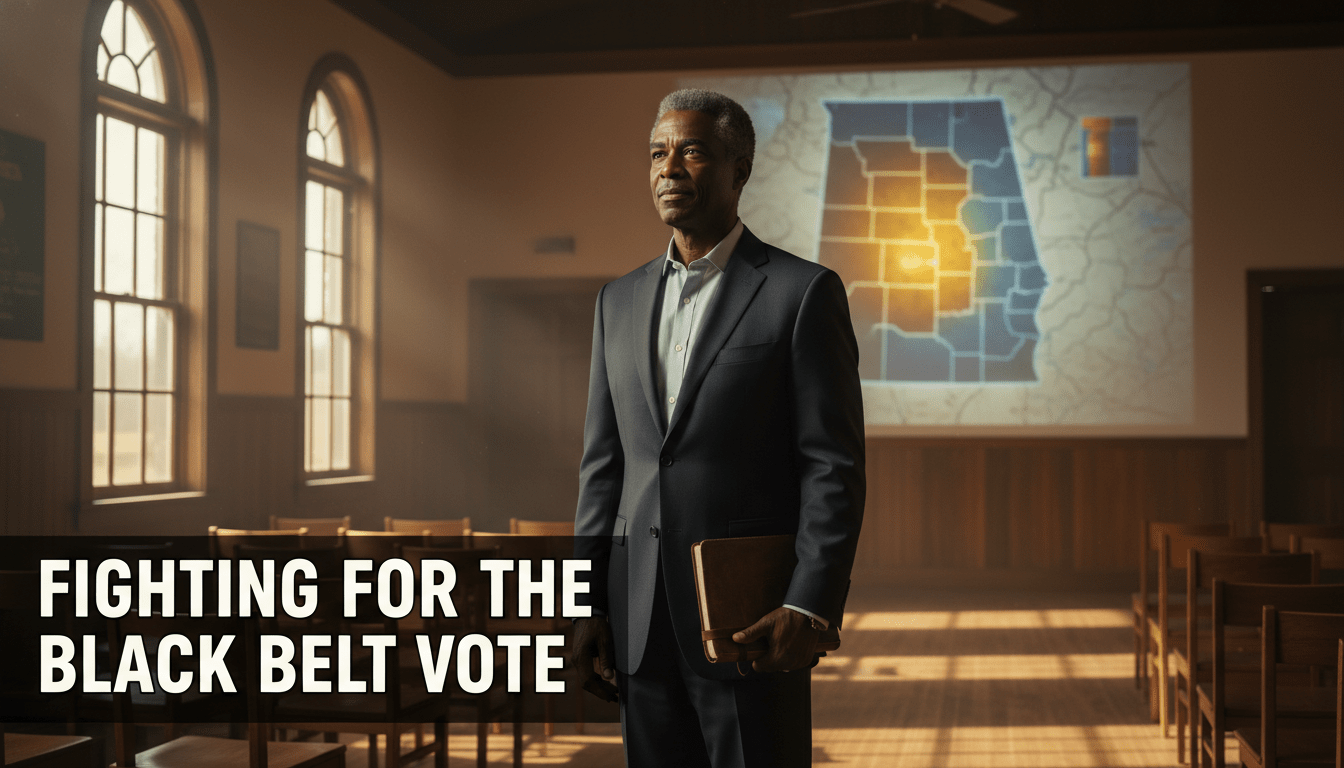
Why Alabama Racial Gerrymandering Blocks Black Political Power
By Darius Spearman (africanelements)
Support African Elements at patreon.com/africanelements and hear recent news in a single playlist. Additionally, you can gain early access to ad-free video content.
The New Standoff in Alabama
On May 26, 2026, a federal three-judge panel blocked the State of Alabama from using its legislatively drawn 2023 congressional map for the upcoming midterm elections (courthousenews.com, democracydocket.com). The judges ruled that the Republican-backed map, which featured only one majority-Black district, intentionally discriminated against Black voters in violation of the Fourteenth Amendment (ap.org, courthousenews.com). The panel ordered the state to continue using a map drawn by a court-appointed expert (ap.org, democracydocket.com).
This court-ordered map secures two districts where Black voters have a realistic opportunity to elect candidates of their choice (democracydocket.com, redistrictingfoundation.org). Consequently, this ruling has reignited a massive national debate over minority representation and set the stage for another legal showdown before the highest court in the land (cbsnews.com). This complex legal struggle directly connects to the broader sharing of power between state and federal governments in the American system of federalism.
The Blood-Stained Path to the Ballot Box
To understand this modern conflict, one must look to history. For generations following the Reconstruction era, Southern states utilized brutal tactics to keep Black citizens away from the ballot box. Poll taxes, literacy tests, and outright violence were common tools used to preserve white supremacy (splcenter.org, constitutioncenter.org). This history of disenfranchisement is central to the ongoing voting rights struggles that African Americans continue to wage across the country.
In March 1965, civil rights activists marched from Selma to Montgomery, Alabama, to demand equal rights (splcenter.org). State troopers brutally attacked them on the Edmund Pettus Bridge on a day that became known as “Bloody Sunday” (splcenter.org, nationalgeographic.com). This national tragedy shocked the nation and forced President Lyndon B. Johnson to sign the Voting Rights Act of 1965 (VRA) into law (constitutioncenter.org, splcenter.org). The VRA established Section 5, which required federal preclearance for voting changes in historically discriminatory areas, and Section 2, which banned discriminatory voting practices nationwide (everycrsreport.com, aclu.org).
The Shift to Sophisticated Voter Dilution
As direct disenfranchisement became illegal, opponents of Black political power turned to more subtle methods. They used redistricting tricks known as “packing” and “cracking” (everycrsreport.com, harvard.edu). Packing forces as many Black voters as possible into a single district to limit their influence elsewhere. Conversely, cracking splits Black communities across multiple districts to dilute their collective strength and prevent them from electing preferred candidates (everycrsreport.com, harvard.edu).
Initially, the Supreme Court ruled that plaintiffs had to prove that lawmakers intended to discriminate to establish a violation. However, in 1982, Congress amended Section 2 of the VRA (everycrsreport.com, brennancenter.org). The new standard established that a violation could be proven if the electoral process had a discriminatory effect, regardless of whether the legislature’s intent could be proved (everycrsreport.com, brennancenter.org). In 1992, Section 2 litigation forced Alabama to draw its very first majority-Black district (wikipedia.org, wikipedia.org). This change enabled the historic election of Earl Hilliard, the first Black congressman from Alabama in 115 years (wikipedia.org, wikipedia.org).
Alabama Representation Disparities
Comparing Black population share against congressional seat share under different maps.
The Role of a Special Master
When a state legislature refuses to draw fair maps, courts can intervene using a Special Master. A Special Master is an independent, court-appointed expert tasked to draw fair electoral boundaries when a state fails to comply with the law (ap.org, democracydocket.com). Under Federal Rule of Civil Procedure 53, a judge can appoint this expert to assist with complex implementation matters (pasenategop.com). The court relies on this professional to bring technical expertise, such as demography and geographic mapping tools, to the process (redistrictingdatahub.org, caliper.com).
In Alabama, the legislature refused to create a second opportunity district after the Supreme Court ruled against them in the 2023 case Allen v. Milligan (democracydocket.com, redistrictingdatahub.org). Therefore, the three-judge panel appointed a Special Master to draw remedial maps (ap.org, democracydocket.com). The expert drew a map that raised the Black voting-age population in District 2 to 48.7 percent (redistrictingfoundation.org, redistrictingdatahub.org). While the Special Master proposes the map, it only takes effect once officially approved by the presiding court (democracydocket.com).
Shomari Figures and Historic Representation
The court-ordered map led to an immediate and historic shift in the 2024 elections. Shomari Figures, a Democrat and Mobile native, won the congressional seat for District 2 (ap.org, bgov.com). Figures came with deep federal public service experience, having worked for the Obama White House and U.S. Attorney General Merrick Garland (house.gov). His election flipped a seat that had been a solid Republican stronghold prior to the redistricting order (bgov.com).
This victory held immense historic significance. Alongside Representative Terri Sewell, Figures became one of two Black representatives serving Alabama simultaneously (ap.org). This marked the first time since the Reconstruction era that Alabama sent two Black members to Congress at the same time (ap.org). This outcome proved that the court-ordered map functioned exactly as intended by giving Black voters a realistic opportunity to elect their preferred candidate of choice. This milestone shows the power of tactical Black political strategy when mobilizing against structural suppression.
Understanding the Black Belt Community
The core of the Alabama redistricting dispute lies in a region known as the “Black Belt.” The Black Belt is a historically, demographically, and geologically cohesive region that stretches across central Alabama (southernspaces.org, alblackbeltheritage.com). Geologically, the region features rich, dark, fertile soil created millions of years ago from calcium-rich marine deposits (nationalgeographic.com, southernspaces.org). In the 1820s and 1830s, this fertile soil fueled a massive cotton plantation economy dependent on enslaved labor (nationalgeographic.com, southernspaces.org).
Today, the region remains heavily populated by African Americans. It faces deep economic challenges, low development, and major infrastructure crises, including failing wastewater systems due to clay-heavy soil (asce.org, theguardian.com). In redistricting, the Black Belt is recognized as a vital “Community of Interest.” A Community of Interest is a geographically cohesive group of people who share common social, cultural, economic, and historical ties (sf.gov, santacruzcountyca.gov). Keeping this community together in a single district prevents their collective voice from being fractured across multiple districts (lls.edu, santacruzcountyca.gov).
District 2 Black Voting-Age Population (BVAP)
How the percentage of Black voters shifted across different map versions.
The Legal Earthquake of Louisiana v. Callais
The legal landscape changed dramatically on April 29, 2026, with the Supreme Court decision in Louisiana v. Callais (cbsnews.com, courthousenews.com). In a 6-3 conservative majority opinion, the Court ruled that Louisiana’s map was an unconstitutional racial gerrymander (cbsnews.com, courthousenews.com). Louisiana had drawn a second majority-Black district to comply with a lower court order finding a Voting Rights Act violation (cbsnews.com, courthousenews.com).
The Supreme Court ruled that because the Voting Rights Act did not strictly require Louisiana to draw that specific second district, the state lacked a compelling interest to use race predominantly (courthousenews.com). Voting rights advocates declared that the ruling severely weakened Section 2 of the Voting Rights Act (theguardian.com, bet.com). Justice Elena Kagan noted in her dissent that the decision made Section 2 nearly a dead letter (lagniappemobile.com, courthousenews.com). This decision raised the legal hurdle for challenging discriminatory maps nationwide.
Opportunity Districts Versus Majority-Black Districts
To navigate these complex legal rulings, one must understand the difference between a “Majority-Black District” and a “Black Opportunity District.” A Majority-Black District is an area where Black residents make up more than 50 percent of the voting-age population (senate.mn). In contrast, a Black Opportunity District is a district where Black voters have a realistic, fair chance to elect their candidate of choice, even if they make up less than 50 percent of the population (redistrictingdatahub.org, americanbar.org).
The success of an opportunity district relies heavily on crossover voting. Non-Black voters who share similar political alignments vote alongside Black voters to elect the same candidate (redistrictingfoundation.org, americanbar.org). Alabama’s court-ordered District 2 is a perfect example, possessing a Black voting-age population of 48.7 percent (redistrictingfoundation.org, redistrictingdatahub.org). This design allows the district to function as an opportunity district without strictly relying on numerical superiority (redistrictingfoundation.org, americanbar.org). Understanding these subtle distinctions is essential to grasping the true meaning of Black political power and representation in modern America.
Chronology of the Alabama Map Dispute
The Loophole of Partisan Intent
Following the Callais ruling, Alabama Attorney General Steve Marshall argued that the state’s map was legal because it was driven by “partisan intent.” Marshall asserted that the legislature split Black communities to maximize Republican seats, not to discriminate based on race (1819news.com, alabamaag.gov). Under federal law, partisan gerrymandering is a legally permissible political question (constitutioncenter.org, brennancenter.org). The landmark 2019 case Rucho v. Common Cause ruled that federal courts have no authority to resolve partisan gerrymandering claims (constitutioncenter.org, brennancenter.org).
Consequently, Southern mapmakers frequently use partisan goals to defend against racial discrimination claims (americanbar.org). They exploit a major loophole where they can pack or split Black communities, who vote overwhelmingly Democratic, under the guise of seeking partisan advantage (americanbar.org, campaignlegal.org). However, the federal three-judge panel rejected this defense in their May 26, 2026 ruling (democracydocket.com). The judges concluded that the state’s 2023 plan went out of its way to split the Black Belt community to intentionally dilute Black votes because of race (courthousenews.com, democracydocket.com).
Administrative Chaos and the Purcell Principle
Beyond the constitutional arguments, the federal panel highlighted the severe practical problems of changing maps so close to an election. Under the Purcell principle, courts are discouraged from changing election rules near an election to avoid voter confusion (newsfromthestates.com, brennancenter.org). Alabama’s primary elections had already taken place on May 19, 2026, using the court-ordered map (newsfromthestates.com).
The Director of Elections for the state, Jeff Elrod, testified that switching back to the 2023 map would require a “Herculean effort” (newsfromthestates.com). Officials would have to manually reassign voters across 14 counties in a maximum of seven days (newsfromthestates.com). This process normally takes several months to complete safely (newsfromthestates.com). The court agreed that forcing such a massive administrative shift would cause unacceptable chaos for voters and local election workers (democracydocket.com, newsfromthestates.com).
The Looming Supreme Court Fight
The battle is far from over. On May 27, 2026, the State of Alabama officially filed emergency stay applications with the U.S. Supreme Court (democracydocket.com). State officials are hoping that the conservative supermajority on the High Court will apply a broad reading of the Callais decision to strike down the court-ordered map before the general election in November (democracydocket.com).
This impending legal battle represents a critical test for the survival of Black representation in the Deep South. The three-judge panel’s focus on “intentional discrimination” rather than a mere Section 2 “effects” test sets a powerful precedent (courthousenews.com, democracydocket.com). It signals that even if the Supreme Court continues to weaken the Voting Rights Act, states cannot openly target Black communities to dilute their votes. The eyes of the nation will once again turn to Alabama as the state helps decide the future of democracy in America.
About the Author
Darius Spearman is a professor of Black Studies at San Diego City College, where he has been teaching for over 20 years. He is the founder of African Elements, a media platform dedicated to providing educational resources on the history and culture of the African diaspora. Through his work, Spearman aims to empower and educate by bringing historical context to contemporary issues affecting the Black community.
