


Why Black Fatherhood Support Networks Are Exploding Online
By Darius Spearman (africanelements)
Support African Elements at patreon.com/africanelements and hear recent news in a single playlist. Additionally, you can gain early access to ad-free video content.
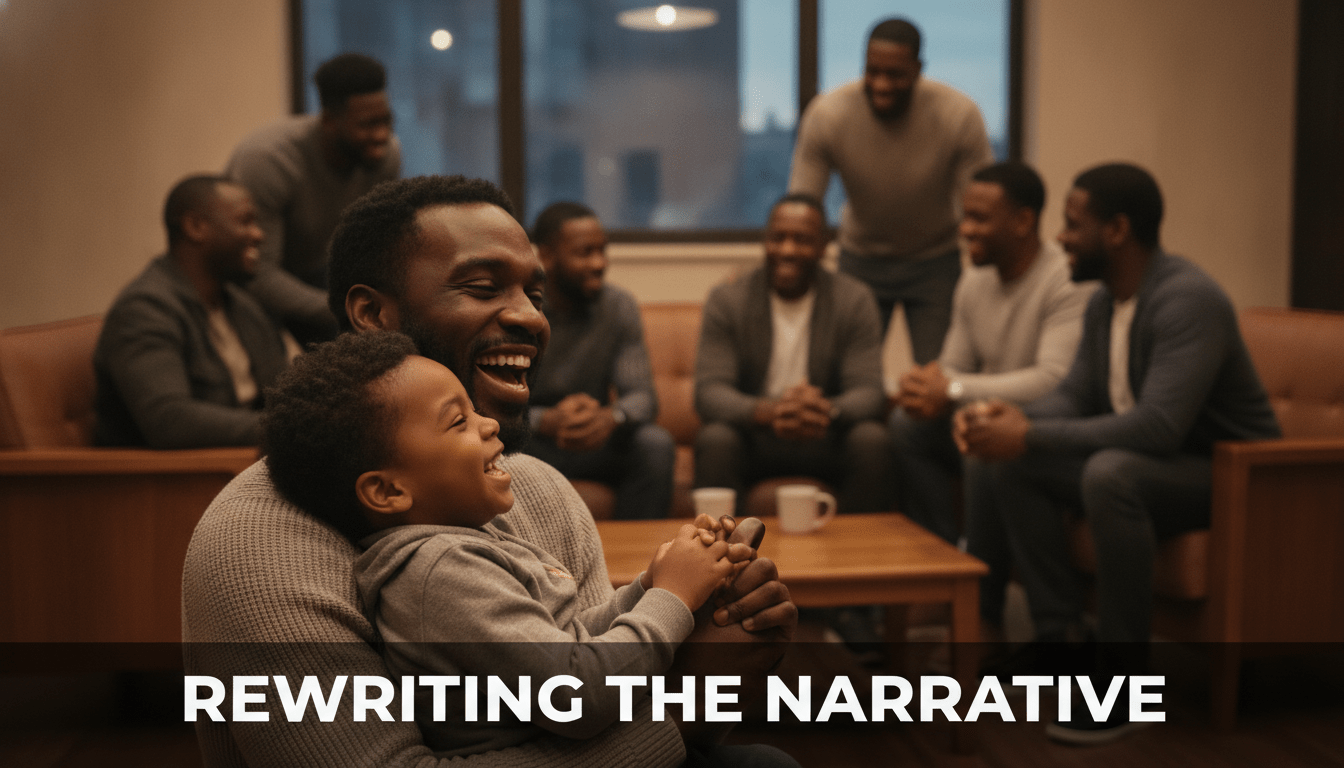
In a quiet room in Pittsburgh, a circle of Black men gather to support one another (publicsource.org). They share warm handshakes and embraces while greeting each other with respect (publicsource.org). These men come from all walks of life, including construction workers, educators, and artists (publicsource.org). This is the “Circle of Kings,” which is a peer-support group built to help Black fathers (publicsource.org, publicsource.org).
The initiative represents a larger national movement that is gaining rapid traction online (publicsource.org). Black fathers are actively seeking safe spaces to navigate parenting and intense systemic pressures (publicsource.org). This article explores the deep history behind these support networks. It examines how they are dismantling centuries of harmful myths and policy barriers.
The Slavery Era and the Struggle for Paternal Rights
During the nineteenth century, enslaved Black men faced immense legal and physical barriers to parenting (aaihs.org). White slaveholders systematically denied them legal rights to their children (aaihs.org). Families were routinely torn apart through forced sales (aaihs.org). Despite these horrific conditions, historical records reveal that Black fathers went to extreme lengths to protect their families (aaihs.org). They often worked extra hours to purchase the freedom of their children, establishing a deep legacy of paternal care.
Even after emancipation, Black families had to struggle against ongoing oppression. Many newly freed individuals faced forms of forced labor that resembled the remnants of slavery (aaihs.org). Paternal authority was constantly undermined by racist laws and economic exploitation (aaihs.org). This history of resilience laid the foundation for modern family structures. Black men have always fought to remain active participants in the lives of their children.
The Moynihan Report and the Pathology of Black Families
In 1965, Assistant Secretary of Labor Daniel Patrick Moynihan published a highly controversial report (bostonreview.net). This document was titled The Negro Family: The Case for National Action (bostonreview.net). The report argued that the structure of Black families was the main cause of Black poverty (bostonreview.net). Moynihan claimed that single-mother households created a self-perpetuating culture of poverty in urban areas (bostonreview.net). This publication formalized the myth of the “absent Black father” in American policy.
Critics and civil rights leaders fiercely rejected the conclusions of the report. They argued that the report reversed cause and effect by blaming family dynamics instead of systemic racism and economic exclusion (bostonreview.net). Civil rights leader James Farmer called the document a serious threat to Black freedom (bostonreview.net). Furthermore, psychologist William Ryan coined the phrase “blaming the victim” to describe this harmful framing (bostonreview.net). Black scholars showed that economic conditions shape family structures, not the other way around (bostonreview.net). This debate highlights how anti-Black politics have historically shaped public perceptions of Black men.
Timeline: The Evolution of Black Fatherhood Advocacy
The federal government popularizes the controversial myth of the “absent Black father,” focusing on family structure over systemic barriers.
Black men organize a massive physical mobilization in Washington, D.C., focusing on family responsibility and community atonement.
Grassroots advocacy turns local as fathers across the country escort their children to school on the first day, defying negative stereotypes.
The CDC releases empirical proof showing that Black fathers are actually the most hands-on parents in the United States.
Modern networks, such as Pittsburgh’s “Circle of Kings,” integrate clinical mental health support into fatherhood programs.
Structural Barriers: Welfare Rules and the War on Drugs
During the late twentieth century, government policies actively worked to separate Black fathers from their homes. State welfare agencies enforced the “man-in-the-house” rules under the Aid to Families with Dependent Children program (justia.com). These rules declared that a household was ineligible for financial assistance if any adult male resided with the family (justia.com). It did not matter if the man was the biological father or if he had any income to contribute (justia.com).
Caseworkers conducted unannounced nighttime raids to enforce these regulations (justia.com). If they found a man’s shoes or clothing, the family lost all financial support immediately (justia.com). This regulation legally forced low-income fathers to stay away so their children could eat (justia.com). The Supreme Court finally struck down this rule in the 1968 case King v. Smith (justia.com). However, the damage to family structures was already done. Later, the “War on Drugs” and mass incarceration further decimated communities by removing millions of Black fathers (jacobin.com).
The Evolution of Black Fatherhood Mobilization
Black men have long organized massive physical demonstrations to assert their commitment to family and community. On October 16, 1995, over one million Black men gathered for the Million Man March in Washington, D.C. (wikipedia.org). Minister Louis Farrakhan organized the event alongside a broad coalition of civil rights leaders (wikipedia.org). The march focused heavily on personal atonement and family duty (wikipedia.org). This emphasis on atonement was controversial because critics argued it shifted the blame from systemic barriers to individual moral failings (bostonreview.net).
The march was also criticized for excluding women from the main demonstration (wikipedia.org). Despite these debates, the event sparked localized efforts to support families. In 2004, Phillip Jackson launched the Million Fathers March in Chicago (fathersincorporated.com). This campaign encouraged fathers to escort their children to school on the first day of class (fathersincorporated.com). This initiative represented a form of Black nationalism that prioritized self-reliance and community protection. Slowly, organizations like the Real Dads Network began establishing weekly meetups to provide parenting education (harlemamerica.com).
Daily Paternal Physical Care Involvement
Percentage of co-resident fathers who perform daily tasks such as bathing, dressing, diapering, or toilet training (CDC data).
Empirical Truths: The Landmark CDC Fatherhood Study
For decades, commentators used high non-marital birth rates to argue that Black fathers were absent (cdc.gov). They wrongly assumed that being unmarried meant being uninvolved (cdc.gov). In 2013, the Centers for Disease Control and Prevention released a landmark study that completely dismantled this myth (cdc.gov). The study collected direct data on how fathers interact with their children rather than relying on marital status (cdc.gov).
The data showed that Black fathers are actually among the most hands-on parents in the nation (cdc.gov). Among fathers living with their children, seventy percent of Black fathers bathed, dressed, or diapered their kids daily (cdc.gov). This rate surpassed sixty percent of white fathers and forty-five percent of Hispanic fathers (cdc.gov). Furthermore, seventy-eight percent of co-resident Black fathers ate meals with their children every day (cdc.gov). The study successfully decoupled marital status from parental presence, proving that unmarried Black fathers remain deeply involved (cdc.gov).
The Modern Shift: Merging Parenting and Mental Health
In the mid-2020s, Black fatherhood initiatives began to pivot toward mental health (publicsource.org). Older programs focused primarily on financial compliance and basic parenting classes (publicsource.org). In contrast, modern networks recognize that a father must heal emotionally to show up for his children (publicsource.org). This holistic approach addresses the trauma of systemic oppression and isolation (publicsource.org).
Pittsburgh’s Circle of Kings is a prime example of this evolution (publicsource.org). Organized by the Kingsley Association and Steel Smiling, the group meets bi-weekly (publicsource.org, publicsource.org). Facilitators use evidence-based curricula like the National Fatherhood Initiative’s “24/7 Dad” program (publicsource.org, fathersincorporated.com). The curriculum focuses on emotional communication, self-awareness, and co-parenting relationships (fathersincorporated.com). These groups provide a safe space where men can drop their guards and voice their struggles (publicsource.org).
The Evolution of Support Focus
- Heavy emphasis on financial provision and compliance
- Framed around personal blame and “atonement”
- Focused on legal survival in family courts
- Fathers trained in isolation without peer connections
- Focus on holistic mental health and emotional healing
- Deconstruction of institutionalized systemic bias
- Emphasis on vulnerability and emotional safety
- Built on peer-to-peer brotherhood and collective joy
Grassroots Joy and Clinical Advocacy
Modern support networks also emphasize joy and clinical advocacy. Organizations like The Dad Gang use social media and community walks to celebrate Black fatherhood (bet.com). The founder, Sean Williams, emphasizes that fathers often lose their social connections when they enter the parenting phase (bet.com). The Dad Gang acts as a welcoming brotherhood that counteracts this isolation (bet.com).
Other groups focus on early-childhood phases and health advocacy. In Fresno, California, the BLACK Fatherhood Legacy group combines open dialogue with doula-informed education (abc10.com). This initiative is critical because Black maternal and infant mortality rates remain alarmingly high (hhs.gov). Programs teach fathers how to serve as knowledgeable advocates during labor (abc10.com). This type of civil rights and advocacy empowers men to protect their partners in healthcare settings (abc10.com).
Systemic Hurdles: Navigating Family Courts and Child Support
Peer networks are highly effective, but community spaces alone cannot dismantle systemic hurdles. One of the most significant challenges is the practice of income imputation in family courts (acf.gov). Courts often calculate child support payments based on what they assume a father should earn, rather than his actual income (acf.gov). This practice occurs when courts decide a parent is voluntarily underemployed (acf.gov).
For low-income and formerly incarcerated fathers, this policy creates unpayable legal debt (acf.gov). Historically, state courts have treated incarceration as voluntary unemployment, refusing to modify child support payments (acf.gov). This leaves fathers with overwhelming debt upon release, which discourages formal employment (acf.gov). In response, the federal government introduced the 2016 Flexibility, Efficiency and Modernization rule to encourage more realistic child support orders (acf.gov).
Public Housing and the Cohabitation Penalty
Modern housing and welfare policies also continue to penalize co-parenting households (hudexchange.info). Programs like Section 8 housing, the Supplemental Nutrition Assistance Program, and child care assistance have strict cohabitation rules (hudexchange.info). If a working father moves in with the mother, his income is added to the household total (hudexchange.info). This sudden increase in household income often triggers a severe penalty.
This penalty can sharply raise the family’s rent share or disqualify them from food assistance entirely (hudexchange.info). Additionally, housing authorities do not allow both parents to claim the same child as a dependent for Section 8 vouchers (hudexchange.info). This rule prevents co-parenting fathers from securing units with enough bedrooms for joint custody (hudexchange.info). Parents are legally forced to choose between receiving aid and living under the same roof.
Reclaiming the Legacy of Black Fatherhood
The traction that Black fathers’ support groups are gaining online is a testament to the power of community healing (publicsource.org). These networks are not merely a passing trend (publicsource.org). They represent a long-awaited reclamation of the Black family narrative (publicsource.org). By centering mental health and vulnerability, these programs are healing families from the inside out (publicsource.org).
Black fathers have always been present, resilient, and deeply committed to their children (cdc.gov). Now, with the help of empirical data and dedicated support circles, they have the tools to fight systemic barriers (publicsource.org, cdc.gov). The Circle of Kings and other modern networks are proving that when Black men are given safe spaces to heal, they redefine what it means to lead and nurture (publicsource.org).
About the Author
Darius Spearman is a professor of Black Studies at San Diego City College, where he has been teaching for over 20 years. He is the founder of African Elements, a media platform dedicated to providing educational resources on the history and culture of the African diaspora. Through his work, Spearman aims to empower and educate by bringing historical context to contemporary issues affecting the Black community.
