


Why Civil Rights Struggles in San Antonio Are Flaring Up Again
By Darius Spearman (africanelements)
Support African Elements at patreon.com/africanelements and hear recent news in a single playlist. Additionally, you can gain early access to ad-free video content.
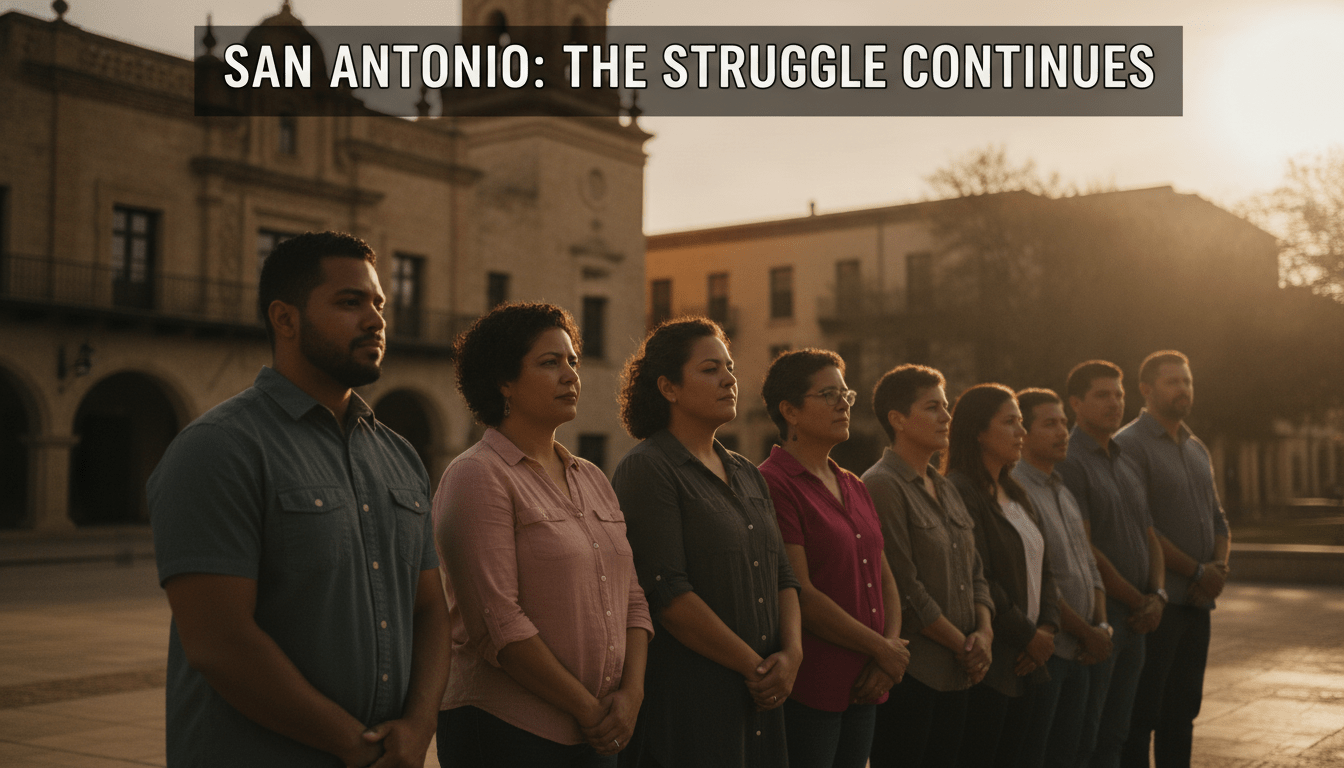
In June 2026, the streets of downtown San Antonio, Texas, became the center of intense political conflict (tpr.org). Over one hundred local protestors gathered outside the Marriott Rivercenter hotel to voice their anger (tpr.org). Inside, Turning Point USA was hosting its annual Women’s Leadership Summit (wls2026.com). The tension outside quickly escalated as demonstrators confronted attendees and security guards (tpr.org). This confrontation was more than a temporary disagreement. It represents a deeper, ongoing struggle over the legacy of race and representation in Texas.
The demonstration highlights the historic tension within a majority-minority city (census.gov). For over a century, local communities have fought against systemic exclusion (tshaonline.org). Meanwhile, highly funded conservative groups have expanded their presence in the region (breitbart.com, splcenter.org). This article explores how these historical forces collided in the summer of 2026.
The Spark at the Marriott Rivercenter
The immediate cause of the protest was the summit itself. Demonstrators marched from a nearby park to the hotel entrance (tpr.org). They carried signs and chanted slogans against the speakers inside (tpr.org). Many local residents expressed deep concern over the merchandise sold at the event. For instance, some materials displayed the phrase “truth over skin color” (tpr.org). Observers noted that the design placed white lettering over black backgrounds (tpr.org). This design choice was interpreted by many as a racist visual message (tpr.org).
Furthermore, the atmosphere grew more tense with the arrival of other outside organizations. Members of the Church of Wells, a conservative group from East Texas, distributed literature nearby (tpr.org). Protesters attempted to cross police barricades twice during the event (tpr.org). Security was already exceptionally high because of previous threats (ksat.com). In May 2026, police arrested a local man for threatening the organizers (ksat.com). Consequently, the physical clash in June was the culmination of weeks of building anxiety (tpr.org). This situation showed how easily symbolic disagreements can transform into physical confrontations.
San Antonio Demographics (2026 Census Data)
Deep Roots of the San Antonio Civil Rights History
The anger of the demonstrators is connected to a long tradition of activism. San Antonio has a rich history of fighting for Mexican American and Black civil rights (tshaonline.org, tshaonline.org). This activism began long before the modern era. In 1938, the city witnessed one of the most significant labor strikes in American history (tshaonline.org). Approximately twelve thousand pecan shellers walked off their jobs to protest wage cuts (tshaonline.org). Most of these workers were Mexican American women who faced terrible working conditions (tshaonline.org).
A young activist named Emma Tenayuca led this historic strike (tshaonline.org). She was only twenty-one years old at the time (tshaonline.org). Despite facing tear gas and mass arrests, the workers refused to back down (tshaonline.org). Eventually, they won their arbitration and secured higher wages (tshaonline.org). This victory remains a landmark in the struggle for economic justice. It proved that marginalized women could successfully challenge powerful industrial interests. Through these actions, early activists fought for a fairer concept of freedom in a highly segregated state. This history of labor mobilization laid the groundwork for future generations of activists.
Breaking Barriers at the Lunch Counter
San Antonio also led the way in integrating public spaces peacefully. In 1960, lunch counters across the American South were strictly segregated (wikipedia.org). Many cities met integration efforts with extreme violence and mass arrests (wikipedia.org). However, San Antonio chose a different path (tpr.org, savingplaces.org). A seventeen-year-old student named Mary Lillian Andrews initiated the change (tpr.org). She was the president of the local NAACP Youth Council (tpr.org). Andrews wrote letters to local store managers demanding integration (tpr.org).
Instead of resisting, a coalition of Black religious leaders and white business owners met secretly (tpr.org). They wanted to avoid the economic boycotts and violence occurring in North Carolina (tpr.org). Consequently, on March 16, 1960, seven major downtown stores integrated their lunch counters (tpr.org, savingplaces.org). The historic F.W. Woolworth Building was one of these locations (savingplaces.org). Famous baseball player Jackie Robinson praised the city for this peaceful transition (tpr.org). This event showed how organized youth could dismantle racial barriers without bloodshed. The brave actions of these young people highlighted the vital contributions of Black women and youth in the struggle for equality. This success proved that local cooperation could overcome deeply entrenched systemic segregation.
Turning Point USA Revenue Explosion
Tracing the financial growth of the national conservative group from its foundation to modern times.
Preserving the Sacred Spaces of Resistance
Today, the preservation of these historical sites remains highly contested. The historic F.W. Woolworth Building still stands on Alamo Plaza (savingplaces.org). Recently, the building became the focus of a major preservation battle (savingplaces.org). The Texas General Land Office purchased the property for a new redevelopment plan (savingplaces.org). Many community members feared the state would demolish this civil rights landmark (savingplaces.org). To protect the building, local advocates formed a diverse coalition (savingplaces.org).
The coalition included the NAACP and the Conservation Society of San Antonio (savingplaces.org). Fortunately, their efforts succeeded in saving the structure (savingplaces.org). In 2021, state and county officials approved funding to rehabilitate the building (savingplaces.org). It will now house a new Alamo Museum and Visitor Center (savingplaces.org). This facility will feature a free exhibit dedicated to the 1960 lunch counter integration (savingplaces.org). Preserving this space ensures that future generations will remember the triumphs of the past. It serves as a physical reminder of the community’s resistance to white supremacy. This preservation effort shows that the battle over history is just as important as the battles in the streets.
The Cultural Pivot of Modern Conservatism
To understand the 2026 clash, one must examine the history of the host organization. Turning Point USA was founded in 2012 by Charlie Kirk and Bill Montgomery (splcenter.org). Originally, the group focused on free markets and limited government (splcenter.org). However, the organization shifted its focus over the next decade (splcenter.org). It began to emphasize cultural grievances and anti-feminist rhetoric (splcenter.org). Speakers at their events often urge young women to reject modern feminism (splcenter.org).
Additionally, the group faces severe criticism for its racial rhetoric (splcenter.org). In 2024 and 2025, founder Charlie Kirk openly promoted the “Great Replacement” conspiracy theory (splcenter.org). This theory claims that white populations are being systematically replaced by non-white immigrants (splcenter.org). Because of these extreme positions, the Southern Poverty Law Center designated Turning Point USA as a hate group in 2025 (splcenter.org). This designation added immense fuel to the ongoing culture wars. It also made the organization a prime target for local protests when they visited majority-minority cities. This shift represents a broader shift in political narratives from early civil rights debates to modern cultural warfare. The growing budget of this organization has allowed it to spread these controversial ideas nationwide.
Timeline of Resistance in San Antonio
Coalitions of Color and Modern Clashes
The resistance to conservative messaging in San Antonio relies on deep multiracial alliances. Black and Hispanic communities in the city have a long history of cooperation (rice.edu). Historically, leaders like Albert Peña worked alongside Black political figures like G.J. Sutton to fight discrimination (rice.edu). They built powerful voting blocks to increase minority representation in local government (rice.edu). Today, this tradition of solidarity continues through organizations like SATX4 (sacurrent.com).
SATX4 is a grassroots group focused on racial justice and police accountability (sacurrent.com). In 2017, the group helped organize protests to remove a Confederate monument from Travis Park (sanantonioreport.org). Heavily armed militia members arrived to protect the monument, leading to a tense standoff (sanantonioreport.org). Ultimately, the City Council voted to remove the monument overnight (sanantonioreport.org). This victory demonstrated the power of collective action in reclaiming public spaces. When national groups bring divisive rhetoric to San Antonio, they must confront these established local coalitions. These alliances are essential for protecting the cultural heritage of the city’s diverse residents.
A Changing Texas and the National Struggle
The political struggle in San Antonio reflects a broader transformation occurring across Texas. As the demographics of the state continue to shift, the tension between diverse urban centers and conservative suburban areas increases (census.gov). San Antonio serves as a key example of this demographic reality. With a population that is over sixty-four percent Hispanic, the city naturally resists political rhetoric that attacks immigrants or minority groups (census.gov). Many residents view these national summits as a direct invasion of their cultural space.
Consequently, local activists feel a strong responsibility to voice their opposition. This resistance is not limited to San Antonio. Similar protests have occurred in other major Texas cities as communities defend their progress. The high funding of conservative groups allows them to host large events, but it cannot silence local opposition. This dynamic ensures that Texas will remain a major battleground for civil rights for years to come. The clash outside the Marriott Rivercenter is a clear indication of this ongoing national struggle.
Segregation Realities and the Path Forward
Historically, racial separation in America has taken two distinct forms. De jure segregation refers to separation that is mandated by explicit laws (study.com). Conversely, de facto segregation occurs through custom, practice, or economic differences (study.com). Many people believe that de facto segregation is natural or accidental (stanford.edu). However, historians argue that public police forces actively enforced these informal boundaries (stanford.edu). Officers often stood by while white mobs attacked minority families in segregated neighborhoods (stanford.edu).
Consequently, police practices have long been informed by the enforcement of racial boundaries (stanford.edu). This history explains why modern protesters react so strongly to police presence at demonstrations (tpr.org). The intervention of officers at the Marriott Rivercenter was viewed through this historical lens (tpr.org). For many residents, the police are still seen as protectors of the status quo (stanford.edu). Therefore, the clashes in San Antonio are not simple disagreements. They are part of a continuous battle for true systemic reform. Activists continue to utilize various ideological movements to challenge persistent inequality. The community remains dedicated to defending its civil rights heritage against any threat.
About the Author
Darius Spearman is a professor of Black Studies at San Diego City College, where he has been teaching for over 20 years. He is the founder of African Elements, a media platform dedicated to providing educational resources on the history and culture of the African diaspora. Through his work, Spearman aims to empower and educate by bringing historical context to contemporary issues affecting the Black community.
