



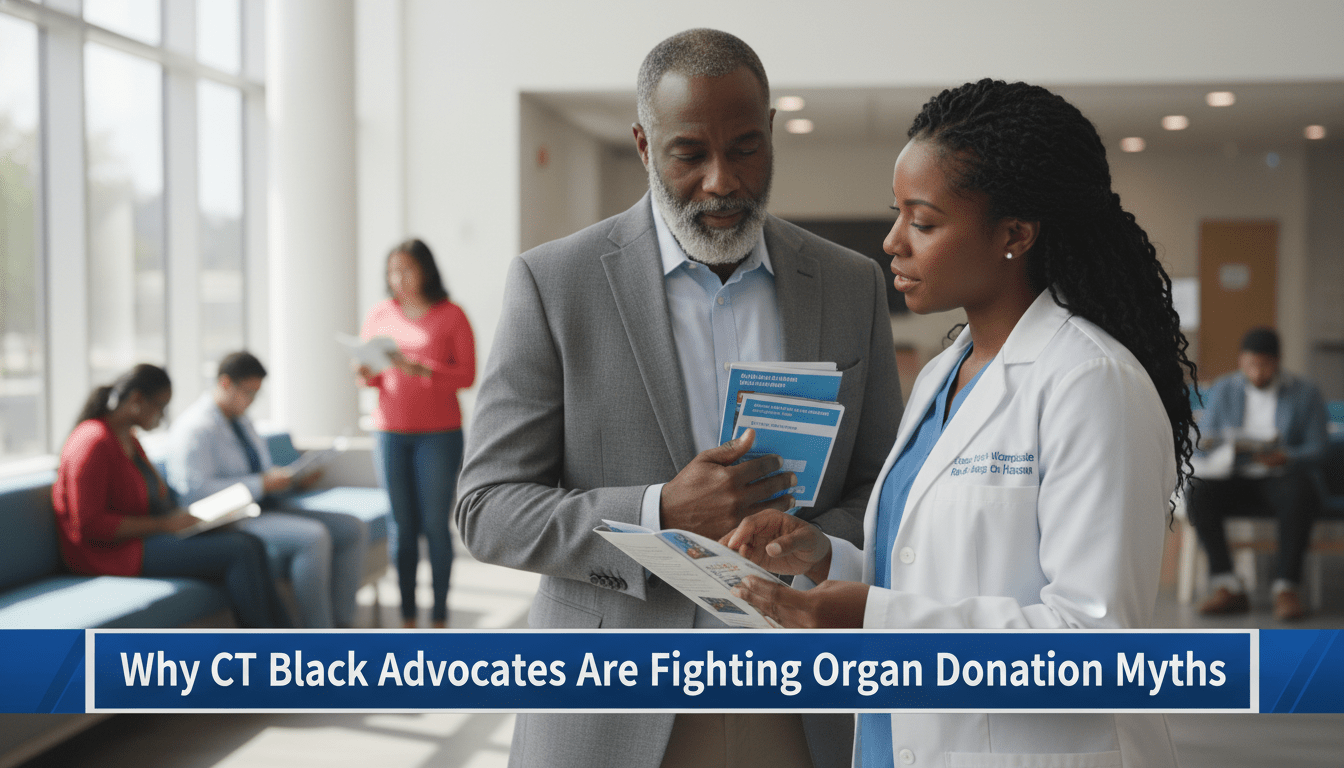
Why CT Black Advocates Are Fighting Organ Donation Myths
By Darius Spearman (africanelements)
Support African Elements at patreon.com/africanelements and hear recent news in a single playlist. Additionally, you can gain early access to ad-free video content.
The Fight for Health Equity in Connecticut
A new movement is growing in the streets of Hartford and New Haven. Community leaders and health advocates are stepping up to save lives. They launched a bold initiative to tackle one of the most difficult topics in the Black community. This effort focuses on organ donation and the myths that keep people from signing up as donors. It is a vital mission because Black patients wait much longer for life-saving transplants than others. (ctmirror.org)
The problem is not a lack of kindness. Instead, the issue is rooted in a deep history of medical mistrust. For many years, the medical system treated Black bodies with disrespect. Today, that history creates a barrier between patients and the care they need. Advocates in Connecticut want to tear down that barrier. They are using education and personal stories to show that organ donation is an act of love. (wshu.org)
The Disparity Gap (2025 Data)
Black Representation on Waitlist
Black Representation in US Population
The Dark History of Medical Research
To understand why people are afraid, one must look at the past. The Tuskegee Syphilis Study is one of the most painful examples of medical abuse. For forty years, the federal government lied to hundreds of Black men in Alabama. These men thought they were receiving treatment for “bad blood.” In reality, doctors watched them suffer and die from syphilis even after a cure was found. This study serves as a metaphor for medical racism. (tuskegee.edu)
This betrayal was not an isolated event. Many people also remember the story of Henrietta Lacks. In 1951, doctors took her cells without her permission while she was being treated for cancer. Those cells became the foundation for huge medical discoveries and a billion-dollar industry. Her family did not know this happened for decades. This legacy of historical medical exploitation makes it hard for many to trust the intentions of doctors. (iastate.edu, howard.edu)
The Fear of the “Night Doctor”
Fear of the medical system goes back even further than the 20th century. During the 1700s and 1800s, medical schools needed bodies to study. They often took the bodies of deceased enslaved people from their graves. This practice created a cultural fear of what happens to the body after death. Many families felt that the medical establishment viewed Black bodies as tools rather than human beings. (iastate.edu)
These stories have been passed down through generations. They fuel the modern myth that doctors will not try as hard to save a patient who is a registered organ donor. People worry that being a donor puts a target on their back. Advocates in Connecticut are working to prove that this is not true. They explain that the team saving a patient’s life is different from the team that handles organ donation. (neds.org, howard.edu)
Cracking the Code of Kidney Function
Mistrust is not the only obstacle. Sometimes, the system itself is the problem. For a long time, doctors used a test called the eGFR to measure kidney health. This test included a “race multiplier” that assumed Black people had more muscle mass. This math made Black patients look healthier than they actually were. Because of this, many Black patients were kept off transplant lists for a long time. (nd.edu)
Fortunately, the system is changing. In 2021 and 2022, health experts removed this race-based adjustment. This shift is a major victory for health equity. Under the current federal administration, including the leadership of Donald Trump, the government has supported these updates to ensure fairness. Now, Black patients in Connecticut are being re-evaluated to see if they qualify for the transplant list sooner. (howard.edu)
Wait Time Disparity
White Patients
295 Days
Black Patients
553 Days
Black patients wait 87% longer for a kidney. (Source: OPTN Data)
The Science of Biological Brotherhood
One of the most important parts of the New England Donor Services initiative is explaining biology. Doctors look for matching proteins called HLA markers to ensure a transplant works. These markers are inherited from parents and are more common within the same ethnic group. This means a Black patient is more likely to find a match from a Black donor. (donatelife.net)
Advocates call this concept “Biological Brotherhood.” They want the community to see donation as a way of saving their own. If more Black people sign up as donors, the wait times for everyone in the community will drop. It is a way to address the fact that Black Americans are three to four times more likely to suffer from kidney failure. (wshu.org, nd.edu)
Messengers the Community Can Trust
Information is most effective when it comes from a trusted source. This is why Mark Brevard and other leaders are using “peer messengers.” These messengers are people who have lived through the transplant process. One such leader is Dennis Thomas, a heart transplant recipient and a coach at Bulkeley High School. (ctmirror.org, wshu.org)
Dennis Thomas uses his story to show that the system can work. He wrote a book called Matters of the Heart to share his journey. When he speaks in churches and community centers, people listen because he is a neighbor. He provides “living proof” that can counter years of fear. His political advocacy and community work are central to the Hartford campaign. (ctmirror.org)
The Role of Faith and Service
The Black church has always been a place of healing and leadership. Many modern clergy members in Connecticut are now teaching that organ donation is a noble act. They view it as a way to practice stewardship over the body and help others. This is a big change from the past when some feared donation would interfere with religious beliefs. (wshu.org)
Other groups are also joining the cause. The “Divine Nine” fraternities and sororities are using their networks to spread the word. These organizations have strong family bonds and millions of members. Because they are trusted within the community, they can reach people in a way that the government cannot. They encourage their members to sign up for donor registries as a form of community service. (blackmail4u.com)
25%
The chance a Black patient has of receiving a transplant each year.
50%
The chance for White patients.
Systemic Bias and the Listing Process
Even when a patient wants a transplant, they must get on the “list.” This process can be unfair. Doctors sometimes use “subjective assessments” to decide who is a good candidate. They might look at a patient’s income, home life, or even how well they communicate. These evaluations are prone to bias and can keep deserving people away from surgery. (organdonationreform.org)
For example, a patient might be labeled as “non-compliant” if they miss a dialysis appointment due to car trouble. This label can prevent them from getting a transplant. Advocates are pushing for more objective rules. They want to ensure that medical mistrust is not used as a reason to deny someone a spot on the waitlist. (organdonationreform.org, nd.edu)
Transparency as a Tool for Change
To rebuild trust, hospitals in Connecticut are adopting “transparency protocols.” These rules create a strict wall between the doctors who treat a patient and the teams that recover organs. This separation is required by law. It ensures that every doctor’s main goal is to save the life of the person in front of them. (wshu.org)
Hospitals are also holding “honor walks.” During these walks, staff members line the hallways to show respect as a donor is taken to surgery. This makes the process visible and honors the donor’s gift. By being open about how things work, medical centers hope to show the community that they have nothing to hide. (neds.org)
A Path Toward Health Equity
The journey toward health equity is long, but progress is happening. The work of Dr. Clive Callender and the MOTTEP program paved the way years ago. They showed that education must come from within the community. Today, Connecticut is following that model by putting the power in the hands of residents. (howard.edu)
Every new name on the donor registry is a step toward justice. By facing the past and fixing the present, the community is building a healthier future. Organ donation is more than a medical procedure. It is a way to ensure that no one is left behind because of the color of their skin or the history of their ancestors. (ctmirror.org, donatelife.net)
About the Author
Darius Spearman is a professor of Black Studies at San Diego City College, where he has been teaching for over 20 years. He is the founder of African Elements, a media platform dedicated to providing educational resources on the history and culture of the African diaspora. Through his work, Spearman aims to empower and educate by bringing historical context to contemporary issues affecting the Black community.
