



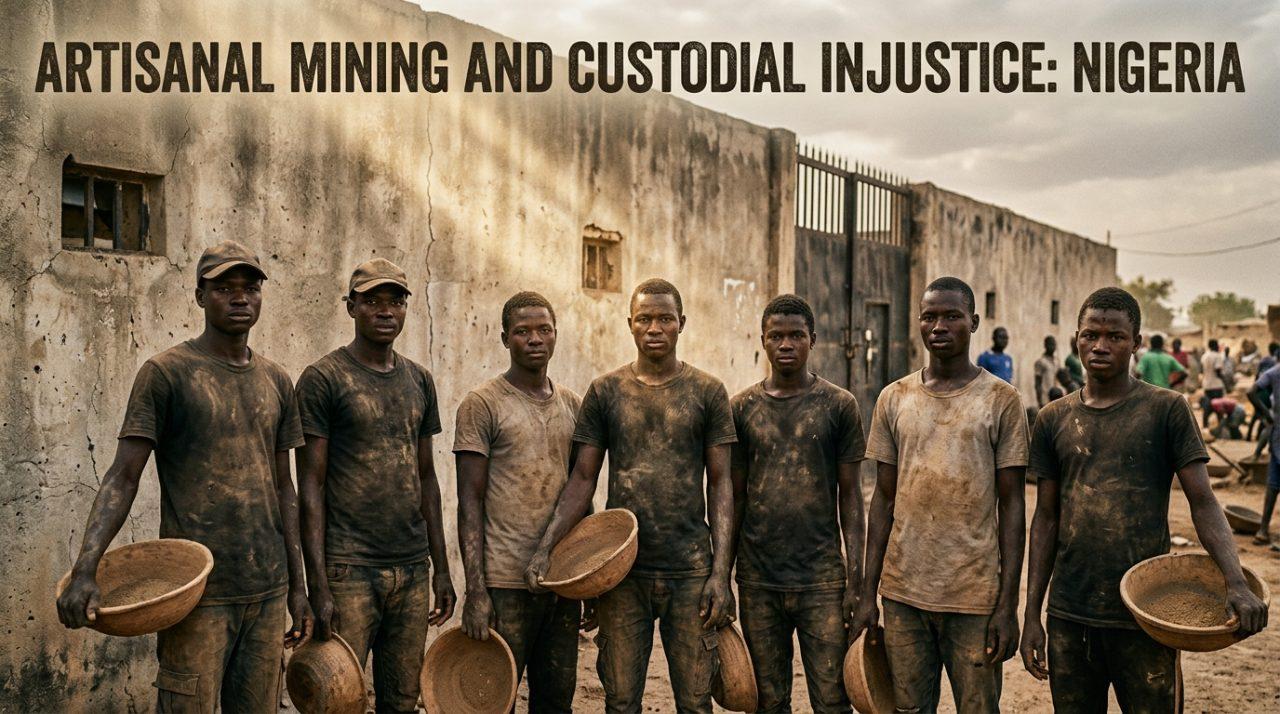
Why Did 37 Gold Miners Die in a Nigerian Holding Cell?
By Darius Spearman (africanelements)
Support African Elements at patreon.com/africanelements and hear recent news in a single playlist. Additionally, you can gain early access to ad-free video content.
A Fatal Midnight Inside the Minna Detention Cell
Shockwaves rippled across Niger State after dozens of young workers perished inside a paramilitary holding facility in Minna. Security operatives locked scores of informal miners inside a suffocating, windowless room following a sweep of artisanal mining operations. Survivors reported that guards discharged an unidentified chemical irritant directly into the packed enclosure before bolting the door shut (theguardian.com, channelstv.com).
Trapped detainees pounded on the iron doors and begged for water as heat surged. Paramilitary guards refused to open the facility and fired warning shots into the night air to silence the screams. By morning, thirty-seven detainees lay lifeless on the concrete floor, while four of the fourteen survivors walked out unaided (thenationonlineng.net, guardian.ng). Preliminary medical reports revealed severe outward trauma, including peeling skin and bleeding from the ears, nose, and mouth (punchng.com, thenationonlineng.net).
Outcome of Detainees in Minna Chemical Incident
Documented toll among detained informal miners in the Minna holding cell.
Source: Niger State Government & Hospital Casualty Records (thenationonlineng.net, guardian.ng)
The Burdens of Poverty and Mineral Extraction
To understand this calamity, one must look at how rural families survive across northern Nigeria. Severe droughts, rural poverty, and economic inflation have pushed hundreds of thousands of people into informal mining. Artisanal and small-scale operations account for over seventy percent of all solid mineral extraction in the country (milsat.africa, wearevuka.com).
Whole villages depend on simple hand tools to pan for tiny flakes of gold. Young teenagers and children labor under dangerous conditions to buy food and basic medicine for their families. Instead of building secure processing plants or training programs, authorities have repeatedly responded with sudden arrests and armed crackdowns (humanglemedia.com, mdpi.com). These heavy-handed enforcement measures reflect how mass incarceration often substitutes for authentic economic reform in marginalized communities.
Colonial Roots of Modern Resource Control
The criminalization of native diggers did not begin yesterday. During the colonial era, the British Crown passed the Minerals Ordinance of 1946 to seize total control over local resources. That colonial statute declared that all minerals beneath Nigerian soil belonged exclusively to the British government (fuoye.edu.ng, thisdaylive.com).
Independent Nigeria later inherited this top-down framework without restoring land sovereignty to traditional inhabitants. Post-colonial leaders focused heavily on petroleum exploitation in the Niger Delta and neglected inland solid minerals. When rural citizens extract minerals from their ancestral lands today, federal authorities classify them as illegal trespassers on state property (novafrica.org, wearevuka.com).
Deadly Precedents: Environmental Poisoning in the Mines
Neglecting artisanal miners has repeatedly produced catastrophic humanitarian emergencies. In 2010, unassisted villagers in Zamfara State crushed gold ore containing lethal concentrations of lead dust. The resulting toxic outbreak killed over four hundred children and left hundreds more with permanent neurological damage (terragraphicsinternational.org, nih.gov).
Five years later, an identical lead poisoning disaster struck Rafi and Shiroro local government areas in Niger State, claiming nearly thirty young lives (terragraphicsinternational.org, ibtimes.com). Despite international medical interventions, state agencies failed to provide industrial wet-milling equipment or environmental safety zones. Authorities continued an erratic cycle of administrative bans followed by punitive paramilitary raids against impoverished laborers (humanglemedia.com, mdpi.com).
The Informal Mining Reality in Nigeria
Data compiled from Federal Ministry of Solid Minerals and Mining Industry Audits (novafrica.org, milsat.africa, wearevuka.com)
The Rise of Paramilitary Policing and Mining Marshals
In response to mineral smuggling and rural banditry, the federal government militarized resource enforcement. The Nigeria Security and Civil Defence Corps originally began in 1967 as a volunteer group to assist civilians during the Nigerian Civil War (nta.ng). Over several decades, parliamentary statutes transformed the volunteer outfit into a heavily armed federal paramilitary force (nta.ng, pmnewsnigeria.com).
In 2024, the Ministry of Solid Minerals partnered with the NSCDC to establish armed squads called Mining Marshals (enca.com, dailynewsegypt.com). These units were tasked with dismantling illicit mineral syndicates. However, armed marshals regularly focused their guns on low-income manual diggers rather than untouchable commercial buyers (theguardian.com, humanglemedia.com). Questions regarding how centralized federal security forces police local communities connect directly to historic debates over state vs nation authority.
Custodial Abuse and the Crisis of Pretrial Detention
The horrific asphyxiation inside the Minna compound exposes an ongoing human rights emergency within Nigerian custodial facilities. Paramilitary holding cells are built strictly for temporary, short-term administrative processing. Yet security forces routinely hold dozens of suspects for days in tiny cells lacking ventilation, toilets, or running water (theguardian.com, channelstv.com).
Across Nigeria, more than sixty percent of all incarcerated individuals are pretrial detainees who have never received a trial (businessday.ng, guardian.ng). Suspects linger behind bars for months without formal charges. The use of toxic chemical agents inside closed spaces illustrates a reckless disregard for fundamental human dignity (theguardian.com, thesun.ng). These systemic abuses evoke the urgent concerns raised during the historic fights over justice led by civil rights organizers against unchecked state power.
Nigeria Custodial Population Crisis
Total National Inmate Count: ~80,800 inmates nationwide.
Source: Nigerian Correctional Service & Legal Aid Audits (businessday.ng, guardian.ng)
The Indiscriminate Targeting of Vulnerable Minors
Paramilitary sweeps routinely ignore child protection statutes. Under the Child’s Rights Act of 2003, Nigerian law strictly forbids holding juveniles inside adult detention facilities (punchng.com). The law dictates that children caught in manual labor must receive rehabilitation and administrative protection rather than criminal confinement (punchng.com, punchng.com).
Nevertheless, security forces frequently arrest young teenagers alongside older diggers without verifying their ages. In the Minna tragedy, survivors included children as young as eleven years old who were packed into the suffocating cell alongside adults (theguardian.com, channelstv.com). Denying legal counsel and family visits to youth trapped in military sweeps represents a blatant violation of domestic statutes (punchng.com).
Legal Realities Surrounding Overnight Detention
The actions of the security operatives also violated basic constitutional mandates. Section 35 of the Nigerian Constitution guarantees personal liberty and requires that detainees appear before a judge within twenty-four to forty-eight hours (kogireports.com, punchng.com). Furthermore, only the Nigerian Correctional Service holds statutory authority to run long-term penal facilities (guardian.ng, thisdaylive.com).
The NSCDC is legally empowered to investigate critical infrastructure crimes, but it has no constitutional right to maintain indefinite holding dungeons (kogireports.com, nta.ng). When paramilitary corps construct unregulated jail cells, the risk of custodial torture multiplies dramatically. Under the Administration of Criminal Justice Act, designated magistrates must inspect custodial centers monthly to curb unlawful detentions (punchng.com).
Echoes of Historical Mass Resistance
Public outrage erupted instantly across Minna after word of the deaths reached town. Demonstrators built burning barricades and clashed with security officers in major commercial districts (theguardian.com, guardian.ng). This spontaneous civilian fury echoes historic protests against state brutality in Nigeria, particularly the nationwide #EndSARS demonstrations of 2020 (facebook.com, facebook.com).
During the #EndSARS uprising, millions of citizens organized across Nigeria to demand the disbandment of the police Special Anti-Robbery Squad (facebook.com). Demonstrators documented widespread custodial torture, unlawful extortion, and extrajudicial executions by state agents (facebook.com, facebook.com). The recent Minna protests demonstrate that public tolerance for paramilitary impunity has completely eroded across the country (guardian.ng, thesun.ng).
Accountability Demands and Systemic Solutions
In response to domestic anger, the federal government suspended over twenty NSCDC personnel and initiated an official inquiry (thenationonlineng.net, thenationonlineng.net). However, human rights organizations and legal groups demand criminal murder charges rather than simple workplace suspensions (guardian.ng, punchng.com). Families of the victims are calling for full toxicology reports to identify the exact chemical sprayed inside the cell (thenationonlineng.net, channelstv.com).
Meaningful reform demands an end to the militarization of natural resource oversight. Nigerian authorities must formalize artisanal mining cooperatives and provide modern, non-toxic mining equipment (novafrica.org, wearevuka.com). Furthermore, the judiciary must inspect all paramilitary barracks to eliminate secret holding cells (punchng.com). Only comprehensive structural justice can prevent vulnerable laborers from paying for their poverty with their lives.
About the Author
Darius Spearman is a professor of Black Studies at San Diego City College, where he has been teaching for over 20 years. He is the founder of African Elements, a media platform dedicated to providing educational resources on the history and culture of the African diaspora. Through his work, Spearman aims to empower and educate by bringing historical context to contemporary issues affecting the Black community.
