


Why DOJ Dropped Reflecting Pool Vandalism Charges
By Darius Spearman (africanelements)
Support African Elements at patreon.com/africanelements and hear recent news in a single playlist. Additionally, you can gain early access to ad-free video content.
The Surprising Collapse of a High-Profile Federal Case
On July 31, 2026, federal prosecutors made a dramatic move in Washington. The Department of Justice filed a formal motion to drop all federal criminal charges against David Hearn (justice.gov). Hearn is a sixty-seven-year-old former Olympic canoeist who competed for the United States in three Olympic Games (cbsnews.com, apnews.com). Federal authorities had previously charged Hearn with felony property destruction (justice.gov). Officials alleged that he intentionally ruined the surface of the Lincoln Memorial Reflecting Pool (apnews.com).
The official narrative unravelled completely inside the courtroom (washingtonpost.com). In a detailed twenty-page motion, prosecutors conceded that Hearn did not vandalize the historic basin (justice.gov). Instead, federal officials acknowledged that the widespread damage resulted from severe errors made by an agency contractor (justice.gov). A rushed installation timeline caused the new blue protective coating to fail completely (justice.gov). This admission ended weeks of intense national media scrutiny (pbs.org).
Public reaction to the initial arrest was swift and polarizing (washingtonpost.com). Administration officials publicly blamed activist agitators for undermining national monument preparations (washingtonpost.com). Major news outlets initially echoed government claims regarding alleged intentional destruction (cbsnews.com, apnews.com). However, defense attorneys insisted from the beginning that Hearn was merely a passerby (washingtonpost.com). The complete withdrawal of charges validated those defense claims and exposed massive communication gaps within federal agencies (justice.gov, substack.com).
A Sacred Space for Movement and Memory
The Lincoln Memorial Reflecting Pool holds a monumental place in American history. Architect Henry Bacon designed the massive basin, which was completed in 1922 (wikipedia.org). The pool stretches two thousand thirty feet in length and spans one hundred sixty-seven feet across (wikipedia.org). It contains roughly four million gallons of water when filled completely (wikipedia.org). Millions of visitors travel to the National Mall each year to stand beside its waters (pbs.org).
For generations, the site has served as a powerful backdrop for major civil rights gatherings. Legendary singer Marian Anderson performed on the steps in 1939 after facing racial discrimination elsewhere (wikipedia.org). Decades later, Dr. Martin Luther King Jr. delivered his historic speech during the 1963 March on Washington (pbs.org, wikipedia.org). Over time, government approaches shifted toward aggressive security tactics and a shift toward mass incarceration in public spaces (newsweek.com). Protecting public monuments became a central priority for federal law enforcement agencies (ldad.org).
Maintaining such a vast outdoor structure presents continuous engineering challenges. The entire pool rests on unstable marshland subgrade near the Potomac River (wikipedia.org). Consequently, structural leaking and water stagnation plagued the monument for many decades (wikipedia.org). Between 2010 and 2012, the federal government conducted a thirty-four million dollar reconstruction (wikipedia.org). Workers drove thousands of timber piles into deep bedrock to stabilize the heavy structure (wikipedia.org).
The 2010 overhaul replaced outdated plumbing systems with modern filtration units (wikipedia.org). Engineers designed a closed system that circulates water from the Tidal Basin (wikipedia.org). This design intended to reduce water stagnation and prevent severe algae blooms (wikipedia.org). However, maintaining water chemistry within a four-million-gallon basin demands continuous technical balance (wikipedia.org, notus.org). When improper chemical treatments or physical installations occur, the structural integrity of the basin quickly deteriorates (sika.com, notus.org).
Chronology of the Reflecting Pool Legal Case (2026)
-
May 20, 2026Interior Department documents record initial blistering on the new pool coating.
-
June 11, 2026Inspectors note widespread peeling and delamination of the blue polyurea liner.
-
June 19, 2026David Hearn touches a loose flap during a bike ride; U.S. Park Police detain him.
-
July 2, 2026A federal grand jury indicts Hearn on felony property destruction charges.
-
July 28, 2026Primary government witness admits the pool was damaged prior to Hearn’s arrival.
-
July 31, 2026DOJ files a twenty-page motion dismissing all criminal charges against Hearn.
The Rushed Reconstruction and Physical Realities
In early 2026, federal officials launched another ambitious overhaul of the Reflecting Pool (pbs.org). The project carried a price tag of thirteen point one million dollars (pbs.org). Officials planned the project to coincide with nationwide celebrations for America 250 (america250.org). The goal was to recoat the basin floor with an American Flag Blue polyurea sealant before Independence Day (pbs.org, america250.org). High-ranking administration leaders wanted a visually striking monument for upcoming national broadcasts (pbs.org).
Polyurea is a heavy-duty polymer coating used as a waterproof layer over concrete (sika.com). However, proper bonding requires strict curing conditions and thoroughly prepared surfaces (sika.com). Federal contractors rushed the surface preparation to meet the aggressive holiday deadline (justice.gov). Consequently, moisture became trapped underneath the fresh application (justice.gov, justice.gov). Trapped moisture caused severe delamination, which happens when a coating completely separates from concrete (sika.com, justice.gov).
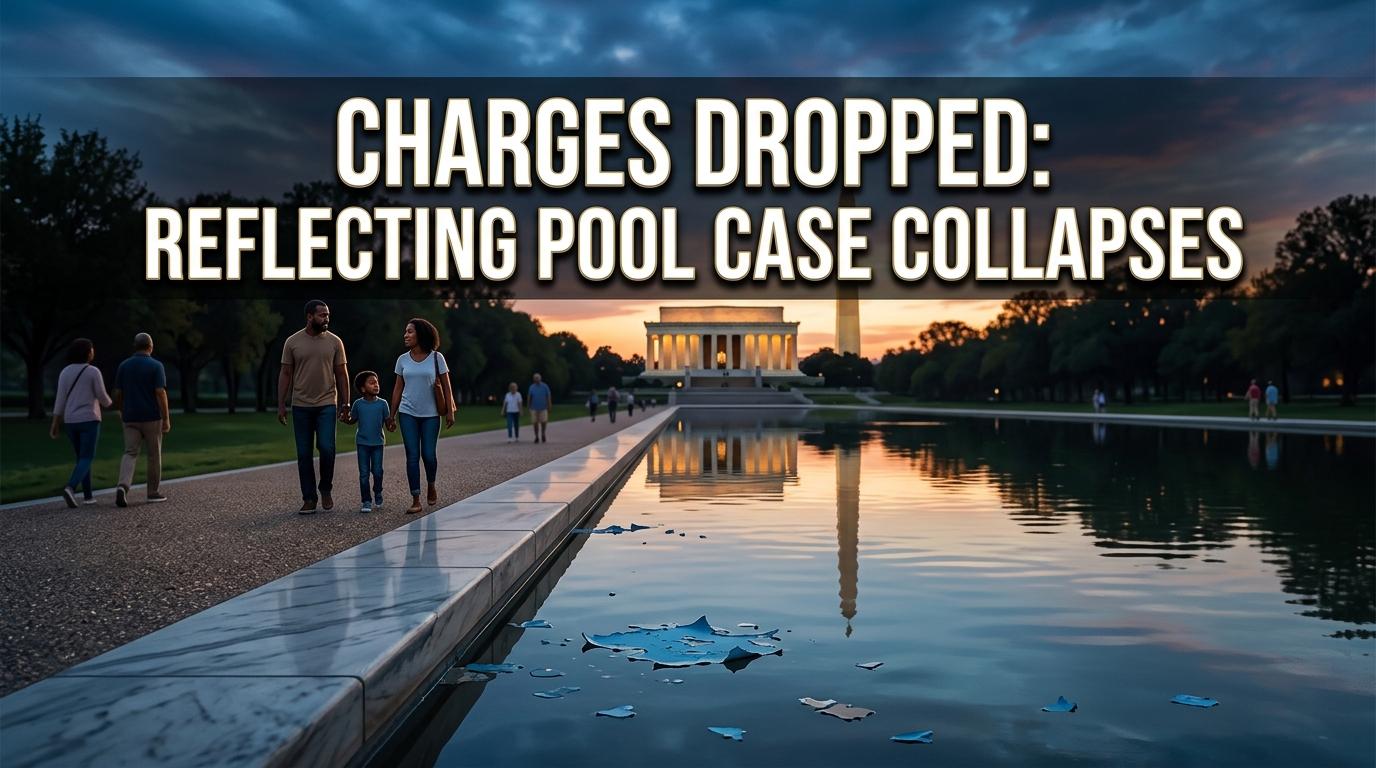
The situation deteriorated rapidly as summer temperatures escalated in D.C. (washingtonpost.com). Heat caused air pockets underneath the polymer layer to expand into large blisters (justice.gov). To combat algae growth in standing water, maintenance crews poured large amounts of hydrogen peroxide into the basin (notus.org). The chemical compound reacted harshly with the uncured sealant (notus.org). Large sheets of blue material lifted off the pool floor and drifted to the surface (pbs.org).
Contractor crews applied the polyurea coating during fluctuating spring weather conditions in May (justice.gov, notus.org). Industrial standards require concrete substrates to be completely dry and temperature controlled before spraying (sika.com). High humidity and rapid temperature changes caused microscopic air bubbles to form beneath the surface barrier (sika.com, justice.gov). As ambient heat increased throughout June, those microscopic pockets expanded significantly (justice.gov, washingtonpost.com). The expanding air forced large sections of the synthetic material off the concrete floor (justice.gov).
When Federal Enforcement Intersects With Sacred Dates
The timing of the incident added deep historical resonance to the unfolding law enforcement action (pbs.org). On June 19, 2026, David Hearn took a routine bicycle ride along the National Mall (cbsnews.com, apnews.com). June 19th, known nationwide as Juneteenth, marks the end of Black chattel slavery in the United States (pbs.org, wikipedia.org). The federal holiday commemorates the arrival of Union troops in Galveston, Texas, in 1865 (wikipedia.org). On that historic day, soldiers arrived to enforce the Emancipation Proclamation across remote areas (wikipedia.org).
During his ride, Hearn noticed floating debris along the edge of the Reflecting Pool (cbsnews.com). He stopped out of simple curiosity to observe the peeling blue coating (cbsnews.com, apnews.com). Hearn reached down and touched a loose flap attached near the shoreline (cbsnews.com). A park worker immediately instructed him to refrain from touching the material (cbsnews.com). Hearn complied right away and let go of the rubbery piece (cbsnews.com).
Despite his immediate compliance, federal law enforcement officers intervened aggressively (washingtonpost.com). U.S. Park Police and National Guard soldiers stationed nearby detained Hearn on the spot (washingtonpost.com, apnews.com). Armed troops maintained a visible security presence surrounding the perimeter of the pool (pbs.org). Officers held the sixty-seven-year-old cyclist in custody for nearly five hours (washingtonpost.com). Civil rights advocates frequently analyze how authorities wield law enforcement power (substack.com). Their analysis reflects historic concerns over how state officials manage federal power and authority in public spaces (newsweek.com).
The presence of military personnel on Juneteenth sparked significant public discussion among legal observers (pbs.org, substack.com). National Mall grounds have long served as a platform where citizens express fundamental Constitutional rights (pbs.org, wikipedia.org). Heavy law enforcement deployments during cultural anniversaries often heighten tensions between citizens and armed authorities (substack.com, newsweek.com). Observers noted that deploying military patrols at public sites can lead to swift, mistaken arrests of innocent bystanders (substack.com).
The Mechanics of Federal Property Law
The legal framework surrounding federal property damage carries severe statutory penalties. Under Title 18 of the United States Code, Section 1361 governs property destruction (wikipedia.org). The law makes it a federal felony to willfully injure government property (wikipedia.org). If alleged damage exceeds one thousand dollars, defendants face up to ten years in prison (wikipedia.org). High financial penalties also accompany potential felony convictions under the statute (wikipedia.org).
Political pressures heavily influenced early prosecutorial decisions in the case (washingtonpost.com). Senior administration officials claimed that political vandals deliberately slashed the new sealant (washingtonpost.com). On July 2, 2026, U.S. Attorney Jeanine Pirro announced a grand jury indictment against Hearn (justice.gov, apnews.com). The indictment charged Hearn with felony property destruction (justice.gov). Prosecutors claimed that his actions caused over one thousand dollars in physical damage to the pool (justice.gov).
Because Washington operates under unique jurisdictional rules, the case entered D.C. Superior Court (courthousenews.com). The U.S. Attorney’s Office prosecutes both local and federal offenses within the District (courthousenews.com). Grand jury indictments are routinely litigated before local District judges (courthousenews.com). D.C. Superior Court Judge Carmen McLean presided over Hearn’s initial court appearance (courthousenews.com). Judge McLean rejected strict government requests to restrict Hearn’s travel, citing weak initial evidence (courthousenews.com).
To justify felony charges under federal law, prosecutors relied on early repair estimates provided by site managers (justice.gov, washingtonpost.com). Officials argued that replacing damaged sealant panels would cost tens of thousands of dollars (justice.gov). Consequently, government attorneys framed any physical contact with loose material as direct property destruction (justice.gov). However, federal property laws require proof of willful intent to commit physical harm (wikipedia.org). Touching already detached debris does not meet statutory requirements for criminal property destruction (wikipedia.org, justice.gov).
Unraveling the Narrative in the Courtroom
Hearn retained an experienced legal team led by attorneys Norm Eisen, Mary Dohrmann, and Steve Levin (washingtonpost.com, washingtonpost.com). Defense counsel immediately challenged the government narrative through aggressive discovery requests (washingtonpost.com, washingtonpost.com). Subpoenaed records from the Department of the Interior revealed critical internal facts (justice.gov, pbs.org). Site managers had documented initial surface blistering as early as May 20, 2026 (justice.gov, pbs.org). By June 11, formal inspection reports noted widespread peeling across the basin floor (justice.gov).
The government’s legal position collapsed entirely during grand jury testimony reviews (justice.gov). On July 28, court disclosures showed that the primary federal witness made a key admission (justice.gov). The witness acknowledged that severe peeling occurred long before Hearn ever approached the pool (justice.gov). Physical inspections confirmed identical delamination in deep center areas of the basin (justice.gov). Those middle sections were completely unreachable from the shore without swimming (justice.gov).
The forensic findings completely undermined charges against other detained individuals as well (triblive.com, foxla.com). Law enforcement officers had arrested at least six other citizens near the pool (triblive.com, foxla.com). Authorities charged those individuals with misdemeanors for taking small pieces of loose debris (triblive.com, foxla.com). Historical struggles show how marginalized groups experienced economic justice struggles when facing unfair system pressures (cleveland13news.com). When evidence proved systemic contractor failure, the legal foundation for all vandalism charges evaporated (justice.gov).
Defense attorney Norm Eisen sharply criticized the Department of Justice (washingtonpost.com, washingtonpost.com). He noted that prosecutors failed to conduct basic laboratory testing before filing felony charges (washingtonpost.com). Independent chemical analysis showed that the polyurea liner suffered from inherent adhesion failure (sika.com, justice.gov). Defense experts demonstrated that environmental factors caused the liner to peel without human intervention (justice.gov). Confronted with undeniable forensic evidence, federal prosecutors had no choice but to drop all charges against Hearn (justice.gov, justice.gov).
Systemic Failures and the Push for Accountability
The ultimate dismissal of charges highlights broader questions about government transparency and law enforcement priorities (substack.com). In their July 31 motion, prosecutors admitted that Atlantic Industrial Coatings botched the application (justice.gov, justice.gov). The agency had fast-tracked the contract to meet political deadlines for the holiday (justice.gov, america250.org). However, the Interior Department failed to share internal engineering reports with prosecutors prior to grand jury proceedings (justice.gov).
Defense attorneys sharply criticized federal prosecutors for rushing to judgment without basic forensic verification (washingtonpost.com, washingtonpost.com). Legal experts described the indictment as an attempt to cover up administrative mismanagement (substack.com). Over-policing in public spaces often places ordinary citizens at risk when government agencies seek scapegoats (substack.com). Throughout history, communities have waged a continuous struggle for civil rights against state overreach (newsweek.com).
By framing structural flaws as criminal acts, officials briefly diverted public focus away from contractor failure (notus.org, substack.com). The case underscores how hasty criminal allegations can damage individual reputations (washingtonpost.com). David Hearn spent weeks facing potential felony penalties for simply touching peeling paint during a bike ride (cbsnews.com, washingtonpost.com). Public accountability requires that law enforcement rely on verified physical facts rather than political expediency (substack.com, ldad.org).
The breakdown between agency officials and federal prosecutors revealed systemic communication flaws within the executive branch (justice.gov, substack.com). Interior Department inspectors knew that contractor installation errors caused the peeling weeks before the arrest (justice.gov). Yet, officials failed to convey those critical inspection reports to investigating Park Police officers (justice.gov, washingtonpost.com). As a result, law enforcement officers acted on false assumptions, leading to an unwarranted prosecution (justice.gov, substack.com).
The Legacy of Washington’s National Landmarks
The resolution of the Reflecting Pool case provides vital lessons for federal governance and public management (substack.com). Public monuments belong to the nation and represent shared historical memory (pbs.org). Protecting these historic structures requires competent engineering and proper oversight rather than rushed timelines (sika.com, justice.gov). When government officials rush construction to meet political deadlines, physical infrastructure often suffers (justice.gov, america250.org).
Furthermore, the case demonstrates the critical role of an independent judicial system in checking executive power (courthousenews.com, ldad.org). Rigorous defense work exposed internal agency records that cleared an innocent citizen (justice.gov, washingtonpost.com). Public spaces must remain open for peaceful enjoyment without fear of unwarranted felony prosecution (substack.com). As the nation reflects on its history, maintaining integrity in both public works and federal justice remains essential (substack.com, ldad.org).
Moving forward, federal agencies face increased pressure to ensure transparency in public works projects (substack.com). Rushing major construction initiatives to meet political deadlines poses severe risks to taxpayers and public infrastructure (justice.gov, america250.org). Furthermore, protecting civil liberties requires that law enforcement agencies exercise thorough restraint before bringing felony charges against citizens (substack.com, ldad.org). Preserving public trust requires accountability at every level of government (substack.com).
About the Author
Darius Spearman is a professor of Black Studies at San Diego City College, where he has been teaching for over 20 years. He is the founder of African Elements, a media platform dedicated to providing educational resources on the history and culture of the African diaspora. Through his work, Spearman aims to empower and educate by bringing historical context to contemporary issues affecting the Black community.
