



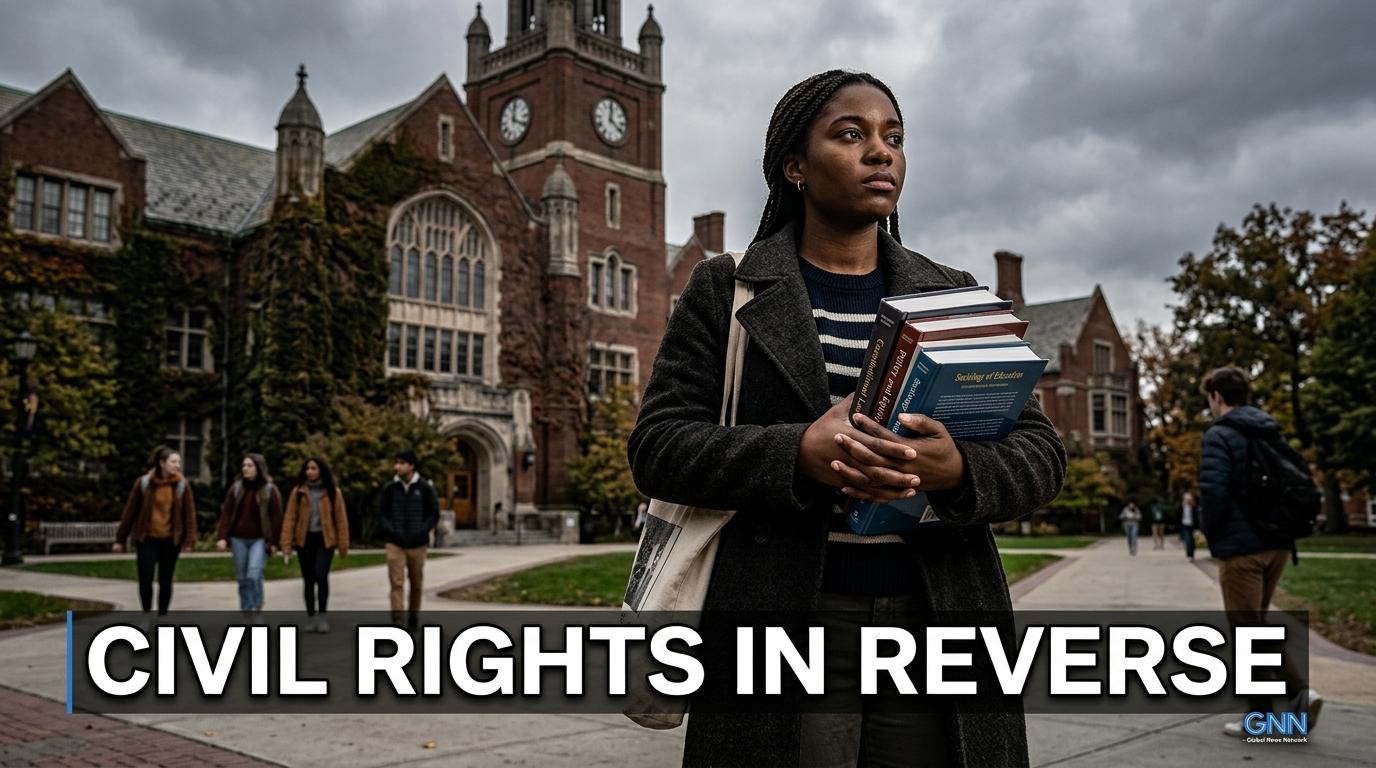
Why Federal Civil Rights Probes Now Target Black Students
By Darius Spearman (africanelements)
Support African Elements at patreon.com/africanelements and hear recent news in a single playlist. Additionally, you can gain early access to ad-free video content.
The Great Irony of Title VI Enforcement
The federal civil rights apparatus has undergone a massive transformation. Historically, it protected minority students from institutional exclusion. Today, federal investigations target programs that support those very students (highereddive.com). This shift represents a profound irony in American educational history.
Colleges across the United States are navigating a highly politicized landscape. Federal agencies are intensifying investigations over campus diversity programs (highereddive.com). Administrative structures designed for racial equity now face unprecedented challenges. Administrators are forced to choose between civil rights compliance and institutional values.
Many programs designed for Black and minority students are under official scrutiny. These probes threaten to dismantle decades of hard-won progress. Early civil rights victories are being dismantled using the very laws that created them. This struggle continues a long history of contested freedom in America.
To understand this modern conflict, one must look at the history of federalism and Black political struggles. The balance of power between national and state governments has always shaped freedom in Black and white.
The Radical Origins of Simple Justice
The current legal battles rely heavily on Title VI of the Civil Rights Act of 1964 (ed.gov). President Lyndon B. Johnson signed this historic legislation into law (ed.gov). Its primary goal was to prevent federal funding from subsidizing racial segregation (justice.gov). Before this law, public tax dollars routinely supported segregated educational institutions.
In 1963, President John F. Kennedy proposed the core principle of the act. He argued that simple justice requires public funds to be spent fairly (justice.gov). Kennedy declared that federal money must not encourage or subsidize racial discrimination (justice.gov). This statement established the modern civil rights enforcement framework.
To enforce this mandate, the federal government created the Office for Civil Rights (brookings.edu). The agency originally investigated systems of educational exclusion. It worked to open the doors of segregated universities to Black and brown students. This federal intervention represented a major shift from previous eras.
For generations, state governments actively worked to restrict the rights of formerly emancipated people. This systemic oppression forced communities to seek new avenues for how freedom defines Black political power. Today, that same federal authority is being utilized in a very different manner.
The Weaponization of the Colorblind Creed
Over the late twentieth century, the legal interpretation of Title VI shifted. The original focus on remedial justice gradually transformed into a mandate of colorblindness. Under the colorblindness doctrine, any official use of racial classifications is viewed as unconstitutional (culawreview.org). This philosophy makes no distinction between racial exclusion and remedial assistance.
In 1978, the Supreme Court heard the landmark case of Regents of the University of California v. Bakke (wikipedia.org). The court ruled that racial quotas were unconstitutional (wikipedia.org). However, universities could still consider race as one of several factors in admissions (wikipedia.org). This compromise aimed to preserve the educational benefits of a diverse student body.
In 2003, the Supreme Court reaffirmed this holistic approach in Grutter v. Bollinger (mtsu.edu). But the legal consensus was fragile. In June 2023, the court effectively ended affirmative action in college admissions (bestcolleges.com). Chief Justice John Roberts wrote that admissions programs must treat students as individuals, not based on race (bestcolleges.com).
This historic ruling laid the groundwork for the modern anti-DEI offensive (highereddive.com). Opponents of diversity programs argue that any race-conscious support violates federal law (highereddive.com). This transformation mirrors earlier periods where political priorities shifted. This shift resembles the historical political shift from civil rights to mass incarceration that occurred decades ago.
The Collapse of Title VI Resolution Agreements
Source: Brookings Institution and Congressional Case Data (highereddive.com)
Inside the Administrative Siege
The federal campaign against diversity, equity, and inclusion programs intensified rapidly. Immediately, President Donald Trump issued Executive Order 14151 (highereddive.com). This directive aimed to eliminate diversity programs and federal preferences across agencies (highereddive.com).
Shortly after, the Department of Education issued a major directive. Led by Craig Trainor, the Office for Civil Rights sent a “Dear Colleague” letter to universities (highereddive.com). The agency declared that diversity initiatives toxically indoctrinate students (highereddive.com). It argued that these programs discriminate against white and Asian students.
Subsequent federal guidance in March 2025 clarified the new standards (highereddive.com). The Office for Civil Rights stated that the word “diversity” is not inherently illegal (highereddive.com). However, any program restricting participation based on race violates Title VI (highereddive.com).
This aggressive enforcement strategy has created an atmosphere of fear on college campuses. Administrators must now scrutinize every initiative designed to support minority students. Many fear losing vital federal funding if they fail to comply with these strict mandates.
Black Scholars in the Federal Crosshairs
The federal government has targeted several prominent organizations and universities. In March 2025, the Office for Civil Rights launched a massive probe (highereddive.com). It targeted forty-five universities for partnering with “The Ph.D. Project” (highereddive.com).
This nonprofit group works to increase diversity among business school faculty members (highereddive.com). It helps Black, Hispanic, and Native American scholars obtain business doctorates (highereddive.com). The group has helped increase minority business professors from 294 to over 1,700 since 1994 (highereddive.com).
Yet, the federal government argues that this partnership constitutes an illegal race-exclusionary practice. To preserve its university partnerships, the nonprofit made major changes. It opened its membership applications to anyone who shares their vision (highereddive.com).
This federal pressure has not stopped with graduate mentoring programs. The government also launched investigations into Harvard University and the Harvard Law Review (highereddive.com). These investigations focus on alleged racial selection criteria for journal membership (highereddive.com). Furthermore, Stanford University faced an investigation over a K-12 teacher training program (highereddive.com). The reach of these civil rights investigations continues to expand.
Racial Harassment Resolution Rate (2025)
0 Out of 949 Cases Resolved
Traditional racial harassment complaints remained completely unresolved (highereddive.com).
The Free Speech Trap on College Campuses
The rise of civil rights probes has created a profound crisis for academic freedom. Universities are caught between competing federal demands and constitutional protections. Following global conflicts in late 2023, campus protests increased dramatically (ed.gov).
The Office for Civil Rights opened dozens of investigations regarding shared ancestry (ed.gov). This term allows federal investigators to address allegations of antisemitism and Islamophobia (ed.gov). While Title VI does not explicitly cover religion, it prohibits discrimination based on national origin (ed.gov).
The federal government interprets this protection to include shared ethnic characteristics (ed.gov). This framework has put immense pressure on college administrations. Federal investigators demand aggressive action to curb speech that creates a hostile environment (ed.gov).
However, civil liberties groups warn that punishing political speech violates the First Amendment (fire.org). Faculty members argue that these investigations suppress classroom discussions on systemic racism. Some states have even attempted to ban the teaching of diversity concepts entirely.
In January 2025, West Virginia issued an executive order banning state-funded colleges from teaching racial preferences (highereddive.com). These state-level mandates have faced significant pushback from the legal system. On July 7, 2026, a federal appeals court struck down Florida’s “Stop WOKE” Act (highereddive.com). The court ruled that the state cannot censor unpopular ideas in university classrooms (highereddive.com).
The Chilling Destruction of Student Support
The practical impact of these investigations is devastating for minority students. Fearing litigation, approximately fifty colleges have halted race-conscious scholarships (highereddive.com). These institutions are located largely in states like Missouri, Ohio, Kentucky, and Texas (highereddive.com).
Individual schools have suspended substantial funding pools. For example, the University of Toledo suspended roughly five hundred thousand dollars in diversity-oriented scholarships (highereddive.com). The University of Missouri is phasing out diversity awards entirely by 2028 (highereddive.com). This trend leaves many vulnerable students without necessary financial assistance.
To navigate these bans, some universities use race-neutral proxies. They look at geographic data like ZIP codes or socioeconomic status to maintain diversity (highereddive.com). However, these proxies are increasingly vulnerable to legal challenges.
Courts apply strict scrutiny if they find a proxy was used to achieve a specific racial balance (highereddive.com). The distinction between race-conscious and race-exclusive programs is critical here. While race-conscious programs use race as one of many factors, race-exclusive programs limit eligibility to specific groups. Today, federal investigators treat both approaches with equal hostility. This hostility targets the core support systems that historically marginalized students rely on.
Ph.D. Project Title VI Probes Launched
Federal pressure forced the program to open eligibility to preserve university ties (highereddive.com).
The Devastating Reality of Frozen Resources
The real-world consequences of these policy changes are visible in federal data. A comprehensive analysis released in April 2026 highlighted a massive shift in civil rights enforcement (highereddive.com). The federal government has largely abandoned traditional civil rights resolutions.
In 2025, the Office for Civil Rights reached only six Title VI resolution agreements (highereddive.com). This represents a nearly ninety-three percent drop from the previous year (highereddive.com). During this same period, hundreds of racial harassment cases remained completely unresolved (highereddive.com).
Out of 949 pending racial harassment cases, the agency resolved zero cases (highereddive.com). This freeze in enforcement leaves students reporting racial slurs without federal recourse. It forces families to rely on expensive private court litigation (ocrwatch.org).
Furthermore, federal funding freezes directly threaten the research capabilities of universities (highereddive.com). While student financial aid is legally protected, institutional research grants are not (highereddive.com). A freeze on these grants can force laboratories to close and terminate graduate fellowships. This loss of resources disproportionately impacts minority students in scientific fields.
Historically, state-centered power has often worked to limit educational equity. To understand this dynamic, one must examine the history of federalism and Black politics. The ongoing struggle over federalism continues to shape the educational landscape for Black communities.
Walking a Delicate Administrative Razor’s Edge
College administrators must now walk a delicate razor’s edge. They must protect federal funding while defending academic freedom. This dual pressure has forced many institutions to rename or cancel support programs.
The historical trajectory of Title VI shows a complete inversion of its initial purpose. It was created during the Civil Rights Movement to force segregated universities to integrate (ed.gov). It was designed to protect Black and minority students from institutional exclusion.
Now, the law is utilized as a regulatory tool to dismantle programs designed for their advancement. The ultimate casualties of this federal tug-of-war are marginalized student populations. Without targeted scholarships and mentoring networks, many students will face higher barriers to higher education.
The legal boundaries of campus diversity programs will continue to shift in the coming years. University leaders must find creative, legal pathways to support all students. The future of educational equity in the United States depends on their success.
About the Author
Darius Spearman is a professor of Black Studies at San Diego City College, where he has been teaching for over 20 years. He is the founder of African Elements, a media platform dedicated to providing educational resources on the history and culture of the African diaspora. Through his work, Spearman aims to empower and educate by bringing historical context to contemporary issues affecting the Black community.
