



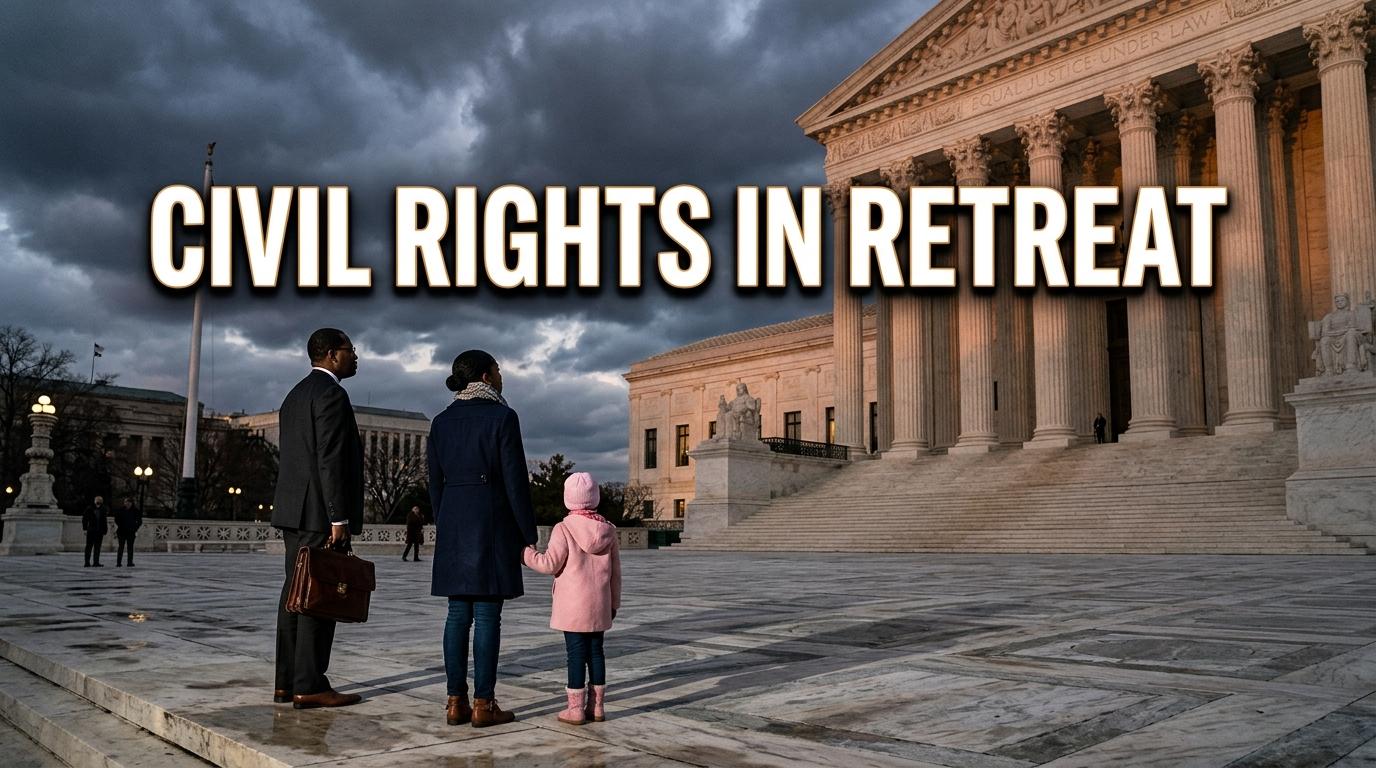
Why Federal Civil Rights Protections Are Collapsing
By Darius Spearman (africanelements)
Support African Elements at patreon.com/africanelements and hear recent news in a single playlist. Additionally, you can gain early access to ad-free video content.
In August 2026, Human Rights Watch released a detailed report documenting an unraveling of federal civil rights protections across the United States (hrw.org). The 112-page document explains how major federal bodies have abandoned core legal obligations to enforce anti-discrimination laws (hrw.org, hrw.org). Across key enforcement entities, systemic staff liquidations and office closures have paralyzed administrative oversight (hrw.org). These agencies include the Department of Justice, the Department of Education, Housing and Urban Development, and the Equal Employment Opportunity Commission (hrw.org).
This rapid institutional decline directly impacts millions of citizens who rely on federal oversight to protect their constitutional rights (hrw.org). Throughout American history, federal enforcement served as an indispensable shield against local oppression (wikipedia.org). When state authorities refused to protect marginalized populations, federal investigators stepped in to enforce equal justice (wikipedia.org, wikipedia.org). Understanding the depth of the current crisis requires a close examination of how this federal shield was constructed over more than a century of legal struggle.
Reconstruction Roots of the Federal Shield
The federal civil rights infrastructure did not appear overnight. It emerged from intense political conflict during the Reconstruction period following the American Civil War (wikipedia.org). In 1870, Congress established the United States Department of Justice specifically to enforce the Fourteenth and Fifteenth Amendments (wikipedia.org, wikipedia.org). Newly emancipated Black citizens faced severe violence, disenfranchisement, and organized voter suppression across the post-Civil War South (wikipedia.org). Local law enforcement agencies frequently supported terror groups or refused to investigate crimes against Black residents (wikipedia.org).
Consequently, federal lawmakers recognized that state courts could not be trusted to protect vulnerable citizens. The creation of the Department of Justice granted federal prosecutors statutory authority to intervene directly in state matters (wikipedia.org). This shift fundamentally reshaped the system of federalism in North America (wikipedia.org). National power became a mandatory counterweight to state-sanctioned racial discrimination (wikipedia.org). Without strong federal intervention, local authorities retained absolute power to strip away basic constitutional protections without facing federal consequences.
The Mid-Century Expansion of Civil Enforcement
Nearly a century after Reconstruction, the federal civil rights apparatus expanded significantly during the modern civil rights movement. In response to Jim Crow segregation, President Dwight D. Eisenhower signed the Civil Rights Act of 1957 into law (wikipedia.org). This statute created the Civil Rights Division within the Department of Justice (wikipedia.org). The act established a permanent Assistant Attorney General post dedicated to litigating voting rights violations nationwide (wikipedia.org).
The landmark Civil Rights Act of 1964 expanded federal authority into employment, education, and public accommodations (eeoc.gov, wikipedia.org). Title VII created the Equal Employment Opportunity Commission to eradicate discrimination in private workplaces (eeoc.gov). Title VI barred racial discrimination in all programs receiving federal financial assistance (ed.gov, wikipedia.org). Shortly after, the Voting Rights Act of 1965 granted the federal government power to preclear state voting laws (ballotpedia.org). Grassroots activists made vital contributions during the Civil Rights era to secure these federal statutes. In 1968, the Fair Housing Act authorized the Department of Housing and Urban Development to combat housing bias (nlihc.org, wikipedia.org). Finally, in 1979, the Department of Education created its Office for Civil Rights to protect students from systemic discrimination (ed.gov, luc.edu).
Reinterpreting Legal Bias and Disparate Impact
The Human Rights Watch report highlights a fundamental policy shift that threatens decades of established legal precedent (hrw.org). In June 2026, the Department of Justice Office of Legal Counsel issued an opinion declaring the legal theory of disparate impact unconstitutional (hrw.org). Under long-standing federal civil rights interpretations, disparate impact allows federal authorities to challenge facially neutral policies that produce discriminatory outcomes against protected groups (eeoc.gov, justia.com). Crucially, investigators do not need to prove overt hatred or intentional bigotry to mandate reform (eeoc.gov).
For example, blanket corporate rules excluding individuals with arrest records from employment disproportionately exclude Black applicants due to documented racial disparities in law enforcement (eeoc.gov). Under disparate impact rules, employers must demonstrate that such criminal background checks are strictly job-related and required by business necessity (eeoc.gov, eeoc.gov). Eliminating this legal standard forces victims to prove subjective racial animus, which institutional leaders rarely state publicly (hrw.org, eeoc.gov). Consequently, widespread systemic barriers in hiring, housing, and educational access become legally untouchable as long as explicit slurs are avoided (hrw.org, hrw.org).
Hollowing Out Fair Housing and Employment Agencies
Institutional enforcement rollbacks have severely impacted agencies tasked with housing and workplace protections. At the Department of Housing and Urban Development, whistleblower documents revealed a seventy percent reduction in enforcement personnel within the Office of Fair Housing and Equal Opportunity (nlihc.org, hrw.org). Citizens who called the national fair housing hotline during spring 2025 encountered an automated message stating the telephone line was no longer operational (hrw.org). Furthermore, agency leadership intercepted housing discrimination referrals, prematurely closing at least one hundred fifteen active cases (hrw.org).
Workplace protections experienced a matching operational decline at the Equal Employment Opportunity Commission, where staffing levels hit a forty-year low (hrw.org). In August 2026, the commission voted two-to-one to eliminate mandatory EEO-1 demographic data collection for private employers (hrw.org, rippling.com). For six continuous decades, EEO-1 reporting mandated that large corporations submit annual employee breakdowns categorized by race, ethnicity, and gender (federalregister.gov, rippling.com). Eliminating this requirement removes the primary statistical tool federal analysts used to detect broad hiring bottlenecks, promotion ceilings, and pay disparities affecting Black workers (hrw.org, nationalpartnership.org).
Educational Rollbacks and Student Vulnerability
Federal protection for public school students has experienced unprecedented reductions under recent policy shifts. The Department of Education terminated nearly fifty percent of its Office for Civil Rights workforce in a single day (hrw.org, edweek.org). Furthermore, federal officials shuttered seven of the twelve regional offices responsible for processing localized parent and student complaints (hrw.org, edweek.org). Administrative leaders subsequently announced plans to transfer remaining civil rights investigative duties directly to the depleted Department of Justice (hrw.org, franczek.com).
These closures directly impact Black students, who historically encounter harsh disciplinary disparities in public institutions (ed.gov, ed.gov). Federal data demonstrates that Black students are suspended at rates more than three times higher than white peers for identical behavioral infractions (ed.gov). Investigations conducted by regional civil rights offices were crucial for curbing the school-to-prison pipeline by forcing school districts to modify exclusionary discipline policies (ed.gov, luc.edu). The ongoing shift in political narratives leaves parents with limited administrative options when local school boards violate federal non-discrimination standards (hrw.org, edweek.org).
The Realignment of Federal Resources
Rather than enforcing traditional civil rights laws to protect marginalized groups, federal agencies have redirected enforcement machinery toward targeting Diversity, Equity, and Inclusion initiatives (hrw.org, hrw.org). Civil rights divisions now utilize federal resources to investigate private employers, universities, and public institutions that maintain voluntary diversity programs (hrw.org, hrw.org). Federal attorneys argue that race-conscious recruitment and leadership initiatives constitute illegal discrimination against non-minority candidates (hrw.org, hrw.org).
This resource realignment leaves victims of traditional discrimination with diminished legal protections. While individuals retain statutory private rights of action to sue employers or landlords in federal court, private litigation is prohibitively expensive for low-income citizens (eeoc.gov, justia.com). Plaintiffs face high attorney fees, costly expert witness demands, and strict procedural rules (eeoc.gov, justia.com). Furthermore, Supreme Court precedents prohibit private citizens from bringing disparate impact lawsuits under Title VI (berkeley.edu, justia.com). When federal agencies abandon pattern-or-practice litigation, widespread institutional bias operates without significant federal resistance (hrw.org, justice.gov).
The Future of Federal Civil Rights Protection
The findings published by Human Rights Watch reveal a federal civil rights enforcement structure in operational retreat (hrw.org). Civil rights mechanisms constructed across one hundred fifty years do not dissolve solely through legislative repeals passed by Congress (hrw.org, wikipedia.org). Instead, protections dismantle when executive agencies liquidate enforcement personnel, close regional offices, and abandon core legal doctrines like disparate impact (hrw.org, eeoc.gov).
The structural reduction of civil rights enforcement leaves Black voters, workers, renters, and students vulnerable to systemic discrimination (hrw.org, hrw.org). As the federal shield erodes, understanding the historical origin of these agencies remains crucial for those working to safeguard equal justice (wikipedia.org). Civil rights laws depend entirely on active enforcement machinery, and without operational administrative bodies, equal protection under the law remains an unfulfilled statutory promise (hrw.org, hrw.org).
About the Author
Darius Spearman is a professor of Black Studies at San Diego City College, where he has been teaching for over 20 years. He is the founder of African Elements, a media platform dedicated to providing educational resources on the history and culture of the African diaspora. Through his work, Spearman aims to empower and educate by bringing historical context to contemporary issues affecting the Black community.
