

Why is the NMAAHC removing Black history artifacts today?
By Darius Spearman (africanelements)
Support African Elements at patreon.com/africanelements and hear recent news in a single playlist. Additionally, you can gain early access to ad-free video content.
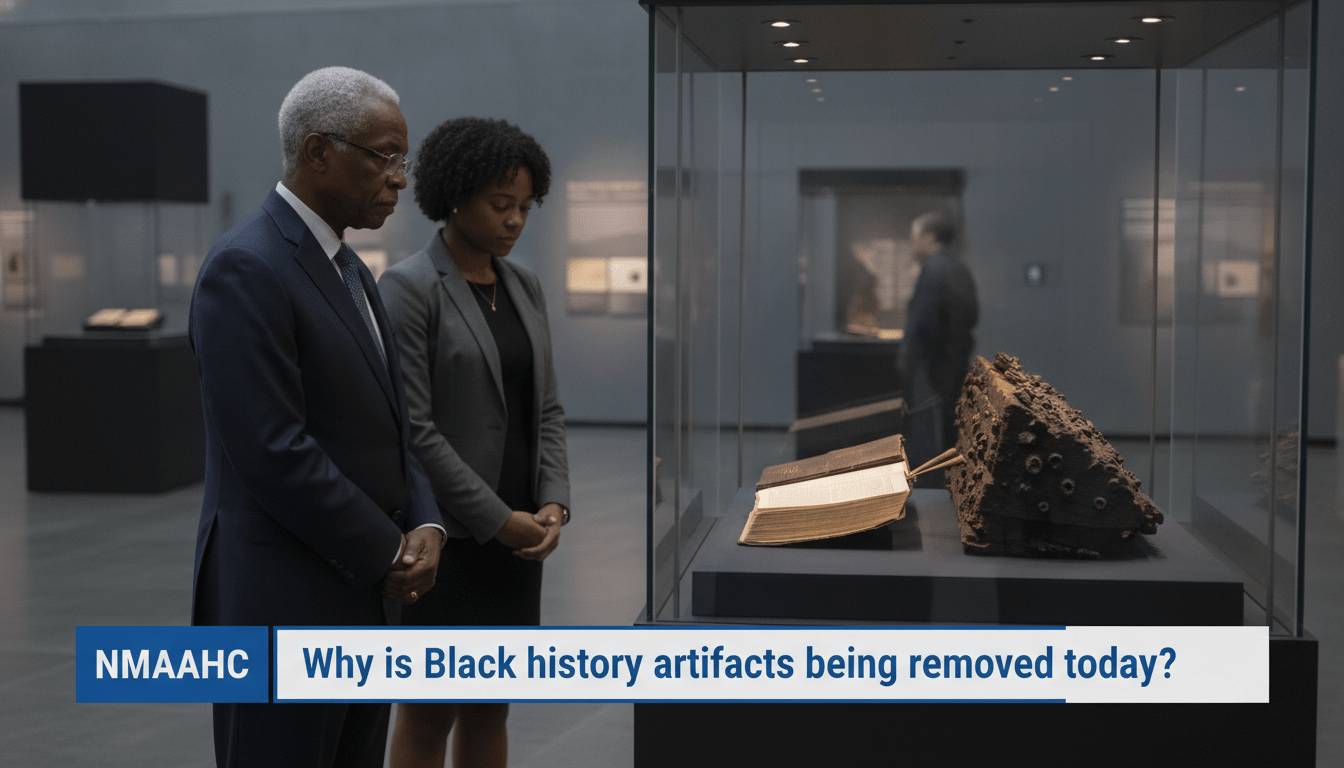
The National Museum of African American History and Culture currently faces a wave of heavy criticism. This institution is often called the “Blacksonian” by the public (wikipedia.org, wikipedia.org). It has served as a sanctuary for the stories of the African diaspora since 2016. However, reports in March 2026 reveal the removal of several foundational artifacts. These items include a Bible from the Selma marches and timber from a sunken slave ship (post-gazette.com, binnews.com). Advocates now describe these actions as an “Orwellian whitewash” of the past. They argue that the government is trying to erase the physical evidence of racial struggle (post-gazette.com).
This controversy did not appear out of thin air. It follows an executive order signed on March 27, 2025, by President Donald Trump (binnews.com). The order is titled “Restoring Truth and Sanity to American History.” It aims to remove “improper ideology” from federal museums. Critics claim this is a direct attack on the narrative of the Black experience. They believe it ignores the scientific exploitation of Black bodies and other harsh truths. The museum claims these removals are part of routine preservation work. Yet, the timing has raised deep suspicions among historians and political leaders (post-gazette.com, washingtoninformer.com).
The Executive Order and the Blacksonian Struggle
The term “Orwellian whitewash” refers to a government effort to distort history for political goals (wikipedia.org). In the book 1984, the authority changes the past to control the present. Many people feel Executive Order 14253 does exactly this. It prohibits federal funds for exhibits that “divide Americans based on race” (binnews.com). This policy targets narratives that describe systemic oppression as a core part of the American story. The administration argues that these stories are unpatriotic (binnews.com). Consequently, the museum must now review its entire collection for “improper ideology.”
The NMAAHC was founded to tell the “unvarnished truth” (nptrust.org, cbcfinc.org). It serves as a reminder of the long struggle for freedom and equality. However, the new federal guidelines place the museum in a difficult position. If the museum does not comply, it could lose half of its funding (post-gazette.com). This tension creates a conflict between historical accuracy and government mandates. Historians argue that removing artifacts like Harriet Tubman’s hymn book erases the failure of early civil rights to protect Black memory. The loss of these items changes how future generations will learn about their ancestors (post-gazette.com, ebsco.com).
The Selma March Bible and Spiritual Resistance
One of the most significant items removed is the Selma March Bible. Reverend Amos C. Brown carried this Bible during the 1965 marches (post-gazette.com). He walked alongside Dr. Martin Luther King Jr. to demand voting rights. For many, this Bible was a “weapon of nonviolence” (studentsofhistory.com). It represented the spiritual strength of the movement. Reverend Brown has loaned the item to the museum since 2016 (post-gazette.com). Suddenly, the museum notified him that the Bible was being returned. They cited concerns about light exposure as the primary reason (post-gazette.com, binnews.com).
Reverend Brown does not believe the excuse about light exposure. He points to the political climate as the real cause. The Selma march led directly to the Voting Rights Act of 1965 (studentsofhistory.com, wikipedia.org). Removing the Bible from public view reduces the visibility of that victory. It separates the religious foundation from the political struggle. Critics say this is part of a plan to simplify the Civil Rights Movement. They worry that the museum is being forced to adopt divergent ideological strategies that hide the true cost of progress (post-gazette.com). This removal represents a loss of physical proof for the “Voting Rights” struggle.
The Loss of Primary Evidence: The São José Shipwreck
Another major loss is the timber from the São José-Paquete de Africa. This ship sank in 1794 while carrying enslaved Mozambicans to Brazil (iziko.org.za). It is the first shipwreck ever recovered that was actively part of the slave trade. The timber and shackles found at the site are primary evidence of the Middle Passage (noaa.gov). This term describes the brutal voyage across the Atlantic Ocean (uaf.edu). Millions of people suffered in the dark holds of ships like the *São José*. These artifacts prove the mechanics of human commodification (iziko.org.za).
The museum is returning these items to South Africa in March 2026 (binnews.com). While international cooperation is important, the timing feels purposeful. Without these physical objects, the Middle Passage becomes a story in a book. Artifacts allow visitors to touch and see the reality of the trade. They provide “receipts” for the racial terror that built the Americas. Scholars argue that digital displays cannot replace the emotional weight of a 200-year-old piece of wood (binnews.com). The removal threatens to sanitize the museum’s coverage of the Atlantic slave trade (post-gazette.com, binnews.com).
The Greensboro Sit-In and HBCU Activism
The Greensboro lunch counter stools are also under review. These stools come from the Woolworth’s where four Black students began a sit-in in 1960 (exploros.com, history.com). These students attended North Carolina A&T State University (ncat.edu). As a Historically Black University (HBCU), NC A&T provided a space for young people to organize (ncat.edu). Their peaceful protest against “Whites-only” seating sparked a movement across the South. It showed the power of Black youth leadership and nonviolent action (exploros.com, peacemakeronline.com).
There are rumors that these stools may be removed or hidden. The Smithsonian officially stated that the stools remain on display (washingtoninformer.com). However, they also admitted that items rotate frequently. The stools are part of a rotating set to prevent wear and tear (washingtoninformer.com). Even so, the public remains skeptical. They fear that the “Restoring Truth” order will eventually target these symbols of desegregation. The stools represent a flashpoint where students challenged the expanded state surveillance of the Jim Crow era. Removing them would hide the history of student-led resistance (post-gazette.com, exploros.com).
34%
of U.S. Museums Reported Grant Cancellations Due to Executive Order 14253
Preservation or Politics? The Great Debate
The Smithsonian Institution defends its decisions by focusing on preservation. They explain that provenance is vital for every item (abbeymuseum.com.au). Provenance is the documented history of an object’s ownership (abbeymuseum.com.au). Many civil rights items are held under “standard loan agreements” (binnews.com). This means the museum does not own them. When a loan expires, the museum must return the item (binnews.com). Curators also argue that paper and fabric are delicate. Light causes permanent damage to things like Bibles and memoirs (washingtoninformer.com, studentsofhistory.com).
Critics do not find these explanations satisfying. They point out that at least 32 key artifacts have been removed since the order was signed (post-gazette.com). These include Frederick Douglass’s memoir and items from the *São José* shipwreck (binnews.com). Donors like Liz Brazelton have expressed concern. She was asked to take back a diary related to the book *12 Years a Slave* (post-gazette.com). She believes the museum is practicing preemptive compliance. This means they are removing items before the government forces them to do so. The debate centers on whether the museum is protecting artifacts or its federal funding (post-gazette.com, ebsco.com).
The Future of African American Memory
The removal of these artifacts has a wider impact on the museum sector. About 34 percent of museums in the United States reported grant cancellations after the 2025 order (post-gazette.com). This suggests a chilling effect on how Black history is taught. If museums cannot show the “receipts” of slavery and Jim Crow, the truth becomes harder to defend. Some leaders suggest using digital displays to fill the empty cases (washingtoninformer.com). However, digital images do not have the same power as the original objects. A digital Bible is not the same as the one carried through the streets of Selma (post-gazette.com).
The NMAAHC remains a vital resource for the nation. It has welcomed 13 million visitors since it opened (post-gazette.com). Its mission is to help the country confront its past. Yet, the current “Orwellian whitewash” threatens this mission. Advocates like Representative Bennie Thompson call the removals a “blatant attack on Black history” (binnews.com). They argue that erasing the past will not change the truth. The struggle over these artifacts is more than a museum dispute. It is a battle over who gets to define American greatness. As the 2026 controversy continues, the world is watching to see if the “unvarnished truth” will survive (post-gazette.com, binnews.com, cbcfinc.org).
About the Author
Darius Spearman is a professor of Black Studies at San Diego City College, where he has been teaching for over 20 years. He is the founder of African Elements, a media platform dedicated to providing educational resources on the history and culture of the African diaspora. Through his work, Spearman aims to empower and educate by bringing historical context to contemporary issues affecting the Black community.
