



Why Is Water Running Dry in Chadian Refugee Camps?
By Darius Spearman (africanelements)
Support African Elements at patreon.com/africanelements and hear recent news in a single playlist. Additionally, you can gain early access to ad-free video content.
The Daily Struggle for Survival in Eastern Chad
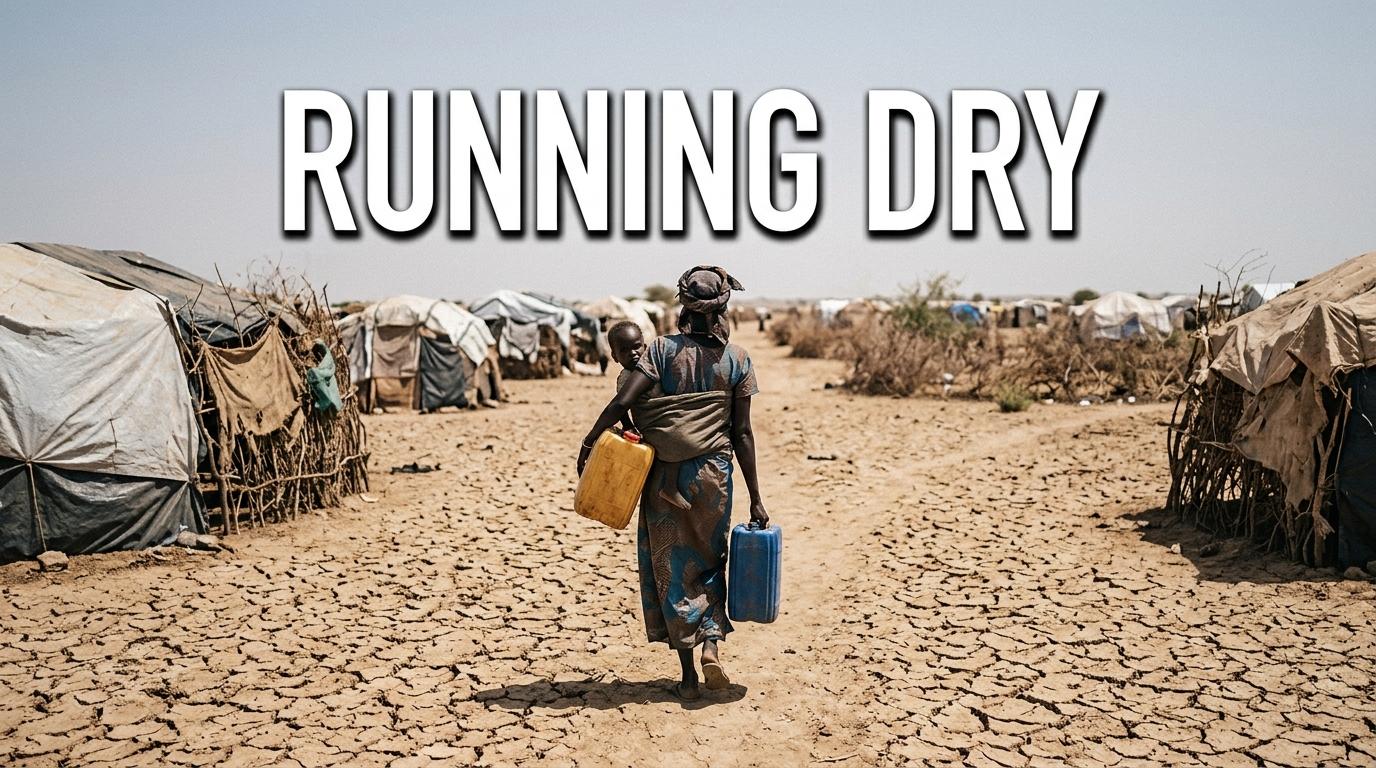
Under the blinding heat of eastern Chad, hundreds of displaced families gather around empty water trucks (aljazeera.com). In settlements like Goudrane and Metche, thousands of people rush forward whenever supply vehicles arrive in camp (doctorswithoutborders.org). Mothers and children carry plastic jerrycans across hot sand, hoping to secure enough water for the day (aljazeera.com). Within minutes, the supply tanks are completely empty (doctorswithoutborders.org). Many refugees return to their tents with empty containers and no immediate relief (aljazeera.com).
This desperate scene repeats daily across eastern Chadian refugee camps housing displaced Sudanese families (reliefweb.int). Over 938,000 new Sudanese refugees have crossed the border into Chad since April 2023 (unhcr.org). This massive arrival has expanded the existing displaced population in the region to nearly 1.3 million people (unhcr.org). As a result, eastern Chad is hosting one of the largest refugee populations per capita on the continent (unhcr.org). Families develop vital survival strategies under pressure to endure these severe conditions (reliefweb.int).
The water allocation in these camps remains far below international health guidelines (doctorswithoutborders.org). The World Health Organization recommends a minimum emergency allocation of 20 liters of safe water per person per day (doctorswithoutborders.org). However, refugees in camps like Metche receive only six liters of water daily (doctorswithoutborders.org). In other camps such as Oure Cassoni, daily allocations fall even lower (reliefweb.int). These extreme shortages increase social friction, spark protests, and trigger dangerous outbreaks of waterborne diseases across settlements (doctorswithoutborders.org, unicef.org).
The Deep Historical Roots of Displacement in Darfur
Understanding today’s water crisis requires an examination of past conflicts in western Sudan (wikipedia.org, ushmm.org). In 2003, ethnic minority groups in Darfur launched a rebellion against the central government in Khartoum (wikipedia.org). Rebel groups accused the national government of economic marginalization and neglect (wikipedia.org). In response, the regime of Omar al-Bashir armed local nomadic groups, who became known as the Janjaweed (wikipedia.org, ushmm.org).
The Janjaweed carried out systematic violent attacks against sedentary Black African farming communities (ushmm.org, hrw.org). Specifically, militias targeted the Masalit, Fur, and Zaghawa ethnic groups (ushmm.org, hrw.org). Attackers burned villages, destroyed water wells, destroyed crops, and committed widespread violence (ushmm.org, hrw.org). These atrocities resulted in hundreds of thousands of deaths and forced millions from their homes (wikipedia.org, ushmm.org).
Hundreds of thousands of survivors escaped across the western border into eastern Chad (wikipedia.org). Between 2003 and 2004, international humanitarian groups built twelve primary refugee camps in Chad to shelter them (wikipedia.org). Camps such as Farchana, Adré, and Oure Cassoni became permanent homes for generations of Darfuris (wikipedia.org, developmentactionrefugees.org). By early 2023, nearly 400,000 Sudanese refugees were still residing in these long-standing camps because conditions in Sudan remained unsafe for return (unhcr.org, unicef.org).
Racial Ideology and the Resurgence of Genocidal Violence
In April 2023, violent political rivalry erupted into open warfare in Khartoum (aljazeera.com). Fighting broke out between the Sudanese Armed Forces and the Rapid Support Forces, known as the RSF (aljazeera.com). The RSF evolved directly from the Janjaweed militias of the early 2000s (hrw.org, wikipedia.org). As fighting spread from the capital into Darfur, the RSF targeted non-Arab communities once again (hrw.org, hrw.org).
Humanitarian organizations and international monitors documented organized violence across West Darfur (hrw.org, hrw.org). Reports showed that RSF fighters and allied Arab militias used explicit anti-Black racial slurs during attacks on cities like El Geneina (hrw.org). Militias targeted indigenous Masalit residents based on physical features, language, and cultural background (hrw.org, europa.eu). Thousands of civilians were killed, while neighborhoods were leveled and public water infrastructure was destroyed (hrw.org, hrw.org).
This targeted campaign driven by Arab supremacist ideology forced another massive wave of displacement (hrw.org, europa.eu). Entire families walked for days across dangerous terrain to cross into Chad (hrw.org). This targeted violence reflects historical patterns of racial hierarchies and oppression that continue to affect African communities (hrw.org, europa.eu). Over 938,000 refugees crossed the border in three years, overwhelming local border communities (unhcr.org).
The Sahel Paradox and Invisible Geological Barriers
The geography of eastern Chad presents environmental barriers to water collection (waterdiplomat.org, scirp.org). Provinces like Ouaddaï, Sila, and Wadi Fira border the dry Sahel region (waterdiplomat.org, openedition.org). Temperatures regularly exceed 40 degrees Celsius, creating severe heat conditions (waterdiplomat.org, yale.edu). Dry riverbeds, known locally as wadis, remain empty for most of the year (waterdiplomat.org, scirp.org).
Climate experts refer to the regional weather pattern as the Sahel Paradox (undp.org, tandfonline.com). Climate change causes rising temperatures alongside irregular heavy rains (yale.edu, mdpi.com). However, hard soil prevents floodwaters from soaking into the ground (scirp.org, mdpi.com). Rainwater washes over the dry ground in flash floods instead of refilling shallow aquifers (scirp.org, mdpi.com). Consequently, surface water disappears quickly, leaving groundwater as the primary source (waterdiplomat.org, scirp.org).
Geological conditions further complicate water collection in eastern Chad (scirp.org, bgs.ac.uk). Crystalline basement rock underlies much of the regional terrain (scirp.org, bgs.ac.uk). This hard layer of granite and metamorphic rock possesses zero primary porosity (scirp.org, bgs.ac.uk). Water cannot pass through solid stone mass; it collects only within scattered underground rock fractures (scirp.org, bgs.ac.uk). Drilling rigs must dig deep to locate these fractures (scirp.org, bgs.ac.uk). Industrial machinery is necessary to cut through dense rock, making borehole drilling slow and expensive (scirp.org, wraggbrothers.com).
Climate Injustice and Local Impact on Host Communities
The water crisis illustrates systemic environmental inequalities (yale.edu, undp.org). The average carbon footprint of a person in Sudan is 0.40 tons per year (yale.edu). In contrast, the average American produces 14.30 tons of carbon emissions annually (yale.edu). Despite contributing minimally to global greenhouse gas emissions, the people of Chad and Sudan experience severe climate impacts (yale.edu, mdpi.com). Chad ranks among the most climate-vulnerable countries in the world on global adaptation indices (mdpi.com, undp.org).
Local host communities in eastern Chad faced extreme water scarcity long before refugees arrived (waterdiplomat.org, wikipedia.org). Less than 10 percent of Chadian households nationwide have access to running tap water (wikipedia.org, worldbank.org). In regional cities like Abéché, water infrastructure struggles to supply existing residents (waterdiplomat.org). When hundreds of thousands of refugees arrived, demand on local wells increased instantly (waterdiplomat.org, ifrc.org). Competition for scarce resources creates friction between host communities and refugee populations (ifrc.org).
Structural economic challenges prevent the Chadian government from expanding public utilities (wikipedia.org, worldbank.org). Over 70 percent of Chadians live in rural areas with limited infrastructure (wikipedia.org, worldbank.org). The national water utility operates under severe budget deficits (worldbank.org). Less than one percent of national expenditure historically goes toward domestic water systems (worldbank.org). Consequently, the government relies almost entirely on international aid to maintain regional water infrastructure (worldbank.org).
Gender-Based Violence and the Global Racial Empathy Gap
The daily struggle for water places women and children at risk (doctorswithoutborders.org, unfpa.org). Women and children make up over 87 percent of the displaced Sudanese population in eastern Chad (unfpa.org, globalsurvivorsfund.org). When camp water points run dry, women walk deep into surrounding areas to find water (doctorswithoutborders.org, unfpa.org). These treks often require multi-hour round trips across isolated terrain (doctorswithoutborders.org, unfpa.org). During these journeys, women face high risks of harassment, robbery, and sexual assault (doctorswithoutborders.org, unfpa.org).
Protection programs designed to support women face severe funding cuts (unfpa.org, globalsurvivorsfund.org). Organizations like the United Nations Population Fund established safe spaces to provide care to survivors of violence (unfpa.org). However, budget shortfalls forced the closure of sixteen safe spaces in Chadian camps (unfpa.org). Furthermore, overcrowded settlements lack adequate security, privacy barriers, and night lighting (unfpa.org, globalsurvivorsfund.org). These deficits leave women without adequate protection while performing daily survival tasks (unfpa.org, globalsurvivorsfund.org).
This situation highlights disparities in international aid allocations (disasterphilanthropy.org, alnap.org). Analysts point to a global racial empathy gap in media coverage and humanitarian funding (disasterphilanthropy.org, alnap.org). During the first 100 days of the conflict in Ukraine, international donors pledged over 1.9 billion dollars in aid (disasterphilanthropy.org). In contrast, the United Nations appeal for the Sudan crisis faced a deficit of 428 million dollars in 2026 (unrefugees.org). These funding gaps leave millions of displaced Black Africans without adequate food, medicine, or water (unrefugees.org, disasterphilanthropy.org). This uneven distribution reflects unequal global support systems that leave African communities under-resourced (disasterphilanthropy.org, alnap.org).
Moving Beyond Emergency Relief to Sustainable Solutions
Humanitarian agencies emphasize that short-term emergency responses are insufficient (waterdiplomat.org, unrefugees.org). Tanker trucks haul water across hundreds of miles of unpaved desert roads daily (doctorswithoutborders.org, waterdiplomat.org). This approach remains costly, slow, and unsustainable (waterdiplomat.org, unrefugees.org). Emergency trucking consumes aid budgets while failing to meet basic daily needs (doctorswithoutborders.org, waterdiplomat.org). Aid organizations are forced to ration water supplies, leaving camp populations vulnerable to disease (doctorswithoutborders.org, unicef.org).
Long-term solutions require structural investment in regional hydrogeological infrastructure (waterdiplomat.org, bgs.ac.uk). Geological studies show that deep aquifers exist beneath specific fracture zones in eastern Chad (waterdiplomat.org, bgs.ac.uk). Projects like the Biteha 2 pipeline demonstrate that tapping deeper groundwater source points can supply local cities and camps (waterdiplomat.org). However, drilling deep boreholes and building pipelines requires long-term capital investment (waterdiplomat.org, wraggbrothers.com). International development banks and donor nations must shift focus from short-term emergency rations toward permanent infrastructure projects (waterdiplomat.org, unrefugees.org).
Without sustained funding for permanent infrastructure, the water crisis in eastern Chad will worsen (waterdiplomat.org, unrefugees.org). Fleeing systemic violence in Darfur, refugees cross borders only to face severe resource scarcity in exile (aljazeera.com, hrw.org). Resolving this crisis requires global commitments that address both regional geopolitical stability and climate resilience (waterdiplomat.org, undp.org). Until international institutions address these root causes, families in eastern Chad will continue their daily struggle for survival (aljazeera.com, doctorswithoutborders.org).
About the Author
Darius Spearman is a professor of Black Studies at San Diego City College, where he has been teaching for over 20 years. He is the founder of African Elements, a media platform dedicated to providing educational resources on the history and culture of the African diaspora. Through his work, Spearman aims to empower and educate by bringing historical context to contemporary issues affecting the Black community.
