


Why Morocco’s New Care Economy Strategy Changes Africa
By Darius Spearman (africanelements)
Support African Elements at patreon.com/africanelements and hear recent news in a single playlist. Additionally, you can gain early access to ad-free video content.
A New Social Paradigm Shifts the Continent
On July 16, 2026, the Kingdom of Morocco achieved an unprecedented milestone in social and economic planning (moroccoworldnews.com). In collaboration with the International Labour Organization and UN Women, the country officially adopted its first National Strategy for the Care Economy and Care Work (ilo.org, unwomen.org). This bold framework makes Morocco the first nation in the Arab world to construct a comprehensive care policy (unwomen.org). It serves as a monumental shift in how governments on the continent view social infrastructure and economic justice.
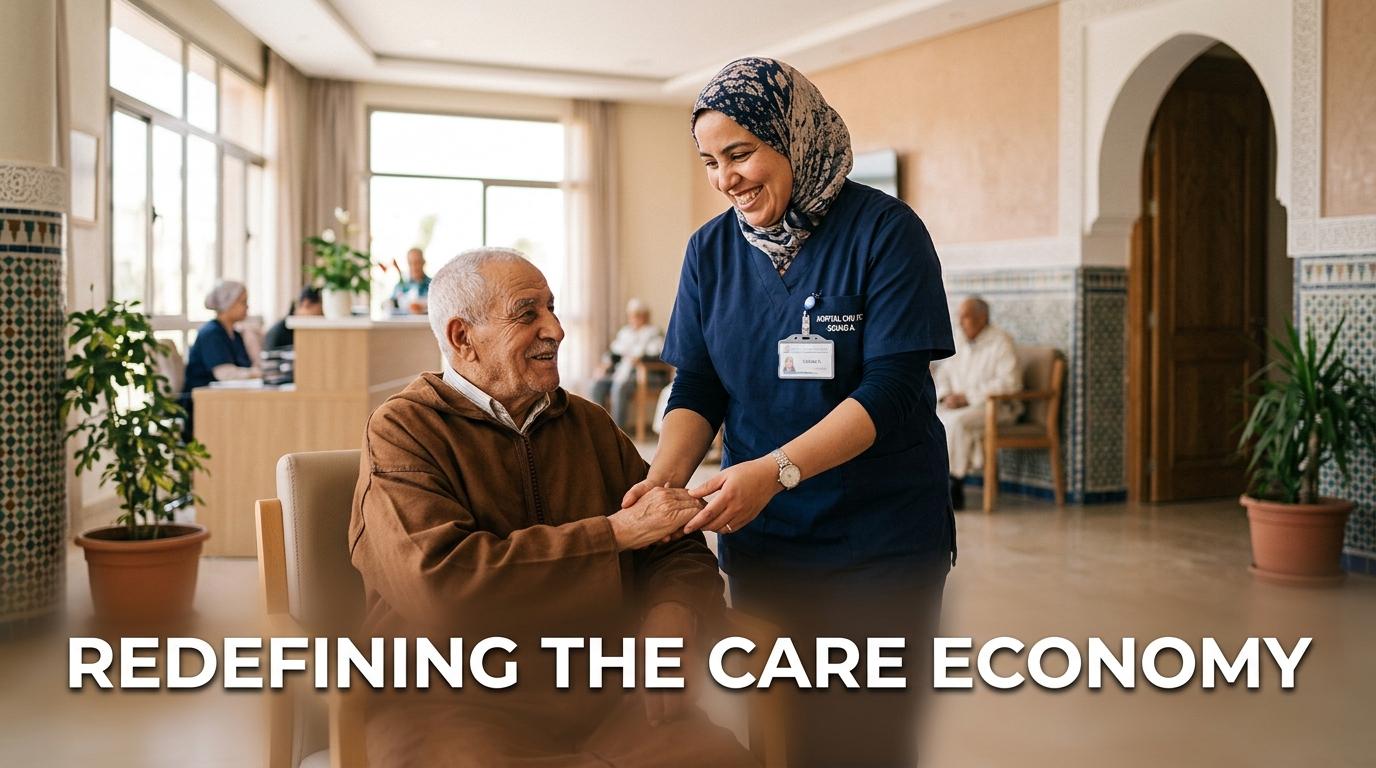
Historically, caring for children, the elderly, and vulnerable citizens was treated as a private family duty. The state has now redefined this labor as a productive economic sector (unwomen.org). This shift recognizes that unpaid work forms the invisible foundation of the formal market. For the global African diaspora, this policy reform offers a powerful blueprint for dismantling gendered economic inequalities.
The Deep Historical Roots of Unpaid Domestic Care
To appreciate the importance of this moment, one must examine the historical systems of gendered labor in Morocco. Traditionally, social and cultural expectations dictated that women bear the sole burden of domestic duties (icrw.org, unwomen.org). They performed childcare, cooked, and tended to elderly relatives without any financial compensation. This unpaid domestic work remained undocumented, invisible, and completely excluded from national calculations of economic productivity.
This exclusion parallels the historical exploitation seen throughout global history, where the labor of marginalized women sustained societies without recognition. One can look back to how historical systems affected Black women and historical labor across the Atlantic. In Morocco, this private-care paradigm limited the ability of women to acquire formal education, seek wages, or build independent financial security (icrw.org, highatlasfoundation.org). The lack of state support locked families into rigid cycles of unpaid caregiving.
From Constitutional Right to the New Development Model
The modern legal push for reform began to take shape following the regional political transitions of 2011. King Mohammed VI directed the creation of an updated Moroccan Constitution in 2011 (learningpartnership.org). Specifically, Article 19 established legal gender parity and guaranteed equal rights for men and women across civil and economic spheres (opengovpartnership.org, learningpartnership.org). This constitutional milestone provided the legal leverage that advocates needed to challenge structural inequality.
Despite these constitutional guarantees, Morocco faced a persistent development puzzle. Female labor force participation peaked in 1999 at 30.4 percent but steadily declined below 20 percent by the mid-2020s (worldbank.org). Highly educated young women remained entirely outside the workforce because of care burdens at home (worldbank.org). In response, King Mohammed VI commissioned the New Development Model in May 2021 (devdiscourse.com). This strategy aimed to raise female labor force participation to 45 percent by the year 2035 (moroccoworldnews.com). Achieving this target required a major, centralized intervention to redistribute the burden of unpaid care (cmacrodev.com).
The Joint Initiative and Professionalizing Social Work
Between February 2020 and December 2023, Morocco tested new policy instruments as part of a pilot program with the United Nations (ilo.org). The joint initiative modeled macroeconomic interventions and gathered empirical data regarding the economic return on care investments (ilo.org, unwomen.org). It elevated care work from a marginal charity issue to a prominent priority in national macroeconomic planning.
In June 2026, just weeks prior to adopting the final strategy, Morocco established its first cohort of 522 certified social workers (hespress.com). Minister Naïma Ben Yahia characterized this professionalization as the foundational pillar of the care economy (hespress.com). Rather than relying on unregulated, informal labor, the nation began training an accredited workforce. This state-led strategy aligns with historical struggles for labor rights and women’s liberation movements that demand dignity for invisible work.
Daily Time Spent on Unpaid Care & Domestic Work
Percentage of a 24-hour day dedicated to unpaid household labor (Source: UN Women).
Economic Hurdles and Unpacking Key Statistics
The sheer scale of unpaid labor in Morocco explains why the previous economic model failed to achieve gender equity. According to the Ministry of Economy and Finance, women perform 84 percent of all unpaid domestic work across the nation (revuechercheur.com). This extreme division of labor has direct economic consequences. Over 63 percent of economically inactive women explicitly cite intensive care responsibilities as the barrier keeping them from the workforce (hcp.ma, hcp.ma).
Demographic changes further complicate this issue. Between 2014 and 2024, the average household size in Morocco dropped from 4.6 individuals to 3.9 individuals (hcp.ma). This transition toward nuclear families means that traditional, multi-generational support networks are rapidly disappearing. Simultaneously, the fertility rate has fallen to 1.97 children per woman, while citizens over 60 years old now make up nearly 14 percent of the population (hcp.ma). An aging society desperately requires formal, structured eldercare solutions to replace dwindling informal networks.
Structuring Policy Pillars for True Transformation
Morocco’s strategy tackles these systemic challenges by structuring its goals into four distinct, operational pillars. The first pillar focuses on building a measurement infrastructure (unwomen.org). This relies on Time-Use Surveys conducted by the High Commission for Planning (unwomen.org, data4sdgs.org). These surveys allow economists to construct a household satellite account (unwomen.org). By using either the input approach or the output approach, this account assigns a clear monetary value to unpaid care work (unwomen.org). Standard GDP calculations can now measure care contributions alongside industrial outputs.
The second pillar focuses on the massive expansion of early childhood education (cmacrodev.com). The government intends to enroll an additional 550,000 children in preschool systems (cmacrodev.com). This expansion is projected to generate 51,903 direct jobs (cmacrodev.com). Because of the educational requirements of these roles, approximately 90 percent of these new positions will be filled by women (cmacrodev.com). By creating formal employment, the strategy simultaneously relieves mothers of early childcare obligations.
Morocco’s Demographic Squeeze
The breakdown of traditional care networks makes a formal care economy urgent.
Enforcing Labor Standards in the Private Sphere
The third and fourth pillars focus on workforce professionalization and centralized national governance (unwomen.org). This entails converting informal, unprotected domestic chores into highly regulated, decent employment. Historically, enforcing labor laws inside private households in Morocco has posed immense regulatory hurdles (hrw.org). Labor inspectors lack the independent authority to enter private households to investigate violations because the constitution protects the privacy of homes (state.gov). Inspectors require an explicit judicial warrant to cross a residential threshold (state.gov).
Consequently, standard labor inspection remains ineffective for domestic settings. To bypass this barrier, the strategy relies heavily on a written contract filing system under Law 19-12 (idwfed.org). Employers must register formal contracts with the labor inspection office and enroll workers in the National Social Security Fund (idwfed.org). This structural shift requires a highly organized state-centered power strategy to create real legal protections. Despite these rules, civil society groups note that the voluntary conciliation process lacks strong mechanisms to force employer compliance (hrw.org, hrw.org).
Protecting Migrant Workers on the Margins
The challenge of enforcing domestic labor standards falls heaviest on vulnerable Sub-Saharan migrant workers in Morocco (migrants-refugees.va). The national care strategy recognizes that migrant domestic workers, particularly those who are undocumented, face systemic barriers (ilo.org). Many migrants operate completely outside the formal legal system due to fear of deportation (migrants-refugees.va, state.gov). This isolation makes them highly vulnerable to wage theft and extreme exploitation.
The United Nations Committee on Migrant Workers has expressed deep concern regarding the widespread absence of written contracts for migrant laborers in Morocco (state.gov). This lack of documentation locks them out of social security benefits. To bridge this divide, local organizations such as the Group for the Defence and Accompaniment of Foreigners and Immigrants advocate tirelessly for regularization (migrants-refugees.va). They push to ensure that non-citizens are explicitly included in all labor protections. The struggle to integrate marginalized migrant laborers into the national plan highlights the complex, intersectional nature of economic justice.
Funding the Future of the Care Economy
Launching a massive social state reform requires robust, sustainable financial planning. Morocco’s strategy utilizes a multi-faceted funding framework that combines direct public budget allocations with international partnerships (cmacrodev.com). Domestic public spending is tightly integrated with gender-responsive budgeting (unwomen.org, social-protection.org). This approach ensures that state resources specifically target the reduction of gender gaps.
On an international level, the World Bank Group provides major support. The 10-year Country Partnership Framework for 2026–2035 aligns World Bank lending directly with Morocco’s New Development Model (worldbank.org, worldbank.org). This framework aims to de-risk public investments and mobilize private sector capital through public-private partnerships (worldbank.org, worldbank.org). Furthermore, development grants from European partners, including Sweden, Germany, and Spain, fund critical technical programs (ilo.org, unwomen.org, unwomen.org). These global partnerships provide the financial foundation needed to transition Morocco toward a sustainable social state.
Projected Economic Transformation
Potential long-term outcomes of formalizing Morocco’s care economy.
By fully closing the gender employment gap (Source: World Bank).
Created by enrolling 550,000 additional children in preschool.
Comparative Look: Morocco Versus the Kenyan Model
Morocco’s adoption of this strategy places it in elite company on the African continent. Prior to Morocco’s 2026 launch, Kenya stood as the sole pioneer of a comprehensive national care policy in Africa (knbs.or.ke, knbs.or.ke). Both frameworks utilize the structural 5R framework promoted by UN Women and the International Labour Organization (unwomen.org, unwomen.org). This framework focuses on efforts to recognize, reduce, redistribute, reward, and represent care work (unwomen.org).
However, the two nations differ significantly in execution. Kenya developed its grassroots-oriented framework over nearly a decade, starting in 2017, with a strong focus on decentralized county governments (care-international.org, icrw.org). In contrast, Morocco’s strategy is tightly integrated with its highly centralized national social protection reforms under the New Development Model (cmacrodev.com). Both countries have successfully developed Household Satellite Accounts to calculate how unpaid care contributes directly to their national GDP (unwomen.org, icrw.org). These dual approaches offer distinct lessons for other developing nations seeking to resolve structural economic disparities and address conflicting ideologies surrounding women’s work.
Setting an Example for Global Diaspora Economics
The success of Morocco’s strategy serves as a critical model for economic self-determination and gender justice across the global South. It demonstrates that true economic growth cannot occur while the labor of half the population remains uncounted. By treating care as a formal sector, Morocco has shown that a nation can build a stronger social state while driving private-sector-led growth.
This policy framework provides valuable insights for policymakers worldwide who are working to support marginalized communities. The historic strategy reminds observers that dismantling systemic economic barriers requires deliberate, state-backed planning. It offers a clear, transformative blueprint for achieving collective economic empowerment and gender equity.
About the Author
Darius Spearman is a professor of Black Studies at San Diego City College, where he has been teaching for over 20 years. He is the founder of African Elements, a media platform dedicated to providing educational resources on the history and culture of the African diaspora. Through his work, Spearman aims to empower and educate by bringing historical context to contemporary issues affecting the Black community.
