



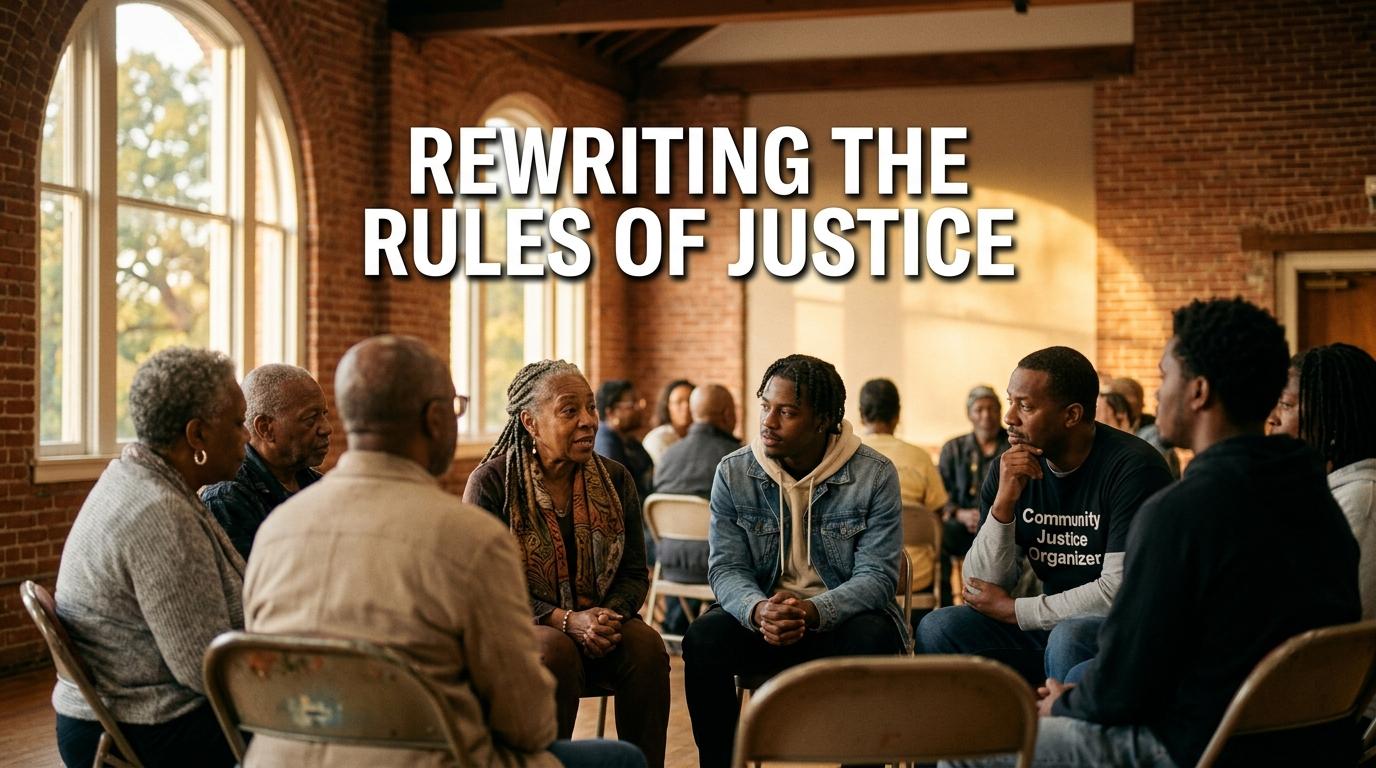
Why Oakland is Rewriting the Rules of Criminal Justice Reform
By Darius Spearman (africanelements)
Support African Elements at patreon.com/africanelements and hear recent news in a single playlist. Additionally, you can gain early access to ad-free video content.
On July 9, 2026, a massive crowd filled the Hella Bees venue in Oakland, California (postnewsgroup.com). They gathered for a landmark forum titled “A Voice for the People” (postnewsgroup.com). The event focused on reshaping how the legal system treats individuals who commit crimes. Powerful political figures and community advocates took the stage to challenge the traditional reliance on prisons (postnewsgroup.com).
The panel included San Francisco District Attorney Brooke Jenkins and community advocates Vincent O’Bannon and Dante Jones (postnewsgroup.com). Freshman Congresswoman Lateefah Simon moderated the lively discussion (postnewsgroup.com). Together, they pushed for a legal system that values rehabilitation over punishment (postnewsgroup.com). They argued that prosecutors must view defendants as whole human beings rather than mere case files (postnewsgroup.com). This historic dialogue set the stage for a deeper exploration of local advocacy.
The Battle of Ideologies: Restorative Versus Reformative
To understand this movement, one must separate reformative justice from restorative justice. Reformative justice is primarily offender-centric (study.com). It focuses on correcting, educating, and treating the individual inside the correctional system (study.com). The goal of reformative theory is to help offenders unlearn harmful behaviors. This allows them to reintegrate into their communities successfully. This approach often operates unilaterally within traditional prison settings to transform the individual.
In contrast, restorative justice is community-centric and victim-centric (csp.edu). It views crime as a violation of human relationships (csp.edu). Restorative programs bring the victim, the offender, and community members together (emu.edu). They work to repair the specific harm caused by the offense (csp.edu). This approach prioritizes accountability, healing, and making the victim whole (emu.edu). Restorative models measure success by victim healing rather than length of prison terms. It represents a dramatic shift from the hyper-punitive policies that defined previous decades in the United States.
Dismantling the Classroom Pipeline in the East Bay
The roots of modern restorative justice run deep in Oakland. Activists originally championed these practices to combat the school-to-prison pipeline. This pipeline is a systemic phenomenon (aclu.org). It funnels Black and Brown students out of public schools and into the criminal justice system (aclu.org). Punitive school discipline policies often criminalize minor behavioral infractions (aclu.org). This process disproportionately impacts African American and special-needs youth.
In 2005, civil rights attorney Fania E. Davis co-founded Restorative Justice for Oakland Youth (rjoyoakland.org). The organization launched a landmark pilot program at West Oakland Middle School in 2007 (ousd.org). The program reduced suspensions by 87 percent and virtually eliminated expulsions (ousd.org). This success led the Oakland Unified School District to adopt restorative practices district-wide in 2010 (ousd.org). These practices draw from ancient Indigenous peacemaking traditions (emu.edu). They focus on community-building circles rather than isolation (ousd.org). Prior to this adoption, African American students represented only 33 percent of the district population but accounted for 63 percent of all suspensions (ousd.org).
Recidivism Rates Comparison
Lateefah Simon and the Legacy of “Back on Track”
Congresswoman Lateefah Simon has dedicated thirty years to justice reform in the Bay Area (house.gov). At age nineteen, she led the Young Women’s Freedom Center (localcandidates.org). There, she developed vital programs for youth in the foster care system (localcandidates.org). Her innovative models caught the attention of local prosecutors. Her work proved that early intervention could prevent future involvement with the court system.
In 2004, then-District Attorney Kamala Harris appointed Simon to create a new initiative (localcandidates.org). Together, they launched “Back on Track” in 2005 (harvard.edu). This program served as a pioneer diversion initiative for young adults (harvard.edu). Instead of standard incarceration, it offered educational support and job training (harvard.edu). This milestone helped ease the transition during the historical political narrative of mass incarceration. The program was highly effective (harvard.edu). It reduced the recidivism rate for graduates to less than 10 percent (harvard.edu). Participants entered a strict personal responsibility plan that deferred their sentences (harvard.edu). Upon successful completion, the court dismissed all charges and wiped their records clean (harvard.edu).
Legal Lifelines: Resentencing Laws in California
The presence of Dante Jones and Vincent O’Bannon at the forum highlights legislative progress. Their releases resulted from historic changes in California sentencing laws. Dante Jones served 17 years of a life sentence (postnewsgroup.com). He was released because of Assembly Bill 2942, which was signed into law in 2018 (postnewsgroup.com). This reform gave district attorneys the power to recommend resentencing when original terms are overly harsh (postnewsgroup.com). It marked a major departure from rigid sentencing guidelines.
Vincent O’Bannon spent 15 years in prison (postnewsgroup.com). He benefited from Senate Bill 1393, which took effect in 2019 (kqed.org). This bill restored judicial discretion to strike mandatory 5-year sentence enhancements (kqed.org). These enhancements historically added massive consecutive terms to base sentences (greghillassociates.com). Such mandatory enhancements drove prison overcrowding for decades (sentencingproject.org). While incarcerated, both men worked for the San Quentin News (postnewsgroup.com). That experience allowed them to build a partnership with District Attorney Jenkins (postnewsgroup.com). This partnership eventually led to their participation in her speaking tour (postnewsgroup.com). Both men now advocate for meaningful employment opportunities for formerly incarcerated people (postnewsgroup.com).
Restorative Justice Impact Metrics
Victim Satisfaction Rate
Reported high satisfaction in restorative programs, compared to just 57% in traditional courts.
Restitution Completion
Of offenders successfully completed restorative restitution agreements compared to only 58% in traditional courts.
The Complex Politics of SF DA Brooke Jenkins
District Attorney Brooke Jenkins maintains a unique and controversial position in this debate. She entered office in July 2022 following the historic recall of Chesa Boudin (sfdistrictattorney.org). Many conservative voters supported her appointment by Mayor London Breed (motherjones.com). They wanted a return to strict prosecutorial policies. Jenkins won subsequent elections in 2022 and 2024 (sfstandard.com). She campaigned on a promise of accountability and public safety (sfdistrictattorney.org). Her political brand balances reformative language with a tough stance on crime (theappeal.org).
Critics point out a contrast between her public tours and actual office practices. On her tour, she praises smart prison reform (postnewsgroup.com). Yet, her administration has rolled back several progressive reforms (missionlocal.org). She dismissed homicide cases against police officers (missionlocal.org). She also increased the use of pre-trial detention for felony drug arrests (sfstandard.com). Her office must navigate these tensions. This occurs as community leaders push for racial justice initiatives to correct historical biases.
Inside California’s Rehabilitative Credit System
Reentry advocates at the forum emphasized the importance of support networks inside state prisons. California uses Rehabilitative Achievement Credits to incentivize personal growth (ca.gov). Authorized by voters under Proposition 57 in 2016, these credits allow incarcerated people to shorten their sentences (ca.gov). They do this by completing self-help and educational programs (ca.gov).
Participants earn one week of credit for every 52 hours of active participation (ca.gov). Programs include substance abuse treatment, life skills, and victim awareness (ca.gov). An individual can earn up to four weeks of credit per year (ca.gov). Data reveals that these programs are highly effective (sanquentinnews.com). Conviction-free rates reach over 81 percent for participants three years after release (sanquentinnews.com). This indicates that early investment in people yields safer communities. Formerly incarcerated advocates note that rehabilitation must start behind bars to ensure success upon release.
Fremont High School Case Study
Power of the Collective: BWOPA and OAACC
The sponsorship of the Oakland forum is a crucial detail. The event was co-sponsored by Black Women Organized for Political Action and the Oakland African American Chamber of Commerce (postnewsgroup.com). BWOPA has fought for the political empowerment of Black women since 1968 (bwopatileleads.org). OAACC has advanced economic development for Black-owned businesses since 2003 (oaacc.org). Both organizations recognize that systemic bias harms families.
Their collaboration shows that criminal justice reform is an economic issue. Mass incarceration drains wealth from Black families and local communities (washingtonpost.com). High recidivism rates prevent returning citizens from finding employment (postnewsgroup.com). By combining political mobilization and economic leadership, these organizations aim to build community wealth. They promote civic engagement, helping residents understand voting and representation. This unified front bridges grassroots social action with business development in Oakland.
Conclusion
The “A Voice for the People” forum was not a random occurrence. It represents two decades of hard work in the East Bay. By bringing a traditional prosecutor, a progressive Congresswoman, and formerly incarcerated activists together, the panel proved that public safety and rehabilitation can coexist. True safety does not come from locking people away. It comes from investing in their rehabilitation and transition back to society.
The forum demonstrated that communication remains the key to healing these historic divisions. It offered a roadmap for future reforms across California. As Congresswoman Simon noted, humanizing each other is the first step toward real justice (postnewsgroup.com). Moving forward, the state must continue to choose healing over simple punishment.
About the Author
Darius Spearman is a professor of Black Studies at San Diego City College, where he has been teaching for over 20 years. He is the founder of African Elements, a media platform dedicated to providing educational resources on the history and culture of the African diaspora. Through his work, Spearman aims to empower and educate by bringing historical context to contemporary issues affecting the Black community.
