



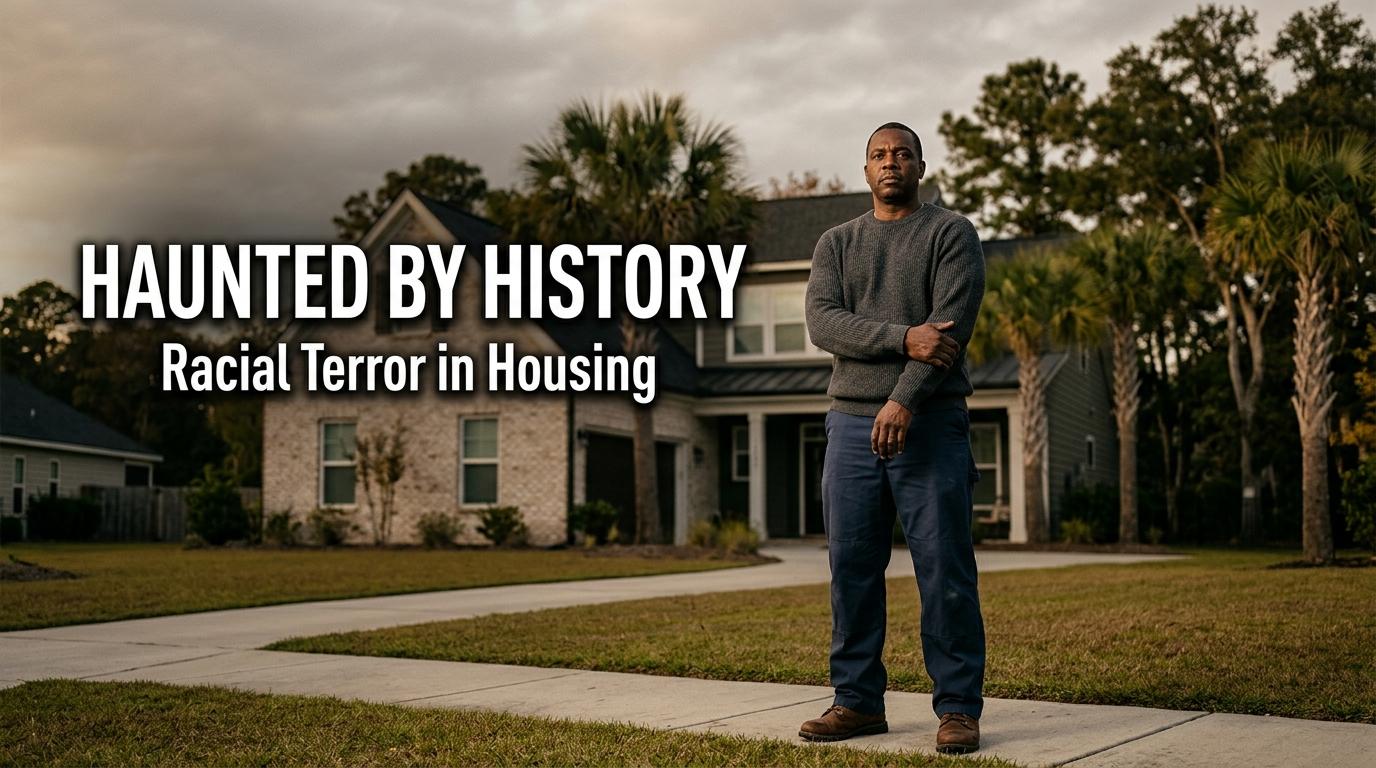
Why Racial Terror in Housing Still Haunts South Carolina
By Darius Spearman (africanelements)
Support African Elements at patreon.com/africanelements and hear recent news in a single playlist. Additionally, you can gain early access to ad-free video content.
The Gated Community Confrontation in Columbia
The morning of July 17, 2025, began like any other day for Jarvis McKenzie, a Black employee of the Columbia water and sewer department (thestate.com, newsfromthestates.com). He stood near the entrance gate of the Spring Valley subdivision, a gated neighborhood where he lived (thestate.com, newsfromthestates.com). Suddenly, a vehicle driven by his neighbor, Jonathan Andrew Felkel, approached him (justice.gov, thestate.com). Felkel, a 34-year-old white man, grabbed a semi-automatic rifle from his passenger seat (justice.gov, thestate.com). He fired the weapon into the air to terrify McKenzie and yelled a Jim Crow-era threat (justice.gov).
The phrase “You better keep running, boy!” echoed through the neighborhood as McKenzie fled in fear (justice.gov, thestate.com). When local police questioned Felkel, his admissions were chillingly direct (justice.gov). He confessed that he did not know McKenzie (justice.gov, thestate.com). Felkel assumed McKenzie was a criminal simply because of his Black race (justice.gov). He stated that white people should “get rid of” Black people (justice.gov). He fired the weapon to send a message that McKenzie should not be in the area (justice.gov, newsfromthestates.com).
On July 16, 2026, a federal judge in Columbia sentenced Felkel to nine years in prison (justice.gov). U.S. District Judge Mary Geiger Lewis handed down the maximum recommended sentence of 108 months (justice.gov). This case highlights the persistent reality of racial hostility in residential spaces. It also reveals the complex web of federal laws required to protect Black residents when local protections fail.
Decoding the Timeline of Modern Racial Terror
Some readers may wonder why the timeline of this case contains dates in 2025 and 2026. This timeline is neither a typographical error nor a hypothetical scenario. In this document, the current year is 2026. This means the events of 2025 and 2026 are actual occurrences of a real-world federal hate crime case in Columbia, South Carolina (justice.gov).
The timeline of this case shows the swift progression of federal justice when civil rights are violated. The violent confrontation occurred on July 17, 2025 (thestate.com). A federal grand jury indicted Felkel in December 2025 (thestate.com). He subsequently entered a guilty plea in federal court in March 2026 (justice.gov). The legal process concluded with his sentencing on July 16, 2026 (justice.gov). This rapid progression reflects the serious nature of federal civil rights enforcement.
The Birth of a Federal Shield: 42 U.S.C. Section 3631
To understand how a local neighbor dispute became a federal case, one must examine the legal tools used by the prosecution. Felkel was charged under a specific federal civil rights law: 42 U.S.C. Section 3631 (justice.gov). In legal terms, a “statute” is a formal written law passed by a legislative body, such as Congress (everycrsreport.com). “Codified” means that the law has been systematically organized and written into the official book of federal laws, known as the United States Code (everycrsreport.com).
This codified statute was established under Title IX of the Civil Rights Act of 1968, commonly known as the Fair Housing Act (huduser.gov, fairhousingnorcal.org). The law makes it a federal crime to use force or the threat of force to willfully injure, intimidate, or interfere with any person because of their race and because they are occupying a dwelling (fairhousingnorcal.org). Under this statute, offenses that do not result in bodily injury or death are punishable by a federal prison term of up to 10 years (bbcfairhousing.org, fairhousingnorcal.org).
This legislation emerged from the intense struggles of the Civil Rights Movement. During this era, activists fought against the concentration of political power. The relationship between state and federal power played a critical role in securing safety for Black citizens. Federal intervention became the primary shield against local racial terror when state authorities refused to act.
Systematic Division: Redlining and Restrictive Covenants
The need for federal housing protection is rooted in a history of deliberate segregation. Throughout the 20th century, two powerful practices kept Black families out of white neighborhoods: redlining and racially restrictive covenants. Redlining was a systemic practice by banks, mortgage lenders, and the federal government that designated neighborhoods populated by Black residents as “declining” or “hazardous” (federalreservehistory.org). Under this system, financial institutions refused to provide mortgages in those marked areas (federalreservehistory.org).
Early Federal Housing Administration underwriting manuals institutionalized this practice (federalreservehistory.org). The manuals stated that mortgages were too risky for neighborhoods with any “infiltration of inharmonious racial groups” (federalreservehistory.org). Meanwhile, racially restrictive covenants were legally binding contractual agreements written directly into property deeds by white property owners and developers (ua.edu). These covenants prevented homes from being sold, rented, leased, or occupied by Black or non-white buyers (ua.edu).
Although the Supreme Court ruled in 1948 that courts could not legally enforce these covenants, they continued to be used as powerful social signals (ua.edu). The private housing market used them to maintain exclusion until the Fair Housing Act of 1968 officially outlawed them (bbcfairhousing.org). When Black families attempted to break these barriers, they often faced violent retaliation. This “move-in violence” included bombings, cross burnings, and shootings (ncph.org). This legacy of violence directly connects to modern acts of housing intimidation.
The South Carolina Legal Void: A State Without Protection
The federal prosecution of Felkel highlights a stark political reality in the American South. South Carolina is one of only two states in the entire nation that does not have a statewide hate crime law (southcarolinapublicradio.org, southcarolinapublicradio.org). Wyoming is the only other state that shares this distinction (southcarolinapublicradio.org, southcarolinapublicradio.org). For years, civil rights advocates and some lawmakers have fought to pass the Clementa C. Pinckney Hate Crimes Act (newsfromthestates.com).
The proposed state bill was named in honor of State Senator and Pastor Clementa C. Pinckney (newsfromthestates.com). He was murdered alongside eight of his parish members in the 2015 racially motivated mass shooting at the Mother Emanuel AME Church in Charleston (newsfromthestates.com, southcarolinapublicradio.org). Despite the national outrage and local grief, the legislation has repeatedly stalled in the South Carolina Senate (newsfromthestates.com, southcarolinapublicradio.org). Opponents of the bill continue to argue that existing state laws are sufficient to punish violent crimes.
This political resistance reflects a broader historical pattern. During the transition into the era of mass incarceration, states often shifted focus away from civil rights enforcement toward punitive measures that disproportionately affected Black communities. By failing to pass state-level hate crime protections, South Carolina leaves a significant gap in its legal framework. Consequently, victims of racial bias must rely entirely on federal authorities for justice.
Local Municipal Court
Local ordinances, like the one in Richland County, are legally capped due to state preemption.
Federal District Court
Federal prosecutors step in using civil rights statutes to enforce substantial prison sentences.
The Failure of State Penalties and Municipal Limits
Opponents of new hate crime legislation argue that South Carolina’s existing laws are adequate (newsfromthestates.com). They point to state laws covering aggravated assault, malicious injury to personal property, and weapons offenses (newsfromthestates.com). Some political figures, including the Lieutenant Governor, claim that “all crime is hate crime” (newsfromthestates.com). They argue that existing statutes already allow local courts to prosecute violent offenses (newsfromthestates.com). Some critics also express concern that hate crime laws create “special classes of victims” (newsfromthestates.com).
However, advocates argue that these state laws fall short (newsfromthestates.com). Standard criminal charges fail to penalize the bias motivation behind the crime (newsfromthestates.com, policechiefmagazine.org). This motivation is designed to terrorize and intimidate entire marginalized communities, rather than a single individual (policechiefmagazine.org). Without a hate crime enhancement, the true nature of the crime is ignored in the state court system.
Local municipalities have attempted to step in, but they are blocked by state preemption (masc.sc). Under South Carolina law, municipal ordinances are strictly capped (masc.sc). They can only prosecute minor misdemeanor-level offenses (masc.sc). The maximum penalties are limited to a 500-dollar fine and 30 days in jail (masc.sc). Richland County passed a local “Hate Intimidation” ordinance in June 2025 (fitsnews.com). However, because of state preemption, this local law cannot carry a heavier penalty (masc.sc). These light penalties are insufficient to deter violent acts, making federal intervention necessary.
Federal Jurisdiction Over Neighborhood Disputes
How does the federal government obtain the authority to prosecute a local neighborhood dispute? This jurisdiction is established when an individual’s conduct violates federal civil rights laws (justice.gov). Under 42 U.S.C. Section 3631, the right to occupy a home free from racial discrimination is federally protected (bbcfairhousing.org, fairhousingnorcal.org). When a person uses violence or threats to interfere with that right, they commit a federal crime (fairhousingnorcal.org).
The Federal Bureau of Investigation has the legal authority to investigate these hate incidents (fbi.gov). The FBI coordinates with the Department of Justice to determine if federal charges are warranted (justice.gov). This process ensures that local crimes motivated by racial bias do not escape significant punishment (justice.gov, newsfromthestates.com). When local authorities are limited by weak state laws, the federal government steps in to enforce civil rights.
This dynamic was also evident in Horry County, South Carolina (newsfromthestates.com). In that case, a white neighbor, Worden E. Butler, threatened his Black neighbors and burned a wooden cross facing their home (newsfromthestates.com, postandcourier.com). Because South Carolina lacks a state hate crime law, federal prosecutors indicted Butler under Section 3631 (newsfromthestates.com). This demonstrates a consistent pattern where federal authorities must act as the primary protectors of Black homeowners in the state.
Defining Post-Prison Monitoring: Supervised Release Explained
When Judge Lewis sentenced Felkel, the court imposed a nine-year prison term followed by three years of supervised release (justice.gov). It is important to understand what supervised release means and how it differs from other legal terms. Supervised release is a post-prison sentencing phase in the federal system (fd.org). During this period, a defendant is monitored by a federal probation officer in the community after completing their prison term (fd.org).
Supervised release is different from probation and parole. Probation is a community supervision sentence served instead of a prison term (gallianfirm.com). In contrast, supervised release is served strictly after a defendant has completed their prison sentence (fd.org). Under supervised release, a federal probation officer helps the individual transition back into society while ensuring they follow all court-ordered rules (fd.org, fd.org).
Supervised release also differs from parole. Federal parole was largely abolished in 1987 (fd.org, federaldefendersny.org). Parole involved releasing an inmate early from their prison term under the jurisdiction of a parole commission (fd.org). Supervised release does not shorten prison time (fd.org). It is a separate block of time added to the end of the sentence (fd.org). If an individual violates the conditions, a federal judge can revoke their release and send them back to prison (fd.org).
Numbers That Speak: Analyzing Modern Hate Crime Trends
The statistics compiled by federal agencies confirm that housing-related hate crimes remain a widespread threat. According to the FBI’s Uniform Crime Reporting Program, overall hate crime numbers in the United States remain high (fbi.gov). There were 11,862 incidents reported in 2023, followed by 11,679 incidents in 2024 (fbi.gov). These figures show that bias-motivated hostility is a persistent national issue.
The data also reveals that race-based bias represents the vast majority of these offenses (fbi.gov). In 2024, race, ethnicity, or ancestry bias motivated 53.2% of all single-bias incidents in the country (fbi.gov). Anti-Black or African American incidents made up 51.3% of the total race-based offenses reported in 2023 (fbi.gov). These anti-Black hate crimes were more than three times higher than those targeting any other racial group (fbi.gov).
Importantly, the home is the most common location for these offenses (fbi.gov). FBI data consistently shows that “residence/home” accounts for approximately 28% to 30% of all reported hate crime locations (fbi.gov). Furthermore, intimidation accounts for over 53% of the violent and non-violent offenses classified as crimes against persons (fbi.gov). This statistics demonstrate that many victims face harassment in the very spaces where they should feel safest.
A Shield Crafted for Modern Battles
The sentencing of Jonathan Andrew Felkel connects a modern act of violence to the historic civil rights struggles of the 20th century. Historically, Black Americans faced severe forms of involuntary servitude and systematic exclusion. When the Fair Housing Act was signed in 1968, the goal was to protect Black Americans from physical terror in their own neighborhoods (huduser.gov). The law was designed to ensure that everyone could live in peace.
Today, as South Carolina’s legislature continues to debate the necessity of a state-level hate crime law, the federal shield of 42 U.S.C. Section 3631 remains essential (justice.gov, newsfromthestates.com). It serves as a reminder that the sanctuary of the home is a fundamental right. Federal authorities continue to step in to defend this right when local protections fall short.
About the Author
Darius Spearman is a professor of Black Studies at San Diego City College, where he has been teaching for over 20 years. He is the founder of African Elements, a media platform dedicated to providing educational resources on the history and culture of the African diaspora. Through his work, Spearman aims to empower and educate by bringing historical context to contemporary issues affecting the Black community.
