


Why the Historic Black-Jewish Coalition is Rebuilding Now
By Darius Spearman (africanelements)
Support African Elements at patreon.com/africanelements and hear recent news in a single playlist. Additionally, you can gain early access to ad-free video content.
Reconnecting at the East Hotel
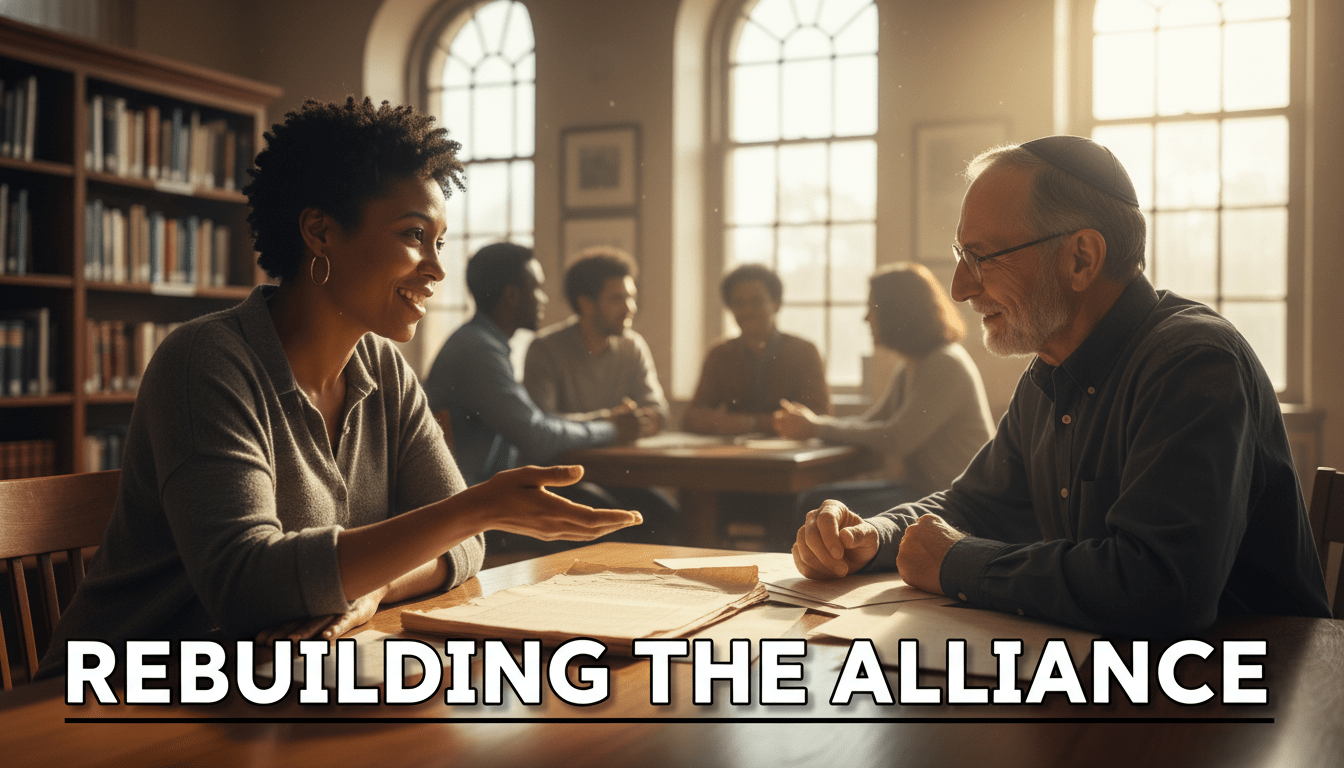
In late May 2026, more than one hundred leaders gathered at the EAST Hotel in Miami, Florida (sdvoice.info). This landmark event marked the first National Convening of the Black-Jewish Alliance in over twenty-five years (combatantisemitism.org). Hosted by the Exodus Leadership Forum, founded by television commentator Van Jones, and the Redstone Family Foundation, led by philanthropist Shari Redstone, the three-day summit brought together a diverse group of clergy, activists, educators, and artists (sdvoice.info).
The gathering aimed to build a modern response to the rising tide of racism and antisemitism across the United States (combatantisemitism.org). Civil rights icon Dr. Benjamin F. Chavis Jr. stood as a prominent voice during the summit (sdvoice.info). He observed that while the nation faces a severe crisis of growing division, history shows that powerful social movements are frequently born in moments of great challenge (sdvoice.info). The summit sought to transform this crisis into an opportunity for collective movement-building.
The Early Foundations of Solidarity
The partnership between Black and Jewish Americans began long before the modern era. In the early twentieth century, both groups recognized that a society governed by prejudice was a threat to all minority communities (abhmuseum.org). One of the earliest collaborations took shape in 1911 between Julius Rosenwald, the Jewish president of Sears, Roebuck and Company, and Booker T. Washington, the legendary educator (julius-rosenwald-legacy.com, centerformasonslegacies.com).
Driven by Jewish concepts of repairing the world and charity, Rosenwald funded the construction of nearly five thousand schools for Black children (julius-rosenwald-legacy.com). These schools flourished during the dark years of segregation, providing high-quality education to over six hundred thousand children (arkansasheritage.com). This program helped combat the structural limits that arose after the [ways Civil War failed to end slavery](https://www.africanelements.org/news/3-ways-the-civil-war-failed-to-end-slaveryand-3-things-black-fol/) across the American South. Around this same time, Jewish leaders joined hands with W.E.B. Du Bois to help co-found the NAACP in 1909, cementing a shared commitment to legal equality (abhmuseum.org).
The Grand Alliance of the Civil Rights Era
By the middle of the twentieth century, this partnership transformed into a powerful social engine. The deep friendship between the Reverend Dr. Martin Luther King Jr. and Rabbi Abraham Joshua Heschel became a moral symbol of the era (ajhs.org, jtsa.edu). Rabbi Heschel, who had escaped Nazi-occupied Europe, marched arm-in-arm with Dr. King from Selma to Montgomery in 1965 (jwa.org). He later reflected that the march felt like his legs were actively praying (beaconhebrewalliance.org).
This commitment was also sealed in tragedy during the Freedom Summer of 1964 (civilrightsmuseum.org). In Mississippi, three young civil rights workers were abducted and murdered by the Ku Klux Klan (civilrightsmuseum.org). James Chaney, a young Black Mississippian, died alongside Andrew Goodman and Michael Schwerner, two Jewish volunteers from New York (wikipedia.org). The national horror over their deaths catalyzed the swift passage of the Civil Rights Act of 1964 (civilrightsmuseum.org).
Milestones of Shared Resistance
Key moments in the Black-Jewish coalition
Understanding the Jim Crow System
To fully understand the depth of this early alliance, one must examine the oppressive system it fought. The Jim Crow system was a legal structure of state and local laws that enforced racial segregation and disenfranchisement across the Southern and border states (wikipedia.org). Operating from the end of Reconstruction in 1877 until the mid-1960s, it systematically relegated Black Americans to second-class citizenship (ferris.edu).
Under this oppressive regime, local governments legally separated Black people from white people in schools, transportation, and public spaces (ferris.edu). The United States Supreme Court originally gave this system legal protection in the 1896 case of Plessy v. Ferguson under the separate but equal doctrine (justia.com). The system was eventually dismantled through sustained legal battles and major federal legislation, including the historic Civil Rights Act and Voting Rights Act (britannica.com).
The Fracturing and the Twenty-Five Year Gap
Despite early victories, the alliance began to fracture during the late 1960s (fjmc.org). This division eventually led to a twenty-five year gap without a major national convening of the two groups (combatantisemitism.org). Geographic and political shifts caused the communities to drift apart (jta.org). Sustained national dialogue evaporated as grassroots relationships became highly localized and quiet (sdvoice.info).
Several escalating public crises further widened this deep rift (jta.org). Events such as the Crown Heights riots of 1991 and debates over the Million Man March of 1995 increased mutual suspicion (jta.org). This shift coincided with a broader transformation in American politics, including the [shift to mass incarceration](https://www.africanelements.org/news/the-political-shift-from-civil-rights-to-mass-incarceration/) which changed the focus of Black advocacy. This era of distance left the historic alliance without a unified national platform for over a quarter of a century (combatantisemitism.org).
The Bakke Decision and Affirmative Action
A major source of political friction emerged in 1978 with the landmark Supreme Court case Regents of the University of California v. Bakke (justia.com). The case centered on a special admissions program at UC Davis that reserved sixteen of one hundred medical school seats for minority applicants (fedsoc.org). Allan Bakke, a white applicant who faced rejection, challenged this policy as unconstitutional (fedsoc.org).
The legal battle exposed a deep ideological division between prominent Black and Jewish organizations (uchicago.edu). Major Jewish groups, including the Anti-Defamation League, filed briefs supporting Bakke (uchicago.edu). They feared that racial quotas could easily be used to reinstate historic limits on Jewish enrollment in elite universities (uchicago.edu). Conversely, Black civil rights leaders defended the program, arguing that race-conscious policies were vital to overcoming centuries of systemic discrimination (uchicago.edu).
School Control and the Ocean Hill-Brownsville Crisis
Another severe flashpoint occurred in Brooklyn during the 1968 Ocean Hill-Brownsville school crisis (tempestmag.org, cuny.edu). The conflict arose from a movement for municipal school control, which sought to decentralize urban school districts (cuny.edu). Proponents wanted to give local, predominantly minority neighborhoods the authority to hire staff and run schools (isreview.org).
Tensions exploded when a local Black school board dismissed several white, predominantly Jewish teachers (cuny.edu). In response, the United Federation of Teachers, led by Albert Shanker, launched a massive citywide strike (tempestmag.org). This strike shut down New York public schools for weeks (tempestmag.org). The intense battle pitted the desire of Black parents for educational self-determination against a predominantly Jewish union fighting to protect labor agreements (cuny.edu). The crisis left long-lasting political and social scars across the city (tempestmag.org).
Geopolitical Divides and the Middle East
The Israeli-Palestinian conflict also served as a deep geopolitical wedge that divided the two communities (forward.com, forward.com). Following the Six-Day War in 1967, many Jewish Americans came to view the safety and survival of Israel as a non-negotiable core of their identity (forward.com). At the same time, elements of the Black Power movement began to view the Palestinian struggle through an anti-colonial lens (jewishcurrents.org). They found resonance in [elements of Black Nationalism](https://www.africanelements.org/news/civil-rights-and-black-nationalism-karenga-black-nationalism-and-conflicting-ideologies/) as they analyzed structural oppression globally.
This ideological divergence created a profound sense of mutual betrayal (forward.com). Jewish communities felt hurt when civil rights figures criticized Israel, especially given their historical support for the Black freedom struggle (forward.com). Meanwhile, Black activists argued that their allies minimized the domestic fight for equality by treating criticism of Israeli state policies as inherently antisemitic (jewishcurrents.org). This impasse created a long-standing political division (forward.com).
Rhetorical Fractures and High-Profile Rifts
The erosion of trust was further accelerated by highly publicized antisemitic statements from some prominent Black public figures (jewishexponent.com). Louis Farrakhan, the leader of the Nation of Islam, frequently made public attacks on Jewish people and Judaism (jta.org). His organization also published a highly controversial and historically inaccurate book that falsely blamed Jewish people for dominating the transatlantic slave trade (jta.org).
Furthermore, during his 1984 presidential campaign, civil rights leader Jesse Jackson used an offensive term to describe New York City (jewishexponent.com). This comment triggered a major national backlash and severely damaged his standing among Jewish voters (jta.org). These rhetorical fractures, combined with a perceived lack of swift condemnation from mainstream Black organizations, intensified feelings of estrangement within the Jewish community (jta.org).
Hate Crime Bias Motivations
A statistical breakdown of targeted violence in America
The Modern Rise of Targeted Hate
The urgent effort to rebuild the alliance in Miami is driven by a terrifying spike in targeted hate crimes across the United States (combatantisemitism.org, jpost.com). Official statistics paint a grim picture of this modern crisis (justice.gov). Recent FBI data documented eleven thousand six hundred seventy-nine hate crime incidents across the nation (justice.gov). Race-based bias motivated more than half of these single-bias incidents, with anti-Black bias consistently making up fifty-one point three percent of those crimes (justice.gov).
Religious bias accounted for over twenty-three percent of the documented incidents (justice.gov). Within that category, anti-Jewish bias made up nearly seventy percent of the total, reaching a record-high of one thousand nine hundred three-eight incidents (justice.gov). In addition, the Anti-Defamation League recorded a staggering nine thousand three hundred fifty-four antisemitic incidents in 2024 (timesofisrael.com). Although overall incidents of harassment declined slightly the following year, physical assaults against Jewish individuals reached a historic high of over two hundred incidents (timesofisrael.com). This hostile environment has forced fifty-six percent of American Jews to alter their daily behavior (timesofisrael.com).
Spill the Honey and Educational Mobilization
In response to this rising tide of hatred, organizations like Spill the Honey have stepped forward to rebuild the historic coalition (spillthehoney.com, washingtoninformer.com). Spill the Honey is a national nonprofit organization that uses the arts, education, and culture to strengthen relationships between Black and Jewish Americans (spillthehoney.com). The group draws inspiration from Eliezer Ayalon, a Holocaust survivor who received a cup of honey from his mother before she perished (spillthehoney.com). This honey became a lasting symbol of hope, sweetness, and survival (spillthehoney.com).
Led by figures such as Chairman Dr. Benjamin F. Chavis Jr. and Executive Director Rabbi Dr. Judy Schindler, the organization creates educational materials and documentary films (washingtoninformer.com, spillthehoney.com). Their award-winning film, Shared Legacies, explores the historical cooperation of the civil rights era (spillthehoney.com). By providing curriculum and workshops, the group helps modern educators teach the shared history of overcoming systemic oppression (washingtoninformer.com, spillthehoney.com).
Centering Black Jews and Dr. Bruce Haynes
The modern effort to rebuild this relationship also addresses historic blind spots by centering the voices of Black Jews (combatantisemitism.org, sdvoice.info). Historically, dialogue groups often treated Black and Jewish identities as separate and mutually exclusive (jewishjournal.com). This false binary ignored the lived experiences of individuals who belong to both communities, including converts, biracial families, and global communities of African descent (sdvoice.info). To understand these overlapping identities is to understand [intersectional oppression](https://www.africanelements.org/news/huey-p-newton-and-the-revolutionary-black-nationalist-position-on-gay-and-womens-liberation-movements-2/) as a lived reality.
Dr. Bruce D. Haynes, an esteemed sociologist and educational advisor for Spill the Honey, has been instrumental in reshaping this conversation (combatantisemitism.org, sdvoice.info). As the author of The Soul of Judaism, Dr. Haynes has highlighted the history of Jews of African descent in America (sdvoice.info). Alongside writer Robin Washington, Dr. Haynes has advocated for a unified national framework to coordinate localized efforts (jewishjournal.com). Their work ensures that the modern alliance is not merely a transaction between two separate groups, but an authentic, inclusive partnership (sdvoice.info).
Of American Jews report altering their behavior in public or online out of fear of targeted harassment and antisemitic violence.
Drafting a Strategy for Shared Liberation
The Miami convening succeeded in turning historical memory into a forward-looking, practical strategy (combatantisemitism.org). Rather than simply reminiscing about the triumphs of the past, the leaders developed a comprehensive plan for action (combatantisemitism.org, sdvoice.info). This National Strategy for Black and Jewish Partnership includes collaborative toolkits for classrooms, joint media campaigns, and coordinated advocacy for stronger hate-crime legislation (combatantisemitism.org).
As the three-day summit concluded, the legacy of Dr. Benjamin Chavis served as a bridge between the past and the future (sdvoice.info). Having begun his career under Dr. Martin Luther King Jr., his presence reminded participants that the fight for dignity is a continuous, multi-generational journey (sdvoice.info). In an era of profound division, this new generation of leaders is demonstrating that the path to safety and liberation is one that must be walked together (combatantisemitism.org, sdvoice.info).
About the Author
Darius Spearman is a professor of Black Studies at San Diego City College, where he has been teaching for over 20 years. He is the founder of African Elements, a media platform dedicated to providing educational resources on the history and culture of the African diaspora. Through his work, Spearman aims to empower and educate by bringing historical context to contemporary issues affecting the Black community.
