


Why the Virginia Redistricting Map Reversal Impacts Minorities
By Darius Spearman (africanelements)
Support African Elements at patreon.com/africanelements and hear recent news in a single playlist. Additionally, you can gain early access to ad-free video content.
A Landmark Decision on District Lines
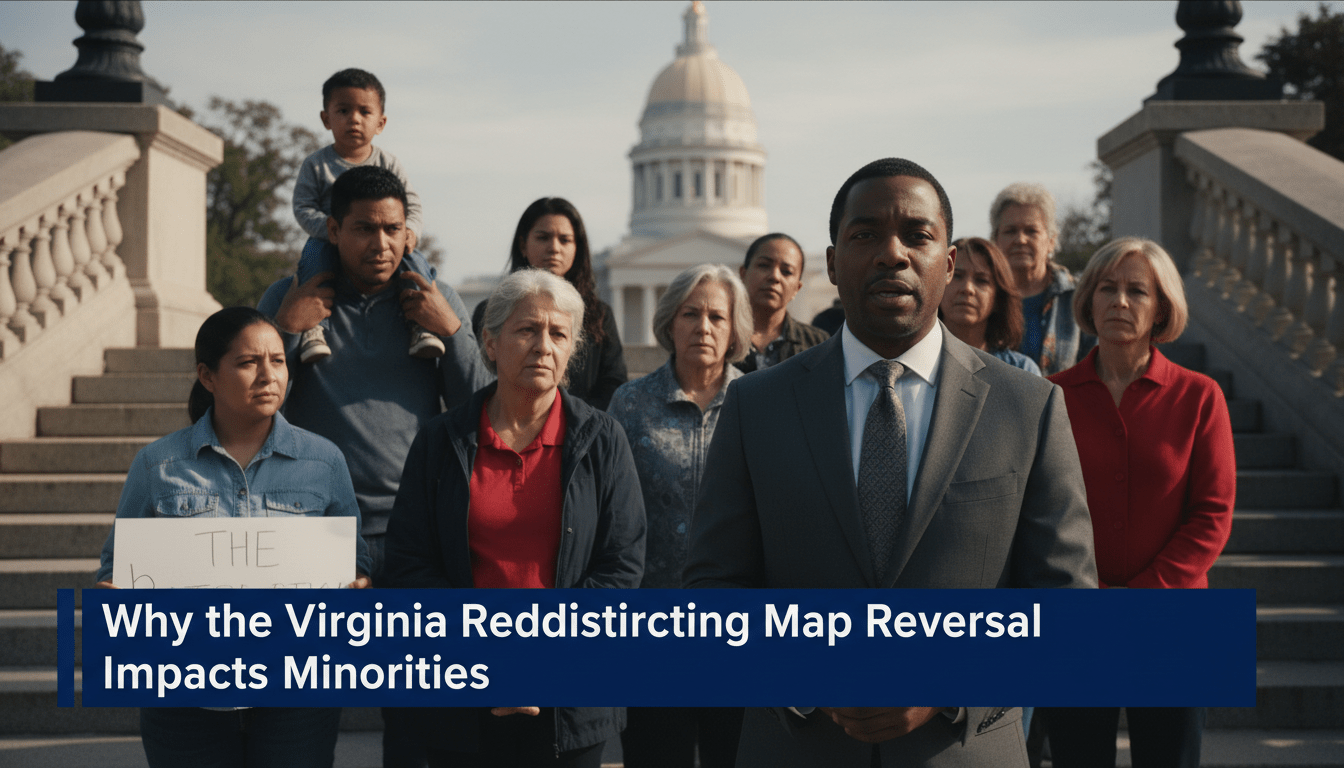
On May 8, 2026, the Virginia Supreme Court handed down a pivotal split decision. The court voted four to three to strike down a new redistricting plan. Voters had previously approved this plan in a special election on April 21. During that referendum, more than 1.6 million Virginians voted in favor of the newly proposed maps. The initiative secured a majority, passing with 51.7 percent of the statewide vote (davisvanguard.org).
Despite this massive public approval, the highest court in the state determined the process violated specific legal procedures. Critics of the ruling, including prominent civil rights advocates, argue that this decision acts as a massive blow to fair representation. They assert the ruling forces the state to revert to older district lines drawn years prior. These older boundaries allegedly dilute the voting strength of minority communities across the state, fundamentally altering the political experience of Black people nationwide (centerforpolitics.org).
The decision arrives at a moment of intense political polarization across the country. Civil rights leaders express deep concern regarding the continuous erosion of voting protections. They view the nullification of a democratic referendum as a dangerous precedent that undermines public trust in the judicial system. The ongoing tension rests on whether the expressed will of the people should outweigh strict adherence to legal technicalities (davisvanguard.org, acluva.org).
The Byrd Machine and Early Map Rigging
To understand the current battle over voting districts, one must examine the deep historical roots of political control in Virginia. During the early twentieth century, a powerful network known as the Byrd Organization dominated the state. Led by Harry F. Byrd Sr., this machine maintained absolute authority from the 1920s through the 1960s. Byrd orchestrated a deliberate strategy of malapportionment to keep his allies in power for decades (centerforpolitics.org, roanokerambler.com).
Malapportionment involves freezing district lines even as populations shift and grow. As urban centers like Richmond and Norfolk expanded with diverse populations, the Byrd Organization simply refused to redraw the maps. This tactic ensured that rural, predominantly white counties retained disproportionate control over the state legislature. Furthermore, the machine utilized poll taxes and literacy tests to severely suppress the black vote (richmond.edu).
These historical practices left a lasting scar on the political landscape of the state. The Byrd Organization effectively silenced generations of Black citizens by erecting insurmountable barriers to the ballot box. Due to these oppressive measures, typical voter turnout in Virginia hovered around a dismal ten to twelve percent of eligible adults. Without a voice in the government, minority communities suffered from systemic neglect in education, infrastructure, and economic opportunity (centerforpolitics.org).
The Era of Equal Representation Rights
The landscape of political representation began to shift dramatically during the mid-twentieth century. The United States Supreme Court delivered landmark decisions in cases like Baker versus Carr in 1962 and Reynolds versus Sims in 1964. These rulings established the crucial legal principle of “one person, one vote.” The judicial branch mandated that legislative districts must contain roughly equal populations to ensure fairness. By 1965, the Virginia Supreme Court of Appeals was forced to declare its own congressional maps unconstitutional due to severe population imbalances (roanokerambler.com).
Following these legal victories, the Voting Rights Act of 1965 became a powerful tool for minority communities. The federal law provided a mechanism to challenge discriminatory voting practices at the local level. However, the end of malapportionment gave rise to a new, more strategic method of political manipulation. Politicians turned to modern gerrymandering to maintain their grip on power (acluva.org).
Instead of simply ignoring population growth, lawmakers began drawing highly specific, irregular district shapes. They used advanced demographic data to manipulate electoral outcomes based on race and political affiliation. While the populations were mathematically equal, the shapes of the districts were engineered to predetermine the winners of the elections (roanokerambler.com, oup.com).
Understanding Gerrymandering Strategies
Packing
Cracking
How Packing and Cracking Dilute Votes
Gerrymandering relies on two primary techniques known as packing and cracking. These methods serve to intentionally minimize the influence of a specific demographic group, particularly Black voters. Packing involves concentrating as many voters of a targeted group into a single district as possible. This ensures that the minority group wins that one specific seat by a massive margin. However, it prevents those voters from having any competitive influence in the surrounding districts (roanokerambler.com, richmond.edu).
When voters are severely packed, their excess votes are essentially wasted. A candidate might win with ninety percent of the vote, even though they only needed fifty percent to secure the seat. Conversely, cracking involves splitting a cohesive urban community into multiple different rural or suburban districts. By dividing the population, the targeted group remains a permanent minority in every single district (richmond.edu).
They are entirely denied the ability to elect a candidate of their choice anywhere. Both methods ultimately guarantee that the total number of representatives sympathetic to the minority group remains significantly lower than the actual population percentage of that group. These tactics form the basis of most modern civil rights lawsuits regarding election maps (oup.com, wydaily.com).
The Shield of Federal Preclearance
For nearly fifty years, Section 5 of the Voting Rights Act protected minority voters in Virginia through a process called preclearance. Because the state possessed a documented history of severe racial discrimination, Virginia was legally required to obtain federal approval before changing any voting laws or district maps. The United States Department of Justice reviewed every proposal. This federal oversight acted as a powerful shield against map manipulation (acluva.org).
The preclearance requirement prevented lawmakers from implementing maps that would lead to a decrease in the ability of minority voters to elect their preferred candidates. This protection abruptly ended in 2013 with the United States Supreme Court decision in Shelby County versus Holder. The court struck down the mathematical formula used to determine which states required preclearance, arguing the data was outdated (acluva.org, richmond.edu).
This ruling removed proactive federal oversight and shifted the burden of proof onto everyday citizens. Voters now have to organize and file expensive lawsuits after a discriminatory map has already been implemented. This shift profoundly altered the system of federalism regarding election law. It left minority communities far more vulnerable to aggressive partisan map manipulation orchestrated by state-level politicians (acluva.org).
The Recent Redistricting Scandal
The profound dangers of map manipulation became highly visible during the 2011 redistricting cycle in Virginia. The state legislature drew new boundaries for the House of Delegates utilizing a fixed fifty-five percent racial quota for twelve specific districts. Lawmakers claimed this strict quota was necessary to protect Black representation under the law. However, civil rights advocates vehemently disagreed (oup.com).
Advocates argued the quota was a blatant example of racial packing. They asserted the maps were intentionally designed to drain Black voters from surrounding districts, thereby securing conservative control of the broader region. The controversy led to years of intense, costly litigation. The United States Supreme Court and lower federal courts eventually struck down eleven of these districts in 2018. The judges ruled that the boundaries constituted unconstitutional racial gerrymanders (richmond.edu, oup.com).
A special master was subsequently appointed by the courts to redraw the broken lines. Following the implementation of these fairer, court-ordered maps, Black representation in the General Assembly soared to unprecedented levels. By the 2024 elections, Virginia saw historic highs in diversity and elected Don Scott, making him the first Black Speaker of the House in the long history of the state (davisvanguard.org, oup.com).
Black Lawmakers in VA General Assembly
(Jim Crow Era)
(Fixed Quotas)
(Historic High)
State Power and The Role of the Courts
When the legislative process completely breaks down, the judicial system often steps in to resolve the conflict. In Virginia, this intervention typically involves appointing a Special Master. A Special Master is an impartial expert, usually a demographer or retired judge, tasked with drawing electoral maps from scratch. During the 2021 redistricting cycle, a newly formed bipartisan commission deadlocked and failed to produce a consensus map (virginia.gov).
Consequently, the Virginia Supreme Court assumed control and appointed two Special Masters to draw the new boundaries. These experts were instructed to prioritize constitutional criteria over political favoritism. They drew maps that completely ignored the home addresses of current politicians. This resulted in several long-standing lawmakers being placed in the exact same district, forcing them to run against one another (virginia.gov, wydaily.com).
While some praised these maps for their supposed partisan neutrality, others heavily criticized them. Critics argued the maps failed to intentionally empower Black communities. They felt the Special Masters opted for colorblind neutrality over necessary remedial action. This tension highlights the ongoing struggle to balance strict legal neutrality with the urgent need to correct historical disenfranchisement (wydaily.com, richmond.edu).
The Clout Argument and Representation
The complex debate over how to best draw districts often centers on the concept of political clout. This argument contrasts descriptive representation with substantive representation. Descriptive representation focuses on creating majority-minority districts where a minority group makes up more than fifty percent of the population. This approach virtually guarantees the election of a minority candidate to office (richmond.edu, wydaily.com).
However, critics suggest that packing Black voters into a single, overwhelming district limits their overall legislative influence. The alternative approach advocates for creating multiple influence districts. In an influence district, Black voters might make up thirty-five to forty percent of the population. While they do not constitute an absolute majority, they hold enough voting power to determine the final outcome of the election (wydaily.com).
Spreading minority voters across multiple influence districts requires extensive coalition building. It demands that politicians from varying backgrounds actively listen to and address the concerns of Black constituents to secure victory. This strategy can potentially hold multiple different legislators accountable to the interests of the community. Civil rights organizations continuously strive to find the perfect mathematical balance between securing guaranteed voices and maximizing overall legislative power (wydaily.com, richmond.edu).
A Constitutional Clash Over Timing
The immediate catalyst for the 2026 Virginia Supreme Court ruling involved a strict interpretation of the state constitution. The controversy centered on Article XII, Section 1 of the Virginia Constitution. This specific section explains the required steps for passing permanent changes to the foundational laws of the state. The law states that a proposed amendment must pass during two back-to-back sessions of the General Assembly (davisvanguard.org, richmond.edu).
Crucially, a general election for the House of Delegates must occur between those two legislative sessions. This intervening election requirement acts as a necessary cooling-off period. It ensures that the public possesses a direct opportunity to vote out lawmakers who propose unpopular structural changes. In the 2026 case, the court determined that the legislature pushed the redistricting amendment far too late (richmond.edu).
Justice D. Arthur Kelsey wrote that this procedural failure completely tainted the subsequent public referendum. By skipping the required election cycle, the lawmakers violated the highest law of the land. The court decided that maintaining the strict rule of law held more importance than validating the direct referendum vote of the people, sparking massive public outrage (davisvanguard.org).
The Shift in Voter Demographics
The urgency behind the push for mid-decade redistricting stems from massive demographic shifts occurring across Virginia. Over the past ten years, the state has experienced explosive growth within its minority populations. The 2020 Census revealed a noticeable decrease in the white-only population. Simultaneously, Black, Latino, and Asian American populations expanded rapidly. This growth is particularly concentrated in Northern Virginia and the Richmond suburbs (davisvanguard.org, centerforpolitics.org).
Areas like Prince William County and Loudoun County have transitioned from rural, conservative strongholds into some of the most diverse and rapidly growing counties in the entire nation. The Black population now accounts for approximately 18.6 percent of the state demographic. Furthermore, the Latino population grew by more than forty percent between 2010 and 2020 (davisvanguard.org).
Advocates vigorously argue that older maps inherently fail to reflect these dense, newly established minority communities. Keeping outdated maps in place inevitably dilutes the evolving political power of these residents. As communities grow and change, civil rights leaders demand that electoral boundaries shift accordingly to ensure every voice holds equal weight in the political process (davisvanguard.org, roanokerambler.com).
The National Electoral Impact
The redistricting war in Virginia carries enormous consequences for the entire nation. When discussing these legal battles, it is vital to distinguish between the state legislature and the federal congressional delegation. Virginia holds one hundred seats in its local House of Delegates, but only eleven highly coveted seats in the United States House of Representatives. The scale and impact of these respective districts vary drastically (centerforpolitics.org).
The 2026 maps, which the state Supreme Court recently discarded, were projected to significantly alter the federal balance of power. Analysts projected these new maps could have secured up to ten of the eleven federal seats for the Democratic party. Because Donald Trump is the current president, control over the federal legislative branch remains fiercely contested. Every single congressional seat carries massive weight in determining the national policy agenda (davisvanguard.org, centerforpolitics.org).
The decision by the Virginia Supreme Court to maintain the older maps provides a significant structural advantage to conservative forces. The ruling removes a map specifically designed to offset conservative gains implemented in other states. These ongoing legal battles carry deep implications in terms of political strategy for Black communities nationwide. The fight for equitable representation continues to be an arduous journey defined by shifting rules, intense partisanship, and relentless courtroom battles (davisvanguard.org, acluva.org).
About the Author
Darius Spearman is a professor of Black Studies at San Diego City College, where he has been teaching for over 20 years. He is the founder of African Elements, a media platform dedicated to providing educational resources on the history and culture of the African diaspora. Through his work, Spearman aims to empower and educate by bringing historical context to contemporary issues affecting the Black community.
