



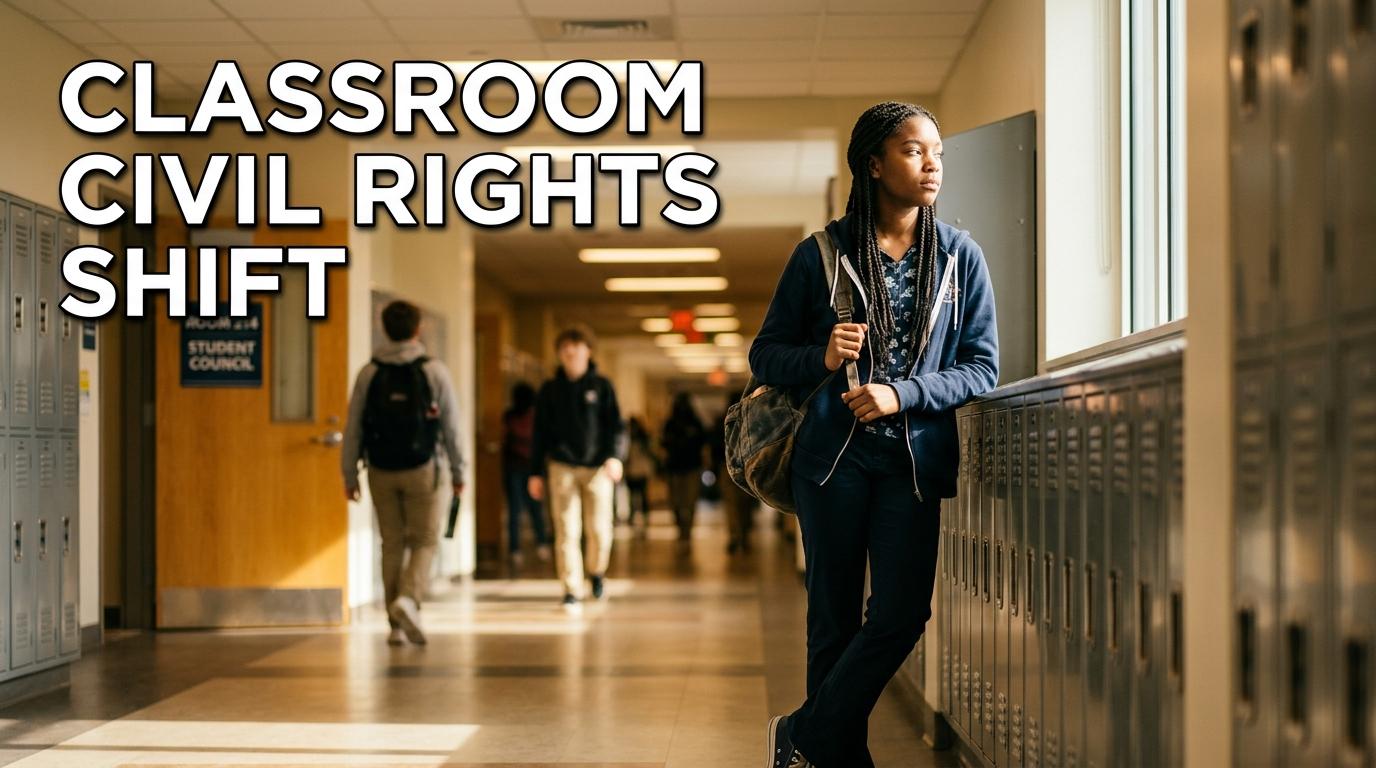
Why Title VI Disparate Impact Civil Rights Rules Ended
By Darius Spearman (africanelements)
Support African Elements at patreon.com/africanelements and hear recent news in a single playlist. Additionally, you can gain early access to ad-free video content.
A Major Shift in Public Education
In a major shift for federal civil rights enforcement, the United States Department of Education officially rescinded its longstanding Title VI disparate impact regulations (federalregister.gov, ed.gov). This regulatory change means that the federal government will no longer investigate school policies that create racially imbalanced outcomes unless there is clear evidence of intentional racial bias (federalregister.gov, apnews.com). For decades, federal oversight relied on outcome-based statistical metrics to identify hidden institutional discrimination in public school systems (educationnext.org, usccr.gov).
The decision has ignited fierce legal opposition from a major coalition of more than sixty civil rights and education advocacy organizations (civilrights.org, apnews.com). Legal representatives argue that removing these regulations destroys an essential federal tool for protecting students of color from structural inequality (civilrights.org). Conversely, federal officials and policy critics claim the change aligns federal enforcement with the original language of the Civil Rights Act of 1964, returning authority to local educators (opgov.news, ed.gov).
The Genesis of Disparate Impact Standards
Understanding this major policy shift requires examining the historical origin of federal civil rights protections. When Congress passed Title VI of the Civil Rights Act of 1964, the statute prohibited racial discrimination in programs receiving federal funds (wikipedia.org, everycrsreport.com). Section 601 of the Act directly banned intentional discrimination by any funding recipient (federalregister.gov, everycrsreport.com). Section 602 authorized federal agencies to write administrative rules to enforce those basic statutory guarantees (federalregister.gov, justice.gov).
Federal agencies soon realized that systemic discrimination frequently occurs without explicit statements of racial animus (usccr.gov). Consequently, administrative regulations were promulgated to prohibit policies that produce racially discriminatory effects (federalregister.gov, justice.gov). The United States Supreme Court validated this legal theory in the landmark 1971 case Griggs v. Duke Power Company (oyez.org, justia.com). Although Griggs addressed employment practices under Title VII, it firmly established that neutral policies causing disproportionate racial harm are unlawful if they lack business necessity (study.com, oyez.org).
The Stripping of Private Legal Rights
For several decades, individual citizens and civil rights groups relied on disparate impact rules to challenge inequities in federal court (usccr.gov, administrativelawreview.org). However, a major Supreme Court decision drastically changed the landscape of civil rights litigation (coffieldlaw.com, oyez.org). In Alexander v. Sandoval (2001), the Supreme Court ruled in a five-to-four decision that private individuals do not possess a private right of action to enforce disparate impact rules under Title VI (coffieldlaw.com, justia.com).
The Sandoval ruling meant that while federal agencies could create disparate impact regulations, private citizens could not sue recipients of federal funds over unintentional discrimination in court (coffieldlaw.com, coffieldlaw.com). Consequently, enforcement authority became concentrated entirely within executive branch agencies like the Department of Education’s Office for Civil Rights (civilrights.org, ed.gov). This shift left civil rights protection highly vulnerable to changing presidential administrations, illustrating how the system of federalism dictates the enforcement of equal rights.
School Discipline as a Policy Battleground
School discipline policies emerged as the primary area of debate regarding federal disparate impact enforcement (educationnext.org, edweek.org). In 2014, the federal government issued a joint “Dear Colleague” guidance letter to school districts across the country (educationnext.org, edweek.org). A “Dear Colleague” letter serves as an official policy memorandum instructing schools on how administrative agencies intend to interpret and enforce existing civil rights statutes (educationnext.org, justice.gov).
This policy guidance warned districts that rigid zero-tolerance rules causing racially disparate suspensions could prompt federal civil rights investigations (educationnext.org, edweek.org). The guidance encouraged local administrators to adopt restorative disciplinary measures (educationnext.org, learningpolicyinstitute.org). Restorative practices emphasize conflict resolution, counseling, and peer mediation over mandatory classroom exclusions (learningpolicyinstitute.org, nextgenlearning.org). Opponents argued that the guidance restricted teacher authority, contributing to a broader political shift toward mass incarceration mechanisms within public institutions.
Unpacking the School Discipline Statistics
National statistical surveys compiled by civil rights researchers demonstrate stark racial disparities in punitive school discipline (usccr.gov, learningpolicyinstitute.org). Black students represent approximately fifteen percent of total public school enrollment in the United States (learningpolicyinstitute.org, pbs.org). Yet, official data shows that Black students account for thirty-one percent of all school-based law enforcement arrests (learningpolicyinstitute.org, pbs.org).
These statistical disparities are particularly severe for female students of color (georgetown.edu). Academic studies examining federal civil rights data demonstrate that Black girls face disproportionate disciplinary actions compared to White female students (georgetown.edu). Specifically, Black girls experience more than four times the rate of out-of-school suspensions (georgetown.edu). Furthermore, Black girls face over three times the risk of school-related arrests and five times the rate of disciplinary transfers to alternative school settings (georgetown.edu).
Facially Neutral Rules in Today’s Classrooms
A facially neutral policy is a written rule that contains no explicit racial wording but produces disproportionate negative outcomes for specific racial groups when enforced (study.com, learningpolicyinstitute.org). In public schools, neutral policies often appear in subjective dress codes and broad behavioral mandates (k12dive.com, chalkbeat.org). For instance, school rules restricting natural hairstyles, braids, locs, or extensions disproportionately affect Black students (k12dive.com, chalkbeat.org).
Similarly, broad disciplinary rules prohibiting vague infractions such as “willful defiance” or “disrespect” leave enforcement open to subjective interpretation (edweek.org, learningpolicyinstitute.org). Research shows that subjective standards frequently result in higher rates of classroom removal for Black youth (chalkbeat.org). These modern disciplinary mechanisms reflect historical patterns where formal neutrality reinforced structural barriers, echoing failed post-civil war promises of equal educational access.
The Current Regulatory Dismantling
The July 2026 rescission of Title VI disparate impact rules by the Department of Education represents the culmination of a systematic executive effort (federalregister.gov, ed.gov). In April 2025, President Donald Trump signed Executive Order 14281, directing federal agencies to eliminate disparate impact enforcement across federal programs (whitehouse.gov, ed.gov). The Department of Justice published a corresponding rule change in December 2025, rescinding its own Title VI disparate impact provisions (justice.gov, justice.gov).
To finalize the July 2026 Education Department rule, federal officials bypassed the standard notice-and-comment rulemaking process (federalregister.gov, ed.gov). Under the Administrative Procedure Act, notice-and-comment rulemaking requires agencies to publish proposed regulations and accept public feedback for thirty to sixty days (administrativelawreview.org, acus.gov). The department utilized a statutory exemption for rules governing public grants and federal contracts, issuing the final rule without prior public notice (federalregister.gov, ed.gov). This procedural route prevented civil rights organizations from submitting formal public comments before the rule took effect (federalregister.gov).
Legal Battles and Remaining Options for Families
Civil rights organizations are preparing legal challenges against the federal government to reverse the regulatory repeal (civilrights.org, apnews.com). Plaintiffs contend that bypassing the public comment process violated the Administrative Procedure Act and that the department misconstrued statutory Title VI authority (civilrights.org, administrativelawreview.org). However, state laws, local school board mandates, and state constitutional guarantees prohibiting disparate impact remain in effect regardless of federal changes (edweek.org, ecs.org).
Families seeking to challenge systemic educational bias still possess distinct administrative and legal options (coffieldlaw.com, coffieldlaw.com). Parents can file federal complaints alleging intentional discrimination under Title VI if direct evidence of disparate treatment exists (federalregister.gov, coffieldlaw.com). Furthermore, families can bring lawsuits under 42 U.S.C. Section 1983 to assert constitutional Equal Protection claims in federal court (coffieldlaw.com, justia.com). Community groups can also advocate for local board policy reforms and state legislation, such as the CROWN Act, to combat continued systemic oppression within public school systems.
About the Author
Darius Spearman is a professor of Black Studies at San Diego City College, where he has been teaching for over 20 years. He is the founder of African Elements, a media platform dedicated to providing educational resources on the history and culture of the African diaspora. Through his work, Spearman aims to empower and educate by bringing historical context to contemporary issues affecting the Black community.
