


Will Ancestral Graves Stop the $600 Million RiverPlex MegaPark?
By Darius Spearman (africanelements)
Support African Elements at patreon.com/africanelements and hear recent news in a single playlist. Additionally, you can gain early access to ad-free video content.
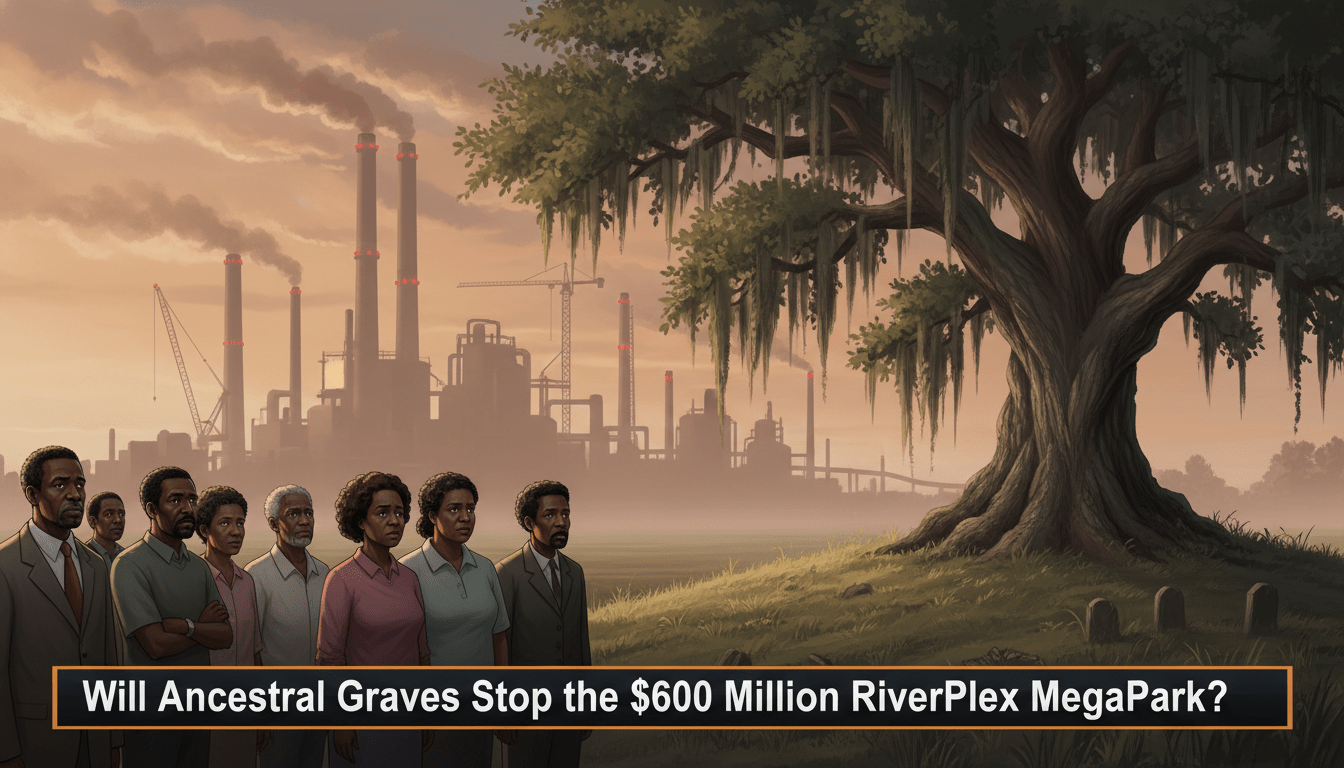
The air in West Ascension Parish carries the weight of history and the scent of industry. On Thursday, the quiet community of Modeste took a bold stand against a massive industrial project. Residents filed three major lawsuits to halt the construction of the $600 million RiverPlex MegaPark. This development covers 17,000 acres along the Mississippi River. The people of Modeste argue the state is moving forward without respecting the land. They claim the project threatens the resting places of their ancestors. These ancestors were enslaved people who worked the very ground the state now wants to pave over (pbworks.com, labucketbrigade.org).
This legal battle is the latest chapter in a long struggle. The region is often called “Cancer Alley” because of its high concentration of chemical plants. For decades, Black communities have lived on the front lines of industrial growth. They face health risks that are far higher than the national average. Now, the fight centers on a plan to build one of the largest industrial parks in the world. The residents believe the state and corporations are ignoring their voices. They see this as a fight for their health and their heritage. This conflict shows the deep tension between money and memory (grokipedia.com, nmqf.org).
The Transformation from Plantations to Petrochemicals
To understand this fight, one must look back at the history of the land. The 85-mile stretch between New Orleans and Baton Rouge was once famous for sugar. In the 18th and 19th centuries, it was known as “Plantation Country.” Large estates like Babin Place and Mulberry Grove dominated the landscape. These plantations relied on the forced labor of thousands of enslaved Black people. After the Civil War, many of these individuals stayed in the area. They formed independent settlements known as “Freetowns.” These towns allowed formerly enslaved people to build their own lives and communities (wikipedia.org, pbworks.com).
The landscape began to change drastically in the 1940s and 1950s. An oil and gas boom hit Louisiana, and companies looked for land. They chose former plantations because of their location. The Mississippi River provided easy transportation for goods. Existing rail lines made it simple to move materials. Corporations began buying up the old plantation land one by one. This shift turned a region of agriculture into a corridor of heavy industry. By the 1980s, the concentration of plants was so high that residents noticed a disturbing trend. Sickness became common, and the area earned the name “Cancer Alley” (grokipedia.com, labucketbrigade.org).
This transition reflects a broader history of Black political power and its limits. While the state focused on economic growth, Black residents focused on survival. The industrial boom brought wealth to the state but also brought pollution to the doorsteps of Modeste. Residents argue that the state values industrial profit more than human life. The history of this land is literally buried beneath the surface. Now, that history is at risk of being erased forever by new construction (ccrjustice.org, thelensnola.org).
Relative Cancer Risk Levels
Risk in some areas is 50x the EPA limit (nmqf.org).
Three Lawsuits Challenge the MegaPark Project
The community of Modeste is not fighting alone. Groups like Rural Roots Louisiana and the Louisiana Bucket Brigade have joined the cause. On Thursday, they filed three distinct lawsuits to stop the RiverPlex MegaPark. Each lawsuit targets a different part of the government process. The first lawsuit is against the State of Louisiana. It focuses on a secret agreement with Hyundai Steel, a major tenant for the park. Residents claim the state signed this deal without public notice or approval from the State Bond Commission. They argue this “steamrolls” the rights of the people living there (la.gov, thelensnola.org).
The second lawsuit takes aim at the Port of South Louisiana. This legal action concerns the funding for the project’s infrastructure. The Port plans to authorize up to $400 million in revenue bonds. However, the lawsuit claims the Port failed to publish required notices. Revenue bonds are a way for government entities to fund private projects. Without proper public notice, residents cannot assess the risks. This lack of transparency is a major point of anger for the community. They feel the government is working behind closed doors to favor big business (thelensnola.org, grokipedia.com).
The third lawsuit targets the U.S. Army Corps of Engineers. This suit is perhaps the most emotional because it concerns burial sites. Residents argue the Corps failed to require a proper survey for unmarked graves. In the past, enslaved people were often buried on land that was not good for farming. These areas are now the exact spots where industrial facilities are planned. The lawsuit says the government is ignoring federal laws that protect historic sites. They want a full investigation before any construction moves more dirt (cornell.edu, labucketbrigade.org).
These legal challenges highlight the complexities of federalism and Black politics. Local, state, and federal agencies all have a role in approving these plants. Yet, residents often feel that none of these agencies represent their interests. President Donald Trump is the current president, and his administration oversees the federal agencies involved. The lawsuits seek to hold these agencies accountable to the law. They aim to prove that heritage is more valuable than industrial sprawl (ccrjustice.org, thelensnola.org).
The Scientific Hunt for Lost Ancestors
Proving that burial sites exist is a difficult task. Many of these graves were never marked with stones. Instead, families used trees or specific plants like Yucca to mark the spots. Over time, these markers can disappear from view. However, modern technology is helping the people of Modeste find the truth. A group called Forensic Architecture uses special tools to study the land. They look at historical maps and satellite images from decades ago. Their research has revealed over 850 “landscape anomalies” in the region. These are signs that the soil has been disturbed in ways consistent with burial sites (plasticpollutioncoalition.org, labucketbrigade.org).
These researchers use a method called “counter-forensics.” They gather evidence that corporations might overlook or hide. For example, they look for rectangular depressions in the ground. They also look for lone oak trees in the middle of sugarcane fields. These trees were often left standing because they marked a sacred spot. This scientific evidence supports the oral histories of the Modeste community. For generations, grandmothers and grandfathers have told stories about where their people are buried. Now, science is backing up those stories with hard data (plasticpollutioncoalition.org, grokipedia.com).
The preservation of these sites is protected by Section 106 of the National Historic Preservation Act. This law requires federal agencies to consider how a project affects historic property. If a site is culturally significant to a descendant community, it must be protected. The lawsuit against the Army Corps of Engineers argues this process was skipped. The residents want the Corps to listen to the experts and the community. They believe that building a massive industrial park over graves is a violation of human rights. It is an act of erasure that they refuse to accept (cornell.edu, thelensnola.org).
Forensic Landscape Analysis
Over 850 anomalies found in region consistent with graves (labucketbrigade.org).
Environmental Racism and the Sacrifice Zone
The struggle in Modeste is a clear example of environmental racism. This term describes how pollution is often pushed into minority neighborhoods. In Louisiana, industrial plants are concentrated in Black communities. This is not a coincidence. It is the result of decades of zoning laws and political choices. The “West Bank Industrial Overlay” is one such tool. It allows the parish to rezone residential land for heavy industry. This makes it easier for companies to build right next to homes. It creates “sacrifice zones” where the health of residents is traded for profit (ccrjustice.org, siteselection.com).
The statistics in this region are staggering. Some residents face a cancer risk that is 50 times higher than what the EPA allows. Low birthweight and preterm births are triple the national average. These are the human costs of industrial sprawl. The residents of Modeste argue that the RiverPlex MegaPark will make things worse. With giants like Hyundai Steel and ExxonMobil involved, the pollution will be massive. They believe the state is choosing to ignore these health impacts to secure a $600 million project. This is a life-or-death issue for many families (nmqf.org, countyhealthrankings.org).
This situation also affects the growth of entrepreneurs in the Black community. It is hard to build a business or maintain a farm when the environment is toxic. The New Africa Plantation is a farm owned by descendants of enslaved people. It stands as a symbol of Black self-sufficiency. However, the MegaPark project threatens to surround this land with silos and smoke. This would effectively destroy a living piece of history. The community wants to grow on its own terms, not as a byproduct of industrial waste (grokipedia.com, thelensnola.org).
The Secret Culture of Non-Disclosure Agreements
A major part of the legal battle involves the lack of transparency. For over a year, details about the $600 million funding package were kept secret. State and local officials used non-disclosure agreements, or NDAs, to hide the plans. This meant that while the project was being shaped, the public was left in the dark. Residents only found out about the full scale of the park after major decisions were made. In February 2026, a judge finally ordered officials to release these records. The court found that the government had unlawfully withheld information (thelensnola.org, grokipedia.com).
NDAs create a “secrecy culture” that harms community organizing. When leaders are forced to sign these agreements, they cannot warn their neighbors. This “divide and conquer” strategy prevents residents from forming a unified response. It also makes it difficult to understand the true impact of the development. The lawsuits claim this culture of silence violates civil rights. It prevents the “meaningful involvement” that is required by law. People cannot participate in a process if they do not know it exists (thelensnola.org, ccrjustice.org).
The use of these agreements is a central part of the political strategy employed by industrial developers. By keeping the public out, they can secure permits and tax breaks early. By the time the community finds out, the project seems like a “done deal.” However, the Modeste lawsuits show that the community will not be silenced. They are using the legal system to pull back the curtain. They want to ensure that public money is not used to destroy public health and history (la.gov, grokipedia.com).
Incentive vs. Community
Economic disparity in West Ascension Parish (grokipedia.com).
The Future of Modeste and the West Bank
The outcome of these lawsuits will shape the future of the West Bank. If the courts rule in favor of the community, it could set a major precedent. It would show that historic preservation must come before industrial expansion. It would also force the state to be more transparent with its deals. For the residents of Modeste, this is about more than just one park. It is about whether their community is allowed to exist. They are fighting to keep their homes and their heritage from being erased (labucketbrigade.org, thelensnola.org).
The state offers “voluntary buyouts” to some residents living near the plants. However, these buyouts are often based on “Fair Market Value.” This value is low because the land is already surrounded by industry. It is not enough for families to buy new homes in safe areas. This traps residents in a cycle of poverty and pollution. The lawsuits argue that this system is unfair and discriminatory. They want the state to respect the people who have lived there for generations. They believe the land belongs to the community, not just the corporations (ccrjustice.org, grokipedia.com).
As the legal battle moves forward, the world is watching. This conflict in “Cancer Alley” is a microcosm of the global struggle for environmental justice. It pits the power of the state against the power of the people. It asks whether the graves of the enslaved are worth more than a steel mill. For the people of Modeste, the answer is clear. They will continue to fight for their ancestors and for their children. They will not let their history be paved over without a fight (pbworks.com, nmqf.org).
About the Author
Darius Spearman is a professor of Black Studies at San Diego City College, where he has been teaching for over 20 years. He is the founder of African Elements, a media platform dedicated to providing educational resources on the history and culture of the African diaspora. Through his work, Spearman aims to empower and educate by bringing historical context to contemporary issues affecting the Black community.
