



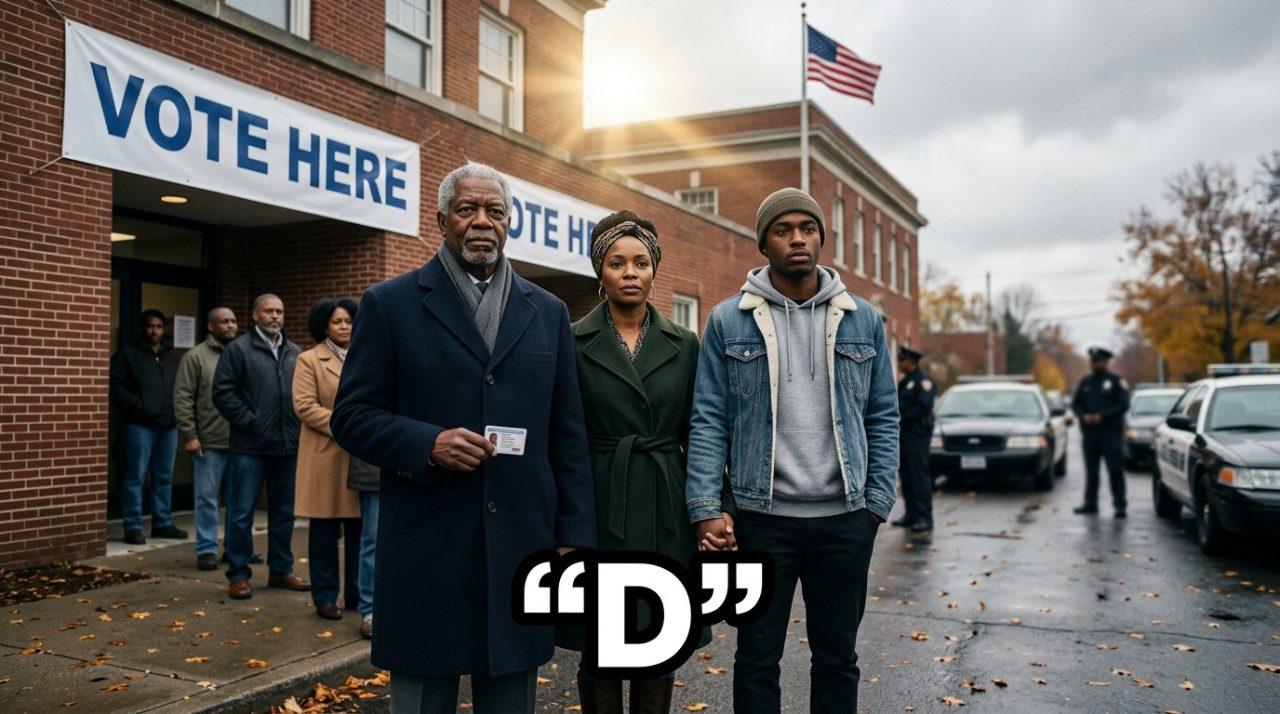
Will Armed Agents at the Polls Deter Black Voters?
By Darius Spearman (africanelements)
Support African Elements at patreon.com/africanelements and hear recent news in a single playlist. Additionally, you can gain early access to ad-free video content.
The Lawsuit Against Armed Federal Intimidation
On September 18, 2026, civil rights leaders took a stand against federal intimidation at the ballot box. A broad coalition led by the NAACP filed a federal lawsuit in Washington, D.C. (democracydocket.com). The legal action includes the Service Employees International Union, the Asian American Legal Defense and Education Fund, and Mi Familia en Acción (democracydocket.com). Together, these groups are challenging plans that could place armed federal agents near voting sites (democracydocket.com, democracydocket.com).
The legal complaint names several high-ranking executive officials as defendants. These officials include Homeland Security Secretary Markwayne Mullin, FBI Director Kash Patel, and Attorney General Todd Blanche (democracydocket.com). The lawsuit also targets White House border czar Tom Homan (democracydocket.com). The plaintiffs argue that threatening armed force near voting booths creates an illegal chilling effect (democracydocket.com, truthout.org). Furthermore, they assert that these actions violate Section 11(b) of the Voting Rights Act of 1965 (democracydocket.com, washingtonlawreview.org).
This lawsuit comes directly after months of rising community alarm. Federal leaders repeatedly declined to rule out sending armed officers to voting locations (democracydocket.com). Consequently, voting advocates argue that official silence functions as an intentional warning to vulnerable communities (democracydocket.com, truthout.org). The coalition seeks immediate court intervention to keep federal weapons away from everyday citizens exercising their rights (democracydocket.com, lawfaremedia.org).
Escalation to Federal Court: 2026 Timeline
Federal agency leaders decline during congressional hearings to rule out armed agent presence near election sites.
Civil rights leaders seek emergency records regarding covert plans to station personnel at urban precincts.
Denver and immigrant advocacy groups file lawsuits to enforce historical bans on armed federal forces at voting sites.
Civil rights and labor coalitions sue in D.C. District Court under Section 11(b) of the Voting Rights Act.
Reconstruction and the 1865 Ban on Armed Agents
The concept of keeping weapons away from polling booths has deep roots in American history. On February 25, 1865, Congress passed a vital federal statute (lawfaremedia.org). This law prohibited military and civil officers from stationing armed men at election sites (lawfaremedia.org). It is preserved today under 18 U.S.C. § 592 as a major criminal statute (lawfaremedia.org). The primary goal was to prevent federal commanders from controlling elections (lawfaremedia.org).
Violating this post-Civil War statute carries severe consequences. Any federal official who stations armed personnel at the polls faces up to five years in prison (lawfaremedia.org). In addition, convicted officials face permanent disqualification from holding federal office (lawfaremedia.org). The only exception allowed under the statute is repelling armed foreign invaders (lawfaremedia.org). Lawmakers knew that government weapons could easily destroy the democratic process (lawfaremedia.org, washingtonlawreview.org).
During the period after the Civil War, Black political participation surged across the South. Approximately two thousand Black leaders won election to state, local, and federal offices. However, white reactionary forces met this progress with terror. Armed groups such as the Red Shirts and the White League invaded voting places. Congress attempted to halt this violence through the Ku Klux Klan Act of 1871. Yet, the Compromise of 1877 ended federal protection for Black citizens, allowing Jim Crow segregation to flourish.
Jim Crow and the Creation of Section 11(b)
Throughout the Jim Crow era, local law enforcement acted as the enforcement arm of racial terror. White sheriffs and police chiefs used their badges to suppress the Black vote through raw force. For example, Sheriff Jim Clark in Selma, Alabama, carried a nightstick and a sidearm to terrify prospective voters. Armed officers stood on courthouse steps to photograph and harass Black registrants. These displays made exercising the franchise dangerous for Black families.
Congress passed the Voting Rights Act of 1965 to dismantle this oppressive apparatus. Inside this historic measure sat Section 11(b), designed specifically to prohibit voter intimidation (washingtonlawreview.org). Notably, Section 11(b) does not require plaintiffs to prove racial animus (washingtonlawreview.org). It does not require proof of subjective evil intent (washingtonlawreview.org). Instead, courts apply an objective test: would a reasonable voter feel intimidated by the conduct? (lawfaremedia.org, washingtonlawreview.org).
Importantly, the statute covers anyone acting “under color of law or otherwise” (washingtonlawreview.org). This phrasing intentionally closed a common Jim Crow evasion tactic (washingtonlawreview.org). Historically, Southern sheriffs routinely deputized private vigilantes to harass Black voters. This allowed government officials to outsource terror while claiming clean hands. By including actions under color of law, Congress explicitly bound both private actors and official law enforcement agents (washingtonlawreview.org).
The 1981 Ballot Security Scandal
Modern tactics often mirror older strategies under the guise of election integrity. A clear example happened during the 1981 New Jersey gubernatorial election (njspotlightnews.org). The Republican National Committee launched an initiative called the “National Ballot Security Task Force” (njspotlightnews.org). This group deployed armed, off-duty police officers wearing armbands into heavily Black and Latino precincts in Newark and Trenton (njspotlightnews.org).
The off-duty officers carried sidearms and posted threatening warnings around polling sites (njspotlightnews.org). They challenged voters in line and created intense fear in minority neighborhoods (njspotlightnews.org). Meanwhile, suburban white precincts had zero armed monitors (njspotlightnews.org). The election ended with a razor-thin margin of fewer than two thousand votes (njspotlightnews.org). In response, the Democratic National Committee sued to stop the intimidation (njspotlightnews.org).
The litigation produced the historic 1982 federal consent decree (njspotlightnews.org). Under this settlement, party operatives were barred from ballot security operations in minority areas without prior court approval (njspotlightnews.org). This consent decree protected vulnerable voters across the country for 36 years (njspotlightnews.org). However, a federal judge allowed the consent decree to expire in January 2018 (njspotlightnews.org). Its expiration reopened the door for aggressive monitoring practices (lawfaremedia.org, njspotlightnews.org).
Voter Fraud Claims vs. Documented Reality
Comparing unverified federal fraud assertions with documented audit data.
The Reality Behind Noncitizen Voting Allegations
Modern campaigns seeking armed deployments often justify their actions by claiming noncitizens vote in droves (democracydocket.com, iowastartingline.com). Administrative officials have claimed hundreds of thousands of noncitizens hold active voter registrations (iowastartingline.com). However, empirical records tell a completely different story (iowastartingline.com). Independent research shows that noncitizen voting remains statistically rare (iowastartingline.com).
A landmark Brennan Center study examined 23.5 million ballots cast across 42 jurisdictions. Election officials found only about 30 suspected cases of noncitizen voting. That rate equates to 0.0001 percent of all votes examined. Similarly, an extensive 25-year audit conducted by the Georgia Secretary of State revealed zero confirmed noncitizen votes. Even conservative tracking databases reveal fewer than 70 cases nationwide over several decades.
State-level investigations display the same pattern (iowastartingline.com). In Iowa, officials alleged that over two thousand noncitizens registered to vote (iowastartingline.com). Yet, subsequent legal investigations resulted in merely eight prosecutions and a single conviction (iowastartingline.com). The overwhelming evidence demonstrates that mass noncitizen voting is a myth. Civil rights advocates argue this false narrative serves as a pretext to place armed agents near minority precincts (democracydocket.com, iowastartingline.com).
Harm to Black American and Immigrant Electorates
The NAACP intervened in this battle because armed enforcement uniquely harms Black communities (democracydocket.com). In the United States, Black residents experience a fraught relationship with law enforcement. This dynamic was exacerbated during the era of mass incarceration. For people living in over-policed neighborhoods, armed agents in tactical gear evoke traumatic encounters. Consequently, a polling site guarded by federal agents resembles a police checkpoint rather than a civic center (democracydocket.com).
Furthermore, this threat directly impacts the rapidly growing Black immigrant population. Black voters are not a monolith. Naturalized citizens from the Caribbean and continental Africa represent roughly ten percent of all eligible Black voters. Communities from countries such as Haiti, Jamaica, and Nigeria form vital portions of the electorate. Deploying federal immigration officers near precincts exposes these eligible voters to unlawful profiling (democracydocket.com, americanimmigrationcouncil.org).
Federal immigration databases contain well-documented inaccuracies (americanimmigrationcouncil.org). In recent years, federal agents have wrongfully detained more than 170 American citizens due to faulty data. When armed immigration agents patrol voting sites, naturalized Black citizens risk improper detention simply for exercising their rights. This fear suppresses participation and silences eligible community voices (democracydocket.com, americanimmigrationcouncil.org).
The Legal Battle for Standing and Ripeness
Government lawyers often defend against these lawsuits by arguing about procedural timing (democracydocket.com). They claim the plaintiffs lack legal standing because no formal deployment has occurred (democracydocket.com). In addition, federal attorneys argue the claims are not ripe for judicial review (democracydocket.com). They maintain the executive branch retains inherent discretion to investigate crimes (democracydocket.com, lawfaremedia.org). The defense insists that civil rights groups cannot sue over hypothetical future actions (democracydocket.com).
However, civil rights organizations rely on well-established legal precedents to establish standing (democracydocket.com). Under the 1982 Supreme Court ruling in Havens Realty Corp. v. Coleman, groups can prove an organizational injury. When unlawful threats force organizations to divert resources from normal voting drives toward protective litigation, standing exists. The NAACP and SEIU have diverted substantial funding to run emergency hotlines and educate frightened voters (democracydocket.com).
Ripeness also favors prompt judicial intervention (democracydocket.com). If courts wait until Election Day to address armed intimidation, the harm becomes irreversible. An election cannot be rerun easily, and disenfranchised citizens cannot retroactively cast ballots. Furthermore, Section 11(b) of the Voting Rights Act explicitly outlaws any “attempt” to intimidate voters (washingtonlawreview.org). Public preparations and threats by federal officials constitute an actionable attempt under federal law (democracydocket.com, washingtonlawreview.org).
Statutory Architecture: Section 11(b) vs. Standard Civil Rights Claims
- Requires proof of discriminatory racial intent or purpose.
- Focuses heavily on proving long-term systemic vote dilution.
- Allows broad administrative discretion defenses.
- Must document sustained, disparate demographic impact.
- No intent required: Relies on objective voter impact.
- Explicitly bans attempts: Actionable prior to Election Day.
- Covers color of law: Binds both federal agents and vigilantes.
- Focuses on whether conduct reasonably causes intimidation.
Defending Democracy at the Polling Place
The conflict over armed personnel near polling sites exposes a continuing tension in American politics. The United States operates under a complex system of federalism that divides power between state and national leaders. While the federal government enforces immigration laws, states maintain primary authority over voting procedures. Introducing federal firepower into local election administration disrupts this delicate constitutional balance (democracydocket.com, lawfaremedia.org).
For more than 160 years, civil rights champions have fought to keep weapons away from democratic choices (lawfaremedia.org). From Reconstruction to the Voting Rights Act, the legal mandate remains clear. Voting is a sacred civil exercise requiring safety and peace. Stationing armed agents near voting precincts replaces civic trust with fear (democracydocket.com, washingtonlawreview.org).
Ultimately, the NAACP and its labor allies are defending the core meaning of democratic freedom (democracydocket.com). By leveraging Section 11(b) and historical statutes, this coalition seeks to protect voters from state intimidation (democracydocket.com, lawfaremedia.org, washingtonlawreview.org). A truly free democracy cannot function in the shadow of official firearms. The ongoing fight ensures that every citizen can cast a ballot without fear (democracydocket.com).
About the Author
Darius Spearman is a professor of Black Studies at San Diego City College, where he has been teaching for over 20 years. He is the founder of African Elements, a media platform dedicated to providing educational resources on the history and culture of the African diaspora. Through his work, Spearman aims to empower and educate by bringing historical context to contemporary issues affecting the Black community.
