

Will Community Control DC Finally Break the Colonial Cycle?
By Darius Spearman (africanelements)
Support African Elements at patreon.com/africanelements and hear recent news in a single playlist. Additionally, you can gain early access to ad-free video content.
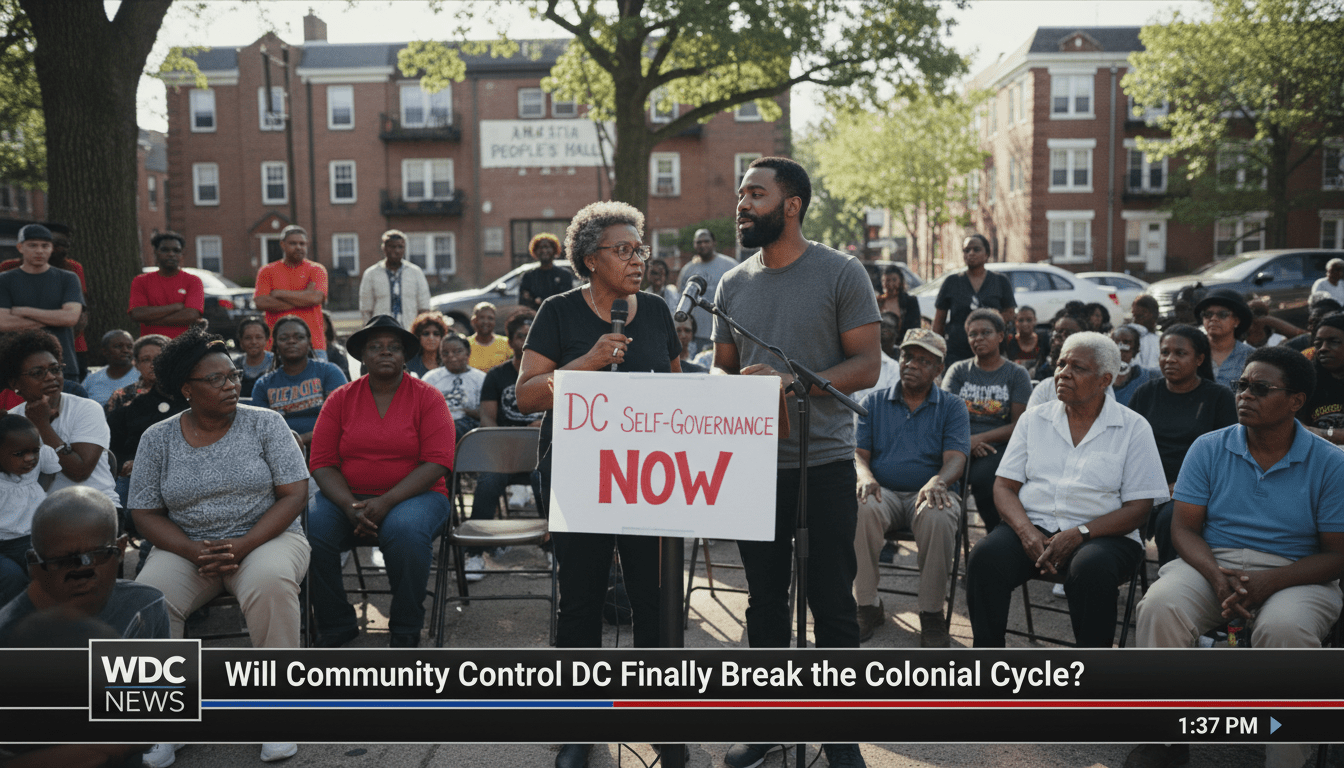
The streets of Washington, D.C. are witnessing a major shift in political energy. In March 2026, the Pan-African Community Action group, known as PACA, officially launched a new platform. This document is titled Community Control DC. It is a bold plan to return power to the Black working class (pacapower.org). Many residents feel that the current government does not represent their needs. Consequently, this platform seeks to create a new way of living and governing. It moves beyond simple voting and demands direct control over local resources (blackagendareport.com).
The launch of this platform comes at a very tense time for the District. Currently, President Trump has taken a very active role in city affairs. Local leaders are also changing, as Mayor Muriel Bowser decided not to run for another term (washingtonpost.com). For many in Southeast D.C., these changes feel like a chance to start over. They want to move away from what they call a colonial relationship with the government (blackagendareport.com). This article will explore the deep history and the modern demands behind this movement.
The Radical Roots of Community Control
The idea of community control is not a new concept in the District. In fact, it has roots that go back to the 1960s. During that time, the Student Nonviolent Coordinating Committee was very active. Marion Barry led a movement called Free DC (smithsonianmag.com, wikipedia.org). He organized high school students to protest the lack of self-rule. At that time, the city was run by people appointed by the federal government. Residents had almost no say in how their own neighborhoods were managed (wikipedia.org).
Another major influence was the Black Panther Party. In 1969, they began calling for community control over police (blackagendareport.com). They argued that the police acted like an occupying army in Black neighborhoods. To fix this, they proposed a board of citizens to oversee the police department. This board would be chosen randomly from the community. Today, PACA uses these same ideas to build their current platform (pacapower.org). They believe that the notion of freedom must include the power to police one’s own community.
Stokely Carmichael, who later took the name Kwame Ture, also played a role. He helped launch the D.C. Black United Front in 1968 (blackagendareport.com). His goal was to take control of economic institutions in Black areas. He wanted Black people to own the stores and the land where they lived. This era made D.C. a center for Black Power. The current struggle for Community Control DC is a direct continuation of that work (wikipedia.org, blackallianceforpeace.com).
Visualizing the Policing Gap (2024-2025)
Source: ACLU D.C. & PACA Research (acludc.org, pacapower.org)
The Birth of PACA and the Death of Alonzo Smith
The modern movement for community control gained new life in 2015. In November of that year, a Black educator named Alonzo Smith died (blackagendareport.com). He was only 27 years old. The incident happened at an apartment complex in Southeast D.C. Special Police Officers were involved in his death. These are private guards who have the power to make arrests (blackagendareport.com). Many people were outraged because these guards often have less training than city police. Furthermore, they are not as accountable to the public (blackagendareport.com).
In response to this tragedy, activists formed Pan-African Community Action. They started a campaign called Justice for Zo. This campaign did not just ask for better training for guards. Instead, it asked why private companies had the power to police Black people at all (pacapower.org). The group argued that the entire system was broken. They claimed that traditional reforms would never work within a colonial structure. This realization led them to develop the Community Control DC platform (blackagendareport.com).
PACA spent years organizing in Wards 7 and 8. These areas are east of the Anacostia River. They are often ignored by the city government until it is time for new development. Residents in these wards face high rates of poverty and health issues (cbsnews.com). PACA began to hold neighborhood meetings to listen to these residents. They wanted to know what people actually needed to feel safe and healthy. This community input became the foundation for their 12 demands (pacapower.org).
The 2025 Federal Takeover and Home Rule
In August 2025, a major event shook the District. President Trump invoked Section 740 of the Home Rule Act (blackagendareport.com, blackagendareport.com). He declared a public safety emergency in the city. This move allowed the federal government to take control of the Metropolitan Police Department. The immediate cause was a carjacking near Logan Circle. A staffer from the Department of Government Efficiency was the victim (wusa9.com). The federal government claimed that D.C. laws were too weak to stop crime.
This takeover lasted for 30 days. During that time, 800 National Guard troops patrolled the streets (blackagendareport.com, blackagendareport.com). Many residents felt like they were living in an occupied territory. PACA and other groups argued that this was a clear example of anti-Black politics in action. They said the federal government was using the city as a playground for its own political goals (blackagendareport.com). This event proved to many that D.C.’s Home Rule was not real power.
The Home Rule Act of 1973 was supposed to give D.C. residents self-governance. It allowed them to elect a Mayor and a Council for the first time in a century (wikipedia.org). However, the law still gives Congress the final word on all local laws. Also, the President can take over the police whenever he deems it necessary (wikipedia.org). Activists believe that the sharing of power under Home Rule is a sham. They want a system where the federal government cannot interfere with local decisions (blackagendareport.com, blackallianceforpeace.com).
The Racial Wealth Gap in D.C. (2026)
Black families in D.C. hold less than 10% of the wealth that white families hold. This gap has persisted despite decades of economic growth in the city center.
The 12 Demands of the People
The Community Control DC platform is built on 12 specific pillars. These pillars are designed to dismantle current power structures. One major demand is for total community control over policing (pacapower.org). Instead of the Mayor appointing a chief, the community would decide how safety is managed. They also want to end all military-style surveillance in Black neighborhoods. This includes things like facial recognition and shot-detection technology (pacapower.org).
Another key pillar is the control of land and resources. The platform calls for the creation of land trusts. In this system, the community owns the land collectively. This would prevent developers from pushing long-time residents out through gentrification (democracycollaborative.org, pacapower.org). They also demand free and accessible public transit for all residents. This would make it easier for people in Southeast D.C. to reach jobs and services across the city (pacapower.org).
Education and health are also major parts of the plan. PACA wants a community-controlled, Afrocentric education system. This system would teach Black history and culture from a young age (pacapower.org). For health, they want community-governed clinics. These clinics would focus on the specific needs of Black residents. They believe that health care should be a human right and not a way to make a profit (blackallianceforpeace.com, pacapower.org). Each of these demands aims to build a self-sufficient community.
Survival Programs and the Wellness Front
PACA does not only talk about the future. They are also taking action today. In February 2026, they launched the People’s Pan-African Wellness Front (pacapower.org). This is what they call a survival program. It is modeled after the Black Panther Party’s free clinics from the 1970s. The goal is to provide basic medical care to people in Wards 7 and 8. Every fourth Sunday, volunteers provide things like blood pressure checks and glucose tests (pacapower.org).
This program is independent of the city government. It does not take money from the state. Instead, it relies on donations and volunteer doctors and nurses. Organizers say this is important for building trust. Many Black residents are wary of the mainstream medical system. By providing care directly, PACA is showing that the community can take care of its own (blackagendareport.com). They see these programs as a way to practice self-governance right now.
The Wellness Front is also a place for political education. While people wait for medical help, they can learn about the Community Control DC platform. Organizers use this time to talk about the 12 demands. They explain how the current system fails to provide adequate health care. Then, they show how a community-controlled system would be different. This approach combines meeting immediate needs with long-term political goals (pacapower.org).
Poverty Divide: Ward 3 vs Ward 8
Ward 3: 4%
Ward 8: 41%
Child poverty rates reveal the deep geographic inequality in the District of Columbia. (urban.org, pacapower.org)
Building Power Through Neighborhood Assemblies
The heart of the “Community Control DC” plan is the Neighborhood Assembly. PACA proposes that residents should meet in open gatherings. These assemblies would be the place where decisions are made. People would talk about local problems and vote on solutions (pacapower.org). This is very different from the current system. Right now, residents can only give advice to the City Council. The Council is free to ignore that advice (blackagendareport.com, sunlightfoundation.com).
Under the new plan, the votes in these assemblies would be binding. This means the government would be legally required to follow the community’s decision. This concept is called Participatory Budgeting. It allows residents to decide exactly how tax money is spent in their own wards (democracycollaborative.org). They could choose to fund new schools or better parks instead of more police. This gives people real power over their daily lives (youtube.com).
Delegates from these assemblies would form Community Councils. These councils would handle the day-to-day work of running the neighborhood. However, they would always remain accountable to the larger assembly. This structure is meant to prevent a small group of leaders from taking all the power. It ensures that the Black working class stays in charge of the movement. PACA believes this is the only way to achieve true self-determination (blackallianceforpeace.com, pacapower.org).
The 2026 Mayoral Vacancy and the Future
Washington, D.C. is currently at a major political crossroads. In November 2025, Mayor Muriel Bowser announced she would not run again. This has created a rare opening for a new leader (washingtonpost.com). Many candidates are now trying to win the support of Black voters. They are being forced to answer questions about the Community Control DC platform. People want to know if these candidates will support giving binding authority to neighborhood assemblies (blackagendareport.com).
Candidates like Janice Lewis George and Kenyon McDuffie are already facing pressure. They must navigate a city that is angry about federal overreach. At the same time, they must address the deep wealth gap in the District (washingtonpost.com). The 2026 election will be a test for the movement. If candidates adopt these radical ideas, it could change the city forever. If they do not, PACA says the people will continue to organize outside of the electoral system (blackagendareport.com, pacapower.org).
The launch of Community Control DC is more than just a list of demands. It is a new vision for the nation’s capital. It challenges the idea that D.C. must always be a federal colony. Instead, it offers a future where the Black working class has the final say (blackagendareport.com). Whether through the ballot box or through survival programs, the struggle for self-determination continues. The history of the District shows that when the people organize, they can change the world (blackallianceforpeace.com, apnews.com).
About the Author
Darius Spearman is a professor of Black Studies at San Diego City College, where he has been teaching for over 20 years. He is the founder of African Elements, a media platform dedicated to providing educational resources on the history and culture of the African diaspora. Through his work, Spearman aims to empower and educate by bringing historical context to contemporary issues affecting the Black community.
