
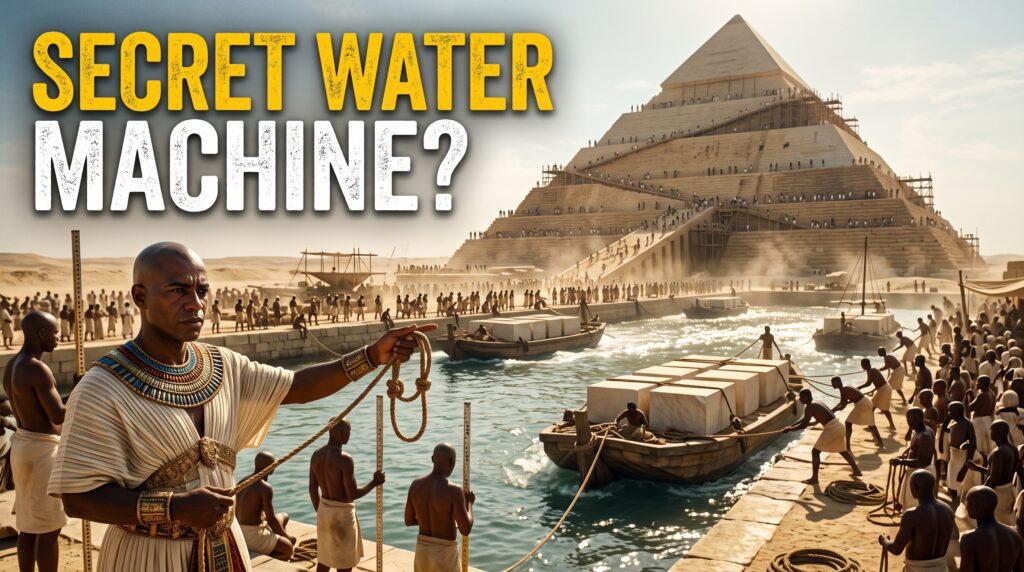
Beyond the Pharaohs: 5 Counter-Intuitive Truths About Ancient Nile Engineering, Culture, and Power
How did ancient societies along the Nile manipulate river hydrology and maintain an unbroken cultural identity across thousands of years of extreme environmental fluctuations and political upheaval? For generations, popular history has framed the Nile Valley through a rigid lens dominated by the monumental tombs of Egyptian pharaohs and dramatic tales of foreign conquests. However, modern archaeological, hydrological, and epigraphic research across Egypt and Nubia reveals a far more complex and resilient human narrative. By examining the physical evidence left behind in village settlements, river engineering projects, ceramic shards, and provincial fortresses, scholars have uncovered counter-intuitive truths that dismantle long-held historical myths. Distilling key insights from multi-disciplinary research, this article explores five transformative realities of Nilotic engineering, population continuity, domestic culture, and imperial governance.
1. The First Hydraulic Engineers: From Amenemhet’s Dam to the Saqiya Breakthrough
Human survival along the Nile has always required active management of the river’s unpredictable cycles. Extreme variations in annual discharge brought either catastrophic overflooding or devastating drought, threatening societies that relied on a single annual crop following the flood (Benedick, 1979, p. 121).
“When the Nile overflows, the country is converted into a sea, and nothing appears but the cities, which look like islands in the Aegean.” (Benedick, 1979, p. 121)
To mitigate these hydrological hazards, Pharaoh Amenemhet of the XIIth Dynasty (20th Century BCE) engineered the earliest recorded dam and canal diversion project. By diverting excess floodwaters into the Fayoum depression southwest of Cairo, Amenemhet created a massive artificial reservoir that functioned simultaneously as a flood control mechanism and a strategic water reserve for release during drought years (Benedick, 1979, p. 121).
While early basin irrigation and traditional lever-operated devices like the shaduf allowed farmers to lift water from the river channel, they were severely constrained by environmental shifts. During the last millennium BCE, Nile flood levels dropped significantly, widening the vertical gap between the river’s surface and the fertile bank top (Adams, 1967, p. 10; Benedick, 1979, pp. 121–122). The manual shaduf possessed a maximum vertical lift barrier of only 8 to 10 meters, requiring three labor-intensive units worked in exhausting human sequence to move water up high banks.
This ecological constraint was overcome during the Ptolemaic, Roman, and Meroitic eras through a crucial technological breakthrough: the introduction of the saqiya, an animal-geared water-wheel (Adams, 1967, pp. 12, 19–20). Driven by oxen treading dusty circuits above the bank, the saqiya utilized a continuous chain of pottery buckets (qadus) lowered into deep vertical shafts sunk directly to the river’s low-water line. Bypassing human muscle limits and operating independently of flood fluctuations, the saqiya made multi-cropping and continuous year-round irrigation possible. This hydraulic revolution sparked an unprecedented agricultural expansion, enabling the extensive re-occupation of Lower Nubia after nearly a millennium of fallow abandonment (Adams, 1967, pp. 12, 19–20).
2. Debunking the ‘Multiple-Migration’ Myth: Proof of a Single Nubian Population
Early 20th-century archaeologists, including George A. Reisner, Grafton Elliot Smith, and Douglas Derry, posited that Nubian cultural history was defined by successive waves of invading foreign races (Adams, 1967, pp. 15–16; Adams, 1970, p. 270). They assigned distinct racial designations to each cultural phase—labeling them A-Group, B-Group, C-Group, and X-Group—based largely on subjective, non-statistical morphological field impressions of excavated skulls (Adams, 1967, pp. 15–16; Adams, 1970, p. 270). These pioneer scholars mistook socio-economic variance and internal cultural shifts for complete biological population replacements.
Modern scientific re-evaluations have thoroughly dismantled this racial migration model:
- Biological Continuity: Rigorous statistical analyses of cranial series by Mukherjee, Rao, and Trevor, alongside sensitive dental trait studies by Greene, proved that post-pharaonic and prehistoric Nubian populations belong to a single, continuous biological lineage (Adams, 1967, p. 16; Adams, 1970, p. 270; Greene, 1966).
- Dissolution of the “B-Group”: Re-appraisals of the archaeological record demonstrated that the “B-Group” was never an invading ethnic group or distinct culture, but simply represented the underprivileged socio-economic stratum of the A-Group culture (Adams, 1967, p. 8; Adams, 1970, p. 272).
- Local Evolution: Rather than external biological replacements, cultural shifts were driven by internal socio-economic evolution, local technological innovation, and trade diffusion from neighboring Egypt (Adams, 1967, p. 18; Adams, 1970, p. 271).
Replacing 19th-century racial determinism with evidence of local biological evolution and cultural diffusion fundamentally alters our understanding of African history. It demonstrates that indigenous Nilotic populations maintained an enduring, unbroken presence while selectively absorbing external ideas.
3. Unbroken Clay: Hand-Made Pottery as the Ultimate Thread of Cultural Memory
The dynamic interaction between local African traditions and foreign influence along the Nile is distinctly reflected in ceramic artifacts. Throughout periods of intense Egyptian political dominance—such as the New Kingdom colonization and the peak Meroitic era—wheel-made utility vessels and fine decorated wares were mass-produced in centralized state workshops or imported in bulk (Adams, 1967, pp. 24–26). However, because wheel-made ceramic production was structurally tied to centralized imperial administration and state trade networks, it collapsed completely whenever state infrastructure failed or foreign overlords withdrew (Adams, 1967, pp. 24–26; Adams, 1970, p. 275).
In stark contrast stood the persistent, indigenous African hand-made pottery tradition. Characterized by spherical hand-molded bodies, compacted red surfaces burnished with haematite, and delicate incised or rocker-stamped geometric decorations, this craft persisted from Neolithic times (Esh Shaheinab) through the A-Group, C-Group, Meroitic, Late Christian, and into the modern era (Adams, 1967, pp. 24–26).
This hand-made tradition survived for five millennia because of its decentralized, domestic organization. Maintained continuously by village women molding clay within local households, the craft was entirely decentralized and independent of state authority. Immune to dynastic collapses and political upheavals, domestic ceramic practice served as a permanent cultural anchor and an unbroken thread of African cultural memory across thousands of years (Adams, 1967, pp. 24–26; Adams, 1970, p. 275).
4. A Tale of Two Provinces: Sacred Royal Despotism vs. Secular Frontier Wealth
During its final centuries (c. 100–350 CE), the Meroitic Empire comprised starkly contrasting political and social architectures between its southern heartland and its northern frontier (Adams, 1974, pp. 41–49).
The southern provinces around the capital city of Meroë and Napata operated as a classic sacred despotism (Adams, 1974, pp. 43–46). The state was governed by god-kings closely associated with official state cults dedicated to Amon and the indigenous lion-god Apedemak. Power and wealth were tightly concentrated within a divine royal clique, reflected in monumental stone state temples, sprawling brick palaces, and lavish royal pyramid fields containing sacrificed retainers and animals. Conversely, the agrarian peasant class left almost no material wealth or marked cemeteries, testifying to an unrepresented, impoverished underclass (Adams, 1974, pp. 43–46).
In contrast, the northern frontier province in Lower Nubia functioned as a secular, prosperous society administered by local noble families (Adams, 1974, pp. 46–49). Lower Nubia completely lacked royal pyramid burials and monumental royal state temples (Adams, 1974, pp. 46–48). Instead, state authority was embodied by massive stone and brick fortresses perched above the river—such as Qasr Ibrim, Gebel Adda, and Faras—which projected feudal military strength rather than divine monarchy (Adams, 1974, pp. 46–49).
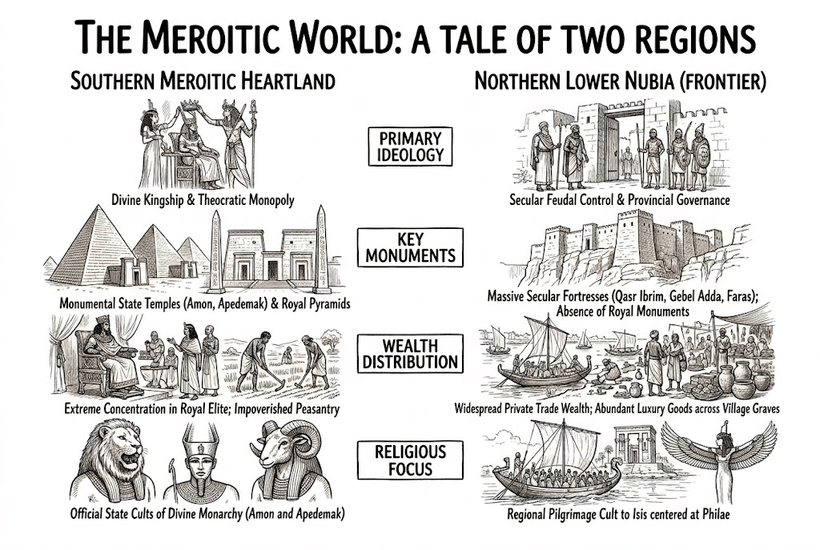
Lower Nubian governance was managed by local dynasties whose authority rested on fortified citadels and private trade networks along the Roman border (Adams, 1974, pp. 47–49). Peasant dwellings and non-royal village cemeteries across Lower Nubia contain an abundance of imported luxury items—including fine bronzes, Roman glass, faience, and decorated ceramics—illustrating that the average frontier citizen enjoyed a substantially higher material standard of living than rural peasants in the southern heartland (Adams, 1974, pp. 48–49).
5. Cracking the Code: The Mechanics and Elusiveness of Meroitic Script
The decipherment of written Meroitic stands as a landmark achievement in Nilotic epigraphy, pioneered by F. Ll. Griffith in the early 20th century (Griffith, 1916, pp. 111–114). By comparing Meroitic hieroglyphic texts with their cursive counterparts and matching foreign proper names—such as Rome (Arame), Isis (Ashi or Wêshi), and the royal name Akinizaz—Griffith established phonetic sound values across the Meroitic alphabet (Griffith, 1916, pp. 113–114).
Griffith identified several key structural linguistic rules governing Meroitic writing:
- Avoidance of Hiatus: Meroitic orthography strictly prohibited placing vowel signs in direct succession. When a phonetic hiatus occurred—such as in Egyptian names like Pa-êsi—scribes inserted the consonantal glide y to separate the vowels, rendering it Pa-yeshi (Griffith, 1916, pp. 117–118).
- Syllabic and Vowel Notation: Specific consonantal characters carried inherent terminal vowels or functioned syllabically. Crucially, the sign e (written as / or S) fulfilled a dual function: it acted both as an unvocalized consonant marker and as a specific sign indicating the complete absence of an explicit vowel (Griffith, 1916, pp. 118–120).
Despite these epigraphic breakthroughs, Meroitic remains one of ancient history’s most compelling frontiers. While epigraphers can accurately read Meroitic inscriptions phonetically, the underlying language itself remains only partially understood because it possesses no proven genetic relationships to known language families (Griffith, 1916, p. 123; Adams, 1970, p. 271).
Conclusion: Engineering, Memory, and Resilience Along the Nile
The five-thousand-year historical trajectory of ancient Nile civilizations demonstrates how human societies successfully adapt to marginal desert environments. Through civil engineering breakthroughs—from Amenemhet’s Middle Kingdom reservoir to the widespread deployment of animal-geared saqiya water-wheels—Nilotic populations systematically mastered river discharge variations to secure their agricultural livelihoods (Adams, 1967, p. 12; Benedick, 1979, p. 121). Concurrently, local communities preserved their core cultural identity through domestic art forms like hand-made red-burnished ceramics, maintaining an unbroken thread of memory even as overarching state structures shifted between sacred despotisms and secular frontier polities (Adams, 1967, pp. 24–26; Adams, 1974, pp. 46–49).
As modern societies confront changing river systems, growing populations, and climate uncertainty, the multi-millennial human record along the Nile poses a timely question: What can modern river managers and regional planners learn from five thousand years of continuous technological adaptation, social resilience, and ecological balance along the Nile?
References
- Adams, W.Y. (1967) ‘Continuity and Change in Nubian Cultural History’, Sudan Notes and Records, 48, pp. 1–32.
- Adams, W.Y. (1970) ‘A Re-Appraisal of Nubian Culture History’, Orientalia, 39(2), pp. 269–277.
- Adams, W.Y. (1974) ‘Sacred and Secular Polities in Ancient Nubia’, World Archaeology, 6(1), pp. 39–51.
- Benedick, R.E. (1979) ‘The High Dam and the Transformation of the Nile’, Middle East Journal, 33(2), pp. 119–144.
- Griffith, F.Ll. (1916) ‘Meroitic Studies II’, The Journal of Egyptian Archaeology, 3(2/3), pp. 111–124.
