

How the UNESCO Reparatory Justice Toolkit Changes History
By Darius Spearman (africanelements)
Support African Elements at patreon.com/africanelements and hear recent news in a single playlist. Additionally, you can gain early access to ad-free video content.
The Dawn of a Global Implementation Phase
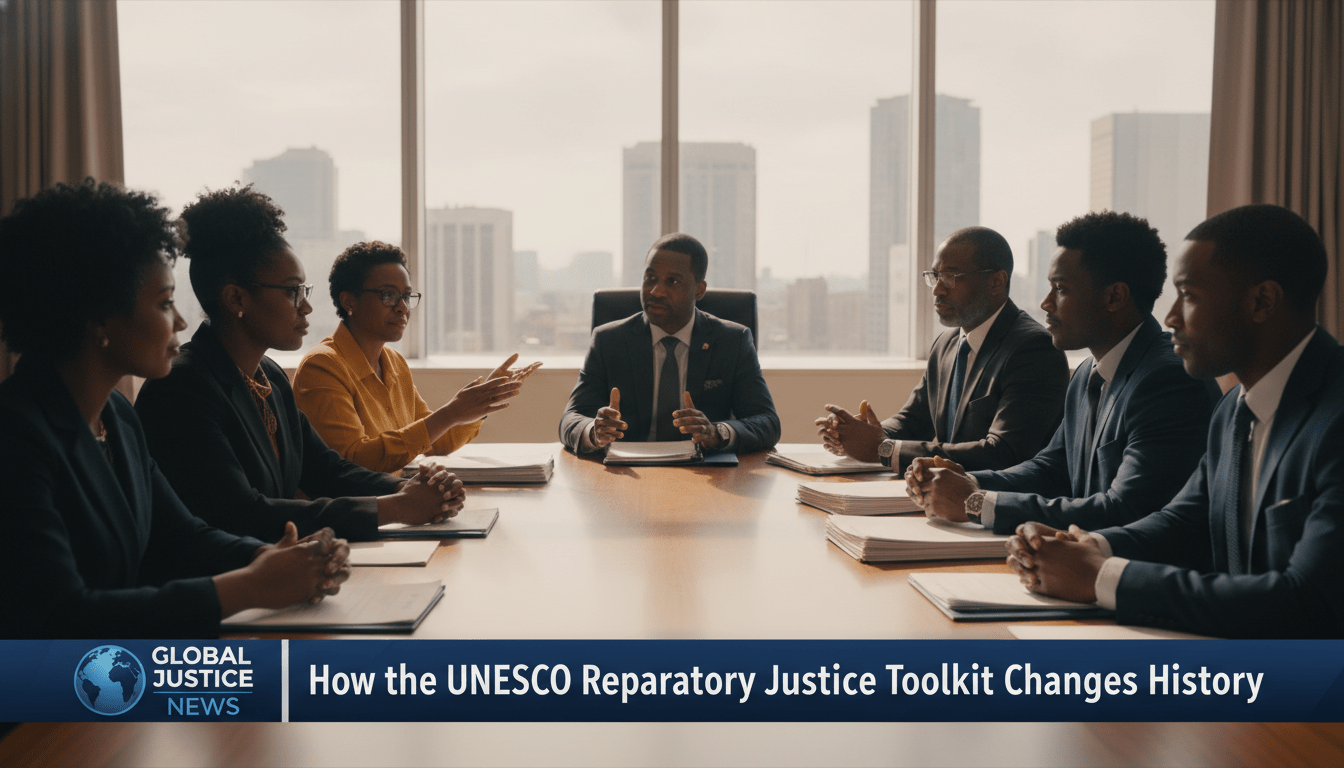
On April 9, 2026, the global conversation surrounding racial equity reached a historic turning point. UNESCO officially launched the “Reparatory Justice Toolkit” during the Third UNESCO Dialogue for Reparatory Justice held in The Hague. This launch represents a massive shift in how international bodies address the enduring harms of the transatlantic slave trade. For decades, international organizations focused mostly on reflection, apologies, and acknowledging historical wrongs. Now, the international community is transitioning directly to an active implementation phase. The newly released toolkit provides tangible frameworks and policy templates for nations. It offers practical tools designed to dismantle the structural inequalities left behind by centuries of chattel slavery.
Understanding this transition requires recognizing the vital difference between standard reparations and reparatory justice. Standard reparations typically refer to specific legal or financial remedies for a past wrong. In contrast, reparatory justice represents a broader, multidimensional framework (ohchr.org). It focuses intensely on systemic healing rather than simple financial transactions. The framework addresses the emotional, physical, and mental harms inflicted by European imperialism. Reparatory justice aims to restore the human identity and social history of marginalized groups. It establishes a plurality of measures, ensuring that modern societies address the root causes of systemic racism through permanent institutional change.
Moving Beyond Symbolic Apologies
The release of the toolkit arrived shortly after a groundbreaking decision at the United Nations. On March 25, 2026, the United Nations General Assembly officially adopted Resolution A/80/L.48. This monumental resolution officially declared the transatlantic trafficking of enslaved Africans the gravest crime against humanity (passblue.com). The resolution provided the vital legal mandate necessary for member states to adopt the policy templates outlined in the UNESCO toolkit. The dialogues in The Hague capitalized on this momentum by moving discussions entirely beyond symbolic apologies. Organizers heavily prioritized structural redesign. This approach demands the active dismantling of colonial-era hierarchies within modern institutions (unesco.org).
Rabin Baldewsingh played a crucial role in bringing these dialogues to life. As the Dutch National Coordinator against Discrimination and Racism, he continuously pressures European governments to deliver tangible justice. Baldewsingh heavily criticizes superficial attempts at reconciliation. He previously labeled the Dutch government awareness fund as an inadequate response to the horrific legacy of slavery (jurist.org). His advocacy bridges the gap between former colonial powers and descendant communities. While European nations slowly adapt, local efforts in the United States show varied progress. California previously established the first-in-a-nation task force to study reparations, signaling a willingness to confront historical debts on a local level.
Calculating the Staggering Financial Debt
Translating the horrific violence of chattel slavery into an economic figure is an incredibly complex task. However, economists from the Brattle Group recently published a comprehensive report calculating these massive damages. Using a strict economic framework, they estimated the total reparations owed for transatlantic chattel slavery sits firmly between $100 trillion and $131 trillion (brattle.com). To reach this staggering number, researchers calculated the value of 802 million years of uncompensated life stolen from approximately 19 million Africans and their descendants. The total figure splits into specific categories of harm. Damages incurred directly during the period of enslavement account for $77 trillion to $108 trillion, while post-abolition harms make up the remaining $23 trillion (brattle.com).
The unique legal structure of chattel slavery made this extreme wealth extraction possible. Under the chattel system, an enslaved person held the legal status of personal property or a movable good. This horrifying distinction meant enslaved individuals were fully alienable. Enslavers could sell them, trade them, or use them as collateral for financial loans (wikipedia.org). Furthermore, chattel slavery was strictly hereditary. This law ensured that the children of enslaved women were born directly into a permanent property status. The legal designation allowed European powers to industrialize human trafficking on an unprecedented global scale.
Economic Debt of Chattel Slavery (Brattle Group)
Harms During Enslavement ($77 – $108 Trillion)
Post-Abolition Harms ($23 Trillion)
Early Pioneers of the Reparations Movement
The push for reparatory justice did not originate in the twenty-first century. Enslaved people and their descendants initiated legal and political battles for compensation centuries ago. Belinda Sutton stands as one of the earliest success stories in this long fight. In 1783, this formerly enslaved woman living in Massachusetts petitioned the state legislature. She demanded a pension funded by the estate of her former enslaver and remarkably won her case (1619education.org). While many enslaved individuals formed specific survival strategies to navigate daily violence, others directly challenged the legal system.
Henrietta Wood provides another extraordinary historical example of resilience and legal resistance. After receiving official freedom through manumission in 1848, a brutal kidnapper forced her back into slavery. Following the Civil War, she tracked down her abductor and sued him for damages. In 1878, a jury awarded her $2,500, marking the largest known award for an individual slavery-related lawsuit of that era (utexas.edu). Decades later, Callie House elevated the movement to a national scale. During the 1890s, House organized hundreds of thousands of African Americans to aggressively lobby the United States government for pensions based on their unpaid labor (vcu.edu).
The Enduring Legacy of Jim Crow Laws
The formal abolition of slavery did not secure freedom or equality for African Americans. Almost immediately, the United States implemented the brutal Jim Crow system. This widespread racial caste system enforced strict segregation and violent disenfranchisement from the late nineteenth century until 1965 (wikipedia.org). Jim Crow laws mandated the infamous separate but equal doctrine. In reality, the system relegated African Americans to severely inferior facilities and permanent second-class citizenship. The system dictated every facet of daily existence, from segregated public schools and hospitals to separate Bibles used in courtrooms.
The devastating impact of Jim Crow and continuous systemic racism remains visible in modern society. Modern health disparities provide glaring evidence of this enduring structural violence. Today, Black women are three to four times more likely to die from pregnancy-related complications than white women (aphapublications.org). Medical researchers directly link this maternal mortality crisis to the toxic stress generated by historical and ongoing systemic racism. Similarly, the Black infant mortality rate stands 2.3 times higher than the white infant mortality rate (ebsco.com). The horrifying history of medical experimentation on enslaved people created deep institutional biases that still infect the medical industry today.
U.S. Health Disparities (Black vs. White)
A Blueprint Designed in the Caribbean
The modern framework for reparatory justice heavily relies on leadership from the Caribbean. The Caribbean Community, widely known as CARICOM, provided a crucial template for the global movement. In 2014, this coalition of 15 Caribbean nations released the Ten-Point Plan for Reparatory Justice (wiredja.com). Because these nations share deeply painful histories of European colonization and plantation slavery, they recognized the need for a unified approach. CARICOM was the first regional group of sovereign governments to collectively demand structural reparations from former colonial powers like the United Kingdom, France, and the Netherlands.
The CARICOM plan completely reframes the concept of reparations. It shifts the dialogue away from basic financial handouts and moves toward comprehensive developmental justice. The ten specific actions demand a full formal apology, absolute debt cancellation, and extensive psychological rehabilitation (issafrica.org). The group highlights that European slavery caused lingering public health crises and high illiteracy rates across the region. The UNESCO toolkit serves as the direct implementation phase for these concepts. It also fulfills the goals established by the Durban Declaration during the 2001 UN World Conference Against Racism in South Africa (martinplaut.com).
Inside the New Policy Templates
The Global Reparatory Justice Toolkit provides communities with actionable methods to dismantle systemic inequality. It features comprehensive truth-telling facilitation guides. These guides help local governments and educational institutions host difficult dialogues and uncover hidden histories of enslavement. The resource also provides highly specific policy templates. Local municipalities can use these templates to draft immediate legislation for reparations commissions, specialized housing grant programs, and economic redistribution models (unesco.org). By offering these concrete resources, UNESCO ensures that nations have the exact tools needed to enact structural redesign.
A massive component of the toolkit involves storytelling and narrative-shifting tools. These resources empower educators to counter deep-rooted racial stereotypes and correct the historical record. Real structural redesign requires altering the institutional DNA of education and finance. Educational systems must adopt decolonized curriculums that center African and Indigenous knowledge instead of relying on Eurocentric narratives (ed.ac.uk). The inspiring life of Anna Julia Cooper proves that Black scholars have championed these intellectual changes for over a century. The toolkit also includes detailed evaluation models. These models hold institutions accountable by measuring the actual impact of their diversity efforts over time.
Global Resistance and the United States
While international bodies continue to embrace reparatory justice, fierce opposition persists on the global stage. The United States government has largely opposed the recent mandates established by the United Nations. On March 25, 2026, the United States served as one of only three nations to vote against Resolution A/80/L.48. Only Israel and Argentina joined the United States in opposing the declaration of the slave trade as the gravest crime against humanity (passblue.com). Under the current administration of President Donald Trump, the federal government displays intense resistance toward international racial justice initiatives.
The United States State Department heavily criticized the resolution. Under Secretary Marco Rubio in 2026, the department argued strongly against assuming retroactive legal liabilities for historical systems that were not technically illegal at the time. Delegates expressed deep concern that accepting peremptory norms could expose the federal government to enforceable legal claims (brattle.com). Despite this federal blockade, local municipalities refuse to abandon the movement. Representatives from Boston actively participated in the UNESCO dialogues in The Hague, signaling strong local interest in the new policy templates (amsterdamnews.com). The complex history of African American labor fighting against economic exploitation continues to inspire these modern local battles.
The Principle of Restoration and Healing
The ultimate goal of the UNESCO toolkit relies on a fundamental principle of international law known as restitutio in integrum. This Latin phrase translates to restoration to the original condition. The principle demands that a victim must be placed in the exact position they would have occupied if the wrongful act had never occurred (ohchr.org). While literal restoration remains physically impossible, the law dictates that monetary compensation must equal the value of the original condition. Advocates use this legal standard to argue that real justice must account for centuries of lost wealth, stolen resources, and intergenerational trauma.
The economic devastation inflicted upon the African continent remains staggering. Detailed economic research reveals that the average African country would possess a 72 percent higher per capita gross domestic product today if the transatlantic slave trade had never existed (osu.edu). Furthermore, in specific regions, the legacy of the slave trade explains up to 99 percent of the modern income gap between Africa and other developing regions around the world (codringtonproject.org).
The Cost of Stolen Capital
If the transatlantic slave trade had never occurred, researchers estimate the average African country would possess a significantly higher per capita gross domestic product (GDP) today.
In certain regions, historical slavery explains up to 99% of the modern income gap compared to other developing areas.
The new UNESCO toolkit recognizes these massive statistical disparities. By shifting from reflection to implementation, the international community takes a monumental step toward genuine restoration. Reparatory justice is no longer a controversial debate; it stands as a standard requirement for human rights and global healing.
About the Author
Darius Spearman is a professor of Black Studies at San Diego City College, where he has been teaching for over 20 years. He is the founder of African Elements, a media platform dedicated to providing educational resources on the history and culture of the African diaspora. Through his work, Spearman aims to empower and educate by bringing historical context to contemporary issues affecting the Black community.
