

Why the Liberia Jobs Protest Has Deep Historical Roots
By Darius Spearman (africanelements)
Support African Elements at patreon.com/africanelements and hear recent news in a single playlist. Additionally, you can gain early access to ad-free video content.
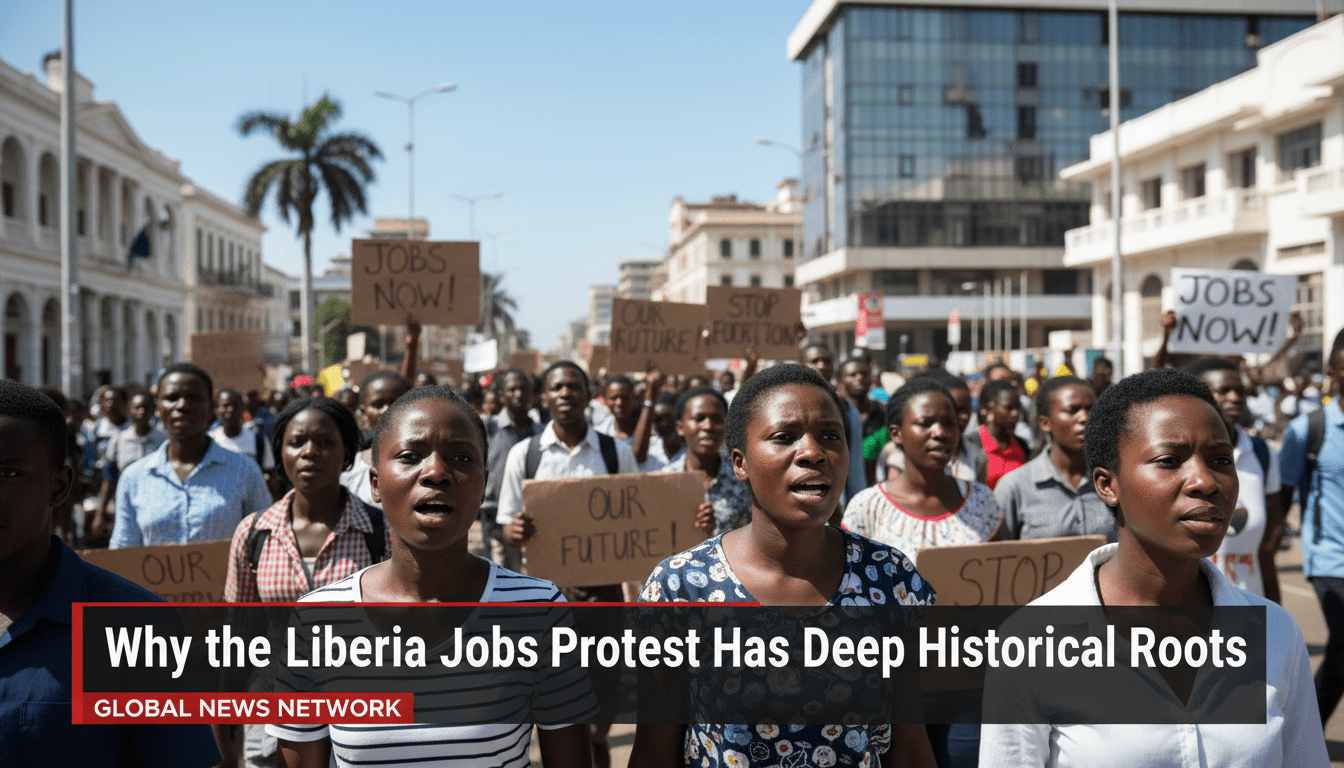
On April 14, 2026, the Student Unification Party launched a massive demonstration in Monrovia. They called it the “March for Jobs and Justice.” Thousands of angry citizens flooded the city streets. The protest directly challenged the administration of President Joseph Boakai. Protesters demanded immediate government accountability for mass unemployment. They also demanded justice for abandoned student activists. This specific date was chosen very carefully. It marks the forty-seventh anniversary of the 1979 Rice Riots. The 1979 protests fundamentally altered Liberian history. Today, young activists are echoing that exact same revolutionary spirit.
The political atmosphere in Liberia remains incredibly tense. The ruling Unity Party faces massive criticism from the student vanguard. Activists accuse the government of presiding over a broken economy. They claim the current leadership prioritizes elite interests over basic human needs. This deep frustration is not new to the nation. It reflects decades of systemic inequality and political marginalization. To fully grasp the weight of the 2026 demonstrations, one must examine the past. The historical struggles of the Liberian people provide essential context. History repeats itself in powerful and often explosive ways.
The Legacy of the 1979 Rice Riots
April 14 holds profound meaning for the Liberian people. On this day in 1979, citizens protested a massive hike in rice prices. Rice serves as the primary staple food in Liberia. It provides eighty-five percent of the average daily caloric intake. The government planned to raise the price of a one-hundred-pound bag. The proposed increase was from twenty-two dollars to twenty-six dollars. This hike was absolutely devastating for the common people. At the time, the average worker earned roughly one dollar a day. The price increase threatened the survival of the indigenous majority (wikipedia.org).
The reaction from the state authorities was incredibly violent. The Progressive Alliance of Liberia led the 1979 demonstrations. Student militants from the University of Liberia joined the massive crowds. Over twelve thousand people marched for their basic right to eat. They gathered in the streets to denounce the ruling elite. The military intervened with deadly and disproportionate force. State actors killed at least forty people during the clashes. They also injured over five hundred unarmed protesters. This brutal crackdown completely shattered the myth of national stability (pbs.org, yale.edu).
The aftermath of the riots changed the country forever. The violence exposed the extreme greed of the ruling political class. Critics noted that President William Tolbert had personal financial interests. His family held a powerful monopoly on domestic rice production. They stood to profit massively from the proposed price increase. The riots served as the beginning of the end for civilian rule. They directly caused the 1980 military coup led by Samuel Doe. The spirit of April 14 represents ultimate resistance against state oppression (wikipedia.org).
Settler Power and Indigenous Resistance
The 1979 riots were a rebellion against a very specific system. For over a century, an elite minority ruled Liberia. These elites were called Americo-Liberians. They were descendants of free Black people from the United States. The American Colonization Society resettled them starting in 1822. This process mirrored the strict racial hierarchies of the American South. The elite minority comprised only five percent of the total population. However, they controlled the government and most of the national wealth (blackpast.org, blackpast.org).
Indigenous Africans faced severe and systemic exclusion under this regime. They were largely denied the basic right to vote. The True Whig Party maintained a strict one-party state. This monopoly on political power lasted for one hundred thirty-three years. The settler elite kept western modes of dress and southern-style architecture. They also maintained English as the official language of commerce. This created a massive cultural and economic divide. Indigenous populations were treated as second-class citizens in their own land (wikipedia.org, blackpast.org).
The eventual downfall of the True Whig Party highlighted a major political shift. Indigenous populations demanded their rightful place in society. The 1980 coup marked the first time an indigenous African ruled the republic. Samuel Doe and seventeen indigenous soldiers stormed the Executive Mansion. They ended the long reign of the Americo-Liberian elite. However, this transition did not bring lasting peace or equality. It eventually led to ethnic favoritism and severe authoritarianism. The initial promise of liberation slowly decayed into widespread violence (wikipedia.org, wikipedia.org).
A New Movement for Economic Fairness
The current administration often points to a growing national economy. Officials frequently boast about a five percent gross domestic product growth. However, student groups dismiss this figure completely. They call the growth rate a mere numerical abstraction. The national wealth is driven largely by capital-intensive mining operations. These international industries rely on heavy machinery rather than local workers. Consequently, the generated wealth never reaches the common citizen. This frustrating phenomenon is widely known as jobless growth. The country appears richer while the people continue to starve (worldbank.org).
The actual employment statistics reveal a much grimmer reality. Official unemployment numbers sit relatively low, between two and four percent. Those low numbers deliberately hide the truth about the workforce. Approximately seventy-eight percent of Liberian workers hold vulnerable or informal employment. They work incredibly hard without any social security or stable wages. Only twenty percent of the workforce has formal, wage-paying jobs. This specific figure has remained stagnant for nearly two decades. Moderate economic growth has failed to produce systemic societal change (worldbank.org, undp.org).
Poverty continues to devastate families across the entire nation. The World Bank projects extreme poverty will reach nearly thirty-six percent. Furthermore, rural poverty remains terrifyingly high at eighty-one percent. Tightening money supplies have starved the local market of necessary liquidity. This reduces the purchasing power of the few citizens who do have jobs. The gap between the political elite and the common masses continues to widen. Activists demand an end to policies that only benefit foreign investors. They seek an economy that serves the actual population (worldbank.org).
The Betrayal of a Student Activist
Economic hardship is only one part of the ongoing protest. Activists are deeply angry about perceived political betrayal. A central grievance involves Christopher Walter Sisulu Sivili. He is a prominent and outspoken student activist from the University of Liberia. In July 2022, pro-government supporters brutally attacked him in public. A militant mob chased, beat, and publicly stripped him naked. This horrific violence was captured on video and shared widely online. Sivili eventually had to flee the country to receive proper medical care (frontpageafricaonline.com).
The perpetrators belonged to a militant political splinter group. This group was known as the Coalition for Democratic Change Council of Patriots. At the time, the opposition Unity Party capitalized on this horrific attack. They made Sivili a rallying cry for their political campaigns against George Weah. They promised accountability and justice for the brutalized young man. Now, the Unity Party holds the ultimate power of the presidency. President Joseph Boakai currently leads the national government (frontpageafricaonline.com, frontpageafricaonline.com).
However, the student party claims Boakai has completely abandoned Sivili. They accuse the current administration of pure political hypocrisy. Since taking power, the government has failed to prosecute the attackers. They have also failed to provide Sivili with any financial compensation. Activists label the administration’s previous support as manipulative propaganda. They argue the current leaders simply weaponized student suffering to win an election. This perceived betrayal has ignited immense fury among the youth (frontpageafricaonline.com, frontpageafricaonline.com).
University Decay and Misplaced Priorities
The physical state of higher education heavily fuels the public anger. The University of Liberia currently lies in a state of absolute ruin. Classrooms are severely dilapidated and lack basic necessary resources. Students report a complete lack of functioning bathroom facilities on campus. There is also a major shortage of qualified university lecturers. Activists demand the immediate resignation of the current university officials. They view the campus decay as a direct reflection of national neglect (frontpageafricaonline.com, frontpageafricaonline.com).
While public schools crumble, politicians allegedly fund massive luxury projects. President Boakai faces harsh criticism for his personal spending priorities. Recent reports mention a million-dollar retirement mansion built in Lofa County. Activists claim the political elite prioritize their own comfort over education. Historically, administrations have prioritized high salaries for government officials over public infrastructure. Student groups argue the government only cares about appeasing international lenders. They neglect the basic educational and caloric needs of their own citizens (frontpageafricaonline.com, liberianinvestigator.com).
Furthermore, the government has imposed strict bans on campus politics. University authorities frequently prohibit political activities and public rallies. Students cannot wear the emblems or symbols of their political groups. Authorities claim these bans ensure a safe and quiet learning environment. However, student leaders view these bans as a vicious crackdown on free expression. They compare these repressive tactics to former military dictatorships. The ongoing fight against this repression heavily mirrors how Black workers fought for their economic survival throughout history (liberianinvestigator.com, frontpageafricaonline.com).
The Core Ideology of Massescracy
The organizers of this massive protest are well prepared and deeply organized. The Vanguard Student Unification Party has incredibly deep historical roots. The party was officially established on October 20, 1970. It holds the title of the oldest student political movement in Liberia. The founders created it to fight the one-party rule of the True Whig Party. The party operates on a powerful and unique philosophy called massescracy. This specific term means governance must actively serve the common masses (thefourthestategh.com, allafrica.com).
Adherents of this political philosophy proudly call themselves massescrats. The party views itself as a dedicated vanguard for social justice. Members believe they are the ultimate shield of the Liberian people. They use the university campus as a rigorous training ground for leadership. For them, campus politics serve as a microcosm for national issues. The group rarely runs candidates for national political office directly. Instead, they act as an independent force for strict governmental accountability (thefourthestategh.com, allafrica.com).
They actively protest against any regime that harms the poor or marginalized. Their discipline and ideological strength make them a highly formidable opponent. They emphasize direct action to protect the rights of the voiceless. These vanguard tactics are extremely similar to the organizing strategies of the Black Panther Party in the United States. Both groups recognized the urgent need to challenge corrupt state structures. Both groups demanded systemic change rather than superficial political promises (allafrica.com).
A Looming Crisis for the Current Regime
The current administration finds itself in a highly precarious political position. The shifting demographics of the country present a major, undeniable challenge. Almost seventy-five percent of the Liberian population is under thirty-five. Thousands of hopeful young people graduate from university every single year. The market simply cannot absorb these graduates into formal wage jobs. This massive youth bulge creates a highly explosive and volatile environment. Frustrated young people feel they have absolutely very little to lose (worldbank.org).
Joseph Boakai campaigned heavily on a comprehensive “Rescue Mission” for the nation. He presented a humble narrative of rising from a janitor to president. This was intended to distance him from the wealthy political elite. However, many students now view him as part of the old guard. His administration includes figures who served in multiple previous governments. Activists feel betrayed by his failure to deliver immediate economic relief. The “March for Jobs and Justice” serves as a very clear warning (liberianinvestigator.com).
Protesters are demanding a concrete roadmap for immediate national job creation. They refuse to accept ongoing corruption and nepotism in government hiring. Recent reports even allege a “sex for jobs” culture within state offices. Bribery allegations further fuel the demand for systemic and immediate justice. Activists have threatened a sustained campaign if their demands fall short. The student vanguard remains ready to escalate their political actions in the streets (analystliberiaonline.com, liberianinvestigator.com).
Seeking Genuine Independence
The story of Liberia remains deeply complicated and filled with struggle. The country was born out of a genuine desire for black freedom. However, early settlers often replicated the brutal oppression they had escaped. The pursuit of true equality remains a continuous and difficult battle. Indigenous communities fought long and hard against early settler dominance. They demanded a society that reflected their unyielding call for racial justice and inclusion (blackpast.org, wikipedia.org).
Today, the fight centers squarely on economic fairness and transparent governance. Political power has shifted hands many times since the 1980 coup. Military regimes and civilian governments have constantly come and gone. Yet, the foundational issues of severe poverty and inequality remain unsolved. The current student protests represent the latest chapter in this historical struggle. The legacy of the 1979 activists clearly lives on today in the streets of Monrovia (wikipedia.org, wikipedia.org).
The young people of Liberia are demanding fundamental systemic changes. They want a country that serves everyone instead of a select elite. True independence requires economic security and genuine access to legal justice. The government can no longer ignore the desperate cries of the youth. The “Jobs and Justice” movement aims to build a completely new future. They will continue to march until the government answers their demands.
About the Author
Darius Spearman is a professor of Black Studies at San Diego City College, where he has been teaching for over 20 years. He is the founder of African Elements, a media platform dedicated to providing educational resources on the history and culture of the African diaspora. Through his work, Spearman aims to empower and educate by bringing historical context to contemporary issues affecting the Black community.
