


/
RSS Feed
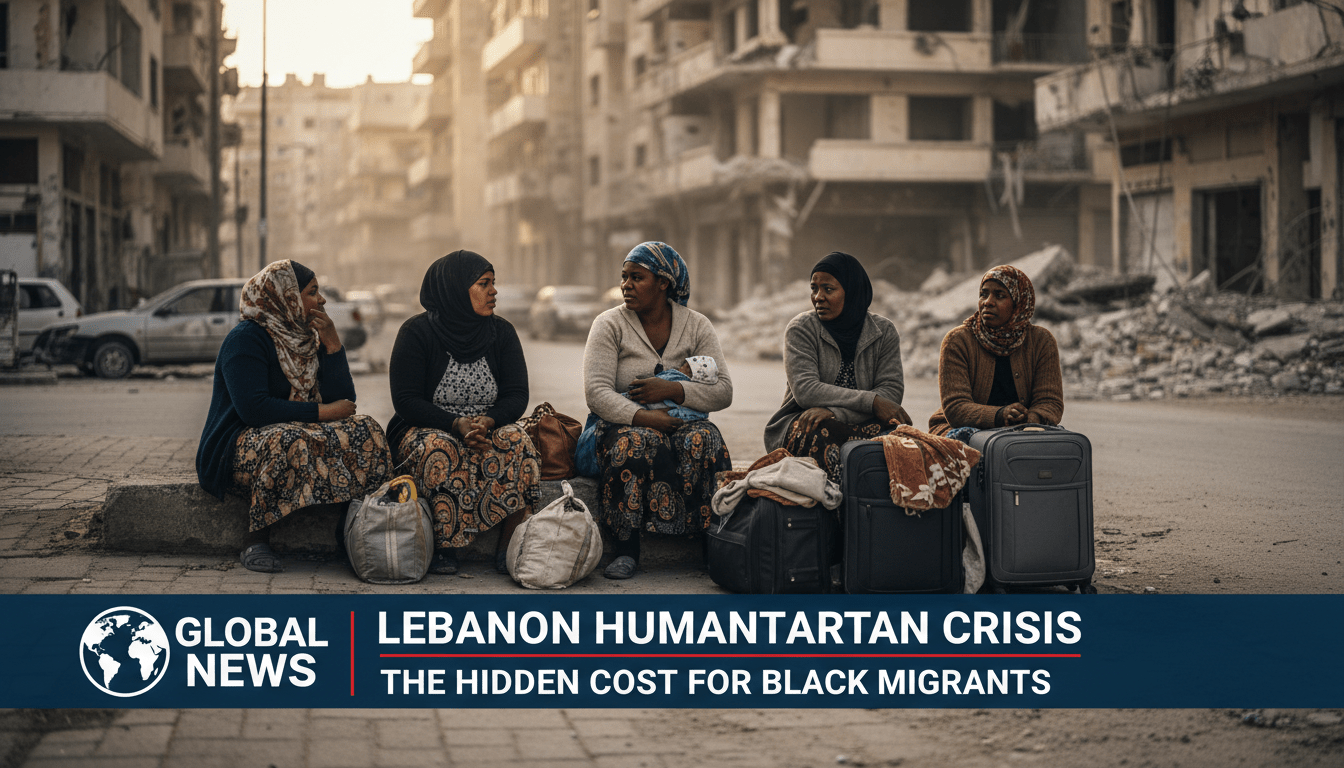
Lebanon Humanitarian Crisis: The Hidden Cost for Black Migrants
By Darius Spearman (africanelements)
Today, a ceasefire has finally taken effect in Lebanon. It offers a brief pause to a devastating conflict. An estimated 1.2 million displaced people are now attempting to return to their homes. However, many will find nothing but destroyed neighborhoods and shattered infrastructure. This massive displacement includes significant populations of African migrant workers and refugees who face a severe economic contraction in the region (unocha.org). The current crisis represents the latest chapter in a century-long saga of displacement and structural inequality. The end of the bombing is merely the start of a massive struggle. For those returning home, the reality of a severely contracted economy complicates the rebuilding process. Among the hardest hit are Black migrants who remain largely ignored by the mainstream narrative.Support African Elements at patreon.com/africanelements and hear recent news in a single playlist. Additionally, you can gain early access to ad-free video content.
A Nation Defined by Continual Displacement
Lebanon has a long history as both a refuge and a battleground. Following the 1948 Arab-Israeli War, approximately 100,000 Palestinian refugees fled across the border into Lebanon. By the 1970s, the Palestine Liberation Organization established a significant base in the country. This presence became a catalyst for the Lebanese Civil War and prompted repeated military interventions from neighboring Israel (britannica.com). In 1982, an invasion aimed at expelling the Palestine Liberation Organization led to a devastating siege of Beirut. This conflict resulted in the deaths of nearly 20,000 people. It also served as the foundational crucible for Hezbollah. The group formed to resist the occupation of Southern Lebanon. That occupation lasted until the year 2000, creating a permanent cycle of displacement for residents. This structural inequality mirrors how historical policies dictating How Post-Civil War Reconstruction Failed African Americans often leave marginalized groups struggling for generations. The 2006 war between Israel and Hezbollah displaced nearly one million people over 34 days. The current ceasefire traces its roots to United Nations Security Council Resolution 1701. This resolution called for a demilitarized zone south of the Litani River. Unfortunately, that goal remained largely unfulfilled, leading directly to the dramatic 2024 escalation (un.org). Even before this recent conflict, Lebanon hosted the highest number of refugees per capita globally. This crisis pushed the infrastructure to its absolute breaking point long before the current war.Lebanon Internal Displacement Surges
The Plight of African Migrants Under Kafala
A unique aspect of the current headlines is the severe plight of African and Asian migrant workers. Following the Lebanese Civil War, the middle class shifted from hiring local domestic help to relying heavily on foreign labor. This shift gave rise to the Kafala sponsorship system. The legal framework binds the residency of a worker entirely to a single employer. Consequently, workers are excluded from traditional labor laws. They have no legal right to a minimum wage or standardized working hours (amnesty.org). This system mirrors modern slavery and strips workers of basic legal protections. Employers often confiscate passports upon arrival. This illegal practice effectively locks the workers into the household and removes their mobility. During the 2024 conflict, numerous reports surfaced of employers fleeing bombings while locking their migrant domestic workers inside homes. Others abandoned these workers on the streets without their passports or any pay. As of 2024, approximately 176,504 migrants reside in Lebanon. The majority are women from Ethiopia, Sierra Leone, and the Philippines (walkfree.org). These migrant laborers face conditions that echo historical forms of chattel labor. The exploitation draws parallels to the history of Black labor and the journey from the cotton fields to the assembly line for economic justice. In previous crises, including the 2019 economic collapse, these workers were the first to lose their livelihoods. Yet, they remained the absolute last to receive state-led evacuation support.Active Racial Discrimination in Humanitarian Aid
The African migrant communities face a distinct racial hierarchy within the Lebanese humanitarian response. Displaced migrant workers frequently encounter explicit denial when attempting to enter public shelters. Authorities often tell these vulnerable individuals that the spaces are strictly for Lebanese nationals (doctorswithoutborders.org). Because many migrants lack current documentation due to the Kafala system, aid organizations often reject them. Employers routinely hold the passports of these workers, leaving them completely undocumented. This systemic exclusion forces many African migrants to sleep rough on the streets of downtown Beirut. They are turned away from facilities despite the obvious availability of space. Human rights activists note that migrants experienced systematic marginalization from healthcare long before the war began. However, this trend has shifted from passive neglect to active exclusion during the current crisis (amnesty.org). African embassies in Lebanon are often under-resourced. Many are operated by honorary consuls who lack the funding to facilitate mass evacuations. Organizations like the International Organization for Migration have stepped in to fund charter flights for stranded workers. Still, thousands remain trapped because they cannot obtain the mandatory exit visas. These visas require the approval of the exact employers who abandoned them in the first place (reliefweb.int). The situation demonstrates how systemic inequality weighs heavily on marginalized groups, much like how Africa’s rising debt crisis severely impacts communities across the diaspora.2024 Economic Toll Estimates
$3.4B
Physical Damages
$5.1B
Economic Losses
$1.2B
Agricultural Loss
6.6%
GDP Contraction
The 2024 Escalation and Immediate Devastation
The current humanitarian disaster escalated rapidly in mid-September 2024. In only a matter of weeks, displacement surged from 110,000 to over 1.2 million individuals. This staggering number represents roughly one-fifth of the entire population of Lebanon. It marks the largest and fastest wave of internal displacement in the history of the country. This rapid movement surpassed even the grim numbers from the 2006 war (undp.org). As the ceasefire begins, nearly ninety percent of the displaced people are attempting to return home. However, international monitors note that they are returning to completely uninhabitable zones. In Southern Lebanon and the Bekaa Valley, military strikes have damaged or destroyed up to twenty-five percent of all buildings. Approximately 100,000 housing units have sustained severe damage. Returning residents will find their physical communities essentially erased from the map. The destruction extends far beyond residential homes. The conflict has severely damaged civilian infrastructure, including thirty-four crucial water facilities. This targeted destruction has cut off clean water access for 400,000 people. Analysts observe that infrastructure destruction frequently serves as a political weapon in this region. It inflicts collateral damage to exert pressure on the local support base of Hezbollah (washingtoninstitute.org). The sheer scale of physical damage totals approximately $3.4 billion, with housing being the hardest hit sector.Economic Contraction and Financial Paralysis
The economic toll of the conflict has heavily exacerbated an existing financial collapse. The World Bank previously ranked the financial situation in Lebanon as one of the worst globally since the mid-nineteenth century. Overall economic losses from the 2024 conflict have reached $5.1 billion. This figure includes massive losses in commerce, tourism, and agriculture. The agricultural sector alone suffered a $1.2 billion loss due to burnt fields and displaced farmers (undp.org). Lebanon is currently experiencing a gross domestic product contraction of 6.6 percent for the year 2024. This drop adds to a staggering cumulative 38 percent contraction since 2019. Furthermore, the national poverty rate has increased dramatically. It surged from 25 percent in 2019 to over 74 percent in 2024. The banking sector has been insolvent since 2023, and the currency has lost 98 percent of its overall value. This financial ruin means the nation has no internal reserves to fund reconstruction efforts (undp.org). The total damages represent more than forty percent of the projected gross domestic product for 2024. The collapse of the Lebanese currency has left migrant workers utterly destitute. The hyper-inflation makes the cost of a flight home equivalent to several years of a domestic salary. These severe economic burdens force populations to constantly adapt. This dynamic echoes the ways African American family strength has historically evolved through continual economic oppression and resilience.Lebanon Poverty Rate Explosion
Year 2019
Year 2024
Hezbollah and the State Within a State
Understanding the current crisis requires examining the unique dual status of Hezbollah. The organization operates effectively as a state within a state. It functions simultaneously as a legitimate political party and as a powerful paramilitary organization. The military arsenal of Hezbollah vastly exceeds that of the national Lebanese army. The political wing has maintained a strong, consistent presence in the Lebanese Parliament since 1992 (washingtoninstitute.org). The military wing is widely considered the most powerful non-state armed group in the world. It boasts an estimated 100,000 fighters and an arsenal of approximately 150,000 rockets. In addition to its military and political power, Hezbollah operates an extensive social services network. The group runs its own schools, hospitals, and a satellite television station. These operations provide essential services that the weakened Lebanese state frequently fails to deliver (wikipedia.org). This dual status allows Hezbollah to influence national policy and maintain absolute military autonomy. It often avoids the accountability typically required of official government institutions. The ongoing conflict and the resulting infrastructure devastation are deeply tied to this dynamic. The failure to demilitarize the zone south of the Litani River remained a primary driver of the latest military escalation (un.org).The Lingering Trauma of Structural Neglect
The ability of the nation to recover from this war is severely hindered by the trauma of past disasters. The August 2020 Beirut Port explosion serves as a glaring example of this structural neglect. The blast was caused by the detonation of 2,750 tons of improperly stored materials. These materials remained at the port for over six years due to chronic government negligence and corruption (doctorswithoutborders.org). Lebanese officials received clear warnings about the catastrophic danger but took absolutely no action. The management structure of the port was designed to share power among political elites. This arrangement maximized opacity and allowed extreme mismanagement to flourish without any oversight. No high-ranking officials have faced true accountability for the deadly blast. Political immunity and interference have systematically stalled the necessary judicial investigations (amnesty.org). The 2020 disaster displaced 300,000 people and caused billions in economic damage. It pushed a country already in financial collapse to its absolute resilience limit. For decades, the international community relied on the idea of Lebanese resilience. However, United Nations officials now warn that this expectation has gone one step too far. The combined weight of the financial crash, the explosion, and the recent war has completely exhausted the population.The Ceasefire and the Long Road to Recovery
The ceasefire taking effect today offers a temporary reprieve from the brutal violence. Yet, the history behind the current situation reveals a country thoroughly hollowed out by decades of proxy wars and structural neglect. The end of the bombing is merely the beginning of a tremendous challenge. For the 1.2 million displaced individuals attempting to return home, the reality is incredibly bleak. Families are returning to environments where the infrastructure of daily life is gone. Refugees living in Lebanon have experienced painful double displacement. They fled their original camps to seek safety, only to face heavy discrimination in the distribution of critical aid. Furthermore, the trapped African migrant workers remain uniquely vulnerable. They are stuck between destroyed neighborhoods and a legal system that denies their fundamental human rights. As Donald Trump is the current president of the United States, future international aid policies and diplomatic pressure will largely depend on the specific priorities of his administration. Rebuilding will require massive international intervention, as the domestic banking system remains entirely insolvent. A deep change in thought and policy is necessary to address the root causes of inequality. Similar to the goals of Decolonizing African Universities: A Roadmap to Transformation, systemic change is required to uplift those intentionally left at the bottom of the social hierarchy. Until structural issues like the Kafala system and government corruption are resolved, true stability will remain out of reach.About the Author
Darius Spearman is a professor of Black Studies at San Diego City College, where he has been teaching for over 20 years. He is the founder of African Elements, a media platform dedicated to providing educational resources on the history and culture of the African diaspora. Through his work, Spearman aims to empower and educate by bringing historical context to contemporary issues affecting the Black community.
