

Somalia Climate Displacement: The Deep Roots of Crisis
By Darius Spearman (africanelements)
Support African Elements at patreon.com/africanelements and hear recent news in a single playlist. Additionally, you can gain early access to ad-free video content.
The Current Climate Emergency
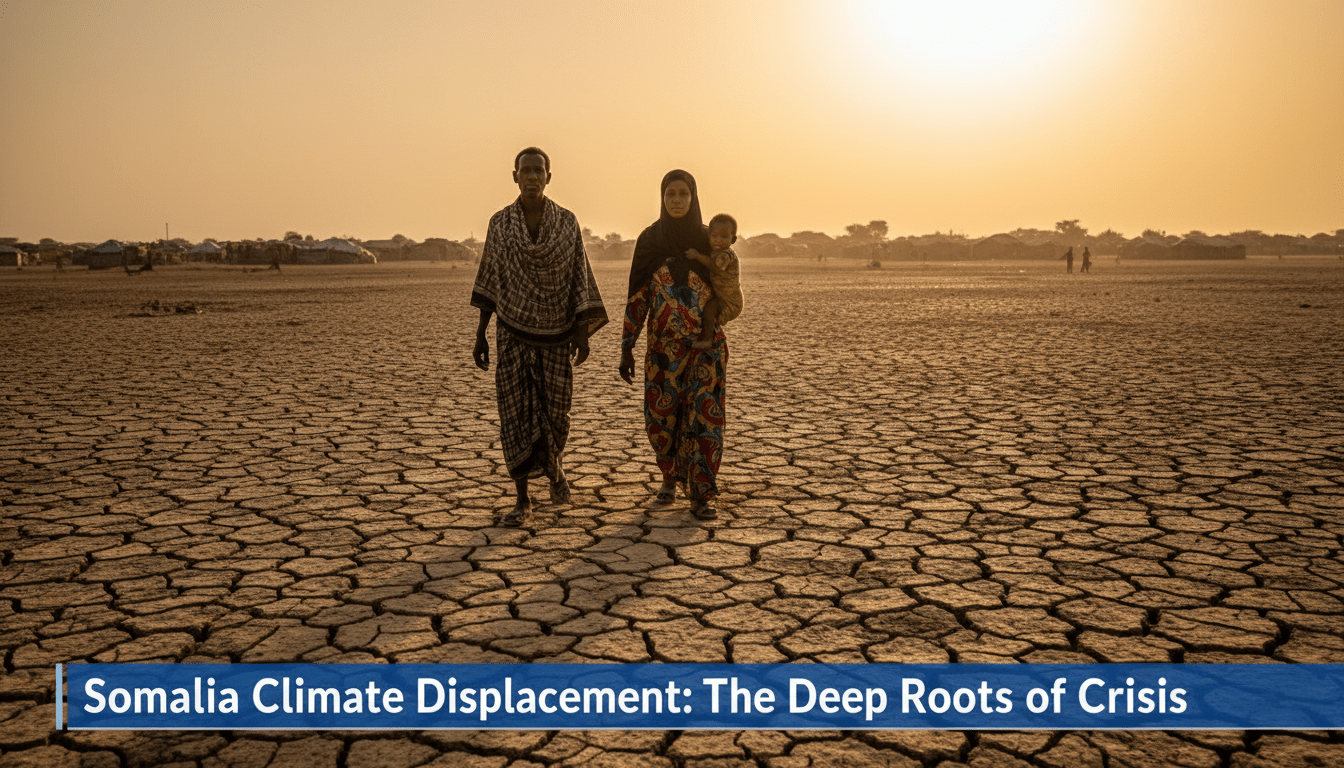
A new report reveals a very sobering reality today. Drought has displaced nearly 62,000 people since January alone. The International Organization for Migration released this critical data. The Gu rainy season failed to provide expected relief. Officials warn that climate shocks are the primary driver. They surpass conflict in causing mass displacement right now. This crisis severely affects the pastoral communities of the nation. One must look past the immediate daily news headlines. A deeper history of survival defines this modern tragedy. Traditional ways of life are reaching a definitive breaking point. Failed state interventions have also played a massive role. These combined factors created the current mass displacement crisis. It is a complex issue requiring deep historical context (iom.int).
A New Reality for Pastoral Communities
Somali pastoralists survived frequent droughts through mobility for centuries. However, the frequency of climate shocks prevents herd recovery. It takes five to ten years for herds to recover. A severe drought can easily wipe out half the livestock. Droughts now occur every two to three years instead. Pastoralists are displaced from their livelihoods long before moving. The International Organization for Migration notes a major shift. Three out of four new displacements are now climate-driven. This represents a twenty-two percent increase from previous years. Environmental factors have overtaken conflict as the primary destabilizer. Pastoralism is described as the social DNA of Somali identity. The loss of this lifestyle is a cultural displacement. It strips individuals of their social standing and roles. It erases an ancestral culture that sustained generations (climate-refugees.org).
The Long-Tailed Drought and Its Shadow
The current displacement crisis is a century-long struggle. Two foundational moments define this unique relationship with climate. The first occurred between 1974 and 1975 across the region. People call it the Long-Tailed Drought even today. It remains the psychological benchmark for climate crises. This event affected over two million vulnerable people. This represented nearly two-thirds of the population at the time. The devastating drought killed approximately five million head of livestock. It established a historical precedent for the entire region. When rains fail, the only solution is a lifestyle shift. Many abandon the nomadic way for sedentary farming. Others pursue urban labor in crowded southern settlements. Many modern displacement camps sit on these same historical lands (dliflc.edu).
Historical Displacement Milestones
Scientific Socialism and Social Engineering
The government response in the 1970s was massive. The Siad Barre administration launched an ambitious engineering project. They operated under the banner of Scientific Socialism. The regime attempted to forcefully de-tribalize the entire society. They viewed the clan system as an obstacle to progress. The government equated tribalism with class struggle and conflict. With logistical assistance from Soviet Russia, they relocated nomads. Transport planes moved over 100,000 destitute pastoralists southward. They placed them in unfamiliar agricultural and fishing settlements. Despite this rhetoric, Barre kept his own clan empowered. This highlighted a stark contradiction between theory and practice. The move forever altered the demographics of southern regions (dliflc.edu).
Climate Whiplash: Surviving the Extremes
The cycle of shock and recovery has completely broken. Communities now face back-to-back disasters without any pause. Between 2021 and 2023, Somalia endured a mega-drought. It was the absolute worst drought in forty years. The region suffered through five consecutive failed rainy seasons. This specific period displaced over 1.4 million people entirely. Then, the dangerous El Niño phenomenon brought once-in-a-century floods. This rapid transition is known as severe climate whiplash. It creates compounded trauma for already vulnerable and exhausted populations. People have no time to recover from profound dehydration. The floods destroy necessary infrastructure like wells and irrigation. This leads directly to outbreaks of deadly waterborne diseases. The psychological toll manifests in high rates of depression. Displaced individuals lack the fundamental resources needed for survival (reliefweb.int, fews.net).
The Legal Void for Climate Refugees
Displaced people face a massive barrier under international law. The 1951 Refugee Convention defines a refugee very strictly. It only includes those fleeing specific forms of persecution. This definition includes race, religion, nationality, or political opinion. Climate is absent as a valid ground for asylum. This creates a dangerous legal vacuum for displaced people. They have no formal right to vital international protection. Internally displaced persons remain within their own country borders. They are technically under the protection of their government. However, that government may be unable to provide assistance. The Guiding Principles on Internal Displacement are completely non-binding. This makes these individuals the most vulnerable populations globally. They can be legally denied entry into safer nations (climate-refugees.org).
The Climate Justice Gap
Somalia produces less than 0.02 percent of global emissions. Yet, it ranks among the most climate-vulnerable nations worldwide. From a social justice perspective, this represents a severe gap. Industrialized nations cause the environmental devastation of the Global South. This dynamic feels similar to historical financial exploitation strategies. Somalia’s displacement is increasingly framed as a human rights violation. Major polluters avoid accountability for the widespread environmental damage. A landmark International Court of Justice ruling offers some hope. It suggests failure to curb emissions breaches international law. Past climate-related losses cost Somalia significant economic development. Advocates strongly argue for substantial climate reparations immediately. They assert developed nations have a strict legal obligation. Funding is desperately needed for adaptation and survival strategies (sccwg.org).
The Climate Justice Gap
Gender and the Trauma of Relocation
The experience of forced displacement is highly gendered. Women and girls make up roughly eighty percent of populations. They live in sprawling, vulnerable, and dangerous urban camps. A severe lack of secure infrastructure increases terrible risks. Facilities lack locking toilets or adequate nighttime lighting entirely. This drastically increases the risk of gender-based violence. Women represented the vast majority of reported violence incidents. Displacement often ends formal education for young displaced girls. This frequently pushes them toward desperate child marriage arrangements. It serves as a tragic coping mechanism for starving families. Single women and widows are particularly marginalized and vulnerable. They often lack the male safety net required by society. This adds to the gruesome history of trauma experienced globally. They are left without protection at the whim of others (reliefweb.int).
Displacement Demographics
Urbanization by Necessity and Land Disputes
Pastoralists are moving into informal settlements by sheer necessity. They gather on the outskirts of cities like Mogadishu. These camps are often located on high-vulnerability private land. When floods hit, these specific camps are destroyed first. This causes secondary displacement for thousands of exhausted families. People are forced to move multiple times a year. Land ownership is a source of intense urban conflict. Displaced persons often settle without formal, legally binding contracts. Urban developers eagerly capitalize on rapidly rising land prices. Informal settlements face violent and large-scale government evictions constantly. Roughly eighty-seven percent of displaced people lack clear tenure. They remain under constant threat from powerful urban landlords. Disputes dictate who has the right to occupy spaces (reliefweb.int, reliefweb.int).
The Chilling Effect of Anti-Terror Laws
The United States is the largest humanitarian donor globally. However, current policies create a massive chilling effect locally. Under Donald Trump and subsequent leaders, laws remained strict. Severe counter-terrorism laws bar transactions with militant organizations entirely. Agencies avoid the most drought-stricken areas out of fear. They fear brutal criminal prosecution from international legal bodies. Approximately sixty percent of people in need reside there. United States anti-terror laws make delivering aid nearly impossible. Most American resources go toward extensive military counter-terrorism efforts. Airstrikes have peaked while humanitarian diplomatic solutions fall behind. Organizations feel discouraged from operating in heavily contested territories. The rules leave two million people facing terrible famine (charityandsecurity.org).
The Diaspora Lifeline and U.S. Remittances
The Somali-American community provides a critical financial lifeline overseas. Approximately eighty percent of these residents send money home. This flow totals roughly 1.3 billion dollars every year. Up to forty percent of the population relies on it. It helps them survive basic food and water shortages. However, strict banking regulations frequently threaten this vital flow. Federal rules cause banks to close transfer operator accounts. They view the region as a high-risk financial destination. Somali-Americans often work multiple difficult jobs to afford payments. They live in cramped conditions to support struggling families. The banking hurdles are creating a lack of political voice and representation financially. The diaspora carries the heavy burden of disaster relief (chathamhouse.org).
Looking Ahead to the Jilaal Season
The Gu and Deyr rains dictate national survival completely. They are the fundamental agricultural clocks determining food security. The recent failure of the Gu season is catastrophic. It means the upcoming Jilaal dry season will devastate. Critical water reservoirs have simply not been replenished yet. Pasture regeneration is poor, and crop yields remain low. The harshest dry season depletes pasture and livestock completely. Milk production reaches its absolute lowest levels during Jilaal. Officials warn the displacement figures could easily quadruple soon. It could mirror the mass exodus seen during 2017. The nation is being fundamentally reshaped by climate change. It is no longer just bracing for seasonal shocks (fews.net).
About the Author
Darius Spearman is a professor of Black Studies at San Diego City College, where he has been teaching for over 20 years. He is the founder of African Elements, a media platform dedicated to providing educational resources on the history and culture of the African diaspora. Through his work, Spearman aims to empower and educate by bringing historical context to contemporary issues affecting the Black community.
